LVMH

Search documents
斯凯奇,年轻人不再爱它了?
3 6 Ke· 2025-11-06 11:15
Core Insights - Skechers, once popular among young consumers, has seen a decline in its appeal, shifting from a trendy brand to one associated with older demographics [1][3] - The brand's struggle to connect with younger consumers is evident as it attempts to balance its image between appealing to youth and catering to the aging population [9][10] Brand Strategy - Skechers appointed Cheng Yi as its brand ambassador in 2024, aiming to attract younger consumers, particularly women aged 25-45, aligning with the brand's image of comfort and health [4][6] - Despite the efforts to rejuvenate its image, Skechers has faced criticism for its lack of innovative products and has struggled to compete with emerging local brands in China [14][15] Financial Performance - Skechers has been privatized by 3G Capital, ceasing its trading on the NYSE, with a reported revenue of $8.97 billion in 2024 and a 7.1% year-on-year growth in Q1 2025 [11][14] - The company has experienced a decline in its Chinese market contribution, dropping from 15.4% in 2023 to 13.6% in 2024, with a significant revenue drop of approximately 15.9% year-on-year in Q1 2025 [14] Market Challenges - The introduction of tariffs on imports from China has increased costs for Skechers, impacting its competitive pricing in the North American market [13] - The brand's low investment in research and development, only 1.2% of revenue, has hindered its ability to innovate compared to competitors like Nike and Anta [14][15] Consumer Trends - The current economic climate has led to a shift towards value-driven purchasing, with consumers prioritizing comfort and affordability over brand prestige [16][19] - Skechers has the potential to leverage its "comfort technology" to appeal to cost-conscious consumers, similar to the strategies employed by Uniqlo during economic downturns [18][19]


进博“夜”品静安,全球CEO共赴“心动时分”
Guo Ji Jin Rong Bao· 2025-11-05 14:05
Core Viewpoint - The "Global CEO Look at Jing'an" event during the 8th China International Import Expo highlights Jing'an's commitment to becoming a hub for international business and investment opportunities, showcasing its efficient service and vibrant commercial environment [1][6]. Group 1: Event Overview - The event featured nearly 20 global CEOs and executives who explored Jing'an's investment potential and discussed future cooperation [1]. - The "Louis Number" exhibition, a significant project by Louis Vuitton, exemplifies Jing'an's ability to attract international brands and create a high-end consumer ecosystem [2][4]. Group 2: Commercial Landscape - Jing'an's Nanjing West Road, known as the "first commercial street in China," is evolving into a world-class shopping district, housing over 2,000 domestic and international brands, with more than 70% being international [5]. - The presence of luxury giants like LVMH, Kering, and Richemont underscores Jing'an's status as a global fashion showcase [5]. Group 3: Night Economy and Cultural Integration - The Zhang Garden, a cultural landmark, is enhancing Jing'an's night economy by blending historical charm with modern commercial activities, featuring local brands and international products [5][6]. - The "first launch + bonded" model at Zhang Garden facilitates a streamlined entry for international brands into the Chinese market, attracting interest from global fashion companies [6]. Group 4: Strategic Invitations - Jing'an is inviting global enterprises to invest and establish a presence in the district, emphasizing its open and innovative environment [6]. - Local leadership expresses a commitment to fostering partnerships and enhancing Jing'an's competitiveness and attractiveness as an international business hub [6].

招银国际每日投资策略-20251105
Zhao Yin Guo Ji· 2025-11-05 03:59
Market Overview - Global markets experienced a decline, with the Hang Seng Index falling by 0.79% and the S&P 500 down by 1.17% [1][3] - The A-share market is in a correction phase since October 2, with a potential drop of 15%-20% expected [3] - Defensive sectors are seeing capital inflows, while materials, healthcare, and consumer discretionary sectors are leading declines in Hong Kong stocks [3] Sector Performance - The Hang Seng Financial Index rose by 0.26%, while the Hang Seng Industrial and Commercial Index fell by 1.44% [2] - High-dividend sectors such as telecommunications and utilities are performing well amidst market volatility [3] Company Insights - Luxshare Precision (002475 CH) has its target price raised to 75.55 RMB, reflecting strong synergy from the Apple upgrade cycle and ODM integration [5] - The expected compound annual growth rate for Luxshare's earnings from FY25-27 is projected at 27%, driven by growth in consumer electronics, automotive, and communication sectors [5] Economic Indicators - The UK government is focusing on reducing inflation and managing national debt, hinting at potential tax increases in the upcoming budget [3] - The U.S. job vacancies have dropped to the lowest level since April 2021, indicating a tightening labor market [4]

关税影响微乎其微?欧洲企业反借美国市场高歌猛进,明年利润或实现两位数增长
Hua Er Jie Jian Wen· 2025-11-03 07:41
Group 1 - European companies are demonstrating remarkable adaptability to U.S. tariff barriers, with a Goldman Sachs portfolio of affected European stocks outperforming the market by approximately 6% in October, double the gain of the Stoxx Europe 600 index [1] - Major European firms like Hermès, Unilever, and Galderma Group AG attribute their better-than-expected performance and raised guidance to strong demand in the U.S. market [1][2] - The frequency of the term "tariff" in earnings calls is decreasing, indicating that corporate management's concerns about tariffs are diminishing [1] Group 2 - The U.S. market has become a key growth driver for many European companies, with Hermès reporting a 14.1% sales increase in its regional markets, and Unilever crediting strong North American demand for its sales performance [2] - Galderma raised its full-year guidance based on strong U.S. sales, while other companies like Haleon Plc and Stellantis also reported unexpected sales growth in North America [2] Group 3 - Companies are adapting to tariff challenges by cutting costs, adjusting production layouts, and increasing investments in the U.S. [3] - Pharmaceutical companies like Novartis and GSK are negotiating with the U.S. government for price reductions in exchange for future tariff exemptions, with AstraZeneca reaching an agreement in October [3] Group 4 - Despite overall optimism, the impact of tariffs is not uniform, with some companies like Rémy Cointreau and Pernod Ricard warning of weaker-than-expected recovery in specific markets [4] - Market sentiment is shifting towards the view that tariffs are manageable, although some analysts caution against premature conclusions regarding their impact [4][5]


2025年第43周:服装行业周度市场观察
艾瑞咨询· 2025-11-03 00:03
Industry Environment - In Q2 2025, major sports and apparel companies reported mixed financial results, with Nike's revenue at $11.097 billion, down 12% year-on-year, and a 21% decline in Greater China; Adidas saw a 2.2% increase in net sales to €5.952 billion, but a 3% drop in Greater China [2][3] - Anta's revenue grew by 14.3% in the first half of the year, with FILA brand revenue hitting a record high; Lululemon's quarterly revenue reached $2.525 billion, up 6.5% [2][3] - Puma's quarterly sales fell by 8.3%, resulting in a net loss of €247 million; Asics reported a 17.7% increase in net sales for the first half of the year [3] Trend Analysis - The "sneaker speculation" trend is waning, leading to reduced premiums in the basketball shoe market; however, new brands are emerging through platforms like Douyin, leveraging personal influence and fan economies [4] - Customization and national trend designs are becoming key drivers in jewelry consumption, with young women aged 24-30 leading the market; the demand for unique designs and emotional resonance is increasing [5] Shopping Center Dynamics - International fast fashion brands like H&M and Zara are losing ground in China due to e-commerce competition and brand aging, leading shopping centers to pivot towards high-rent sectors like dining and beauty [6][7] Global Expansion of Domestic Brands - Chinese apparel brands are increasingly targeting Southeast Asia for expansion, with companies like HLA and Semir opening numerous stores; however, overseas revenue remains low, typically under 2% of total revenue [8] High-End Functional Style - The rise of high-end functional fashion is influenced by cyberpunk aesthetics and a focus on human-centered design, with brands like Descente leading the trend by combining technology and aesthetics [9] Major Brand Developments - Lao Feng Xiang invested $24 million for a 20% stake in Maybach Luxury Goods Asia-Pacific to enhance its high-end business; this move aims to expand into the international market [10] - Tambor is transitioning from down jackets to outdoor sports and has filed for a Hong Kong IPO, facing challenges like brand recognition and high inventory turnover [11] - LVMH reported a 1% year-on-year revenue increase in Q3, leading to a significant rise in stock prices across the luxury sector, with a total market value increase of $70 billion [12][13] Market Innovations - Descente is gaining popularity among civil service professionals in China due to its functional designs, while facing challenges in maintaining a high-end image [14] - Bananain launched a pop-up store in Shanghai, focusing on immersive experiences and social causes, highlighting the brand's commitment to comfort and warmth [15] Lululemon's Challenges - Lululemon's recent quarterly report showed slowing revenue growth, particularly in men's apparel, with a significant drop in market value; the brand faces challenges in balancing core business and diversification efforts [16][17] Market Trends in Gold - The price of gold reached a new high, with institutions predicting further increases; brands like Chow Tai Fook are raising prices, but consumer sentiment remains cautious [18] Shein's Expansion - Shein is transitioning from an online-only model to a multi-channel retail approach, opening stores in France while facing localization challenges and regulatory pressures [19]

奢侈品Q3大反攻 LVMH们“回血”了
3 6 Ke· 2025-10-29 08:49
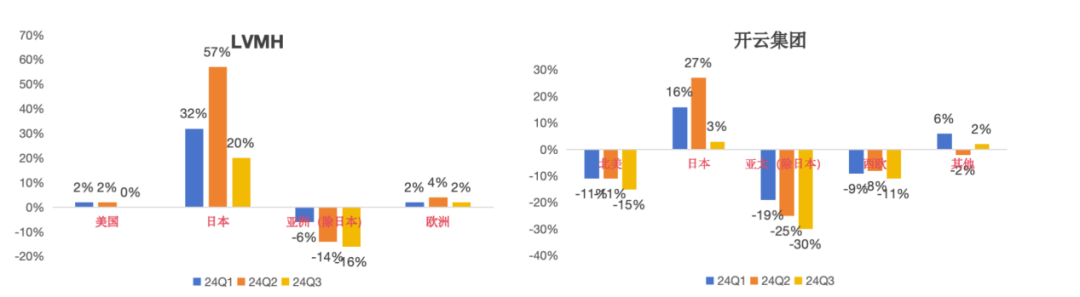
Core Insights - LVMH and Kering both experienced significant stock price increases following their Q3 earnings reports, indicating positive market sentiment towards the luxury goods sector [1][2][3] Financial Performance - LVMH's quarterly revenue growth rates were -3%, -4%, and 1% for Q1 to Q3, showing a shift from negative to positive growth in Q3 [4] - Kering's revenue growth rates were -14%, -15%, and -5%, with a notable reduction in the decline during Q3 compared to previous quarters [4] - Prada maintained stable growth rates of 13%, 8%, and 8% across the same quarters [4] - Hermès showed consistent growth with rates of 7%, 9%, and 10%, indicating a steady upward trend [5] - Overall, all four luxury brands reported strong performance in Q3, with most showing improved year-over-year growth compared to the previous two quarters [6] Regional Sales Analysis - LVMH saw improved revenue growth in all regions except Europe, with the U.S. and Asia (excluding Japan) achieving positive growth rates of 3% and 2% respectively [7] - Kering reported a positive turnaround in North America with a 3% growth rate, while the Asia-Pacific region (excluding Japan) saw a significant narrowing of decline by 9 percentage points [7] - Prada's retail sales in the Asia-Pacific region (excluding Japan) grew by 10%, while the Americas experienced a 14.8% increase in retail sales [7] - Hermès reported growth across all regions, with North America leading at 14% [8] Market Trends and Influences - The luxury goods market is showing signs of recovery, particularly in North America, attributed to a strong high-net-worth consumer base and their resilience to economic cycles [10] - There is a notable correlation between luxury spending and stock market performance, with an 87% correlation between luxury demand and the S&P 500 index [10] - The U.S. stock market's performance has positively impacted the wealth of high-net-worth individuals, thereby boosting luxury consumption [11] Chinese Market Dynamics - The Chinese luxury market is showing signs of improvement, influenced by currency fluctuations that have affected consumer behavior [12] - The depreciation of the yen made luxury goods in Japan cheaper for foreign tourists, leading to a temporary decline in Chinese luxury spending abroad [12] - As the yen strengthens, some consumer demand is returning to the Chinese market, although the overall recovery remains limited [12] Future Outlook - The significant improvements in Q3 for LVMH and Kering, particularly in North America and the narrowing of declines in Asia, suggest a potential turning point for the luxury goods sector [13] - The sustainability of this recovery will depend on performance in Q4, as both companies face high base comparisons from the previous year [13]

奢侈品Q3大反攻,LVMH们“回血”了
Sou Hu Cai Jing· 2025-10-29 05:13
Core Viewpoint - The financial reports of LVMH and Kering indicate a significant recovery in the luxury goods sector, as evidenced by improved year-on-year revenue growth in Q3 compared to the previous two quarters [1][9]. Group 1: Company Performance - LVMH's quarterly revenue growth rates were -3%, -4%, and 1%, showing a positive shift in Q3 [1]. - Kering's revenue growth rates were -14%, -15%, and -5%, with a notable reduction in the decline in Q3 [1]. - Prada maintained stable revenue growth rates of 13%, 8%, and 8% across the quarters [2]. - Hermès showed increasing revenue growth rates of 7%, 9%, and 10% in the same period [3]. Group 2: Regional Sales Performance - LVMH saw improved revenue growth in all regions except Europe, with the U.S. and Asia (excluding Japan) achieving positive growth rates of 3% and 2%, respectively [4]. - Kering reported a significant recovery in North America, with a positive growth rate of 3% in Q3, while the Asia-Pacific region (excluding Japan) saw a 10% decline, which was a substantial improvement [5]. - Prada's retail sales in the Asia-Pacific region (excluding Japan) grew by 10%, while the Americas saw a 14.8% increase in retail sales [4][5]. - Hermès experienced revenue growth across all regions, with North America leading at 14% [5]. Group 3: Market Trends and Influences - The luxury goods market's recovery is significantly influenced by the performance of the U.S. stock market, which has a strong correlation with luxury spending [6][7]. - The increase in wealth among high-net-worth individuals in the U.S. has contributed to the growth in luxury goods consumption [6]. - The depreciation of the Japanese yen has attracted foreign tourists to Japan, boosting luxury sales there, although this trend is expected to reverse as the yen strengthens [7][8]. Group 4: Future Outlook - The sustainability of the recovery in the luxury sector will depend on whether the positive trends in Q3 can continue into Q4, as companies face high base effects from the previous year [11].
Tereos, LVMH Gaïa to scale plant-based polymer with Avantium technology
Yahoo Finance· 2025-10-28 11:48
Core Insights - A consortium is being formed by Avantium, Tereos, and LVMH to accelerate the industrial-scale production of polyethylene furanoate (PEF), a polymer derived from plant-based feedstocks [1][4] - The collaboration aims to establish the first industrial-scale PEF facility in Europe, utilizing Avantium's proprietary YXY Technology and Tereos' plant-based feedstock [2][5] - The initiative is part of a broader movement towards renewable materials and aims to reduce reliance on petrochemical plastics in various sectors [3][5] Group 1: Consortium Formation - The consortium, named releaf, will focus on producing PEF for applications in fashion and industrial fibers [1] - The partnership will also seek to expand membership by including additional strategic partners over time [2] Group 2: Technological and Environmental Goals - The process involves converting renewable plant-based materials into furandicarboxylic acid (FDCA), essential for PEF production [2] - The collaboration reflects a commitment to sustainable practices, aligning with Tereos' goals in green chemistry and LVMH's environmental programs [6] Group 3: Industry Impact - The initiative aims to strengthen the supply and demand ecosystem for renewable polymers across multiple sectors, including food and beverage packaging, cosmetics, and fashion [3] - The PEFerence initiative, which preceded this agreement, focused on transitioning from fossil-based to plant-based polyesters, supporting regulatory movements towards circularity [5]
Arnault tightens his LVMH control with $1.6-B buying spree
The Economic Times· 2025-10-27 19:41
Core Insights - Bernard Arnault has significantly increased his stake in LVMH, purchasing approximately ₹1.4 billion ($1.6 billion) worth of shares over eight months, bringing his family's ownership closer to half of the company [1][8] - The buying spree occurred during a period of weaker quarterly results for LVMH, yet the stock has rebounded following a return to sales growth [5][8] - Arnault's strategy emphasizes maintaining wealth within LVMH rather than diversifying into other investments [1][8] Share Purchase Details - Arnault acquired around 2.5 million shares, representing about 0.5% of LVMH, at an average price of ₹566 per share, with some shares purchased as low as ₹448 in June [5][9] - The total volume of shares purchased this year far exceeded previous years, indicating a strong commitment to LVMH despite recent performance challenges [5][9] Ownership and Control - Arnault's stake in LVMH accounts for 49% of the capital and nearly 65% of the voting rights, reflecting his desire to secure an "absolute majority" [6][9] - The family has a history of consolidating control over LVMH, including a pivotal deal in 2017 to buy out minority shareholders of Christian Dior, increasing their stake significantly [9] Investment Strategy - Analysts suggest that Arnault's substantial investment in LVMH may have been better allocated towards diversification, as his non-LVMH investments are estimated at only ₹4 billion [6][9] - Financiere Agache, Arnault's holding company, remains focused on luxury investments while also having a portfolio of diversified financial investments [7][9]

国泰海通 · 晨报1028|纺服、轻工
国泰海通证券研究· 2025-10-27 11:33
Group 1: Luxury Goods Industry - The luxury goods sector in Q3 2025 showed better-than-expected performance, particularly in North America, with a slight improvement in consumption in mainland China [3][4] - Major brands like LVMH, Hermès, KERING, and PRADA reported revenue changes of +1.0%, +9.6%, -5.0%, and +8.5% respectively, all exceeding consensus expectations [3] - Miu Miu led the industry with a 29% revenue increase, while Hermès maintained a steady growth trend with a 9.6% increase [3] Group 2: Retail Performance in China - In September, China's retail sales for clothing and textiles grew by 4.7% month-on-month, indicating a faster pace compared to August [5] - The online retail sales of clothing items increased by 2.8% year-on-year from January to September, showing an acceleration in growth [5] - The export of Swiss watches showed a month-on-month improvement, with a 17.8% increase in exports to China, recovering from a significant decline in the previous year [5] Group 3: Adidas and Deckers Financial Guidance - Adidas reported Q3 revenue of €6.63 billion, with a neutral year-on-year growth of 8%, but raised its full-year revenue guidance to a neutral growth of 9%, below the consensus of 10% [4] - Deckers' FY26 Q2 revenue was $1.43 billion, a 9% year-on-year increase, but its full-year guidance of $5.35 billion fell short of the consensus expectation of $5.45 billion [4] - Deckers anticipates that tariff impacts will become more pronounced in the second half of FY26, affecting consumer attitudes [4] Group 4: Tobacco Industry Trends - The new type of oral tobacco products, combining heated non-combustible and vaporized electronic cigarette characteristics, is gaining popularity globally [10] - The market for new oral tobacco products is expected to grow due to lower tax rates and less intense competition compared to vaporized electronic cigarettes [10][11] - PMI's $16 billion acquisition of ZYN's parent company and the FDA's approval of ZYN products are expected to catalyze industry growth [12]