
中国平安

Search documents
中国平安保险(集团)股份有限公司2026年第一次临时股东会决议公告
Shang Hai Zheng Quan Bao· 2026-02-13 17:34
Meeting Details - The first extraordinary general meeting of shareholders for 2026 was held on February 13, 2026, at the Ping An Financial Education Training Center in Shenzhen, Guangdong Province [2] - The meeting was convened by the board of directors, with Chairman Ma Mingzhe attending remotely due to other commitments, and was presided over by Executive Director and General Manager Xie Yonglin [2][3] Attendance - All 15 current directors and 5 current supervisors attended the meeting, along with the board secretary and legal witnesses from Beijing Anjie Shize (Shenzhen) Law Firm [3] Proposal Review - A proposal to amend the company's articles of association was reviewed and approved, requiring more than two-thirds of the voting rights held by attending shareholders and their proxies for approval [4] - The amendment to the articles of association will take effect only after approval from the National Financial Regulatory Administration [5] Legal Witness - The meeting was witnessed by lawyers from Beijing Anjie Shize (Shenzhen) Law Firm, who confirmed that the meeting's convening, attendance, and voting procedures complied with relevant laws and regulations [7]

险资投资黄金“周年记”:面对暴涨,需要“克制”
Sou Hu Cai Jing· 2026-02-13 17:09
Core Viewpoint - The insurance industry in China has begun to invest in gold, with six out of ten approved insurance companies becoming members of the Shanghai Gold Exchange, reflecting a cautious approach to this new investment opportunity [2][3][4]. Group 1: Investment Progress - The pilot program for insurance companies to invest in gold was initiated a year ago, with ten companies approved to participate [3]. - As of now, six insurance companies have become members of the Shanghai Gold Exchange, with the first transactions successfully executed by several companies [3][4]. - The investment scope includes various gold-related contracts and products, allowing for a diversified approach to gold investment [3]. Group 2: Regulatory Framework - Insurance companies are required to adhere to strict investment limits, with the total investment in gold not exceeding 1% of their total assets, theoretically allowing for a maximum allocation of nearly 200 billion yuan [4]. - The regulatory framework aims to enhance the risk management capabilities of insurance funds, particularly in the context of inflation and economic pressures [4]. Group 3: Market Context - The gold market has shown strong performance, with significant price increases noted, particularly in early 2025 [9]. - Long-term returns on gold investments have been favorable, with annualized returns of 8.6% in USD since 1971 and 9.8% in RMB since the establishment of the Shanghai Gold Exchange [7]. Group 4: International Perspective - Internationally, insurance companies have a history of investing in gold, with U.S. firms actively using gold to enhance risk-adjusted returns, especially during financial crises [5]. - In contrast, Japanese insurance companies have been more conservative regarding gold investments, reflecting a lower risk tolerance [6]. Group 5: Future Outlook - Despite the current high prices and volatility in the gold market, institutions remain optimistic about gold's long-term potential as a stabilizing asset in investment portfolios [10]. - The cautious approach of Chinese insurance companies towards gold investment is attributed to the need for time to develop investment frameworks and expertise in this area [10].

博泰车联获纳入恒生综合指数 有望成为港股通标的
Zhi Tong Cai Jing· 2026-02-13 14:25
博泰车联(02889)发布公告,为推动"科技+金融+汽车+服务"深度融合发展,公司与中国平安财产保险股 份有限公司("平安财险")于2026年1月31日订立框架合作协议,双方将通过"AI+车联网技术+ 保险服 务"的深度融合创新,打破汽车产业与金融保险产业的行业边界,实现从"基础服务"向"个性化、全场景 赋能"的跨越式升级,重构智慧出行保险生态,引领智慧出行时代的保险服务变革与用户体验升级。 2月13日,恒生指数公司宣布截至2025年12月31日之恒生指数系列季度检讨结果,其中博泰车联(02889) 获纳入恒生综合指数。变动将于2026年3月6日(星期五)收市后实施并于2026年3月9日(星期一)起生效, 届时沪深交易所会相应调整港股通可投资标的范围。据中金研报,博泰车联有可能被调入港股通,因其 满足了包括市值、流动性和上市时间等在内的一系列标准。 ...
港股13日跌1.72% 收报26567.12点
Xin Hua She· 2026-02-13 12:58
Market Overview - The Hang Seng Index fell by 465.42 points, a decrease of 1.72%, closing at 26,567.12 points [1] - The total turnover on the main board was HKD 257.578 billion [1] - The Hang Seng China Enterprises Index dropped by 142.47 points, closing at 9,032.71 points, a decline of 1.55% [1] - The Hang Seng Tech Index decreased by 48.56 points, closing at 5,360.42 points, down by 0.9% [1] Blue-Chip Stocks - Tencent Holdings fell by 0.65%, closing at HKD 532 [1] - Hong Kong Exchanges and Clearing decreased by 2.13%, closing at HKD 405.2 [1] - China Mobile remained unchanged, closing at HKD 78.2 [1] - HSBC Holdings dropped by 2.72%, closing at HKD 135.7 [1] Local Hong Kong Stocks - Cheung Kong Holdings decreased by 0.59%, closing at HKD 46.9 [1] - Sun Hung Kai Properties increased by 0.15%, closing at HKD 133.7 [1] - Henderson Land Development fell by 1.04%, closing at HKD 32.4 [1] Chinese Financial Stocks - Bank of China decreased by 1.48%, closing at HKD 4.65 [1] - China Construction Bank fell by 1.49%, closing at HKD 7.96 [1] - Industrial and Commercial Bank of China dropped by 1.38%, closing at HKD 6.41 [1] - Ping An Insurance decreased by 2.16%, closing at HKD 70.35 [1] - China Life Insurance fell by 3.67%, closing at HKD 33.08 [1] Oil and Petrochemical Stocks - China Petroleum & Chemical Corporation dropped by 5.12%, closing at HKD 5.37 [1] - China National Petroleum Corporation fell by 4.33%, closing at HKD 9.05 [1] - CNOOC Limited decreased by 3.5%, closing at HKD 24.24 [1]





平安人寿大幅增资至360亿元
Zhong Guo Jing Ying Bao· 2026-02-13 12:54
Capital Increase - On February 11, 2026, Ping An Life Insurance increased its registered capital from 33.8 billion RMB to 36 billion RMB [1] - In April 2025, Ping An Life announced that all shareholders planned to inject approximately 19.999 billion RMB into the company [1] - The capital increase was completed with shareholders subscribing to new shares in proportion to their existing holdings, with China Ping An subscribing to any shares not taken up by other shareholders [1] Solvency Position - As of September 30, 2025, Ping An Life's core solvency ratio was 134.52%, and the comprehensive solvency ratio was 185.68%, indicating a sufficient level of solvency [1] - The increase in core capital was attributed to the capital increase, profit retention, reclassification of bonds, and issuance of perpetual capital bonds [1] - The minimum capital requirement increased due to risks associated with overseas equity asset prices [1]
盘点58家财险2025车均保费:超半数同比下降
Mei Ri Jing Ji Xin Wen· 2026-02-13 12:38
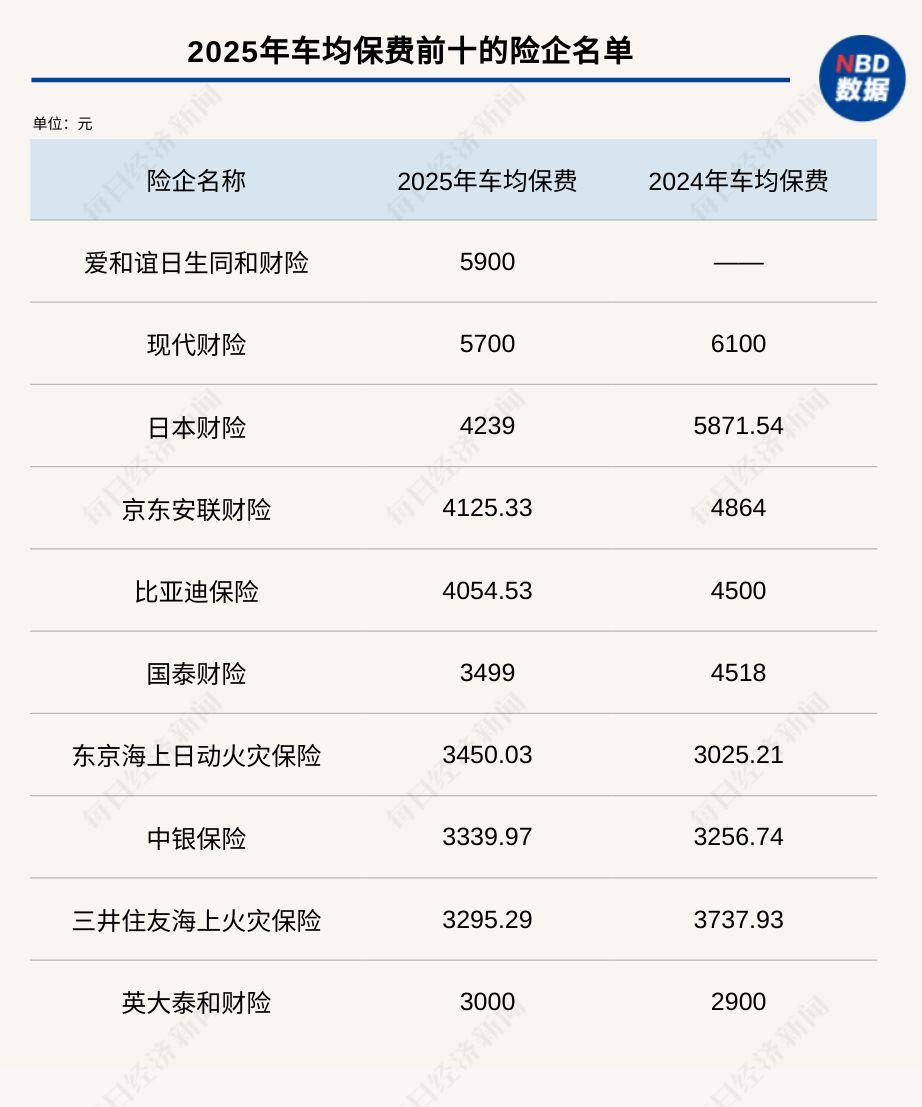
Core Insights - The average car insurance premium for 2025 shows a declining trend for over half of the insurance companies, with the overall premium gap narrowing compared to 2024 [1][2][5] - The average car insurance premium across 58 disclosed companies ranges from 841.99 yuan to 5900 yuan, indicating a concentration of premiums between 1000 yuan and 3000 yuan for most companies [2][4] Group 1: Premium Trends - More than 50% of insurance companies reported a decrease in average car insurance premiums for 2025 compared to the previous year, although the overall decline is not significant [1][5] - The average car insurance premium for 2025 is expected to stabilize due to the structure of existing policies, with a notable impact from the insurance of new energy vehicles [6][7] Group 2: Company Performance - The top ten insurance companies by average car insurance premium for 2025 include: - Ai He Yi Ri Sheng Tong He Insurance: 5900 yuan - Modern Insurance: 5700 yuan (down from 6100 yuan in 2024) - Japan Insurance: 4239 yuan (down from 5871.54 yuan in 2024) [3] - The lowest average premiums are reported by companies such as Xin An Automobile Insurance at 841.99 yuan and Dou Bang Insurance at 870 yuan, with over 70% of companies having premiums between 1000 yuan and 3000 yuan [4][5] Group 3: New Energy Vehicle Insurance - The insurance market is closely monitoring the trends in new energy vehicle insurance, which has previously faced challenges in pricing and coverage [7][8] - As of the end of 2025, the total number of new energy vehicles in China is projected to reach 43.97 million, accounting for 12.01% of the total vehicle population, indicating that nearly 90% of vehicles are still fuel-powered [6] - The profitability of new energy vehicle insurance is improving, with major insurers reporting underwriting profits in this segment [7] Group 4: Future Challenges - The introduction of L3 level conditional autonomous driving vehicles is expected to pose new challenges for car insurance, particularly in risk assessment and pricing models [8] - The complexity of evaluating risks associated with autonomous driving features will require insurance companies to adapt their pricing strategies and product offerings [8]
2025保险业保费破6万亿大关 资产增速15.1%领跑金融业
2 1 Shi Ji Jing Ji Bao Dao· 2026-02-13 11:37
Core Insights - The insurance industry in China has shown strong resilience, with total assets reaching 41.3 trillion yuan by the end of 2025, marking a 15.1% increase from the beginning of the year, surpassing the banking sector's 8.0% growth [1][4] - The original insurance premium income has historically exceeded 6 trillion yuan for the first time, totaling 6.1 trillion yuan in 2025, reflecting a year-on-year growth of 7.4% [2][4] - However, there is a structural differentiation in profitability and capital replenishment within the industry, as evidenced by a slight decline in the core solvency ratio of life insurance companies [1][5][6] Asset Growth - By the end of 2025, the total assets of the insurance industry reached 41.3 trillion yuan, with life insurance companies contributing significantly to this growth, accounting for 88.1% of total assets [4] - Life insurance companies' total assets reached 36.4 trillion yuan, growing by 15.4% from the beginning of the year, contributing approximately 89.5% to the industry's asset increase [4] - Property insurance companies showed more stable performance, with total assets of 3.1 trillion yuan, growing by 7.5% [4] Premium Income and Claims - The insurance sector achieved a record premium income of 6.1 trillion yuan in 2025, with a total of 1.168 billion new policies issued, reflecting a 12.6% year-on-year increase [2] - Claims and benefit payments amounted to 2.4 trillion yuan, representing a 6.2% increase, demonstrating the industry's role as a risk compensation "shock absorber" [2] - Life insurance business contributed approximately 4.65 trillion yuan in premiums, with a year-on-year growth of 9.1%, while property insurance premiums reached 1.47 trillion yuan, growing by 2.6% [2] Solvency and Capital Pressure - As of the end of 2025, the average comprehensive solvency ratio for insurance companies was 181.1%, with a core solvency ratio of 130.4%, indicating overall solvency above regulatory requirements [5][6] - Life insurance companies faced declining core solvency ratios, with comprehensive solvency at 169.3% and core solvency at 115.0%, down from 190.5% and 123.8% respectively at the end of 2024 [6] - To strengthen capital bases, 21 insurance companies were approved for capital increases totaling 41.272 billion yuan, and 23 companies issued bonds to supplement capital amounting to 104.2 billion yuan [6] Structural Optimization - Agricultural insurance has become a key service for national strategy, with premiums exceeding 155 billion yuan in 2025, providing risk coverage for over 125 million farming households [3] - The industry is experiencing a structural optimization in the protection sector, with a focus on diversifying asset allocation to enhance resilience [4]

博泰车联(02889)获纳入恒生综合指数 有望成为港股通标的
智通财经网· 2026-02-13 11:18
Group 1 - The Hang Seng Index Company announced the quarterly review results for the Hang Seng Index series as of December 31, 2025, with Botai Car Union (02889) being included in the Hang Seng Composite Index [1] - The changes will be implemented after the market closes on March 6, 2026, and will take effect on March 9, 2026, leading to adjustments in the eligible stocks for the Hong Kong Stock Connect [1] - According to a report by CICC, Botai Car Union is likely to be included in the Hong Kong Stock Connect due to meeting various criteria, including market capitalization, liquidity, and listing time [1] Group 2 - Botai Car Union announced a framework cooperation agreement with Ping An Property & Casualty Insurance Company on January 31, 2026, aimed at promoting the deep integration of "technology + finance + automotive + services" [1] - The collaboration will leverage "AI + Internet of Vehicles technology + insurance services" to innovate and break down the boundaries between the automotive and financial insurance industries [1] - The goal is to achieve a leap from "basic services" to "personalized, full-scenario empowerment," reconstructing the smart travel insurance ecosystem and leading the transformation of insurance services and user experience in the era of smart travel [1]
有色、通信四季度外资持仓规模上升
Huajin Securities· 2026-02-13 11:12
Group 1 - The total scale of the Stock Connect holdings reached approximately 2.59 trillion yuan in Q4 2025, an increase of 54.06 billion yuan compared to the previous quarter [4][8] - The proportion of holdings in the main board increased by 1.04 percentage points, while the proportion in the ChiNext and Sci-Tech Innovation Board decreased by 0.65 and 0.39 percentage points, respectively [4] - The proportion of holdings in cyclical, growth, and stable styles increased by 2.37, 0.08, and 0.05 percentage points, while consumer and financial styles decreased by 2.37 and 0.15 percentage points [4] Group 2 - The largest sectors by Stock Connect holdings in Q4 were new energy (17.78%, -0.12 percentage points), electronics (13.91%, -0.33 percentage points), and non-ferrous metals (7.18%, +1.96 percentage points) [8] - Non-ferrous metals, communication, and basic chemicals saw significant increases in holdings, while pharmaceuticals, food and beverage, and automotive sectors experienced notable declines [8][14] - The net inflow for non-ferrous metals was 24.872 billion yuan, for communication was 11.278 billion yuan, and for basic chemicals was 5.711 billion yuan, while pharmaceuticals saw a net outflow of 25.665 billion yuan [8] Group 3 - The sectors with the highest overweight ratios were new energy (11.34%), electronics (2.80%), and non-ferrous metals (2.56%), while the lowest were banking (-3.93%), oil and petrochemicals (-2.37%), and computers (-2.26%) [15] - The overweight ratios for non-ferrous metals, communication, and basic chemicals increased by 1.40, 0.47, and 0.29 percentage points, respectively, while those for pharmaceuticals, food and beverage, and banking decreased [15] Group 4 - Core assets and growth stocks such as Zhongji Xuchuang, China Ping An, and Siyuan Electric saw significant changes in foreign holdings, with the concentration of top five holdings decreasing [18] - The top three stocks by Stock Connect holdings were Ningde Times (254.343 billion yuan), Midea Group (77.049 billion yuan), and Kweichow Moutai (75.812 billion yuan) [18] - The largest net inflows were seen in Ningde Times (8.813 billion yuan), Luxshare Precision (5.737 billion yuan), and Weichai Power (5.124 billion yuan) [18] Group 5 - Stock Connect funds are expected to continue increasing their positions in core assets, technology, and cyclical sectors in Q1 2026 [21] - The ongoing Federal Reserve rate cut cycle may favor technology growth and certain cyclical sectors, attracting foreign capital [21] - The expected earnings growth in technology and cyclical sectors, along with favorable policies, may further enhance the attractiveness of these sectors to foreign investors [21][23]
新华保险:深度研究治理革新+权益弹性+负债质变,三层驱动重塑成长逻辑-20260214
东方财富· 2026-02-13 10:20
Investment Rating - The report maintains a "Buy" rating for the company, reflecting optimism about its future performance and growth potential [2][15]. Core Insights - The company is expected to benefit from governance reforms, asset flexibility, and a transformation in liabilities, which together reshape its growth logic. The projected net profit for 2025E-2027E is estimated at 39.244 billion, 42.360 billion, and 44.130 billion yuan, representing year-on-year growth of 49.6%, 7.9%, and 4.2% respectively [2][15]. - The company has demonstrated strong short-term performance, capitalizing on the recovery of the capital market and effective business transformation, leading to significant increases in revenue and net profit [14][15]. Summary by Sections 1. Mechanism-Asset-Business Three-Layer Linkage - The company leverages a three-layer logic of governance reform, asset enhancement, and liability transformation to create a synergistic effect that enhances its value [14][20]. - Governance reforms are seen as the foundational engine driving comprehensive transformation, with a focus on professionalization and marketization across all business lines [20][21]. 2. Industry Environment - The insurance industry is transitioning into a phase characterized by "stock game + value priority," with a focus on value creation rather than mere scale expansion [32][34]. - The overall performance of the insurance industry remains stable, with significant growth in premium income and improved solvency ratios, indicating enhanced risk resilience [32][34]. 3. Company Overview - The company has undergone significant historical evolution, transitioning from scale expansion to high-quality development, with a clear strategic focus on governance and value creation [52][53]. - The company has established a robust capital and governance foundation through its A+H share listing, enabling it to navigate industry challenges effectively [52][53].
