
科沃斯

Search documents
中证500成长ETF华夏(159620)涨2.30%,半日成交额58.20万元
Xin Lang Cai Jing· 2026-01-14 12:32
Core Viewpoint - The China Securities 500 Growth ETF (Hua Xia, 159620) has shown a positive performance with a 2.30% increase, reaching a price of 1.291 yuan, and a trading volume of 582,000 yuan as of the midday close on January 14 [1] Group 1: ETF Performance - The China Securities 500 Growth ETF (Hua Xia, 159620) has a year-to-date return of 26.34% since its inception on July 19, 2022 [1] - The ETF has achieved a return of 9.61% over the past month [1] Group 2: Top Holdings Performance - Among the top holdings, Changchuan Technology increased by 6.39%, Ecovacs by 1.92%, and BeiGene by 1.20% [1] - Other notable performances include Guanghe Technology rising by 1.90%, Amlogic increasing by 3.40%, and Rockchip gaining 2.73% [1] - Hengxuan Technology saw a significant increase of 4.54%, while Ninebot Company experienced a slight decline of 0.18% [1]




以 GEO 为分野,搜索营销会走向何处?
3 6 Ke· 2026-01-14 11:27
Core Insights - The article emphasizes the urgent need for a new search marketing approach due to the shift of consumers from traditional search engines to AI-driven conversational and Q&A products, with over 58% of consumers using AI tools for product/service recommendations in 2024, up from 25% in 2023 [1] - This shift has led to the emergence of Generative Engine Optimization (GEO), which focuses on how brand information can be understood and integrated by AI into its responses, changing the optimization goal from "being seen" to "being thought of" and "being recommended" [1] Group 1: Consumer Behavior and Trends - A survey by Adobe indicates that 39% of U.S. consumers have used generative AI for online shopping, with 53% planning to do so within the year, highlighting a significant trend towards AI in consumer purchasing behavior [2] - On "Cyber Monday" in 2024, traffic from generative AI increased by an astonishing 1950% year-over-year, showcasing the migration of internet users towards AI tools [2] - Consumers are utilizing generative AI for various shopping activities, including product research (55%), obtaining recommendations (47%), finding discounts (43%), and creating shopping lists (33%) [2] Group 2: Brand Visibility and Marketing Strategies - The visibility of brands has become uncertain in the context of AI, as traditional metrics of brand recognition may not apply when AI models generate content based on the frequency and quality of textual references [3][5] - Brands with high visibility in traditional media may not be recognized by AI if they lack sufficient high-quality textual references, leading to a potential decline in their perceived value [5] - The article discusses a matrix for brand visibility that evaluates both presence on large language model (LLM) platforms and overall brand recognition, indicating that new brands may have an advantage in being recognized by AI [3] Group 3: The Role of GEO - GEO is described as a new marketing concept that aims to enhance brand visibility in AI-generated content, focusing on semantic engineering to lower the semantic cost for models to understand and reference brands [11] - The article warns that while GEO can optimize brand visibility, it also poses risks of "polluting" AI sources with misleading information, as brands may attempt to manipulate AI responses through various tactics [14][16] - The relationship between GEO and traditional SEO is highlighted, suggesting that effective SEO practices can naturally lead to successful GEO strategies, although the GEO landscape is still evolving and lacks established norms [18]

和林微纳(688661):三大业务协同发展,AI探针供应全球:和林微纳(688661.SH)
Hua Yuan Zheng Quan· 2026-01-14 11:03
Investment Rating - The report assigns a "Buy" rating for the company, marking its first coverage [5][12][76]. Core Insights - The company is positioned for growth through the synergy of three main business segments: MEMS micro-nano manufacturing components, semiconductor test probes, and micro drive systems. It has established strong relationships with leading global clients, creating significant resource barriers [6][14]. - The MEMS industry is expected to grow significantly, driven by demand from consumer electronics, automotive, and medical sectors. The global MEMS market is projected to reach $15.4 billion in 2024, with a compound annual growth rate (CAGR) of 7.1% from 2025 to 2029 [7][51]. - The semiconductor test probe market is experiencing robust growth due to increased AI computing demands and advanced packaging technologies. The global FT probe market is expected to grow at a CAGR of 7.6% from 2025 to 2029 [8][66]. Summary by Sections Company Overview - The company focuses on micro-precision manufacturing, covering MEMS, semiconductor test probes, and micro drive systems. It has become a recognized supplier for several international brands and is actively expanding into high-margin medical device sectors [18][20][22]. Financial Performance - The company reported a revenue of 679 million yuan in the first three quarters of 2025, a year-on-year increase of 81.77%. The net profit for the same period was 36.78 million yuan, reflecting a significant growth of 447.10% [29][55]. Business Growth Drivers - The MEMS market is expanding rapidly, with the company ranking second globally in the MEMS acoustic module market by revenue in 2024. The company has deepened its penetration into the supply chains of seven out of the top ten global smartphone brands [54][56]. - The micro drive system segment is expected to benefit from the booming market for robotic vacuum cleaners, with a projected CAGR of 15.7% from 2025 to 2029 [56][60]. Profitability and Valuation - The company is expected to achieve net profits of 52 million yuan, 175 million yuan, and 331 million yuan for 2025, 2026, and 2027, respectively, with corresponding year-on-year growth rates of 691.51%, 240.25%, and 89.11% [12][76]. - The current price-to-earnings (P/E) ratios are projected to be 194.59, 57.19, and 30.24 for the years 2025, 2026, and 2027, respectively, compared to a peer average of 37.72 [12][76].

行业洞察丨苏沪深领跑智能机器人产业城市竞争力TOP50 区域协同与梯度发展成势
Zhong Guo Jin Rong Xin Xi Wang· 2026-01-14 10:08
Core Insights - The smart robotics industry is a key indicator of high-end manufacturing development in regions, with a focus on intelligent transformation in global manufacturing [1] - The "2025 China Smart Robotics Industry City Competitiveness TOP 50" list evaluates cities based on six dimensions, including industry scale, quality enterprises, innovation capability, financing ability, industry efficiency, and growth potential [1] Group 1: Top Cities - Suzhou, Shanghai, and Shenzhen lead the list with scores exceeding 90, indicating their strong competitiveness in the smart robotics sector [11] - Suzhou ranks first with a score of 91.90, followed closely by Shanghai at 91.76 and Shenzhen at 90.48, forming the recognized "first tier" of cities [11] Group 2: Competitive Landscape - Other notable cities include Beijing, Hangzhou, Ningbo, Nanjing, Guangzhou, Dongguan, and Hefei, with competitiveness scores ranging from 83.73 to 89.80, showcasing a gradient distribution of capabilities [11] - The diverse development paths of cities reflect their unique industrial foundations and resource endowments, contributing to a rich ecosystem in the smart robotics industry [12] Group 3: Regional Analysis - The Yangtze River Delta and the Guangdong-Hong Kong-Macau Greater Bay Area dominate the smart robotics landscape, with Jiangsu and Zhejiang provinces each contributing eight cities to the TOP 50 list [15] - The central and western regions are emerging as strong contenders, with cities like Chengdu, Wuhan, and Zhengzhou showing significant potential and an average competitiveness index of 72.53 [15][17] Group 4: Development Models - Suzhou's model emphasizes "application-driven and industrial clustering," leveraging its strong manufacturing base to foster a complete industrial chain [12] - Shanghai focuses on "headquarters economy and R&D hub," excelling in innovation and financing capabilities, supported by a robust ecosystem of multinational corporations and research institutions [13] - Shenzhen adopts an "innovation-led and ecological collaboration" approach, integrating robotics with emerging technologies like AI and big data [14]


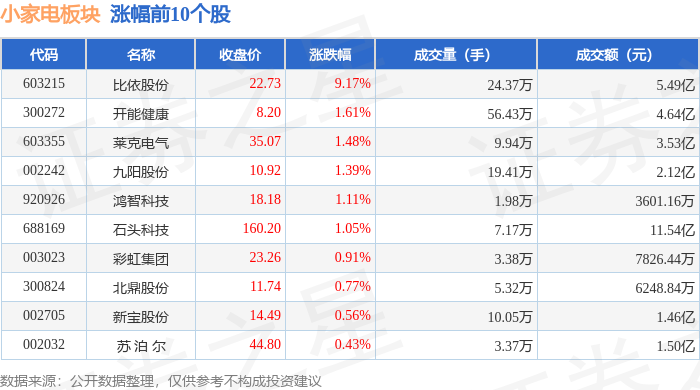
小家电板块1月14日涨0.17%,比依股份领涨,主力资金净流入7947.71万元
Zheng Xing Xing Ye Ri Bao· 2026-01-14 08:50
Group 1 - The small home appliance sector increased by 0.17% compared to the previous trading day, with Biyi Co., Ltd. leading the gains [1] - The Shanghai Composite Index closed at 4126.09, down 0.31%, while the Shenzhen Component Index closed at 14248.6, up 0.56% [1] - Biyi Co., Ltd. saw a closing price of 22.73, with a significant increase of 9.17% and a trading volume of 243,700 shares [1] Group 2 - The small home appliance sector experienced a net inflow of 79.48 million yuan from main funds, while retail funds saw a net inflow of 6.56 million yuan [2] - The trading data indicates that Biyi Co., Ltd. had a main fund net inflow of 1.12 billion yuan, but retail funds showed a net outflow of 65.04 million yuan [3] - Other notable companies in the sector included Kewos with a main fund net inflow of 44.70 million yuan and Suoer with a net inflow of 14.73 million yuan from main funds [3]

家电行业2025年年报前瞻:黎明前夕,沉潜以待
Guolian Minsheng Securities· 2026-01-14 08:22
Investment Rating - The report maintains a "Recommend" rating for the home appliance industry [1] Core Insights - The industry is at a turning point, with expectations for improved performance in 2026 as domestic demand stabilizes and export orders recover [35] - The report highlights the resilience of leading companies in the white goods sector, with a focus on their ability to navigate through challenging market conditions [7][10] - The overall market dynamics indicate a potential for growth in emerging markets, alongside innovation and product expansion in domestic markets [35] Summary by Sections 1. White Goods - External sales are recovering steadily, while internal sales are expected to remain stable in Q4 2025. Leading companies are well-positioned to benefit from favorable demand and cost environments [7][10] - Q4 2025 internal sales for air conditioners, refrigerators, and washing machines are projected to decline by 31%, 11%, and 6% respectively, due to high base effects from the previous year [10] - External sales for refrigerators and washing machines are expected to show modest growth, with a 3% increase for refrigerators and a 9% increase for washing machines [10] 2. Black Goods - The report indicates that the color TV market is under pressure, with internal sales declining significantly due to high base effects from previous subsidies [15] - External sales remain relatively stable, with a slight decline of 2% expected in Q4 2025 [15][16] - Leading brands are expected to improve their profitability through product innovation and market share gains [15] 3. Cleaning Appliances - External sales continue to grow, while internal sales face challenges due to high base effects from previous subsidies [19] - The report notes a decline in retail sales for floor cleaning machines and washing machines, with internal sales dropping by 25% and 8% respectively [20] - The external market shows strong growth, particularly in Europe and Asia-Pacific, although competition remains intense [21] 4. Small Appliances - Domestic prices are rising, but external demand remains weak, with overall growth in retail sales expected to be between 0-10% [30] - The report highlights structural improvements in pricing and product upgrades, which may support profit margins in the domestic market [30] - External sales are under pressure due to overall weak demand in international markets [30] 5. Post-Cycle - The report indicates a downturn in demand for major kitchen appliances, with significant declines in retail sales across various categories [33] - The real estate market remains sluggish, impacting demand for kitchen appliances, and the report anticipates continued pressure on sales [33] - The upcoming subsidy policies are expected to have limited coverage, which may further affect market dynamics [33] 6. Industry Views and Investment Recommendations - The report suggests that the home appliance sector is poised for recovery in 2026, with expectations for improved fundamentals and potential surprises in export performance [35] - Recommended stocks include leading white goods manufacturers such as Midea Group, Haier Smart Home, Gree Electric, and Hisense Home Appliances, as well as TV manufacturers like Hisense Visual and TCL Electronics [35]






科沃斯(603486) - 关于“科沃转债”可选择回售的第一次提示性公告
2026-01-14 08:16
证券代码:603486 证券简称:科沃斯 公告编号:2026-008 转债代码:113633 转债简称:科沃转债 科沃斯机器人股份有限公司 关于"科沃转债"可选择回售的第一次提示性公告 本公司董事会及全体董事保证本公告内容不存在任何虚假记载、误导性陈述 或者重大遗漏,并对其内容的真实性、准确性和完整性承担法律责任。 (一)有条件回售条款 在本次可转债最后两个计息年度内,如果公司A股股票收盘价在任何连续三十个 交易日低于当期转股价格的70%时,本次可转债持有人有权将其持有的本次可转债全 部或部分以面值加上当期应计利息回售给公司。若在上述交易日内发生过转股价格因 发生派送股票股利、转增股本、增发新股(不包括因本次发行的可转债转股而增加的 股本)、配股以及派发现金股利等情况而调整的情形,则在调整日前的交易日按调整 前的转股价格和收盘价格计算,在调整日及之后的交易日按调整后的转股价格和收盘 价格计算。如果出现转股价格向下修正的情况,则上述"连续三十个交易日"须从转 股价格调整之后的第一个交易日起按修正后的转股价格重新计算。 最后两个计息年度可转债持有人在每年回售条件首次满足后可按上述约定条件行 使回售权一次,若在首次 ...
家电ETF(159996)盘中涨超1%,行业双轮驱动格局显现
Mei Ri Jing Ji Xin Wen· 2026-01-14 06:41
Group 1 - The home appliance industry is experiencing a trend of technological upgrades showcased at the CES exhibition, with key brands in the robotic vacuum sector (Stone, Ecovacs, Trifo, and Yunji) launching innovative products [1] - Stone Technology introduced the world's first stair-climbing robotic vacuum, while Ecovacs upgraded its roller length and added a high-pressure pre-spray function [1] - Trifo launched the thinnest model in the industry and is focusing on embodied intelligence, while Yunji expanded its product lineup [1] Group 2 - The industry continues to show a concentration of leading brands, with December sales declining year-on-year due to the reduction of national subsidies and high base effects, although Stone Technology achieved a 33% growth against this trend [1] - In the lawn mower sector, LiDAR technology is becoming a key upgrade direction, with companies like Hesai Technology, Ninebot, and Wanji Technology releasing new products [1] - In the white goods sector, Midea Group acquired the global business of Reiko Medical, creating channel synergies with its traditional medical business [1] Group 3 - Additionally, XGIMI Technology launched AI glasses, indicating that the smart glasses industry is on a fast development track [1] - Overall, consumer robotics is moving towards embodied intelligence, and supply chain replacements are driving down costs [1]
还有3天!2026答案秀倒计时
Xin Lang Cai Jing· 2026-01-14 04:07
Group 1 - The event will take place online on January 17 and 18, 2026, featuring a "Spring Festival Gala" for thinkers [1] - Participants will have the opportunity to win prizes, including a cruise ticket valued at approximately 88,000 yuan and various other prizes [4][6] - The event has strategic partnerships with several companies, including Shanghai Caohejing Development Company and Xiaomi, among others [9] Group 2 - Prizes include high-value items such as the vivo X300pro photography kit worth about 8,299 yuan and an Apple Watch 10 valued at 2,299 yuan [6][7] - The event will also feature accommodations and travel partnerships, enhancing the overall experience for participants [9]

“扫遍”东南亚,中国品牌靠什么拿下八成市场?
Guan Cha Zhe Wang· 2026-01-14 00:48
Core Viewpoint - The Southeast Asian market is emerging as a new opportunity for Chinese smart cleaning device brands, despite previous doubts about its consumer spending power, especially following the bankruptcy of iRobot, which once dominated the global market with nearly 80% share [1][3]. Market Dynamics - Chinese brands have rapidly gained market share in Southeast Asia, capturing 80% of the local robotic vacuum market, driven by technological innovation and localized strategies [4]. - The Southeast Asian e-commerce market is projected to reach $128.4 billion in 2024, with double-digit GMV growth and a young population enhancing online purchasing power [4][9]. Competitive Strategy - Companies like Roborock, Ecovacs, and others are leveraging localized product strategies to adapt to the unique living environments and climates of Southeast Asia, focusing on features such as extended battery life and odor control [4]. - The "online + offline" collaborative model is being employed to enhance brand recognition and consumer trust, with over 100 experience stores established in Vietnam alone [5]. E-commerce Ecosystem - Alibaba's international business group is crucial in supporting Chinese brands' expansion into Southeast Asia, providing a comprehensive service system that facilitates market entry [6]. - Lazada, as a key platform, offers a "one-click light export" project that simplifies the process for merchants, allowing them to synchronize product and marketing information without additional investment [6][8]. Future Outlook - The digital economy in Southeast Asia is expected to drive continued growth for smart cleaning products, with e-commerce transactions projected to reach $186 billion by 2025 [9]. - The outflow model of Chinese brands is evolving from simple product exports to deep localization, with a focus on understanding local consumer preferences and building localized teams [9][10]. - Innovations in platform operations are lowering barriers for market entry, as demonstrated by Lazada's significant sales growth during major shopping events [10].


