
中国太平

Search documents
险企求“资”若渴 发债规模处于高位
Zhong Guo Zheng Quan Bao· 2025-12-22 20:19
Core Viewpoint - The insurance industry is accelerating its bond issuance as the year-end approaches, with total approved and issued bonds exceeding 100 billion yuan, maintaining a historical high level. This trend is driven by the need to enhance capital adequacy in light of the upcoming end of the transitional period for the second phase of solvency regulations [1][4]. Group 1: Bond Issuance Trends - As of December 22, the total amount of capital supplement bonds and perpetual bonds issued or approved for issuance by insurance companies has surpassed 100 billion yuan, with both types of bonds being issued in roughly equal amounts [1]. - Major insurance companies, including Ping An Life and CITIC Prudential Life, have received regulatory approval for significant bond issuances, indicating a robust market for insurance bonds [1][2]. Group 2: Types of Bonds - The primary types of bonds being issued are capital supplement bonds and perpetual bonds, with the latter gaining popularity among insurers this year, leading to a noticeable increase in issuance compared to previous years [2][3]. - Perpetual bonds, which do not have a fixed maturity date and can absorb losses under both ongoing and liquidation scenarios, are particularly favored as they can be counted towards core tier two capital [2][3]. Group 3: Regulatory Context - The transition period for the second phase of solvency regulations is set to end by the end of 2025, prompting insurers to bolster their capital to meet stricter regulatory requirements [3][4]. - Insurers are responding to the low interest rate environment and potential uncertainties in operations by increasing their bond issuance as a proactive measure to enhance their capital adequacy ratios [3][4].
双向奔赴!险资“南下北上”找“增长溢价”
2 1 Shi Ji Jing Ji Bao Dao· 2025-12-22 12:51
Core Viewpoint - The recent surge in local governments' initiatives to attract insurance capital reflects a pressing need for long-term, stable funding to support economic transformation and major projects amid economic pressures and limited traditional financing options [5][6][9]. Group 1: Government Initiatives - Multiple local governments, including those in Henan, Shaanxi, Tibet, Shandong, and Liaoning, are actively promoting "insurance capital into X" initiatives to channel large-scale insurance funds into local economies and significant projects [1][7]. - The "insurance capital into Henan" initiative has successfully attracted over 1 trillion yuan in insurance funds since its launch in July 2022, with a notable increase in investment scale and diversification of investment methods [3][4]. - The introduction of insurance capital is seen as a strategic move by local governments to address capital shortages and enhance financing structures during economic transitions [5][6]. Group 2: Investment Trends - Insurance funds are increasingly being directed towards emerging industries and projects, moving away from traditional sectors like chemicals and infrastructure, with plans to invest over 5 billion yuan in health-related initiatives [3][4]. - The total investment scale of China Life in Henan has exceeded 140 billion yuan, showcasing the significant role of major insurance companies in local economic development [4]. - The competition for attracting insurance capital is not limited to inland provinces but is also evident in coastal and northeastern regions, indicating a nationwide trend [7][8]. Group 3: Economic Context - The push for insurance capital is driven by the need for stable, long-term investments to support infrastructure, technological innovation, and green projects, particularly in the context of economic downturns and rising financing costs [6][9]. - The insurance sector is facing pressure due to declining long-term interest rates, prompting a search for stable returns through investments in significant local projects [9][10]. Group 4: Challenges and Solutions - The successful integration of insurance capital into local projects requires a robust framework that includes project quality, credit enhancement measures, policy support, and exit mechanisms [12][13]. - Local governments must establish a credible, long-term policy environment to attract insurance capital, balancing short-term funding needs with the long-term stability that insurance funds require [12][13].

重点改革稳步推进 2025年保险业向“质”而行
Jin Rong Shi Bao· 2025-12-22 09:43
Core Insights - The insurance industry in China is entering a critical year in 2025, focusing on high-quality development and internal reforms despite a complex external environment [1] Group 1: Life Insurance Sector - The life insurance industry is transitioning from reliance on interest rate spreads to a new cycle of value growth, emphasizing risk management and marketing reforms [2] - A dynamic adjustment mechanism for the predetermined interest rate was implemented, with the minimum guaranteed rates set at 2.0% for ordinary products, 1.75% for participating products, and 1.0% for universal insurance [2] - The insurance agent workforce is being upgraded, with a shift towards professional roles such as "health wealth planners" and "insurance wellness consultants" [3] Group 2: Property Insurance Sector - The property insurance sector is addressing challenges such as the difficulty in insuring new energy vehicles and enhancing management of non-auto insurance [4] - The "Good Insurance for Cars" platform was launched, involving 37 property insurance companies and providing coverage for over 1.1 million vehicles, with a total insured amount of 1.1 trillion yuan [5] - Non-auto insurance is undergoing stricter regulation, with a focus on improving compliance and quality, as outlined in the new regulatory framework [5] Group 3: Insurance Capital - Insurance capital is increasingly being utilized as patient capital, with total investment exceeding 37 trillion yuan, a 16.5% year-on-year increase [6] - Policies supporting insurance capital investment have been strengthened, including adjustments to asset allocation ratios and long-term investment assessments [7] - The scale of long-term investment pilot programs has expanded, with a total of 222 billion yuan approved for participation from various insurance companies [8]
“茅台系”寿险公司再获批增资6亿!年内人身险机构补充资本超1144亿元
Xin Lang Cai Jing· 2025-12-22 09:15
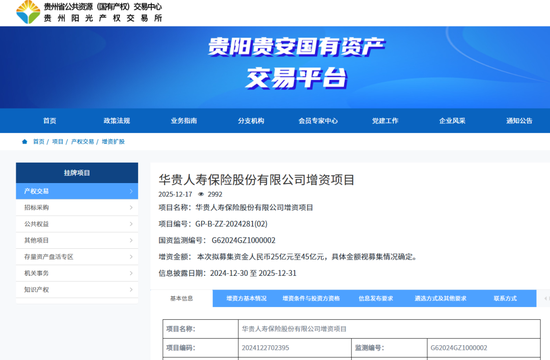
Core Viewpoint - Huagui Life Insurance has received approval from the Guizhou Financial Regulatory Bureau to increase its registered capital by 615 million yuan, raising it from 2 billion yuan to 2.615 billion yuan, as part of a larger fundraising plan aimed at enhancing its solvency and capital adequacy in response to regulatory requirements [1][9][10] Capital Increase and Fundraising Plans - The company plans to initiate a significant fundraising effort of 2.5 to 4.5 billion yuan by the end of 2024, which will increase its registered capital to between 4.5 billion and 6.5 billion yuan [1][9][10] - This recent capital increase follows a previous 1 billion yuan increase completed in April 2023, with participation from major shareholders including the Moutai Group [2][10] Financial Performance - For the first three quarters of 2025, Huagui Life Insurance reported an insurance business revenue of 4.523 billion yuan, a year-on-year increase of 31.03%, and a net profit of 183 million yuan, marking a return to profitability [1][5][13] - The company's investment yield was 4.28%, ranking 14th in the life insurance industry, while the comprehensive investment yield was 5.23%, ranking 8th [1][5][13] - Total assets reached 25.541 billion yuan, reflecting a growth of 17.45% from the beginning of the year, and net assets increased by 68.83% to 883 million yuan [5][13] Solvency and Regulatory Compliance - The core solvency adequacy ratio was reported at 118.8% and the comprehensive solvency adequacy ratio at 133.8% as of the end of the third quarter of 2025, indicating a slight improvement from the previous quarter [4][12] - The company is proactively addressing the upcoming "Solvency II Phase II" regulatory requirements, which mandate higher capital adequacy standards by the end of 2025 [3][11] Industry Context - As of December 15, 2025, the insurance industry has collectively supplemented capital by approximately 114.4 billion yuan, with life insurance companies being the primary contributors [7][15] - The trend in the industry shows a shift towards regular capital supplementation, with a significant portion of the capital coming from debt issuance and strategic equity increases [15][16]
华创证券:保险资负管理要求将深化 提升行业长期稳健经营能力
智通财经网· 2025-12-22 08:05
Core Viewpoint - The new draft regulation, "Insurance Company Asset-Liability Management Measures," aims to guide the industry in balancing cost and yield while enhancing long-term operational stability [1] Group 1: Regulatory Impact - The draft regulation encourages insurance companies to consider duration matching and cost-benefit analysis, potentially leading to a trend of controlling the scale of new lifetime insurance sales [1] - Smaller insurance companies may be more significantly affected by the new regulation, while larger firms may have clearer strategic asset allocation approaches [1] Group 2: Investment Yield and Cost Analysis - The continuous decline in long-term interest rates has pressured net investment yields, posing a potential "spread loss" challenge for the industry [2] - As of H1 2025, the average net investment yield for listed insurance companies is approximately 3.5%, with specific companies reporting yields ranging from 1.7% to 3.8% [2] - The average new business cost for listed insurance companies has decreased significantly, with a year-on-year average decline of 65 basis points, driven by adjustments in preset rates and unified reporting [2] Group 3: Strategic Asset Allocation - Leading insurance companies are expected to follow strategic asset allocation to address spread loss challenges, with current asset-liability matching pressures being relatively manageable [3] - The mismatch between asset duration and liability costs poses a risk, as extending asset duration may lead to a "scarcity of assets" issue and potentially forgo excess returns [3] - Smaller insurance companies face greater pressure on liability costs due to issues such as product homogeneity and high expenses prior to unified reporting [3]
资负管理要求将深化,多维度匹配督促行业行稳致远:保险行业重大事项点评
Huachuang Securities· 2025-12-22 03:46
Investment Rating - The report maintains a "Recommendation" rating for the insurance industry, indicating an expectation that the industry index will outperform the benchmark index by more than 5% in the next 3-6 months [28]. Core Insights - The new asset-liability management regulations aim to deepen the alignment between asset and liability management, enhancing the industry's long-term stability and operational capabilities [16]. - The report highlights that the recent decline in long-term interest rates has put pressure on net investment returns, posing potential "spread loss" challenges for the industry [8]. - The report notes that the head-listed insurance companies are expected to manage their liability costs better than smaller firms, which may face greater pressure due to cost management issues [16]. Summary by Sections Regulatory Changes - The new regulations clarify asset-liability management goals, principles, governance structures, policies, procedures, and establish regulatory and monitoring indicators [3]. - Key changes include institutional integration, improved organizational structures, and optimized calculation standards for regulatory indicators [3]. Monitoring Indicators - Regulatory indicators for property insurance companies focus on cost-benefit matching, duration matching, and liquidity matching, with specific minimum standards set for various metrics [4][5][6]. - Life insurance companies have indicators such as effective duration gap and comprehensive investment income coverage ratio, with strict monitoring requirements [4]. Investment Performance - As of H1 2025, the average net investment return for listed insurance companies is approximately 3.5%, with significant variations among companies [8]. - The report indicates a notable decline in new business costs for life insurance companies, driven by adjustments in preset interest rates and unified pricing strategies [12][15]. Strategic Implications - The report suggests that the new regulations may lead to a trend of controlling the scale of whole life insurance business sales and increasing allocations to long-duration bonds [16]. - It is anticipated that the pricing of new insurance products will become more cautious as companies focus on cost-benefit matching [16].



西部证券晨会纪要-20251222
Western Securities· 2025-12-22 02:54
Group 1: Market Strategy and Economic Outlook - The report suggests that the market is entering a cyclical transition, similar to Japan in 1978, with a recommendation to continue investing in sectors that are expected to reach new highs [1][10] - The anticipated "spring rally" in the A-share market is supported by favorable economic policies and the return of cross-border capital, which could lead to a "Davis Double" effect in the consumer sector [3][21] - The report emphasizes the importance of cyclical recovery in the economy, with a focus on sectors such as non-ferrous metals, new consumption, and high-end manufacturing [10][21] Group 2: Company-Specific Insights - The report on Ecovacs (科沃斯) forecasts revenues of 18.923 billion, 21.973 billion, and 24.919 billion CNY for 2025, 2026, and 2027 respectively, with corresponding net profits of 1.954 billion, 2.306 billion, and 2.777 billion CNY, indicating significant growth potential [2][13] - Ecovacs is expected to benefit from improvements in its cleaning business, the development of its consumer robotics matrix, and synergies from its supply chain layout [13] - The report highlights the potential for the liquid cooling industry to experience significant growth in 2026, with a focus on companies that have technological barriers and can enter major domestic and international supply chains [4][26] Group 3: Industry Trends and Projections - The liquid cooling market is projected to reach a conservative estimate of 6.9 billion to an optimistic 9.7 billion USD by 2026, driven by advancements in GPU technology and increasing demand for efficient cooling solutions [23][24] - The report indicates that the domestic liquid cooling server market is expected to exceed 10 billion USD by 2028, with a compound annual growth rate of 47.6% from 2023 to 2028 [25] - The consumer electronics sector is experiencing a recovery, with a focus on innovative products and market expansion, particularly in the context of the upcoming CES 2026 [32][34]

申万宏源证券晨会报告-20251222
Shenwan Hongyuan Securities· 2025-12-22 00:41
Group 1: Market Overview - The Shanghai Composite Index closed at 3890 points, with a daily increase of 0.36% and a monthly change of 0.03% [1] - The Shenzhen Composite Index closed at 2465 points, with a daily increase of 0.98% and a monthly change of -0.34% [1] - Large-cap indices showed a slight increase of 0.3% yesterday, while mid-cap and small-cap indices increased by 0.91% and 0.8% respectively [1] Group 2: Industry Performance - The decoration and renovation industry saw a daily increase of 3.33%, but a decline of 7.79% over the past month, while it increased by 30.51% over the past six months [1] - The energy metals sector increased by 3.26% yesterday, with an impressive 85.77% increase over the past six months [1] - The general retail sector increased by 3.22% yesterday, with an 8.93% increase over the past month and an 18.79% increase over the past six months [1] Group 3: Notable Declines - The components sector experienced a decline of 0.74% yesterday, with a 3.46% increase over the past month and a significant 69.42% increase over the past six months [1] - The other electronics sector declined by 0.68% yesterday, with a 42.32% increase over the past six months [1] - State-owned large banks saw a decline of 0.67% yesterday, with a 7.66% increase over the past six months [1]


保险资产负债管理全面升级
HTSC· 2025-12-21 13:58
证券研究报告 2025 年 12 月 21 日│中国内地 动态点评 保险 保险资产负债管理全面升级 华泰研究 保险 增持 (维持) | 李健,PhD | 研究员 | | --- | --- | | SAC No. S0570521010001 | lijian@htsc.com | | SFC No. AWF297 | +(852) 3658 6112 | | 于明汇* | 联系人 | | SAC No. S0570124070107 | yuminghui@htsc.com | | | +(86) 21 2897 2228 | 行业走势图 (13) (5) 4 13 21 Dec-24 Apr-25 Aug-25 Dec-25 (%) 保险 沪深300 资料来源:Wind,华泰研究 资产负债管理新规意见稿发布 12 月 19 日,金融监管总局发布《保险公司资产负债管理办法(征求意见稿)》 (《意见稿》),相比于 2018 年以来发布的《保险资产负债管理监管暂行办 法》和五项监管规则,《意见稿》系统地完善了监管规定,从监管目标、治 理结构、政策程序、模型系统、定量指标等方面提出了更为严格且细致的要 求,其中多 ...
《保险公司资产负债管理办法(征求意见稿)》点评:全面规范资负管理引导长期经营,利好头部险企
国泰海通· 2025-12-21 11:50
Investment Rating - The report maintains an "Overweight" rating for the insurance industry [1][2]. Core Insights - The "Insurance Company Asset-Liability Management Measures (Draft for Comments)" aims to comprehensively standardize the asset-liability management system of insurance companies, reinforcing the primary responsibility of companies and clarifying regulatory indicators to guide long-term stable operations [2][3]. - The introduction of the new measures is expected to enhance the asset-liability management framework, particularly under the backdrop of interest rate fluctuations and accounting standard reforms, benefiting leading insurance companies that align with stricter regulatory requirements [4]. Summary by Sections Regulatory Framework - The draft requires insurance companies to establish a governance structure for asset-liability management, with the board of directors ultimately responsible and senior management directly leading the efforts [4][5]. - It specifies the need for a professional department dedicated to asset-liability management, ensuring independence from business and investment management departments [4][7]. Management Policies and Procedures - The measures outline requirements for asset and liability analysis, product pricing management, asset allocation policies, and stress testing [4][5]. - Regulatory indicators include minimum standards for liquidity coverage ratios and effective duration gaps, with specific metrics for property and life insurance companies [9][10]. Monitoring and Risk Management - Monitoring indicators are established to identify and warn against asset-liability mismatch risks, enhancing risk management capabilities [4][9]. - The report emphasizes the importance of aligning asset-liability management with long-term operational goals, with a focus on achieving cost-revenue matching and liquidity matching [4][10]. Investment Recommendations - The report suggests that the new measures will guide the industry towards long-term stable operations and optimize asset-liability matching, maintaining an "Overweight" stance on the industry [4][12]. - Recommended companies include China Ping An, China Pacific Insurance, New China Life, and China Life Insurance [4][12].
