永泰能源

Search documents
A股煤炭股全线下跌,云煤能源跌停,宝泰隆跌超8%
Ge Long Hui A P P· 2025-11-18 02:58
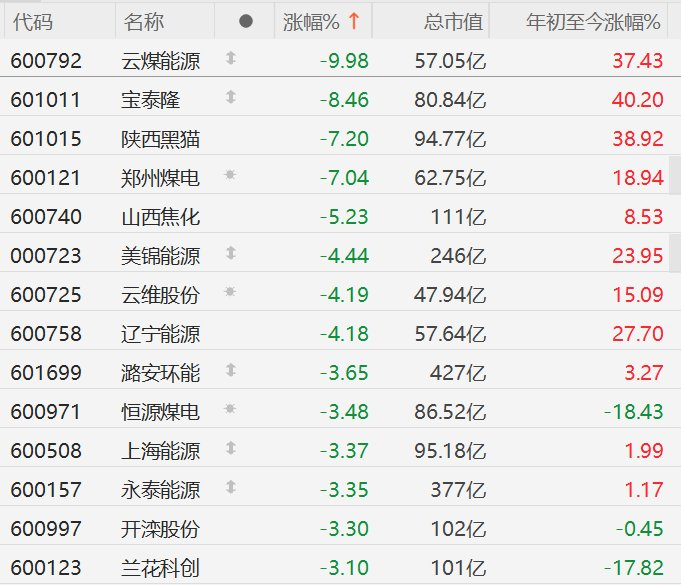
Group 1 - The coal sector in the A-share market experienced a significant decline, with multiple stocks hitting their daily limit down [1] - Yunnan Coal Energy fell by 9.98%, while Baotailong dropped by 8.46%, indicating a broader trend of negative performance among coal stocks [2] - Other notable declines included Shaanxi Black Cat down 7.20%, Zhengzhou Coal Electricity down 7.04%, and Shanxi Coking Coal down 5.23% [1][2] Group 2 - The total market capitalization of Yunnan Coal Energy is 5.705 billion, and it has seen a year-to-date increase of 37.43% [2] - Baotailong's market cap stands at 8.084 billion, with a year-to-date increase of 40.20% [2] - Shaanxi Black Cat has a market cap of 9.477 billion and a year-to-date increase of 38.92% [2]


永泰能源2025年三季报深度解读:主营业务利润同比大幅下降导致净利润同比大幅下降
Zhong Jin Zai Xian· 2025-11-17 13:05
Core Insights - The company, Yongtai Energy Group Co., Ltd., has experienced a significant decline in revenue and net profit in Q3 2025, with total revenue of 17.728 billion yuan, down 20.77% year-on-year, and net profit of 390 million yuan, down 78.47% year-on-year [1][2]. Financial Performance - The company's operating revenue for Q3 2025 was 17.728 billion yuan, compared to 22.375 billion yuan in the same period last year, reflecting a 20.77% decrease [2]. - The net profit for Q3 2025 was 390 million yuan, a substantial drop from 1.813 billion yuan in the previous year, marking a 78.47% decline [2]. - The main business profit for Q3 2025 was 674 million yuan, down 72.76% from 2.474 billion yuan in the same period last year [4]. Reasons for Profit Decline - The decline in net profit is attributed to a significant drop in main business profit, which was 674 million yuan this quarter compared to 2.474 billion yuan last year, a decrease of 72.76% [3][4]. - The gross margin for the current period was 20.71%, down 5.22% year-on-year, contributing to the overall profit decline [4]. Industry Analysis - Yongtai Energy operates in the comprehensive energy sector, focusing on coal mining and electricity supply. The industry has faced challenges due to environmental policies and energy transition, leading to a slowdown in traditional coal demand [5]. - The future trend in the industry is shifting towards clean energy, with expectations that by 2030, the share of new energy installations will exceed 50% [5]. Market Position - Yongtai Energy is a significant supplier in the domestic coking coal sector, ranking among the top 15 in terms of thermal coal production capacity, with over 60% of its revenue coming from electricity [5]. - The company holds a regional energy supply advantage but has a national market share of less than 3% [5]. Competitor Analysis - In Q3 2025, Yongtai Energy ranked 3065th in operational scoring, while it ranked 5th in the coking coal industry [6]. - As of September 24, 2025, Yongtai Energy's rolling revenue over the past twelve months was 28.4 billion yuan, placing it 5th globally in the coking coal sector [7]. Financial Metrics Comparison - Among five companies analyzed, Yongtai Energy has the lowest research and development expense ratio at 0.43%, while Huai Bei Mining has the highest at 4.68% [9]. - The company's price-to-earnings ratio (PE-TTM) as of November 14, 2025, was 132.61, significantly higher than the industry average of 33.71 [10].
永泰能源(600157)2025年三季报深度解读:主营业务利润同比大幅下降导致净利润同比大幅下降
Zhong Jin Zai Xian· 2025-11-17 12:55
Core Insights - The company, Yongtai Energy Group Co., Ltd., has experienced a significant decline in revenue and net profit in Q3 2025, with total revenue of 17.728 billion yuan, down 20.77% year-on-year, and net profit of 390 million yuan, down 78.47% year-on-year [1][2]. Financial Performance - The company's operating revenue for Q3 2025 was 17.728 billion yuan, compared to 22.375 billion yuan in the same period last year, reflecting a decrease of 20.77% [2]. - The net profit for Q3 2025 was 390 million yuan, down from 1.813 billion yuan in the previous year, marking a substantial decline of 78.47% [2]. - The main business profit for Q3 2025 was 674 million yuan, a significant drop of 72.76% from 2.474 billion yuan in the same period last year [4]. Reasons for Decline - The decline in net profit is attributed to a substantial decrease in main business profit, which was 674 million yuan this quarter compared to 2.474 billion yuan last year, alongside a reduction in operating revenue [3][4]. - The gross profit margin for the current period was 20.71%, down 5.22% year-on-year, contributing to the overall decline in profitability [4]. Industry Analysis - Yongtai Energy operates in the comprehensive energy sector, primarily focusing on coal mining and electricity supply. The industry has faced challenges due to environmental policies and energy transition, leading to a slowdown in traditional coal demand [5]. - The company is a significant supplier in the domestic coking coal sector, ranking among the top 15 in coal production capacity, with over 60% of its revenue derived from electricity [5]. - The future trend in the industry is shifting towards clean energy transition, with expectations that by 2030, renewable energy installed capacity will exceed 50% [5]. Market Position - Yongtai Energy holds a regional energy supply advantage but has a national market share of less than 3%, placing it in the mid-tier of the industry [5]. - As of September 24, 2025, the company's rolling revenue over the past twelve months was 28.4 billion yuan, ranking 5th in both the global and national coking coal industry [7]. Competitor Analysis - In terms of financial metrics, Yongtai Energy has the lowest research and development expense ratio among its peers at 0.43%, while Huabei Mining has the highest at 4.68% [9]. - The company's PE-TTM as of November 14, 2025, was 132.61, significantly higher than the industry average of 33.71, indicating a high valuation relative to its peers [11].
主力资金丨4股尾盘获大手笔加仓
Zheng Quan Shi Bao Wang· 2025-11-17 11:44
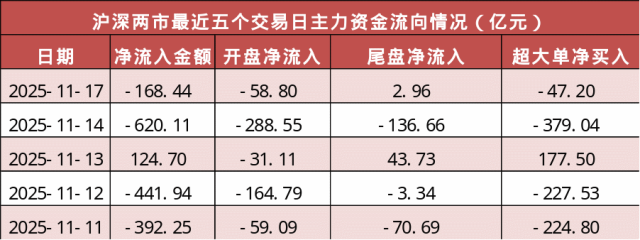
Group 1 - The core point of the article highlights that the main funds in the Shanghai and Shenzhen markets experienced a net outflow of 168.44 billion yuan on November 17, with the ChiNext board seeing a net outflow of 75.05 billion yuan and the CSI 300 index stocks a net outflow of 83.5 billion yuan [2] - Among the 17 industries tracked, 10 industries saw a net inflow of main funds, with the computer industry leading at 43.31 billion yuan, followed by the national defense and military industry at 26.57 billion yuan [2] - The pharmaceutical and biological industry faced the largest net outflow of 62.16 billion yuan, while the electronic industry had a net outflow of 53.12 billion yuan [2] Group 2 - In terms of individual stocks, 94 stocks had a net inflow of over 1 billion yuan, with 20 stocks exceeding 3 billion yuan in net inflow [3] - The stock of Zhongdian Xindong, involved in smart city projects, saw a net inflow of 8.63 billion yuan, marking a significant breakthrough in the urban rail transit sector [3] - Longcheng Military Industry also attracted a net inflow of 7.9 billion yuan, benefiting from a strong opening in the military equipment sector [3] Group 3 - Conversely, 100 stocks experienced a net outflow of over 1 billion yuan, with three leading stocks seeing significant outflows: Ningde Times at 17.62 billion yuan, and both Sunshine Power and Century Huatuo exceeding 10 billion yuan [5] - Century Huatuo's stock hit a limit down, closing with a drop of 9.16% [5] - In the tail end of trading, the total net inflow was 2.96 billion yuan, with Zhongdian Xinchuan leading at 2.6 billion yuan [6][7]



【17日资金路线图】两市主力资金净流出近170亿元 计算机等行业实现净流入
Zheng Quan Shi Bao· 2025-11-17 11:40
Market Overview - The A-share market experienced an overall decline on November 17, with the Shanghai Composite Index closing at 3972.03 points, down 0.46%, the Shenzhen Component Index at 13202 points, down 0.11%, and the ChiNext Index at 3105.2 points, down 0.2% [1] - The total trading volume for both markets was 19107.91 billion yuan, a decrease of 472.88 billion yuan compared to the previous trading day [1] Capital Flow - The net outflow of main funds from the Shanghai and Shenzhen markets reached approximately 170 billion yuan, with an opening net outflow of 58.8 billion yuan and a closing net inflow of 2.96 billion yuan, resulting in a total net outflow of 168.44 billion yuan for the day [2][3] - The CSI 300 index saw a net outflow of 83.5 billion yuan, while the ChiNext index experienced a net outflow of 75.05 billion yuan [4][5] Sector Performance - The computer industry achieved a net inflow of 80.23 billion yuan, with a growth of 1.92%, driven by stocks like Tuowei Information [6][7] - Other sectors with net inflows included media (31.27 billion yuan), communication (16.87 billion yuan), coal (10.69 billion yuan), and food and beverage (9.40 billion yuan) [7] - Conversely, the biopharmaceutical sector faced a significant net outflow of 156.04 billion yuan, declining by 1.57%, along with the electric equipment sector (90.44 billion yuan outflow) and banking (53.47 billion yuan outflow) [7] Institutional Activity - Notable institutional buying included Yahua Group with a net purchase of 41.69 million yuan and Binhai Energy with 19.24 million yuan [11] - Conversely, significant selling was observed in stocks like Shida Shenghua with a net outflow of 24694.51 million yuan and Zhongkuang Resources with 26231.12 million yuan [11] Analyst Recommendations - Recent analyst ratings include TuoBang Co. with a target price of 15.71 yuan, currently at 13.42 yuan, indicating a potential upside of 17.06% [12] - Other stocks with favorable ratings include Kede CNC with a target price of 86.95 yuan, currently at 60.79 yuan, suggesting a 43.03% upside [12]
煤炭行业今日涨1.32%,主力资金净流出3.76亿元
Zheng Quan Shi Bao Wang· 2025-11-17 10:02
Market Overview - The Shanghai Composite Index fell by 0.46% on November 17, with 17 industries experiencing gains, led by the computer and defense industries, which rose by 1.67% and 1.59% respectively [1] - The coal industry ranked third in terms of gains, increasing by 1.32% [2] - The pharmaceutical and banking sectors saw the largest declines, with drops of 1.73% and 1.31% respectively [1] Capital Flow Analysis - The net outflow of capital from the two markets was 31.953 billion yuan, with six industries seeing net inflows [1] - The computer industry had the highest net inflow of capital, totaling 7.211 billion yuan, while the defense industry followed with a net inflow of 2.892 billion yuan [1] - The pharmaceutical industry experienced the largest net outflow, with 8.789 billion yuan, followed by the power equipment sector with a net outflow of 7.644 billion yuan [1] Coal Industry Performance - The coal industry had 37 stocks, with 31 rising and 3 hitting the daily limit, while 4 stocks declined [2] - Among the stocks with net inflows, Meijin Energy led with a net inflow of 484 million yuan, followed by Electric Power Investment Energy and Shanxi Coking Coal with net inflows of 92.541 million yuan and 43.958 million yuan respectively [2] - The stocks with the largest net outflows included Yongtai Energy, Antai Group, and Huaihe Energy, with outflows of 679.415 million yuan, 424.092 million yuan, and 26.691 million yuan respectively [2] Individual Stock Performance in Coal Industry - Notable performers in the coal industry included: - Meijin Energy: +9.96% with a capital flow of 4842.321 million yuan [3] - Electric Power Investment Energy: -1.78% with a capital flow of 92.541 million yuan [3] - Shanxi Coking Coal: +0.97% with a capital flow of 43.958 million yuan [3] - Other significant stocks included: - Yancoal Energy: +6.53% with a capital flow of 1911.10 million yuan [3] - Shaanxi Coal and Chemical Industry: +1.74% with a capital flow of 491.67 million yuan [3]


行业周报:动力煤上穿800元之上的第四目标,煤价逻辑逐一兑现-20251116
KAIYUAN SECURITIES· 2025-11-16 12:44
Investment Rating - The investment rating for the coal industry is "Positive" (maintained) [1] Core Viewpoints - The report indicates that the price of thermal coal has surpassed the target of 800 yuan, with the current price at 834 yuan per ton as of November 14, reflecting a slight increase. The price at Guangzhou Port has reached 880 yuan, achieving the previously set target of 750 yuan for coal-electricity profit sharing. The price increase is attributed to supply contraction and a surge in demand due to the northern cold wave [3][4] - The report outlines that the price of coking coal has rebounded significantly from a low of 1230 yuan in July to 1860 yuan per ton as of November 14, with a notable increase in futures prices as well [3][4] - The investment logic suggests that both thermal and coking coal prices are at a turning point, with thermal coal prices expected to follow a four-step recovery process, ultimately reaching a balance point around 860 yuan [4][13] Summary by Sections Investment Logic - Thermal coal is categorized as a policy-driven commodity, with price recovery expected to follow a structured process involving the restoration of long-term contracts and achieving profit-sharing targets. The ideal target price for coal-electricity profit sharing is projected to be around 750 yuan for 2025, with an anticipated price range of 800-860 yuan [4][13] - Coking coal prices are more influenced by market dynamics, with target prices linked to the ratio of coking coal to thermal coal prices. The current ratio suggests target prices for coking coal at 1608 yuan, 1680 yuan, 1800 yuan, and 2064 yuan corresponding to thermal coal's price targets [4][13] Investment Recommendations - The report identifies four main investment lines in the coal sector: 1. **Cyclical Logic**: Companies like Jinko Coal and Yanzhou Coal Mining are highlighted for their potential in thermal coal. 2. **Dividend Logic**: Companies such as China Shenhua and China Coal Energy are noted for their strong dividend potential. 3. **Diversified Aluminum Elasticity**: Companies like Shenhua Holdings and Electric Power Investment are mentioned. 4. **Growth Logic**: New Energy and Guanghui Energy are recognized for their growth potential [5][14] Key Market Indicators - The coal index experienced a slight decline of 0.96%, outperforming the CSI 300 index by 0.12 percentage points. The average PE ratio for the coal sector is reported at 15.9, while the PB ratio stands at 1.42, indicating a relatively low valuation compared to other sectors [8][26][30]




煤炭开采行业跟踪周报:港口累库缓慢,煤价震荡上涨-20251116
Soochow Securities· 2025-11-16 07:15
Investment Rating - The report maintains an "Accumulate" rating for the coal mining industry [1] Core Viewpoints - The current port coal prices are supported by supply and shipping price issues, with the northern region entering the heating season and expected increases in electricity consumption, leading to a forecast of fluctuating coal prices [1] - The average daily coal inflow to the four ports in the Bohai Rim increased to 1.977 million tons, a rise of 1.87% week-on-week, while the average daily outflow rose to 1.8744 million tons, an increase of 0.77% week-on-week [1][32] - The total inventory at the Bohai Rim ports reached 24.296 million tons, up 2.82% week-on-week, indicating a slow growth in year-on-year comparisons despite absolute increases in outflow and inventory [1][32] Summary by Sections 1. Weekly Market Review - The Shanghai Composite Index closed at 3,990.49 points, down 0.70% week-on-week, while the coal sector index fell by 1.46% to 3,047.30 points [10] - The trading volume for the coal sector decreased by 7.98% to 80.618 billion yuan [10] 2. Domestic Coal Prices - As of November 14, the price of 5500 kcal thermal coal at Qinhuangdao port increased by 17 yuan/ton to 834 yuan/ton, while prices for other regions showed mixed trends [16][19] 3. International Coal Prices - The Newcastle coal price index rose by 2.58 USD/ton to 108.81 USD/ton, while other international indices remained stable [19] 4. Supply and Demand Dynamics - The average daily coal inflow and outflow at the Bohai Rim ports showed increases, with a notable rise in the number of anchored vessels, indicating heightened activity in the coal market [32] 5. Shipping Costs - Domestic shipping costs increased by 0.31% week-on-week, reaching 51.52 yuan/ton [34] 6. Recommendations - The report suggests focusing on resource stocks, particularly recommending Haohua Energy and Guanghui Energy as elastic targets in the thermal coal sector [37]
2025年中国电力运行维护行业政策、产业链、市场规模、重点企业及未来前景展望:电源电网投资强劲,拉动电力运行维护规模达488.33亿元[图]
Chan Ye Xin Xi Wang· 2025-11-15 02:31
Core Insights - The electric power operation and maintenance (O&M) market in China is experiencing rapid growth, with the market size projected to increase from 5.42 billion yuan in 2017 to 48.83 billion yuan in 2024, representing a compound annual growth rate (CAGR) of 27.67% [1][9] - The industry is transitioning towards intelligent, automated, and visualized operation and maintenance practices, driven by advancements in big data, cloud computing, IoT, and artificial intelligence [1][9] - The increasing complexity of power systems and the need for high reliability and efficiency are pushing the industry to adopt new technologies and improve operational standards [1][9] Industry Overview - Electric power operation and maintenance (O&M) involves systematic management of power lines, equipment, and supply systems to ensure safe and stable operation [3] - Key activities include equipment inspection, maintenance, fault handling, data monitoring, safety management, and user support [3] Market Growth - The market size for electric power O&M in China is expected to grow significantly, from 5.42 billion yuan in 2017 to 48.83 billion yuan in 2024, with a CAGR of 27.67% [1][9] - The investment in power construction has also increased, with the total investment in power construction rising from 270 billion yuan in 2017 to 1,168.7 billion yuan in 2024, a CAGR of 23.28% [6][7] Policy Support - The electric power O&M sector has received increased attention from the government, with various regulations and guidelines aimed at promoting standardization, professionalism, and intelligence in the industry [5] - Recent policies include the establishment of a database for major accident hazards and the promotion of intelligent inspection systems [5][6] Industry Chain - The electric power O&M industry chain consists of three main segments: upstream equipment manufacturing, midstream O&M service integration, and downstream application by power generation companies [6] - Collaboration between equipment manufacturers and power generation companies is deepening, driving the evolution of O&M systems towards greater intelligence and efficiency [6] Key Companies - Notable companies in the electric power O&M sector include Zhiguang Electric, Guodian NARI, and Siyuan Electric, among others [2][10] - These companies are leveraging innovative technologies in intelligent monitoring and data analysis to enhance their market competitiveness [10] Future Trends - The industry is expected to evolve towards greater intelligence, with the integration of big data, AI, and digital twin technologies to create smart O&M platforms [13] - Automation will reshape operational models, with drones and robots gradually replacing traditional manual operations [14] - Green development will become a core focus, emphasizing low-carbon practices and the integration of renewable energy sources [15][16]




揭秘涨停 | 超7亿资金追逐,VC溶剂龙头股大涨
Sou Hu Cai Jing· 2025-11-14 12:17
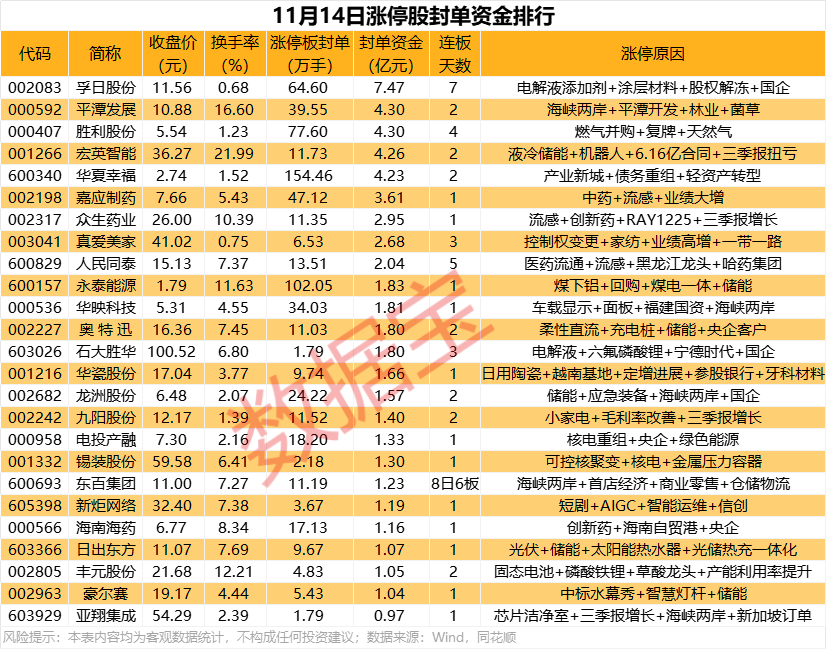
Market Overview - On November 14, the A-share market saw a total of 90 stocks hit the daily limit, with 71 stocks hitting the limit after excluding 19 ST stocks, resulting in an overall limit-up rate of 70.31% [1] Top Gainers - The stock with the highest limit-up order volume was Huaxia Happiness, with 1,544,600 hands; followed by Yongtai Energy, Victory Shares, and Furui Shares, with limit-up order volumes of 1,020,500 hands, 776,000 hands, and 646,000 hands respectively [2] - In terms of consecutive limit-up days, Furui Shares and *ST Lvkang achieved 7 consecutive limit-ups, while Sanmu Group had 6 consecutive limit-ups [2] Fund Inflows - 24 stocks had limit-up order funds exceeding 100 million yuan, with Furui Shares, Pingtan Development, and Victory Shares leading with limit-up funds of 747 million yuan, 430 million yuan, and 430 million yuan respectively [2] Industry Highlights Lithium Battery Sector - Furui Shares, a leader in the electrolyte VC solvent concept, achieved 7 consecutive limit-ups. The company announced its investment in lithium battery electrolyte additive projects through its subsidiary, Furui New Energy, with an annual production capacity of 40,000 tons for chlorinated ethylene carbonate and 10,000 tons each for crude and refined vinyl carbonate [2] Pharmaceutical Sector - Several pharmaceutical stocks hit the limit-up, including People's Tongtai, Zhongsheng Pharmaceutical, and Jiaying Pharmaceutical. People's Tongtai is optimizing its operational strategy and enhancing collaboration with upstream suppliers to penetrate key products into medical institutions and retail terminals [3][4][5] Natural Gas Sector - Stocks such as Changchun Gas, Guo New Energy, and Shouhua Gas also saw limit-ups. Changchun Gas serves over 1.8 million users and expects a gas supply of 544 million cubic meters in 2024 [6] Other Notable Stocks - Stone Daxinghua's fluorobenzene products are used in lithium battery electrolyte additives, while Fengyuan Shares focuses on lithium-ion battery cathode materials and oxalic acid [8][9] Institutional Activity - Four stocks saw net purchases exceeding 100 million yuan, including Haechen Pharmaceutical, Dae Oriental, Yunmei Energy, and Huaxia Happiness, with corresponding amounts of 279 million yuan, 169 million yuan, 142 million yuan, and 124 million yuan [10]