科大讯飞

Search documents
A股1.88万亿研发投入开启AI元年 340万技术人才锻造新质生产力
Chang Jiang Shang Bao· 2026-02-09 06:54
Core Insights - The article highlights the significant breakthroughs in general artificial intelligence (AGI) technology and its integration across various industries, marking a transformative shift in productivity globally [1] - A-share listed companies in China are prioritizing technological innovation, particularly in AI, as a central aspect of their development strategy [1] Group 1: R&D Investment Overview - In 2024, the total R&D investment by A-share listed companies reached 1.88 trillion yuan, accounting for 51.96% of the national R&D expenditure [1] - The number of R&D personnel in these companies totaled 3.42 million, representing 11.08% of the total workforce [1] - The Shanghai Stock Exchange companies' R&D investment exceeded 1 trillion yuan, making up nearly 40% of the national corporate R&D spending [2] Group 2: Sector-Specific R&D Insights - The computer, machinery, defense, automotive, pharmaceutical, and communication sectors showed high R&D intensity, with respective contributions of 14%, 6%, 5%, 5%, 4%, and 4% [2] - The Science and Technology Innovation Board (STAR Market) saw its R&D investment reach 168.08 billion yuan in 2025, which is 2.5 times its net profit, reflecting a 6.4% year-on-year growth [2] - The Shenzhen Stock Exchange companies' total R&D investment surpassed 760 billion yuan, with 410 companies having an R&D intensity exceeding 10% [3] Group 3: Leading Companies in R&D - BYD led the A-share market with R&D expenses of 53.195 billion yuan, focusing on advancements in blade battery technology and smart driving algorithms [3] - China State Construction maintained a strong position with R&D investment of 45.459 billion yuan, focusing on smart construction and low-carbon materials [4] - Companies like ZTE, iFlytek, and Hikvision are increasingly investing in AI infrastructure and applications, with a significant portion of their R&D resources directed towards AI-related fields [4]





字节Seedance2.0引爆AI应用!软件板块强势反弹,三六零涨停!软件ETF汇添富(159590)大涨超3%!AI大模型"终结"软件行业?黄仁勋、机构发声
Sou Hu Cai Jing· 2026-02-09 06:52
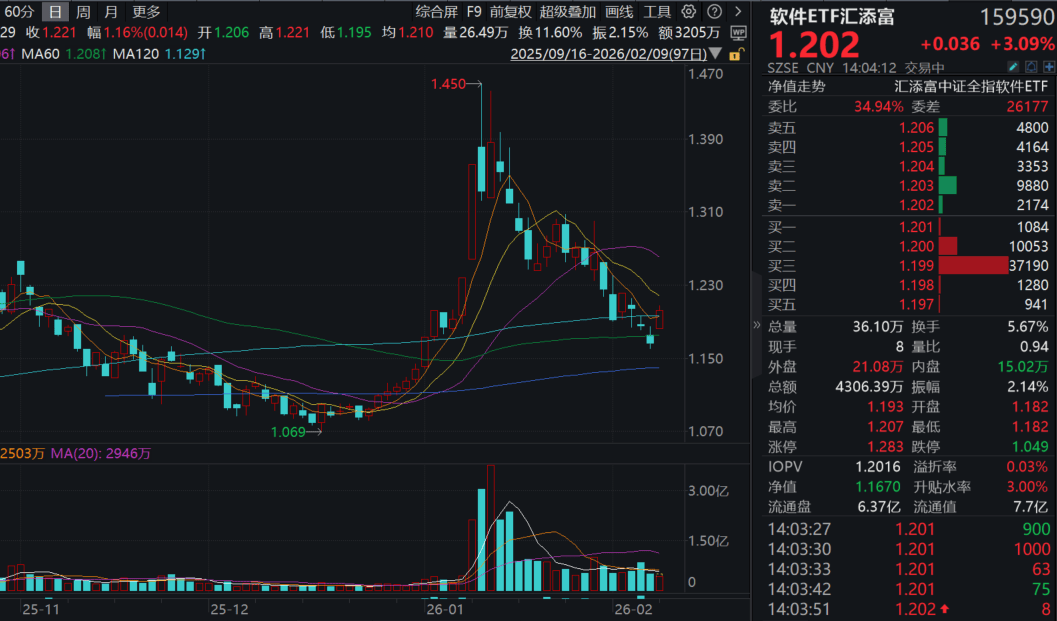
Group 1: Software ETF Performance - The software ETF Huatai (159590) saw most of its constituent stocks perform positively, with Dongfang Guoxin rising over 16%, Wanjing Technology increasing by over 11%, and 360 reaching the daily limit [2] - Key stocks and their performance include: - 360 (601360): 4.03% weight, 9.97% increase, trading volume of 4.363 billion - Keda Xunfei (002230): 12.40% weight, 2.72% increase, trading volume of 2.972 billion - Tonghuashun (300033): 7.02% weight, 3.54% increase, trading volume of 2.591 billion - Dongfang Guoxin (300166): 0.92% weight, 16.83% increase, trading volume of 2.201 billion - Wanjing Technology (300624): 1.18% weight, 11.57% increase, trading volume of 2.154 billion [3] Group 2: AI Video Generation Technology - ByteDance's AI video generation model, Seedance 2.0, has gained significant attention for its ability to create high-quality videos from text or images in under 60 seconds, featuring multi-scene narratives [4] - The model addresses key pain points in AI video generation, such as controllability and coherence, and is expected to catalyze a rebound in AI applications [5][6] - The technology is seen as a turning point for video generation, shifting the focus from technical capabilities to content quality and narrative value [7][8] Group 3: Market Sentiment and Future Outlook - Market sentiment is currently at a low point, but the introduction of Seedance 2.0 is expected to stimulate the AI application sector, particularly in cloud services and computing [5] - Analysts predict that the AI industry will see significant growth as the technology matures, with a focus on AI applications and the integration of AI agents into business processes [10][11] - The evolution of AI agents is anticipated to lead to structural changes in the industry, with increased demand for hardware and a shift in application entry points [12]





AIGC概念股早盘活跃,人形机器人将登春晚舞台,7只业绩预增股获融资客青睐
Sou Hu Cai Jing· 2026-02-09 06:34
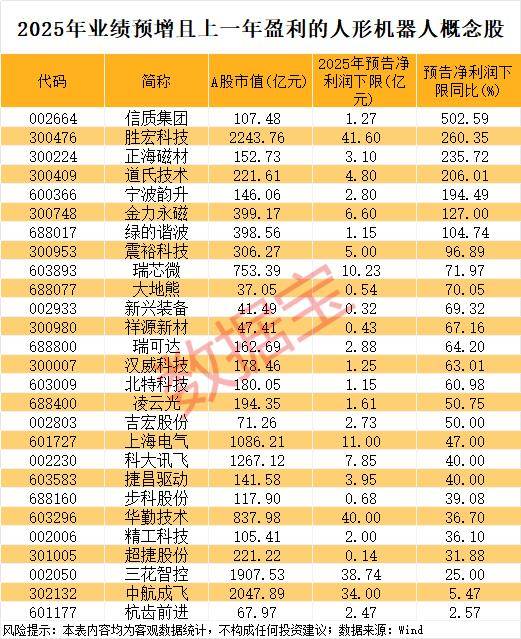
Group 1 - The A-share market is experiencing a dual mainline trend driven by AI and robotics, with AIGC concept stocks and embodied intelligent robots showing strong performance [1] - On February 9, the ChiNext Index rose over 3%, with stocks like Zhongwen Online and Haikan Co. hitting the daily limit, indicating a collective surge in the sector [1] - The core catalyst for this rally is ByteDance's release of the Seedance 2.0 model, an AI video generation tool that can produce movie-quality content, expected to reduce content production costs by over 60% [1] Group 2 - The robotics industry is witnessing significant events, with over five embodied intelligent companies confirmed to participate in the 2026 Spring Festival Gala, marking a transition to large-scale commercial use [1] - Market research predicts optimistic growth for the embodied intelligent robot sector, with user spending expected to surge from $1.4 billion in 2025 to $77 billion by 2030, reflecting a compound annual growth rate of 94% [2] - Morgan Stanley forecasts that the shipment of humanoid robots in China will reach 14,000 units by 2026 and exceed one million units by 2034, indicating a market potential that may surpass that of the new energy vehicle industry [2] Group 3 - Performance data supports the expectation of an industry explosion, with 35 humanoid robot concept stocks forecasting significant profit growth for 2025 [4] - Companies like Liyade have turned losses into profits through an "AI + display + cultural tourism" ecosystem, while Xinzhi Group anticipates a net profit increase of over 500% [4] - Institutional investors are showing clear signs of increased investment, with seven out of 35 pre-profit growth stocks receiving over 100 million yuan in net purchases since January [4]





政策力推算力互联互通!AI算力应用持续上攻,云计算ETF(159890)、软件龙头ETF(159899)涨超3%
Sou Hu Cai Jing· 2026-02-09 06:17
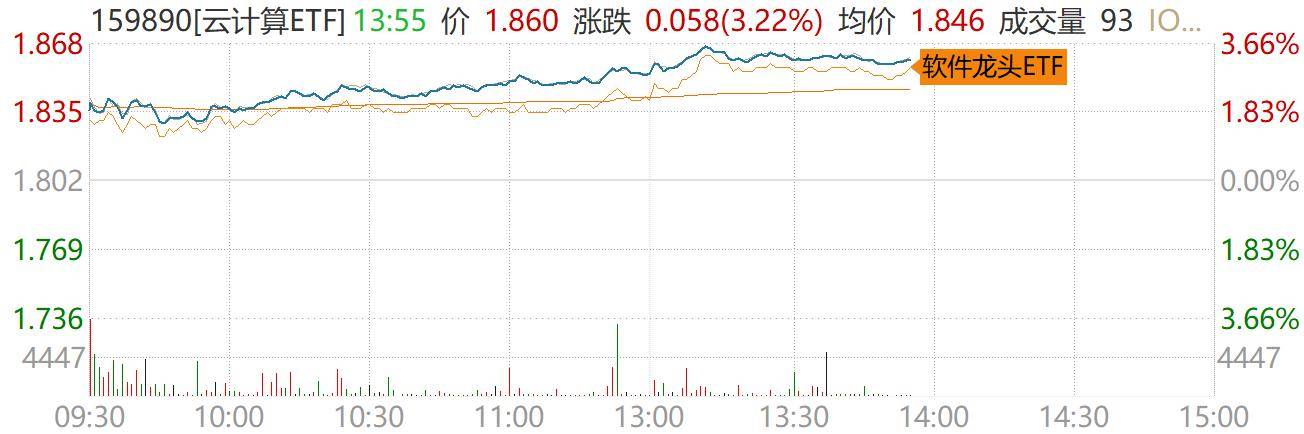
Core Viewpoint - The article highlights the significant growth in the AI computing sector, driven by advancements in domestic models and government initiatives aimed at enhancing computing resource efficiency and service levels [3][4]. Group 1: Market Performance - Major indices saw an increase, with AI computing and application sectors leading the gains [1]. - Cloud computing ETFs (159890) and software leader ETFs (159899) both rose over 3% during trading [1]. - Notable stock performances included 360 Technology hitting the daily limit, and Oriental Guoxin rising over 18% [1]. Group 2: Government Initiatives - A recent government notification aims to promote the "1+M+N" national computing interconnection node system, which is expected to enhance the quality of the computing industry and improve the efficiency of public computing resource usage [3]. - The total number of operational computing center racks in the country has increased from 5.2 million to 12.5 million over the past five years, with an annual growth rate of 30% [3]. Group 3: Model Development and Investment - The period leading up to the Spring Festival has seen a surge in the release of domestic AI models, including significant updates from companies like DeepSeek, Alibaba, and Baidu [4]. - ByteDance plans to invest 160 billion yuan in capital expenditures by 2026, while Alibaba is advancing a 3-year plan for 380 billion yuan in AI infrastructure [4]. - The acceleration in model iteration is expected to drive rapid growth in demand for inference-side computing power, with 2026 anticipated to be a pivotal year for domestic super node deployment [5]. Group 4: Industry Outlook - The rapid iteration of domestic models is likely to significantly increase demand for inference-side computing power, benefiting the domestic computing industry [5]. - The cloud computing ETF (159890) tracks major players in the AI infrastructure and application sectors, while the software leader ETF (159899) focuses on key software development companies, both expected to benefit from the ongoing industry trends [5].

AI应用端大涨,东方国信20CM涨停!字节Seedance2.0海内外刷屏,大数据ETF(516700)猛拉3.2%
Xin Lang Cai Jing· 2026-02-09 05:52
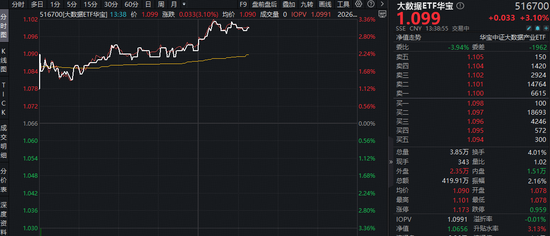
或由于字节跳动Seedance2.0视频生成模型在海内外爆火,今日(2月9日)重点布局国产算力、AI应用 领域的大数据ETF华宝(516700)场内涨幅一度上探3.28%,现涨3.1%,盘中收复5日均线。 成份股方面,东方国信20CM涨停,光环新网涨超10%,易华录、奥飞数据涨逾7%,天下秀、拓尔思、 国网信通等个股大幅跟涨。 | 序号 | 名称 | 旅鉄幅 ▼ | | 两日图 | 申万一级行业 | 申万二级行业 | 申万三级行业 | 总市值 | 成交额 | | --- | --- | --- | --- | --- | --- | --- | --- | --- | --- | | 1 | 东方国信 | 20.02% | | | 计算机 | IT服务Ⅱ | IT服务Ⅲ | 141亿 | 18.57亿 | | 2 | 光环新网 | 10.58% | | | 通信 | | 通信服务 通信应用增值服务 | 2991Z | 31.36亿 | | 3 | 易华录 | 7.93% | | | 计算机 | IT服务II | IT服务Ⅲ | 97亿 | 6.83 亿 | | 4 | 良飞胶据 | 7.84% | | | 通 ...
AI人工智能ETF(512930)涨超3.5%,国产AI大模型扎堆上新
Xin Lang Cai Jing· 2026-02-09 05:32
Group 1 - The core viewpoint of the news highlights a significant rise in the AI sector, with the Zhongzheng AI Theme Index increasing by 3.70% and notable gains in individual stocks such as Chip Origin Co., Ltd. and Guanghua New Network [1] - The AI application concept stocks experienced a surge, driven by the anticipation of the release of Qwen3.5, a new model from Alibaba, which has sparked discussions in the global AI open-source community [1] - According to Zhongyin Securities, the AI industry may be poised for a rebound after a period of decline, with key updates from major domestic models expected around the Chinese New Year [2] Group 2 - The Zhongzheng AI Theme Index consists of 50 listed companies involved in providing resources, technology, and application support for AI, reflecting the overall performance of AI-related securities [3] - As of January 30, 2026, the top ten weighted stocks in the Zhongzheng AI Theme Index accounted for 57.27% of the index, indicating a concentration of investment in leading companies within the AI sector [3] - The AI ETF closely tracks the Zhongzheng AI Theme Index, providing investors with exposure to the performance of AI-related companies [3]



人形机器人将集中亮相马年春晚,融资客抢筹7只业绩增长股
Xin Lang Cai Jing· 2026-02-09 05:24
Core Insights - The humanoid robot industry is expected to open up a market space broader than that of automobiles, with significant investment opportunities emerging as the industry transitions from technology validation to large-scale commercialization [1][7]. Industry Development - Multiple robotics companies are set to showcase their products at the 2026 Spring Festival Gala, marking a significant step in the commercialization of the robotics industry in China [1][7]. - The humanoid robotics sector is moving from isolated breakthroughs to broader industry solutions, entering a phase of value validation and mass production [1][7]. Market Projections - According to IDC, user spending on embodied intelligent robots in China is projected to exceed $1.4 billion in 2025 and soar to $77 billion by 2030, with a compound annual growth rate of 94% [2][8]. - Morgan Stanley forecasts that 14,000 humanoid robots will be shipped in China in 2026, with annual shipments expected to double in the following years, potentially reaching 30 million units by 2041, rivaling the passenger car market [2][8]. Company Performance - A total of 35 humanoid robot concept stocks are expected to see net profit growth in 2025, including eight companies that are projected to turn losses into profits [3][9][10]. - Liard is expected to achieve a net profit of between 300 million and 380 million yuan in 2025, marking a turnaround from previous losses [10]. - Xinzhi Group anticipates a net profit of 12.7 million to 15.1 million yuan in 2025, representing a year-on-year growth of 502.59% to 616.94% [10]. Investment Trends - As of February 6, seven stocks among the 35 with expected profit growth have seen net purchases exceeding 100 million yuan since January, with iFlytek leading at 826 million yuan [5][12]. - Zhenyu Technology and Chaojie Technology have also attracted significant investment, with net purchases of 304 million yuan and 280 million yuan, respectively [12].

“薄利”的微医:第三次冲击港交所,被AI巨头“抢生意”
Sou Hu Cai Jing· 2026-02-09 05:08
Group 1 - The core viewpoint of the article is that WeDoctor's AI foundation appears unstable, as it relies on third-party foundational models and has seen a decline in R&D expenses, raising concerns about its future in the competitive AI healthcare market [2][21][30] - WeDoctor's IPO attempts have faced challenges, with the recent withdrawal of its coordinator, CMB International, raising questions about its future prospects despite a booming IPO market in Hong Kong [2][4] - The company has reported significant losses, with a cumulative loss of nearly 1.8 billion RMB from 2022 to the first half of 2025, and has not yet achieved profitability [4][6][15] Group 2 - WeDoctor's revenue has shown explosive growth, reaching 30.8 billion RMB in the first half of 2025, a year-on-year increase of 69.43%, but it remains deeply unprofitable [6][8] - The company's business model, which relies on earning from healthcare fund surpluses, is described as a "hard business" with low margins and challenges in scalability [8][11][15] - The health management services segment has seen a nearly tenfold increase in revenue, but its profit margins are extremely low, with a profit margin of only 0.7% in the first half of 2025 [9][10] Group 3 - Major competitors like Ant Group, Baidu, and iFlytek are entering the G-end market, intensifying competition for WeDoctor, which is struggling to establish itself [5][25][29] - WeDoctor's reliance on third-party AI models and reduced R&D spending has raised concerns about its ability to innovate and compete effectively in the AI healthcare space [21][30] - The company has expanded its operations to cities like Shanghai and Hangzhou, but remains heavily dependent on its primary market in Tianjin, which accounted for 77.6% of its revenue in the first half of 2025 [14][15]

2025年金融大模型招投标活跃:智能体项目均价百万 四大类厂商激战正酣
Zhong Guo Jing Ying Bao· 2026-02-09 04:33
Core Insights - The financial sector is rapidly adopting large model technology, marking 2025 as the year of commercial exploration for financial intelligence [1] - The number of large model projects in the financial industry surged by 341% year-on-year, with disclosed project amounts increasing by 527% [1][2] - Investment in intelligent agent platforms and application solutions by Chinese financial institutions reached 950 million yuan in 2025, projected to grow to 19.3 billion yuan by 2030, with a compound annual growth rate of 82.6% [1] Project Trends - In 2025, application projects accounted for 58% of large model projects, surpassing traditional computing power procurement projects [1] - The median disclosed amount for projects was 1.184 million yuan, with a significant number of smaller projects emerging [2] - The majority of projects are lightweight explorations, with many valued at tens to hundreds of thousands of yuan, while a few comprehensive upgrades are valued in the millions [3] Market Dynamics - Financial institutions' demand is focused on cost reduction, efficiency improvement, compliance, and growth [4] - The market participants include technology firms (31.4%), IT system and vertical solution providers (27.5%), fintech companies (21.6%), and large enterprises (13.7%) [5] - Major active players in the financial large model project bidding include iFlytek, Baidu, Alibaba Cloud, Ant Group, and others [5] Vendor Selection and Business Models - Financial institutions exhibit two main attitudes when selecting vendors: valuing brand reputation and comprehensive capabilities or seeking cost-effectiveness and close service [6] - The predominant payment model for large model services is project-based, with emerging interest in RaaS (Results as a Service) models [6][7] - The focus is shifting from cost centers to profit centers within financial institutions, emphasizing business value as the core driver for AI investments [6] Implementation Challenges - Currently, 96% of intelligent agent applications are in the exploratory phase, with only 4% in agile practice [7][8] - Compliance is a critical concern, with institutions prioritizing the reliability and controllability of intelligent agents [8] - The industry is expected to face a testing period over the next 1-2 years, with many low-quality projects likely to be eliminated [8][9]
下一个万亿市场?人形机器人的“脸”和“脑子”,谁来做?
机器人大讲堂· 2026-02-09 04:04
" 2026,脸正成为必需品? "你好,我在。" 这句被无数智能音箱重复了亿万次的回应,曾是人机交互的里程碑,如今却成了一个亟待被打破的僵化符 号。 它代表了一种旧范式:明确的指令输入,换取被动、工具式的反馈输出。 2025年,人形机器人产业正经历着奇特的"身体与头部"发展的割裂。 一方面,本体运动控制突飞猛进,双足行走、上下楼梯、甚至跑酷的演示视频不断刷新着技术上限;另一方 面,当这些精巧的"身体"试图与人进行日常交流时,交互体验却往往停滞在智能音箱时代:一个冰冷的语音 合成器,被放置在了一副会动的躯壳之上。 "我们正处于'强本体,弱交互'的尴尬阶段。"一位资深机器人产业投资人指出,"机器人的腿脚越来越灵活, 但它的脸和表达却仍是机器人。这种割裂感,是阻碍其真正融入人类生活场景的核心障碍之一。" 这种割裂背后,是机器人技术栈长期以来的重心失衡。行业将超过80%的研发资源投入在运动、抓取等"生 存技能"上,而用于构建社会性、情感化连接的"交互智能",却长期被视为锦上添花的附属功能。 2026年初春,上海,一家初创科技公司里,一场安静却意义深远的"变革"正在发生。 一台名为"灵智5号"的仿生头静静地置于工作台中 ...