美的集团

Search documents
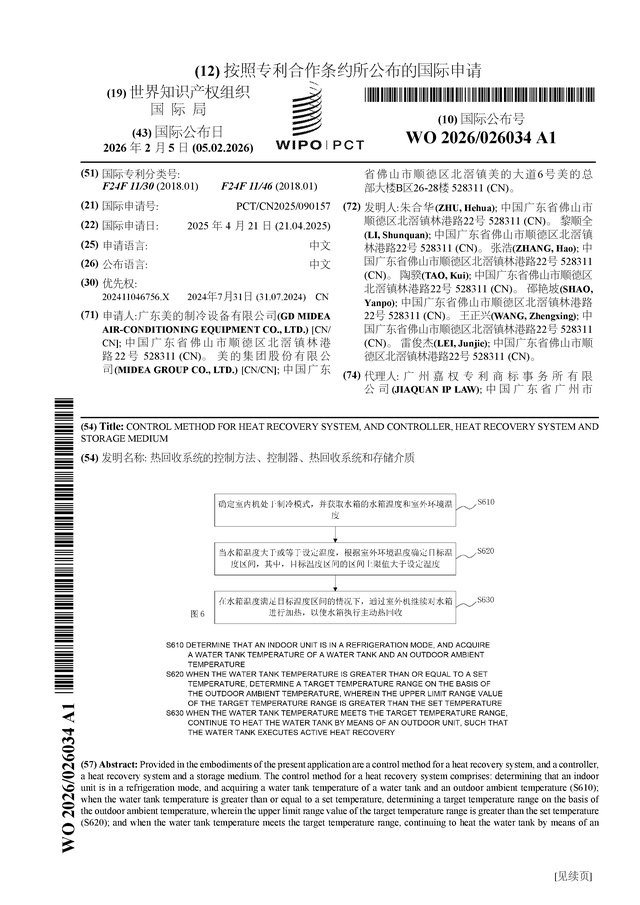
美的集团公布国际专利申请:“热回收系统的控制方法、控制器、热回收系统和存储介质”
Sou Hu Cai Jing· 2026-02-10 06:40
Core Viewpoint - Midea Group has filed an international patent application for a heat recovery system, indicating a focus on innovation in energy efficiency and sustainability [1][2]. Group 1: Patent Application Details - The patent titled "Control Method for Heat Recovery System, and Controller, Heat Recovery System and Storage Medium" was filed under the application number PCT/CN2025/090157, with an international publication date set for February 5, 2026 [1][2]. - The patent includes a control method that determines the operational mode of an indoor unit and manages the temperature of a water tank based on outdoor conditions, aiming to enhance energy recovery [2]. Group 2: R&D Investment and Patent Trends - In 2023, Midea Group has published 25 international patent applications, a decrease of 44.44% compared to the same period last year [3]. - The company invested 8.767 billion yuan in research and development in the first half of 2025, reflecting a year-on-year increase of 14.41% [3].


300ESGETF华夏(159791)涨0.36%,半日成交额3913.80元
Xin Lang Cai Jing· 2026-02-10 05:35
300ESGETF华夏(159791)业绩比较基准为沪深300ESG基准指数收益率,管理人为华夏基金管理有限 公司,基金经理为张金志,成立(2022-02-24)以来回报为11.93%,近一个月回报为-0.49%。 来源:新浪基金∞工作室 声明:市场有风险,投资需谨慎。本文基于第三方数据库自动发布,不代表新浪财经观点,任何在本文 出现的信息均只作为参考,不构成个人投资建议。如有出入请以实际公告为准。如有疑问,请联系 biz@staff.sina.com.cn。 2月10日,截止午间收盘,300ESGETF华夏(159791)涨0.36%,报1.118元,成交额3913.80元。 300ESGETF华夏(159791)重仓股方面,贵州茅台截止午盘跌0.89%,中际旭创跌0.48%,宁德时代跌 0.76%,招商银行跌0.23%,中国平安跌0.90%,美的集团涨1.00%,长江电力涨0.26%,紫金矿业涨 0.28%,兴业银行跌0.21%,比亚迪涨1.22%。 ...
美的旗下医疗板块推出DR智能体 释放医生70%重复性劳动
Zheng Quan Ri Bao Wang· 2026-02-10 04:43
Core Viewpoint - Midea Group, through its subsidiary Beijing Wandong Medical, has launched the Wandong DR Intelligent System, which aims to automate the entire imaging workflow, enhancing efficiency and accuracy in clinical diagnostics [1] Group 1: Product Development - The Wandong DR Intelligent System integrates advanced technologies from Midea's AI Research Institute, Central Research Institute, and Alibaba's Damo Academy [1] - The system automates imaging processes, including intelligent positioning, image capture, AI quality control, and automatic detection of common chest diseases, generating structured diagnostic reports seamlessly [1] Group 2: Technological Innovation - The system leverages over 4 million cross-domain chest DR imaging data from Wanliyun, enabling the development of a multimodal diagnostic model that surpasses traditional AI's single-point recognition limitations [1] - It introduces a deep reasoning engine that simulates clinical thought processes, allowing for multi-step logical deductions in complex cases [1] Group 3: Quality and Consistency - The model includes standardized report templates to ensure terminological accuracy and traceability, significantly improving the professionalism and consistency of reports [1] - Continuous integration of diagnostic experiences from imaging and clinical experts into the model allows for iterative upgrades, aligning the system's logic closer to real clinical thinking [1]

近5日“吸金”12.51亿!A500ETF基金(512050)获资金积极布局,机构称风险释放春节红包可期
Xin Lang Cai Jing· 2026-02-10 03:34
A500ETF基金紧密跟踪中证A500指数,中证A500指数从各行业选取市值较大、流动性较好的500只证券 作为指数样本,以反映各行业最具代表性上市公司证券的整体表现。 数据显示,截至2026年1月30日,中证A500指数(000510)前十大权重股分别为宁德时代、贵州茅台、中 际旭创、中国平安、紫金矿业、招商银行、新易盛、美的集团、长江电力、兴业银行,前十大权重股合 计占比19.39%。 A500ETF基金(512050),场外联接(华夏中证A500ETF联接A:022430;华夏中证A500ETF联接C: 022431;华夏中证A500ETF联接Y:022979),相关指数基金(华夏中证A500指数增强A:023619;华夏 中证A500指数增强C:023620), A500增强ETF基金(512370)。 规模方面,A500ETF基金(512050)近1周规模增长12.46亿元。近5个交易日合计"吸金"12.51亿元,日均 净流入达2.50亿元。 华鑫证券指出,内外同步调整后,风险已有部分释放,情绪边际修复。结合日历效应,近10年春节前5 个交易日到节后20个交易日,A股上涨概率较高,建议A股持股过节, ...
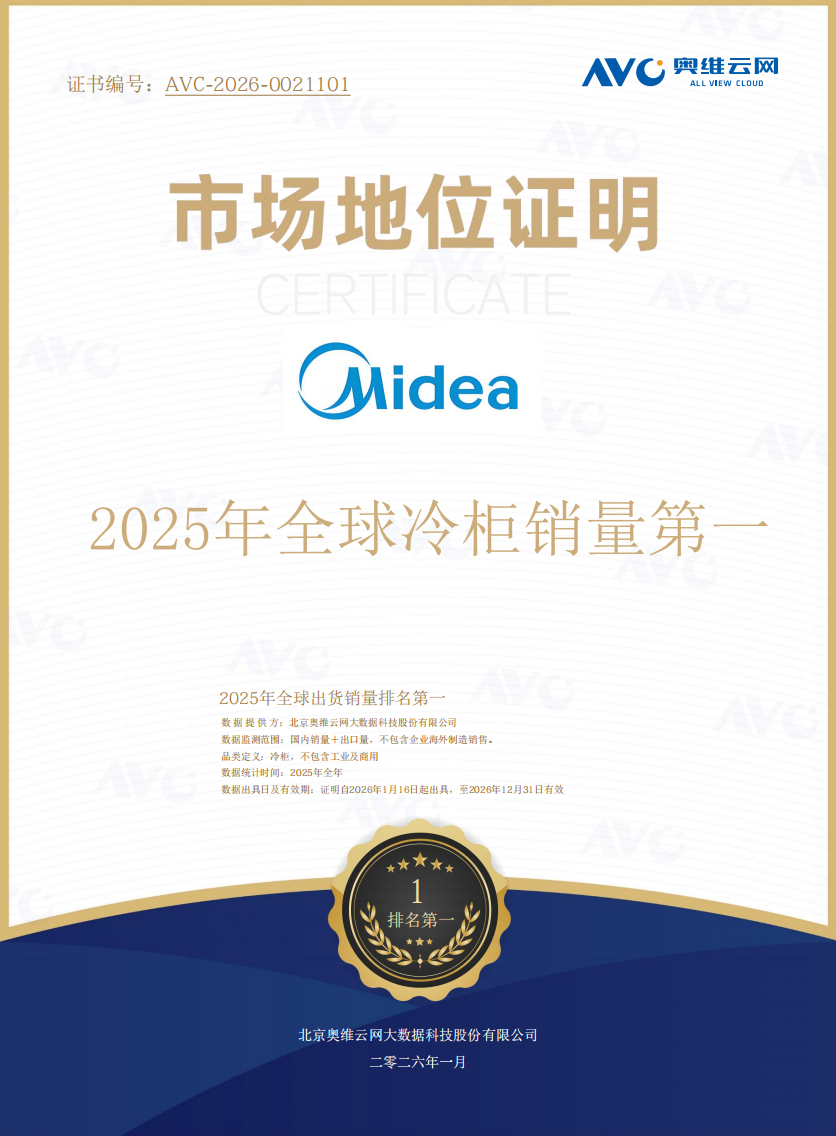
奥维云网: 美的冷柜斩获2025全球销量第一,夯实行业领先地位
Sou Hu Wang· 2026-02-10 01:54
Core Insights - Midea's refrigerator brand has achieved the top position in global refrigerator sales for 2025, demonstrating strong market performance and comprehensive strength [1][3]. Market Performance - The global refrigerator market is projected to grow steadily, with total sales reaching 55.17 million units in 2025, reflecting a year-on-year increase of 1.19% [3]. - Midea's refrigerator sales are expected to reach 6.75 million units in 2024 and increase to 6.85 million units in 2025, capturing a market share of 12.9%, maintaining its position as the global sales leader for two consecutive years [3][4]. Product Strategy - Midea's success is attributed to its comprehensive product matrix, core technological breakthroughs, and global strategy, which cater to diverse consumer needs in a competitive market [5]. - The trend towards high-end products is evident, with Midea introducing the "Frost-Free King" series, which emphasizes health, energy efficiency, and convenience for modern households [5]. Technological Innovation - Midea has made significant advancements in core technologies, particularly in health-oriented features, which are becoming central to industry upgrades [7]. - The introduction of the DM-D dual-drive wind cooling technology addresses common consumer pain points, ensuring even cooling and rapid freezing while maintaining food quality [9]. Global Strategy - Midea's global sales leadership is supported by its comprehensive strategy that encompasses brand strength, technology, supply chain, and localized solutions tailored to different regional markets [10]. - The recognition of Midea's refrigerators as the global sales leader underscores its robust capabilities in technological innovation, product diversity, and deep global engagement [10].
中国银河证券:空调行业提价坚决 扫地机在犹豫中减少自补
智通财经网· 2026-02-10 01:51
Core Viewpoint - The home appliance industry is facing price increases driven by costs and some structural upgrades, with a significant difference from the previous cost increase cycle from Q3 2020 to Q2 2022 [1][2] Group 1: Cost-Driven Price Increases - The current cost increase cycle is primarily driven by rising prices of various metal raw materials, memory, and MCU, rather than strong retail demand [2] - The CPI is expected to return to positive growth in October 2025, with rates of +0.2%, +0.7%, and +0.8% for October, November, and December respectively [1] - The demand for home appliances is weak, and the marginal utility of national subsidies is decreasing, leading to cost-driven price increases [1][2] Group 2: Air Conditioner Price Increases - Air conditioners face higher cost pressures due to the significant cost share of copper, leading to decisive price increases by major brands like Midea, which implemented a tiered price increase strategy [3] - Retail prices for air conditioners have risen, with online and offline average prices reaching 3151 yuan and over 4000 yuan respectively in early 2026 [3] - The peak of competition and cost pressure in the air conditioner market is expected in Q4 2025, with price increases in 2026 alleviating some of the cost pressures [3] Group 3: Robotic Vacuum Cleaners - The robotic vacuum cleaner market is experiencing complexities as national subsidies are set to stop in the second half of 2025, leading brands like Ecovacs and Roborock to face profit pressures [4] - Despite attempts to end self-subsidization, some provinces have resumed subsidies, affecting market dynamics [4] - The average retail price of robotic vacuum cleaners showed a decline in late 2025 but began to recover in early 2026 [4] Group 4: TV Structural Upgrades and Competition in Action Cameras - Although TV demand is declining, the penetration rate of MiniLED TVs has increased since September 2024, contributing to a rise in retail prices [5] - Retail volume and value for TVs in 2025 decreased by 10.4% and 7.3% respectively, while the average retail price increased by 3.51% [5] - The action camera market is seeing intense competition, particularly with brands like DJI and Insta360, leading to price reductions for popular models [6]

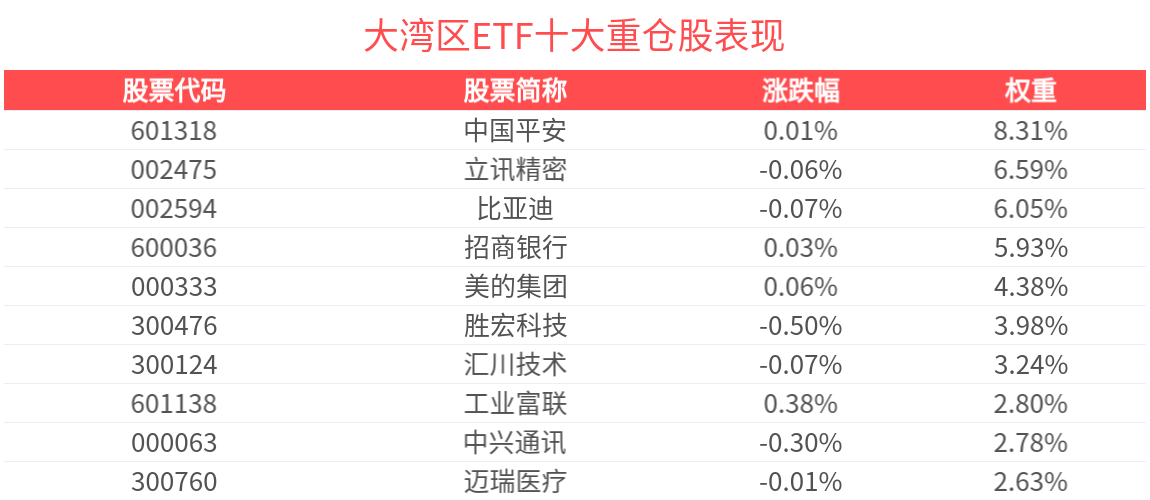
中证粤港澳大湾区发展主题指数上涨0.02%,大湾区ETF(512970)成立以来超越基准年化收益达3.32%
Sou Hu Cai Jing· 2026-02-10 01:43
Core Viewpoint - The performance of the Zhuhai-Hong Kong-Macao Greater Bay Area Development Theme Index and its related ETF reflects the overall performance of companies benefiting from the development of the Greater Bay Area, with notable movements in specific constituent stocks [1][2]. Group 1: Index Performance - As of February 10, 2026, the Zhuhai-Hong Kong-Macao Greater Bay Area Development Theme Index (931000) increased by 0.02%, with notable gains from stocks such as Zhaochi Co. (+9.96%) and Mingyang Smart Energy (+1.56%) [1]. - The Greater Bay Area ETF (512970) showed a mixed performance, with a recent price of 1.52 yuan and a cumulative increase of 2.91% over the past week as of February 9, 2026 [1]. Group 2: Liquidity and Trading Data - The trading volume for the Greater Bay Area ETF was reported at 0.00 yuan, with an average daily trading volume of 711,700 yuan over the past month [1]. - The Sharpe ratio for the Greater Bay Area ETF over the past year was 1.41, indicating a favorable risk-adjusted return [1]. Group 3: Drawdown and Fees - The maximum drawdown for the Greater Bay Area ETF year-to-date was 5.52%, with a relative benchmark drawdown of 0.02% [1]. - The management fee for the Greater Bay Area ETF is set at 0.15%, while the custody fee is 0.05% [1]. Group 4: Index Composition - As of January 30, 2026, the top ten weighted stocks in the Zhuhai-Hong Kong-Macao Greater Bay Area Development Theme Index accounted for 44.55% of the index, with China Ping An, Luxshare Precision, and BYD among the leading constituents [2][3]. - The index includes a maximum of 50 Hong Kong market securities, 300 companies from the Shanghai-Hong Kong-Shenzhen market, and 100 mainland market securities, all selected based on their alignment with the Greater Bay Area development theme [2].




从“产品出海”到“文化出海”:双轮驱动“广货”全球启新程
2 1 Shi Ji Jing Ji Bao Dao· 2026-02-10 00:25
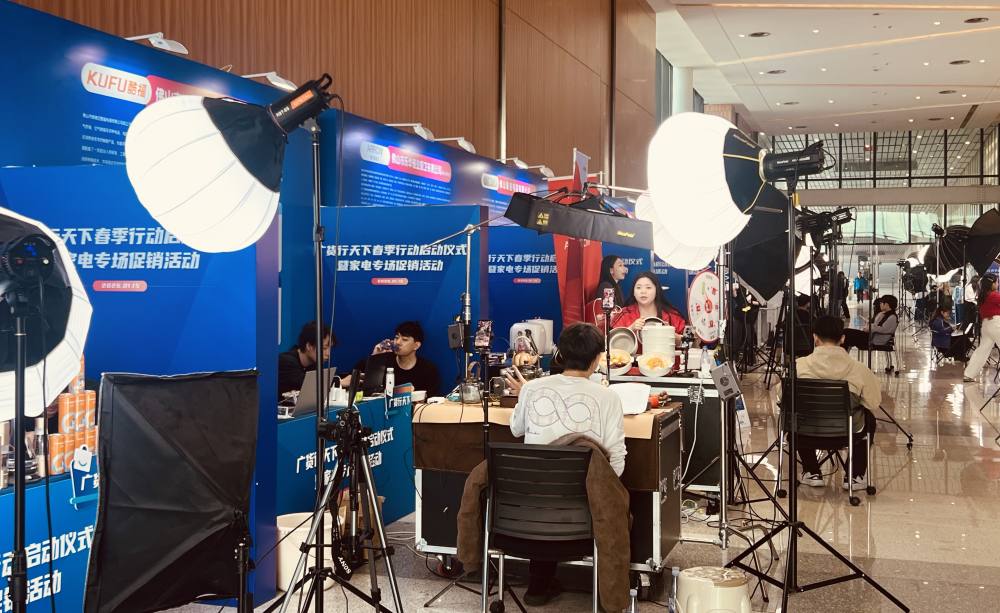
Core Viewpoint - The "Guangdong Goods Going Global" initiative represents a significant step in Guangdong's strategy to enhance its global trade presence, focusing on high-quality development and industrial upgrades, while leveraging local cultural elements to strengthen brand identity and market reach [2][3][9]. Group 1: Industrial Foundation - Guangdong has maintained its position as China's largest foreign trade province for over 30 years, accounting for about one-quarter of the national total, establishing itself as a core hub for international market engagement [3]. - The province has developed a comprehensive industrial ecosystem, particularly in consumer electronics, new energy vehicles, and home appliances, with thousands of specialized enterprises and leading companies [3][4]. - Shenzhen is highlighted as a global innovation center for consumer electronics, with major companies like Huawei and OPPO driving rapid responses to global demand through efficient industrial clusters [4][5]. Group 2: Challenges and Opportunities - Despite impressive export volumes, Guangdong's "Guangdong Goods" face challenges such as a lack of core technologies and global brand recognition, with many small enterprises relying on OEM models [4][5]. - The need for deeper cultural communication and adaptation to international standards is emphasized, as well as the importance of overcoming barriers related to green trade and geopolitical tensions [4][9]. Group 3: Policy and Platform Support - The Guangdong government has implemented supportive policies, including export tax rebates and R&D subsidies, to alleviate financial and logistical pressures on enterprises [5][10]. - The Canton Fair serves as a national-level platform facilitating global connections, attracting numerous international buyers and enhancing trade opportunities [5][10]. Group 4: Cultural Empowerment - Cultural elements are integrated into the branding and marketing strategies of "Guangdong Goods," enhancing their appeal in international markets [7][8]. - The initiative promotes a dual approach of "product + culture," allowing for a richer narrative that resonates with global consumers, as seen in the marketing of local agricultural products and traditional crafts [7][8]. Group 5: Strategic Collaboration - The dual-wheel drive strategy, combining industrial strength and cultural communication, is essential for overcoming the "big but not strong" dilemma faced by Guangdong's exports [9][10]. - Successful examples from companies like Xiaopeng and DJI illustrate the effectiveness of this collaborative approach in enhancing brand recognition and market penetration [9][10]. Group 6: Future Outlook - The "Guangdong Goods Going Global" initiative marks a new starting point for transforming Guangdong into a global brand leader, emphasizing the importance of maintaining quality and innovation while fostering cultural confidence [11].
十论广货④丨科技遇见人文,造就“新广货”竞争力
2 1 Shi Ji Jing Ji Bao Dao· 2026-02-09 23:12
Core Insights - The "Guangdong Goods Going Global" initiative represents a significant transformation in China's manufacturing industry, showcasing Guangdong's strength as the leading manufacturing province in China [1][4] - Guangdong produces a substantial portion of the world's electronics, with statistics indicating that for every two televisions and three air conditioners produced in China, one is made in Guangdong [1] - The shift from factor-driven to innovation-driven growth in Guangdong's manufacturing sector highlights the evolution of local companies from OEMs to world-class brands [2][4] Group 1: Manufacturing Strength - Guangdong accounts for 70% of consumer drones, 18% of integrated circuits, and 40% of industrial robots in China, emphasizing its manufacturing dominance [1] - The province has developed a comprehensive industrial ecosystem, enabling rapid production response and innovation efficiency through close collaboration among various sectors [1][4] - The "Shunde-Zhongshan home appliance cluster" exemplifies successful industrial collaboration, contributing nearly 30% of the province's home appliance revenue and fostering global brands like Midea and Galanz [1] Group 2: Innovation and Technology - The transition to innovation-driven growth has led to increased R&D investments, resulting in breakthroughs in core technologies and brand development [2] - Guangdong's new generation of products is characterized by a combination of "hardcore technology and cultural aesthetics," redefining its position in the global value chain [2][3] - Companies like DJI have overcome technical barriers, establishing new standards in aerial imaging and enhancing Guangdong's influence in high-value segments [2] Group 3: Cultural Integration and Market Adaptation - Cultural elements from Guangdong, such as traditional arts and games, are being integrated into modern products, shifting the competitive landscape from price to cultural recognition [3] - Digital technologies are transforming production and sales ecosystems, significantly reducing production cycles and enhancing responsiveness to market demands [3] - The "Guangdong Goods Going Global" initiative is leveraging multi-channel marketing strategies, achieving impressive sales figures in both online and offline platforms [3] Group 4: Future Outlook - The initiative is expected to drive a shift from "manufacturing products" to "manufacturing aesthetics," pushing companies to enhance product quality and brand value [4] - The integration of smart manufacturing and cultural elements in regions like Beijiao Town serves as a model for harmonizing industrial and cultural development [4] - Guangdong's evolution from imitation to leadership in manufacturing reflects a broader systemic transformation, offering a replicable model for global manufacturing [4]
科技遇见人文,造就“新广货”竞争力
2 1 Shi Ji Jing Ji Bao Dao· 2026-02-09 21:56
Core Insights - The "Guangdong Goods Going Global" initiative represents a significant transformation in China's manufacturing industry, showcasing Guangdong's strength as the leading manufacturing province in China [1][6] - Guangdong produces a substantial share of various consumer goods, including 50% of the world's mobile phones and 40% of industrial robots in China, highlighting its critical role in global supply chains [1][6] Group 1: Manufacturing Strength - Guangdong accounts for 50% of the world's mobile phones, 70% of consumer drones, and 18% of integrated circuits, emphasizing its manufacturing dominance [1] - The province has developed a comprehensive industrial ecosystem, enabling rapid production response and innovation efficiency through "one-hour supply" and "one-hour industrial circles" [1][6] Group 2: Evolution of the Industry - The "Shunde-Zhongshan Home Appliance Cluster" in Foshan exemplifies the evolution from independent competition to collaborative synergy, contributing nearly 30% of the province's home appliance revenue [3] - Guangdong's manufacturing has shifted from factor-driven to innovation-driven, with increased R&D investments post-2008 financial crisis leading to breakthroughs in core technologies and brand development [3][4] Group 3: Technological and Cultural Integration - The new generation of Guangdong goods is driven by "hardcore technology + cultural aesthetics," redefining global value chains and transitioning from merely meeting demand to creating demand [4][6] - Digital technologies are reshaping production and sales ecosystems, significantly reducing production adjustment cycles and enhancing market responsiveness [5] Group 4: Future Outlook - The "Guangdong Goods Going Global" initiative is expected to focus on transitioning from "manufacturing products" to "manufacturing aesthetics," pushing companies to enhance product quality and brand value [5][6] - The integration of smart manufacturing and cultural elements in places like Beijiao Town serves as a model for harmonizing industrial development with humanistic values [5][6]