
欧派家居

Search documents
欧派“情感战略”破局家居红海,多元家庭关系成新增长引擎
2 1 Shi Ji Jing Ji Bao Dao· 2025-11-25 10:36
Core Insights - The home decoration industry is becoming increasingly competitive, with companies transitioning from rigid product transactions to emotional value resonance, and Oppein's strategic adjustments align well with industry transformations [1] Group 1: Market Trends - Oppein is redefining the concept of "home and love" by stepping outside traditional family scenarios to address new relationship dynamics such as divorced parents, unmarried couples, and friends living together, reflecting changes in social structures and evolving consumer demands [1] - The emotional marketing strategy of Oppein has been consistent over the years, and the recent deep integration of brand philosophy with diverse family needs is aimed at building a competitive moat through the exploration of emotional value [1] Group 2: Business Model - The "emotional co-creation" business model adopted by Oppein aligns with the industry's shift from transaction-driven to value-driven development, providing core momentum for long-term growth and offering a replicable business logic for industry value reconstruction [1]

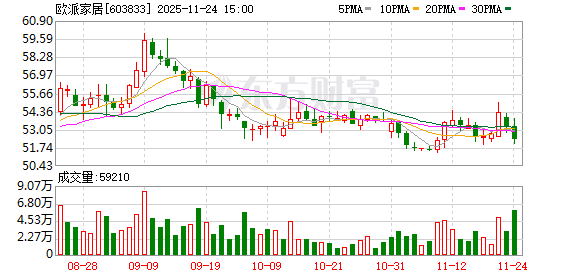
欧派家居涨2.01%,成交额1.26亿元,主力资金净流出188.02万元
Xin Lang Zheng Quan· 2025-11-25 05:46
Core Viewpoint - The stock price of Oppein Home has experienced a decline of 19.66% year-to-date, with a slight increase of 1.56% over the last five trading days, indicating volatility in its market performance [2]. Company Overview - Oppein Home was established on July 1, 1994, and went public on March 28, 2017. The company is based in Guangzhou, Guangdong Province, and specializes in personalized design, research and development, production, sales, installation, and interior decoration services for whole-home furniture products [2]. - The company's main business revenue composition includes: wardrobes and supporting furniture products (51.74%), cabinets (28.80%), wooden doors (6.00%), bathrooms (5.74%), and others (4.69%) [2]. Financial Performance - For the period from January to September 2025, Oppein Home reported operating revenue of 13.214 billion yuan, a year-on-year decrease of 4.79%, and a net profit attributable to shareholders of 1.832 billion yuan, down 9.77% year-on-year [2]. - Since its A-share listing, Oppein Home has distributed a total of 7.234 billion yuan in dividends, with 4.249 billion yuan distributed over the past three years [3]. Shareholder Information - As of September 30, 2025, the number of shareholders of Oppein Home was 20,700, a decrease of 1.78% from the previous period. The average number of circulating shares per person increased by 1.81% to 29,382 shares [2]. - The top ten circulating shareholders include Hong Kong Central Clearing Limited, which holds 11.1909 million shares (a decrease of 488,600 shares), and several new institutional shareholders such as ICBC Value Selection Mixed A and E Fund Yuxin Bond A [3].
渤海证券研究所晨会纪要(2025.11.25)-20251125
BOHAI SECURITIES· 2025-11-25 03:51
晨会纪要(2025/11/25) 编辑人 022-28451618 SAC NO:S1150511010016 cuijian@bhzq.com 崔健 渤海证券研究所晨会纪要(2025.11.25) 基金研究 ETF 简称迎统一规范,宽基指数获得资金净流入——公募基金周报 公司研究 传统主业稳健向前,复合集流体放量已在途——英联股份(002846)公司深 度报告 行业研究 人形机器人量产路线清晰,关注主要企业量产节奏——机械设备行业 2026 年 度投资策略报告 证 四季度服装出口预计向好,关注家居相关政策催化——轻工制造&纺织服饰 行业周报 券 研 究 报 告 晨 会 纪 要 请务必阅读正文之后的声明 渤海证券股份有限公司具备证券投资咨询业务资格 1 of 7 晨会纪要(2025/11/25) 基金研究 ETF 简称迎统一规范,宽基指数获得资金净流入——公募基金周报 宋 旸(证券分析师,SAC NO:S1150517100002) 张笑晨(证券分析师,SAC NO:S1150525070001) 1、本周市场回顾 上周统计区间为 2025 年 11 月 17 日至 2025 年 11 月 21 日,权益市场 ...
欧派家居再度获人民日报点赞!
Zhong Jin Zai Xian· 2025-11-25 03:05
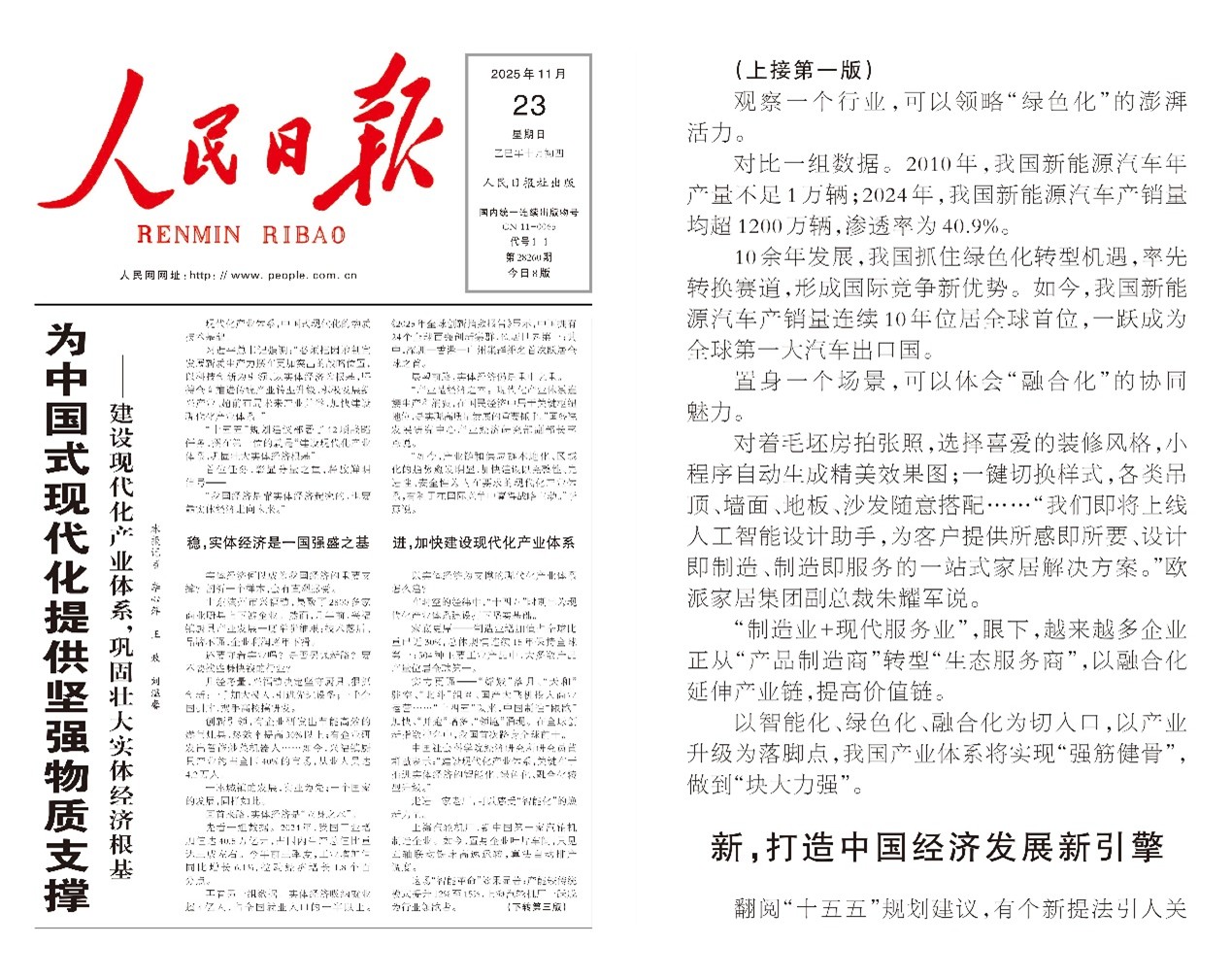
11月23日,人民目报重磅发布《为中国式现代化提供坚强物质支撑》专题报道,系统阐述建设现代化产 业体系的核心路径,并聚焦"智能化、绿色化"产业升级三大方向。其中,欧派家居作为"融合 化"发展的标杆企业被重点报道,其从"产品制造商"向"生态服务商"的战略转型,展现了企业在产业融 合与模式创新上的实践成果。 (上接第一版) 观察一个行业,可以领略"绿色化"的澎湃 活力。 对比一组数据。2010年,我国新能源汽车年 产量不足1万辆;2024年,我国新能源汽车产销量 均超 1200万辆,渗透率为 40.9%。 10余年发展,我国抓住绿色化转型机遇,率外 转换赛道,形成国际竞争新优势。如今,我国新能 源汽车产销量连续10年位居全球首位,一跃成为 全球第一大汽车出口国。 置身一个场景,可以体会"融合化"的协同 魅力。 对着毛坯房拍张照,选择喜爱的装修风格,小 程序自动生成精美效果图;一键切换样式,各类吊 顶、墙面、地板、沙发随意搭配 …… "我们即将上线 人工智能设计助手,为客户提供所感即所要、设计 即制造、制造即服务的一站式家居解决方案。"欧 派家居集团副总裁朱耀军说。 "制造业+现代服务业",眼下,越来越多企业 正从 ...

欧派家居:关于暂时调整募投项目部分闲置场地用途的进展公告
Zheng Quan Ri Bao· 2025-11-24 11:42
Core Viewpoint - The company has decided to temporarily adjust the use of part of its idle space in the "Oupai Home Intelligent Manufacturing (Wuhan) Project" by leasing it out to enhance resource allocation efficiency and overall asset yield [2] Summary by Sections Company Meetings - The company will hold the 31st meeting of the 4th Board of Directors and the 19th meeting of the 4th Supervisory Board on September 26 and October 13, 2025, respectively, along with the 4th temporary shareholders' meeting in 2025 [2] Lease Agreements - On November 22, 2025, the company signed property lease contracts with three companies: Jingmen Jiancheng Supply Chain Management Co., Ltd., Wuhan Dawei Xing Technology Co., Ltd., and Hubei Jiajia Plastic Products Co., Ltd. [2] - The total area of the leased factory space is 13,800 square meters, with a lease term of 12 months [2] - The breakdown of leased areas includes 6,500 square meters to Jingmen Jiancheng, 3,300 square meters to Dawei Xing, and 4,000 square meters to Jiajia Plastic [2]
欧派家居:拟出租1.38万平方米募投项目闲置厂房
Xin Lang Cai Jing· 2025-11-24 08:00
欧派家居公告称,公司拟将"欧派家居智能制造(武汉)项目"部分闲置场地对外出租。2025年,武汉欧 派与荆门建成、达伟兴、佳佳塑料签订《物业租赁合同》,出租厂房面积共1.38万平方米。荆门建成、 达伟兴、佳佳塑料承租面积分别为6500平方米、3300平方米、4000平方米。该事项经董事会、监事会及 股东会审议通过,不构成关联交易和重大资产重组,预计对财务状况有积极影响。 ...
欧派家居(603833) - 欧派家居关于暂时调整募投项目部分闲置场地用途的进展公告
2025-11-24 08:00
| 证券代码:603833 | 证券简称:欧派家居 | | 公告编号:2025-102 | | --- | --- | --- | --- | | 转债代码:113655 | 转债简称:欧 转债 | 22 | | 欧派家居集团股份有限公司 关于暂时调整募投项目部分闲置场地用途的进展公告 本公司董事会及全体董事保证本公告内容不存在任何虚假记载、误导性陈述或者重大遗漏, 并对其内容的真实性、准确性和完整性承担法律责任。 重要内容提示: ●本次交易对方与公司、出租方武汉欧派智能家居有限公司(以下简称"武汉欧派")均不 存在关联关系,本次交易不构成关联交易,亦不构成重大资产重组。 ●公司将严格遵循"保障生产经营稳定性"的原则,本次交易事项不会对公司正常经营产生 重大不利影响,通过将募投项目部分闲置场地对外出租,有助于提高场地利用效率,盘活存量 资产并增强整体运营效能,并能够获取相应的租金收益,对公司未来财务状况将产生一定的积 极影响。本次交易事项遵循公平、公正、公开的原则,定价公允合理,对外出租面积和出租期 限均在股东会审批的范围内,不存在损害公司及全体股东利益的情形。 一、交易情况概述 公司于 2025 年 9 月 ...
如何看待后续地产政策与产业链的投资机会?
2025-11-24 01:46
Summary of Conference Call Records Industry Overview - The conference call primarily discusses the real estate industry and its related sectors, including construction materials and banking. Key Points on Real Estate Industry - The real estate price decline cycle is categorized into small, medium, and large bubbles, each with different declines and durations [1] - Core city housing prices are under pressure due to pessimistic income or inflation expectations, as well as inverted rent-to-sale ratios and interest rates [1][4] - Valuation indicators like rent-to-sale ratios and price-to-income ratios are useful for identifying price turning points but typically lag behind actual price changes [2] - Loan interest subsidy policies can significantly impact the real estate market, with the coverage scope and duration being critical factors [5] - Improving income expectations is more crucial than the interest rates themselves for enhancing housing attractiveness [5] Challenges Facing the Real Estate Sector - The real estate industry is currently facing multiple challenges, including weakened transaction volumes, pressure from old and new inventory, and low income expectations [6] - New and second-hand housing transactions have declined, affecting related sectors like construction materials [6] - Quality leading companies are showing strong risk resistance and growth potential by increasing market share and optimizing their structures [6] Insights on Construction Materials Industry - Despite the ongoing downturn in the real estate market, some leading companies in the construction materials sector are showing signs of operational turning points [7] - Companies like Oriental Yuhong and Beixin Materials are expected to achieve year-on-year growth even if the real estate market continues to decline [7] - The waterproofing industry leaders are experiencing strong growth momentum, with market share increasing from 28% to 30-35% [7] Investment Opportunities in the Construction Sector - The construction industry is poised for new investment opportunities as the real estate market stabilizes and policy expectations strengthen [8] - Key players in the construction sector, such as China State Construction and China Railway Construction, are highlighted as significant investment targets [9] Banking Sector Insights - Banks are facing significant interest margin pressure, with asset yields continuing to decline [14] - Future policies may focus on alleviating pressure on banks and residents through loan interest subsidies [15] - The overall valuation of bank stocks is expected to recover, with attractive dividend yields [16] Home Furnishing Industry Analysis - The home furnishing industry shows strong investment value, particularly among leading companies with good cash flow [10] - Companies like Oppein and Gujia are expected to perform well, providing a safety net for investors [10][11] - The soft furniture segment is outperforming the custom furniture segment, benefiting from increased market share in the second-hand housing market [10] Conclusion - The real estate sector is currently under pressure but presents potential investment opportunities in leading companies within the construction materials and home furnishing industries. The banking sector is also expected to recover, providing attractive investment options.




为中国式现代化提供坚强物质支撑——建设现代化产业体系,巩固壮大实体经济根基
Ren Min Ri Bao· 2025-11-23 02:45
Core Viewpoint - The article emphasizes the importance of building a modern industrial system as the material and technological foundation for Chinese-style modernization, highlighting the need for innovation and the strengthening of the real economy [1][5]. Group 1: Importance of the Real Economy - The real economy is identified as the cornerstone of national strength, with a focus on its role in supporting economic growth and employment [3][4]. - In 2024, China's industrial added value reached 40.5 trillion yuan, accounting for about 30% of GDP, with a year-on-year growth of 6.1% in the first three quarters [4]. - The real economy employs over 400 million people, representing more than half of the national employment population [4]. Group 2: Modern Industrial System Construction - The construction of a modern industrial system is crucial for connecting production and consumption, serving as a key pivot in the national economy for achieving high-quality development [5][6]. - The manufacturing sector's added value accounts for nearly 30% of the global total, maintaining the world's largest scale for 15 consecutive years [7]. - The shift towards intelligent, green, and integrated transformations in the real economy is essential for building a modern industrial system [7][10]. Group 3: Emerging Pillar Industries - The article introduces the concept of emerging pillar industries, which combine characteristics of both emerging and pillar industries, playing a significant role in economic growth [12][16]. - By 2025, the added value of strategic emerging industries is expected to exceed 17% of GDP, an increase of approximately 5.3 percentage points from the end of the 13th Five-Year Plan [16]. - The development of new industries such as low-altitude economy is highlighted, with a projected market size of 1.5 trillion yuan in 2023, potentially reaching 3.5 trillion yuan by 2035 [18]. Group 4: Future Outlook - The article stresses the need to optimize traditional industries while proactively planning for future industries, which are seen as potential strategic emerging industries [19]. - The traditional industries currently account for about 80% of the added value in manufacturing, with an estimated market space of 10 trillion yuan to be added in the next five years [19]. - Strengthening the foundation of the real economy and accelerating the construction of a modern industrial system will lay a solid material foundation for Chinese-style modernization [19].
为中国式现代化提供坚强物质支撑——建设现代化产业体系 巩固壮大实体经济根基
Ren Min Ri Bao· 2025-11-22 22:04
Core Viewpoint - The construction of a modern industrial system is essential for China's economic development, emphasizing the importance of the real economy and technological innovation as foundational elements for future growth [1][5]. Group 1: Importance of the Real Economy - The real economy is highlighted as the cornerstone of national strength, with a focus on its role in supporting economic stability and growth [1][3]. - In Shandong's Bingzhou, the local kitchenware industry, which includes over 2,800 enterprises, has transformed through innovation and investment, now accounting for 40% of the national market [2][4]. Group 2: Current Economic Data - In 2024, China's industrial added value is projected to reach 40.5 trillion yuan, constituting about 30% of the GDP, with a year-on-year growth of 6.1% in the first three quarters of the current year [4]. - The real economy employs over 400 million people, representing more than half of the national employment population [4]. Group 3: Future Directions and Strategies - The modern industrial system is crucial for achieving high-quality development, with a focus on localizing and regionalizing industrial and supply chains [5][6]. - The "14th Five-Year Plan" has laid a solid foundation for building a modern industrial system, with China's manufacturing value added accounting for nearly 30% of the global total [6][7]. Group 4: Technological Advancements - The shift towards intelligent, green, and integrated transformations in the real economy is essential for enhancing competitiveness [7][10]. - The "smart revolution" in manufacturing has led to a 12% to 15% increase in productivity, exemplified by Shanghai's turbine manufacturing plant [8]. Group 5: Emerging Pillar Industries - The concept of "emerging pillar industries" combines characteristics of both emerging and traditional industries, playing a significant role in economic growth and technological advancement [12][17]. - By 2025, the added value of strategic emerging industries is expected to exceed 17% of GDP, indicating a substantial increase from previous years [18]. Group 6: Market Opportunities - The low-altitude economy is projected to reach a market size of 1.5 trillion yuan this year, with expectations of growing to 3.5 trillion yuan by 2035 [20]. - The traditional industries, which currently account for about 80% of manufacturing value added, are also expected to see significant market expansion, potentially adding around 10 trillion yuan in the next five years [21].