速腾聚创

Search documents
毛利率连年下滑 乐动机器人如何向港股讲新故事?
Zhong Guo Jing Ying Bao· 2025-12-26 19:30
Core Viewpoint - The surge in robot companies seeking to list in Hong Kong reflects a growing interest in the sector, with approximately 30 companies having submitted applications this year. Ledong Robotics, a leader in visual perception technology, is facing challenges with declining profit margins and is betting on smart lawn mowers as a new growth avenue [2][3]. Company Overview - Ledong Robotics is primarily focused on two business segments: visual perception products, which are expected to account for 94% of total revenue in 2024, and smart lawn mowers, projected to contribute 5% [2]. - The company provides critical perception and navigation solutions to robot manufacturers, with core products including various types of LiDAR and visual sensor modules [2]. Market Dynamics - The global smart robot market is projected to grow from 158.3 billion yuan in 2020 to 369 billion yuan in 2024, with a compound annual growth rate (CAGR) of 23.6%. The visual perception technology segment is expected to grow from 13.6 billion yuan in 2020 to 28.5 billion yuan in 2024 [3][4]. - Ledong Robotics holds a 1.6% market share in the highly fragmented visual perception market, with its products expected to be used in over 6 million smart robots by 2024 [4]. Financial Performance - Revenue for Ledong Robotics is projected to grow from 234 million yuan in 2022 to 467 million yuan in 2024, with a CAGR of 41.4%. However, net losses are also expected to decrease from 73.1 million yuan in 2022 to 56.5 million yuan in 2024 [4][5]. - The company's gross margin is declining, from 27.3% in 2022 to an anticipated 19.5% in 2024, attributed to a pricing strategy aimed at maintaining market share [4][5]. Competitive Landscape - The company faces increasing competition from major players entering the market with advanced technologies. For instance, Hesai Technology has significantly increased its LiDAR delivery volumes in the robot sector [5][6]. - Ledong Robotics' customer base includes seven of the top ten home service robot companies globally, but the revenue contribution from its largest customer has decreased from nearly 30% in 2022 to 15% in 2024 [6]. Growth Strategy - To counteract the pressures on its core business, Ledong Robotics is pursuing a dual strategy: reinforcing its technology in visual perception and investing in smart lawn mowers as a secondary growth line [7]. - The smart lawn mower market is expected to grow significantly, with projections indicating a market size reaching several billion dollars by 2029 [7][8]. Recent Developments - The new lawn mower business has shown rapid growth, with revenue expected to reach 23.3 million yuan in 2024 and 77.5 million yuan in the first half of 2025, with gross margins improving from 33.6% in 2024 to 45.6% in 2025 [8]. - However, this segment also faces challenges, including potential anti-dumping investigations by the EU that could impact competitiveness [8]. IPO and Future Plans - The upcoming IPO aims to raise funds for enhancing visual perception technology, expanding brand presence, optimizing production capacity, exploring investment opportunities, and supplementing working capital [10]. - The ability of Ledong Robotics to maintain its market share and successfully grow its lawn mower business will be critical for its future trajectory [10].


“激光雷达芯片第一案”白热化,速腾聚创与灵明光子针锋相对
Xin Lang Cai Jing· 2025-12-26 10:43
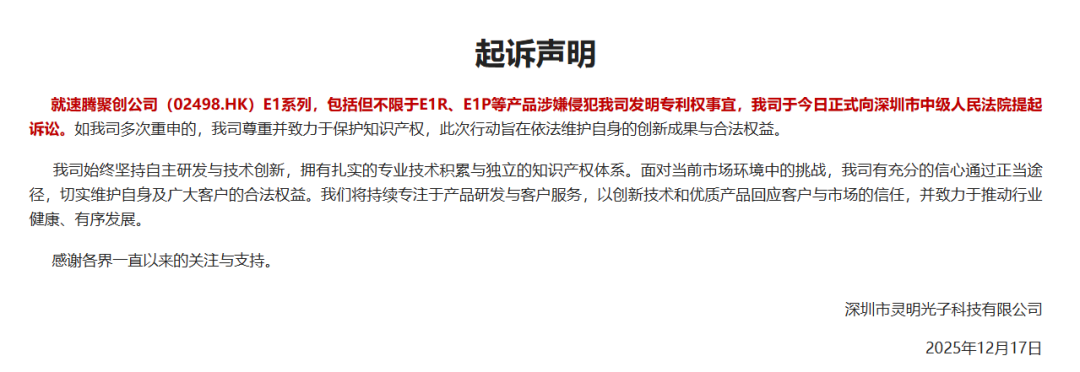
Core Viewpoint - The legal battle between Suoteng Juchuang and Lingming Photon over intellectual property rights in the lidar industry has intensified, focusing on the SPAD-SoC chip technology, which is considered the "digital heart" of lidar systems [1][3][22]. Group 1: Legal Dispute Overview - Suoteng Juchuang filed a lawsuit against Lingming Photon for alleged unfair competition and infringement of its self-developed SPAD chip technology [4][5]. - Lingming Photon countered by claiming that Suoteng Juchuang's E1 series products infringe on its invention patents and has initiated its own legal action [7][9]. - The dispute has escalated with both companies making strong statements and filing multiple lawsuits against each other, indicating a fierce legal confrontation [10][12]. Group 2: Background of the Companies - Suoteng Juchuang and Lingming Photon were once close partners, with Suoteng providing significant support to Lingming during its early days [14][15]. - Their collaboration aimed to develop SPAD-SoC technology, but it ended in early 2023 due to unsatisfactory trial performance of their joint development [16][19]. - Following the termination of their partnership, both companies quickly announced their respective technological advancements, raising suspicions about the sharing of proprietary information [21]. Group 3: Industry Context - The lidar industry is experiencing rapid growth, with the market size in China projected to reach approximately 431.8 billion yuan by 2026 [22]. - The competition has shifted towards chip technology, with companies recognizing the necessity of mastering core technologies to maintain a competitive edge [23][25]. - SPAD technology, particularly in the SPAD-SoC domain, is critical for lidar applications, and the successful mass production of such chips is seen as a significant achievement in the industry [24].
中国汽车智能化步入全新攻坚期
Zhong Guo Qing Nian Bao· 2025-12-24 22:15
Core Insights - The issuance of the first L3-level autonomous driving license plate "渝AD0001Z" to Changan Automobile marks a significant milestone in China's progress in the autonomous driving sector, reflecting the company's commitment to safety and innovation [2][3] - The approval of L3-level conditional autonomous driving products by the Ministry of Industry and Information Technology indicates a critical advancement in the management practices of strategic technologies in China, serving as a catalyst for the industry's intelligent transformation [2][3] Industry Developments - Changan Automobile has undergone seven iterations of technology since establishing its intelligent research and development team in 2009, showcasing its deep-rooted automotive manufacturing experience and successful transition to smart technology [3] - The penetration rate of L2-level advanced driver assistance systems (ADAS) in new passenger cars in China exceeded 60% in the first three quarters of this year, with expectations to rise to 90% by 2030, indicating a shift from technology validation to large-scale commercial application [3] Collaborative Innovation - The achievement of L3-level autonomous driving is attributed to collaborative innovation across the industry chain, with leading domestic brands and new car manufacturers investing heavily in intelligent driving as a core strategy [4] - Domestic chip companies have made significant breakthroughs in high-performance AI computing chips, reducing reliance on foreign suppliers and providing a "digital foundation" for China's smart vehicles [4] Data Advantage - The rapid proliferation of L2-level assistance driving has established a strong foundation for the advancement of higher-level intelligent driving, creating a unique data advantage through millions of smart connected vehicles operating in complex road environments [5] - This data-driven approach enhances the iterative capabilities of autonomous driving algorithms, making it difficult for other countries to replicate [5] Regulatory Framework - The approval of L3-level products does not equate to mass production, as it serves as a "permit" for specific models to conduct road tests under strict conditions, emphasizing safety and regulatory compliance [6][10] - The initial speed limit of 50 km/h for L3-level autonomous driving reflects a cautious approach to ensure safety during testing in complex urban traffic environments [7] Future Outlook - Achieving safe and rapid deployment of L3-level autonomous driving requires a collaborative effort from government, enterprises, research institutions, and society [9] - A clear and stable regulatory framework is essential to define the legal identity of L3 vehicles and clarify responsibilities in the event of accidents [10] - Continuous investment in technology and infrastructure, along with public trust and understanding of autonomous driving, will be crucial for the industry's long-term success [11]


智通港股解盘 | 晶圆涨价持续助推AI材料端 稀有资源镍矿集体走强
Zhi Tong Cai Jing· 2025-12-24 12:22
Market Overview - Hong Kong stocks rose by 0.17% on Christmas Eve, while A-shares showed strong performance as funds remained cautious ahead of the holiday [1] - The U.S. GDP for Q3 grew at an annualized rate of 4.3%, exceeding expectations and marking the fastest growth since Q3 2023, driven by strong consumer spending and a rebound in exports [1] - The U.S. plans to impose tariffs on semiconductor products imported from China, effective June 2027, as a response to China's ambitions in the chip industry [1] Semiconductor Industry - Semiconductor companies, including SMIC, have announced price increases of around 10% for 8-inch BCD process platforms due to high demand for power chips in AI servers [2] - TSMC is consolidating its 8-inch capacity and plans to shut down some production lines by the end of 2027, contributing to price increase expectations [2] - Companies like Samsung and SK Hynix have raised HBM3E prices by nearly 20% due to increased orders from major tech firms [3] Rare Resources and Nickel Market - The Indonesian Nickel Mining Association reported a significant reduction in nickel production targets for 2026, aiming to prevent further price declines, which has led to a rise in nickel-related stocks [3] - Companies such as LDK Resources and Xinjiang Xinjin Mining saw stock increases of nearly 9% following the news of reduced production targets [3] Dairy Industry - Domestic dairy processing capacity is expanding as imported dairy product price advantages diminish, benefiting upstream dairy farms [4] - Companies like Yurun Agriculture and Modern Dairy experienced stock increases of nearly 7% due to this trend [4] Robotics and Automation - Cloud Deep Technology has submitted an IPO application and holds a significant market share in the quadruped robot sector [5] - SUTENG announced advancements in robotic technology, showcasing capabilities in high-precision visual perception and flexible mechanical arm control [5] Currency and Paper Industry - The offshore RMB reached a high of 7.0129 against the USD, enhancing purchasing power for raw materials in the paper industry [7] - Companies like Nine Dragons Paper and Lee & Man Paper are expected to benefit from reduced procurement costs due to the strengthened RMB [7] Company Highlights - Tiangong International has achieved significant breakthroughs in high-end materials, positioning itself as a leader in the global tool steel market [8] - The company is focusing on import substitution in high-end materials, which is expected to drive future revenue growth [8] - The company is also advancing in high-nitrogen steel for humanoid robots, collaborating with domestic firms to enhance its product offerings [9]

格松科技完成亿元级新一轮融资,CEO蔡优飞曾任职速腾聚创、小鹏
Sou Hu Cai Jing· 2025-12-24 12:06
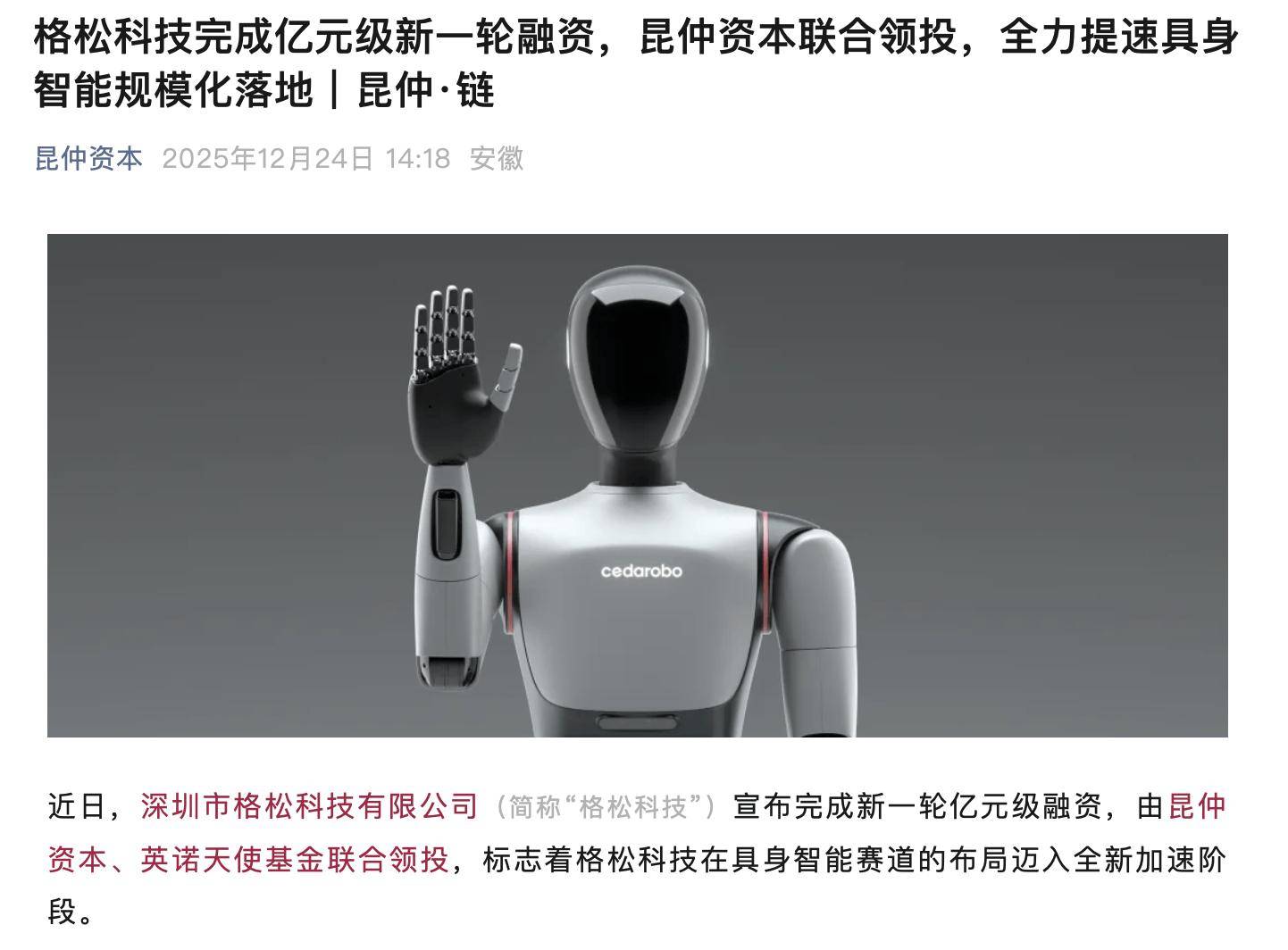
Core Insights - Gerson Technology officially became an independent entity in 2025, focusing on research and production in the field of embodied intelligence [3] - The company is committed to its core mission of "changing the world with robots and bringing robots into every household," with technological innovation as its primary development engine [3] - Gerson Technology aims to build an embodied intelligence industry ecosystem with a value exceeding 100 billion yuan [3] Company Overview - Gerson Technology is an innovative enterprise specializing in the research and mass production of embodied intelligence [3] - The CEO, Cai Youfei, has over 10 years of experience in the robotics industry and has led multiple consumer robot mass production projects [3] - Cai Youfei studied under the renowned robotics expert Xu Yangsheng and has held significant positions, including Vice President of R&D at Suton Juchuang and Product Director at Xiaopeng Ecological Enterprises [3]
预定CES 2026爆款:速腾聚创“手眼协同”黑科技提前解密
Zhi Tong Cai Jing· 2025-12-24 02:58
Group 1 - The core message of RoboSense's recent video release is the demonstration of its new "hand-eye coordination" solution, showcasing advanced environmental perception and precise operational capabilities through a series of robotic tasks [1] - The technology will be fully unveiled at CES 2026, highlighting its integration of high-precision visual perception and dexterous robotic arm control in unstructured dynamic environments [1] - The demonstration illustrates a closed-loop process of "perception-decision-execution," emphasizing the technology's strengths in real-time environmental understanding, trajectory planning, and fine manipulation [1] Group 2 - The hand-eye coordination solution is expected to integrate RoboSense's core self-developed technologies, including VLA, Active Camera, and dexterous hands, targeting applications in last-mile delivery, smart manufacturing, warehousing logistics, and commercial services [2] - As CES 2026 approaches, further technical details and application prospects are anticipated, indicating a strong focus on flexible automation operations [2]

预定CES 2026爆款:速腾聚创(02498)“手眼协同”黑科技提前解密
智通财经网· 2025-12-24 02:54
Core Insights - RoboSense has released a video showcasing its advanced "hand-eye coordination" solution, demonstrating a robot's ability to perform complex tasks such as receiving gifts from Santa, operating an elevator, and placing gifts on a Christmas tree, highlighting its environmental perception and precise operation capabilities [1][2] Group 1 - The video serves as a preview for RoboSense's new technology, which will be fully unveiled at CES 2026 [1] - The demonstration illustrates a closed-loop system of "perception-decision-execution" in unstructured dynamic environments, showcasing the integration of real-time environmental understanding, trajectory planning, and precise end-effector operations [1] - The core technologies involved include RoboSense's self-developed VLA, Active Camera, and dexterous hands, targeting applications in last-mile delivery, smart manufacturing, warehousing logistics, and commercial services [2]
跨越15%——从造车到造“未来”:汽车产业迎接“智融时代”
Shang Hai Zheng Quan Bao· 2025-12-23 19:06
Core Insights - The automotive industry is rapidly expanding beyond traditional vehicle manufacturing into new domains such as robotics and low-altitude aviation, driven by technological innovation and cross-industry collaboration [10][11][12] Group 1: Industry Trends - The automotive sector is witnessing a shift towards "intelligent integration," with companies exploring opportunities in embodied intelligence, low-altitude economy, and commercial aerospace [10][11] - The "14th Five-Year Plan" emphasizes the need for forward-looking strategies in emerging industries, indicating a significant transformation in the automotive landscape [10][11] - Companies like Chery and GAC are developing products such as the Argos robotic dog and GOVY AirCab flying car, showcasing the industry's commitment to innovation [10][11][12] Group 2: Technological Advancements - The Argos robotic dog features advanced capabilities, including 13 degrees of freedom and a maximum load of 5 kg, enabling it to navigate complex terrains and enhance safety management [11][12] - Horizon Robotics has captured a 9.4% market share in China's automotive intelligent driving chip market, indicating the growing importance of AI in the automotive sector [12] - The development of flying cars, such as the "陆地航母" by XPeng, represents a significant milestone in the integration of automotive and aerospace technologies [13][14] Group 3: Market Dynamics - The automotive industry's extensive supply chain and manufacturing capabilities are facilitating the transition into robotics and low-altitude aviation, creating new market opportunities [15][16] - The cost of key components, such as LiDAR, has significantly decreased due to automotive industry advancements, making them more accessible for robotics applications [19][20] - The emergence of new business models and investment strategies is reshaping the competitive landscape, with companies actively seeking to extend their industrial boundaries [21][22] Group 4: Future Outlook - The automotive industry is expected to evolve into a key player in the AI-driven economy, with companies increasingly emphasizing their AI capabilities [23][24] - The integration of vehicles into smart city ecosystems is anticipated to redefine the role of automobiles, transforming them into energy storage and computing units [27] - The future of the automotive sector is characterized by a focus on quality and global competitiveness, moving away from mere scale [26]
一夜蒸发540亿!这家全球市值第一的美国企业,为啥被所有人抛弃?
电动车公社· 2025-12-23 16:06
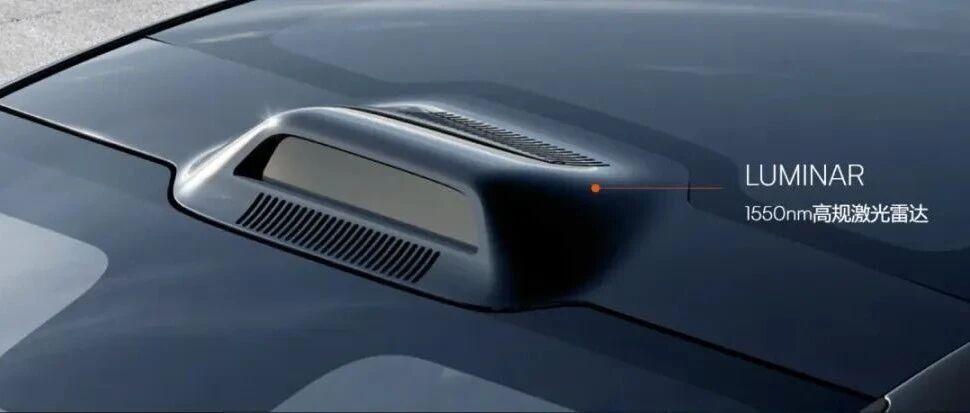
Core Viewpoint - The article discusses the rise and fall of Luminar, a prominent player in the lidar industry, highlighting its rapid growth, technological innovations, and eventual bankruptcy due to internal management issues and market competition [1][95]. Group 1: Company Overview - Luminar was founded in 2012 by Austin Russell, a prodigy who dropped out of college to pursue entrepreneurship in the lidar sector [13][28]. - The company initially gained significant attention and market share by innovating with a 1550nm wavelength lidar, which offered advantages in safety and performance over the traditional 905nm systems [34][38]. Group 2: Market Position and Performance - Luminar's market value peaked at over $5 billion in 2022, making it the most valuable lidar company globally at that time [9][11]. - The company successfully launched its second-generation lidar, Iris, which featured 300 lines and a detection range of up to 500 meters, priced around $500, making it competitive for mass production [51][52]. Group 3: Challenges and Decline - In late 2025, Luminar faced a catastrophic setback when Volvo canceled its partnership, which accounted for 90% of Luminar's revenue, leading to a rapid decline in stock value and eventual bankruptcy filing [59][62]. - Internal management issues, including the dismissal of CEO Austin Russell and disputes over contract obligations with Volvo, contributed to the company's downfall [65][63]. Group 4: Industry Context - The lidar market has seen a significant shift, with Chinese companies like Hesai and RoboSense capturing over 90% of the global market share, while American firms struggle to compete [98][99]. - The article emphasizes that technological superiority does not guarantee market success, as companies must adapt to market demands to survive [94].
阿里无人车的「阵痛史」:团队赛马、战略摇摆与整合困局
雷峰网· 2025-12-23 14:30
Core Viewpoint - The article discusses the evolution and challenges faced by Alibaba's autonomous vehicle initiatives, particularly focusing on the logistics sector, highlighting missed opportunities and internal conflicts that led to the decline of its autonomous vehicle projects [3][4][5]. Group 1: Industry Developments - The autonomous logistics vehicle sector has seen significant capital influx and operational advancements in 2023, with companies like New Stone Technology and NineSight completing substantial funding rounds, indicating a rebound after years of stagnation [3]. - NineSight is reportedly in talks to acquire Alibaba's logistics vehicle division, which could enhance its competitive position in the logistics market [3][4]. - The article notes that the autonomous vehicle sector in China is approaching a pivotal moment with several companies preparing for IPOs, marking a transition from a nascent stage to a more mature market [3]. Group 2: Alibaba's Internal Dynamics - Alibaba's autonomous vehicle efforts began with the establishment of the Cainiao ET Logistics Laboratory, which aimed to develop autonomous logistics vehicles but faced strategic misalignments and leadership changes that hindered progress [7][9]. - The dual approach within Alibaba, with the Cainiao ET Laboratory focusing on logistics and the Damo Academy's autonomous driving lab targeting passenger vehicles, led to resource duplication and inefficiencies [15][29]. - The merger of the Cainiao ET Laboratory into the Damo Academy's autonomous driving lab in 2020 was a significant turning point, consolidating efforts but also leading to internal conflicts and a loss of focus on logistics applications [30][36]. Group 3: Key Personnel and Leadership Changes - Key figures such as Zhang Chunhui and Chen Junbo played pivotal roles in the development of Alibaba's autonomous vehicle projects, with their departures marking critical moments in the decline of these initiatives [12][50]. - The leadership transition within the Damo Academy, particularly the appointment of Wang Gang and subsequent changes in strategic direction, contributed to the fragmentation of the autonomous vehicle team [25][41]. - The article highlights the contrasting management styles of Chen Junbo and Guo Zhenyu, which created friction within the team and ultimately affected project outcomes [47][49]. Group 4: Project Outcomes and Future Directions - The autonomous logistics vehicle "Xiaomanlv" achieved significant operational milestones, including reaching 1 million delivery orders, but faced challenges in scaling due to budget constraints and strategic misalignment [36][52]. - The ambitious plans for the "Dabanlv" project, aimed at developing autonomous heavy-duty trucks, were ultimately abandoned following key personnel exits, signaling a broader decline in Alibaba's autonomous vehicle ambitions [50][54]. - The article concludes with the integration of the Xiaomanlv project back into Cainiao, indicating a shift in focus towards logistics and a potential re-evaluation of Alibaba's strategy in the autonomous vehicle space [53][54].