三生制药

Search documents
久违爆发!港股通创新药ETF(520880)急速飙升4%!国家药监局:2025年我国创新药对外授权超1300亿美元
Xin Lang Cai Jing· 2026-01-05 02:33
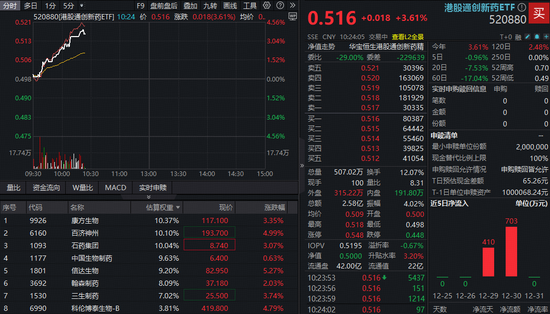
Core Viewpoint - The Hong Kong Stock Connect innovative drug sector experienced a significant rally, with leading stocks such as BeiGene and Innovent Biologics rising nearly 5% and over 5% respectively, indicating strong market interest in innovative pharmaceuticals [1][7]. Group 1: Market Performance - The Hong Kong Stock Connect innovative drug ETF (520880) opened with a continuous rise, peaking at over 4% increase, with a trading volume of 258 million yuan, surpassing the previous trading day's total [1][8]. - Major stocks in the innovative drug sector, including BeiGene, Innovent Biologics, and CSPC Pharmaceutical Group, saw increases of nearly 5% and over 3% respectively, reflecting a positive market sentiment [1][7]. Group 2: Regulatory and Market Developments - The National Medical Products Administration reported that 76 innovative drugs were approved for market in China in 2025, significantly exceeding the 48 approved in 2024, marking a historical high [1][10]. - The total value of authorized transactions for innovative drugs in China exceeded $130 billion in 2025, with over 150 transactions, also setting a new record [1][10]. Group 3: Investment Insights - Analysts from Zhongyou Securities suggest that the maturity of clinical data will be a key driver for the innovative drug market in 2026, with business development (BD) expected to enhance the competitiveness of domestic new drugs [3][10]. - The current period is viewed as an optimal configuration window for the Hong Kong Stock Connect innovative drug sector, following a three-month adjustment that began in September 2025 [3][10]. - The Hong Kong Stock Connect innovative drug ETF (520880) and its associated funds track the Hang Seng Hong Kong Stock Connect Innovative Drug Select Index, which boasts significant advantages such as comprehensive coverage of innovative drug companies and a high concentration of leading firms [3][10]. Group 4: ETF Composition - The top ten holdings in the Hong Kong Stock Connect innovative drug ETF account for over 72% of the total weight, highlighting the dominance of leading companies in the sector [4][11]. - Key constituents include BeiGene (11.51% weight), Innovent Biologics (10.19%), and China Biologic Products (9.47%), among others, indicating a strong representation of major players in the innovative drug market [4][11]. Group 5: Alternative Investment Options - For investors seeking exposure to innovative drugs while mitigating volatility, the unique A-share drug ETF (562050) is recommended, which focuses on the top 50 A-share pharmaceutical companies, balancing innovative drugs with traditional Chinese medicine [4][12].

港股周观点 | 一季度“开门红”有望延续
Xin Lang Cai Jing· 2026-01-04 15:00
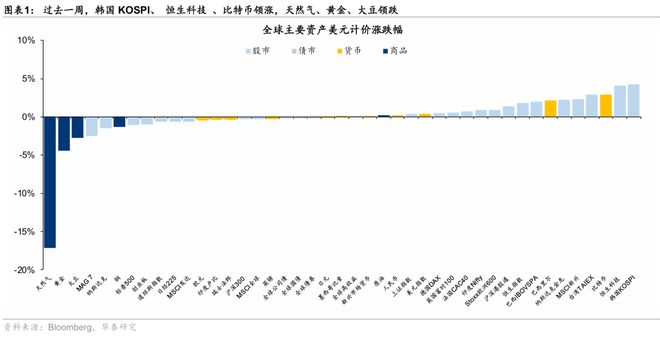
Group 1 - The Hong Kong stock market experienced a "good start" in 2026, driven by technology, with the Hang Seng Index rising by 2.0% and the Hang Seng Tech Index increasing by 4.3% [1][2] - The market's upward movement was primarily supported by overseas and local Hong Kong funds, as the A-share market was closed and southbound trading was inactive [1][2] - The IPO market's negative pressure on the secondary market is more of an amplifier in a weak market rather than a direct factor, with specific projects and industry conditions being more influential than the number of listings [1][2] Group 2 - The probability of successful investment in Hong Kong stocks has increased compared to November, with improved market sentiment and liquidity conditions [2][3] - The sentiment index for Hong Kong stocks dropped to 34.5, indicating a pessimistic range but closer to panic levels, suggesting a potential for recovery [2][3] - The first trading day of the year saw a significant increase in sentiment, with the index slightly recovering to 36 [2][3] Group 3 - A balanced allocation strategy is recommended, focusing on technology chains with strong performance expectations and cash flow assets [3] - The energy chain, particularly upstream resources like lithium and copper, is highlighted as a sector with favorable demand and valuation dynamics [3] - The travel chain is identified as a sector benefiting from domestic demand policies, with a focus on leading companies in hotels, airlines, and online travel agencies [3]
中国创新药大爆发,一年出海狂揽9400亿,超越美国
2 1 Shi Ji Jing Ji Bao Dao· 2026-01-04 12:52
Core Insights - China's innovative drug transaction value has surpassed that of the United States, indicating growing global recognition of domestic innovations [1][4] - The total transaction amount for outbound licensing of innovative drugs from China is projected to reach $135.655 billion by December 31, 2025, with a significant increase in both upfront payments and transaction numbers compared to 2024 [1][4] - The surge in outbound licensing reflects the international community's acknowledgment of the value of Chinese innovative drugs, driven by reforms in drug approval processes and supportive policies [1][4] Transaction Overview - In 2025, the total amount of outbound licensing transactions for innovative drugs from China exceeded $1,300 billion, with over 150 transactions, significantly surpassing the 2024 figures of $519 billion and 94 transactions [4][5] - The first transaction of 2025 involved Innovent Biologics partnering with Roche, receiving an upfront payment of $80 million and potential milestone payments of up to $1 billion [4] - Notable transactions include a record upfront payment of $1.25 billion from 3SBio to Pfizer for a global licensing agreement, and a total transaction amount exceeding $12 billion with GSK [5] Market Dynamics - The demand for Chinese innovative assets is expected to persist as multinational corporations (MNCs) face patent cliffs and cost-cutting pressures [8][9] - The global pharmaceutical supply chain is undergoing significant adjustments, with MNCs increasingly looking to China for early-stage innovative pipelines due to cost-effectiveness and potential superior outcomes [9][10] - The shift in business development (BD) models is evident, with a move towards co-development and co-commercialization agreements, allowing Chinese companies to play a more active role in global markets [10][11] Industry Trends - China's innovative drug pipeline accounts for approximately 30% of the global total, with significant achievements in key therapeutic areas such as PD-1/VEGF bispecific antibodies [8] - The industry is transitioning from a "fast-follower" to a "first-in-class" model, emphasizing the importance of clinical value and unmet medical needs [6][15] - The approval of 76 innovative drugs in 2025, with a high percentage being domestically developed, highlights the growing capabilities of Chinese pharmaceutical companies [5][6] Future Outlook - The innovative drug sector in China is expected to face challenges in maintaining the momentum of BD transactions, with concerns about sustainability and the potential for a slowdown in transaction values [14][15] - The focus for 2026 will likely shift towards solidifying clinical value and addressing unmet needs, particularly in oncology and autoimmune diseases [15][16] - The Chinese regulatory body plans to implement more measures to support the rapid development of innovative drugs, indicating a commitment to fostering industry growth [15][16]
中国创新药大爆发,一年出海狂揽9400亿,超越美国
21世纪经济报道· 2026-01-04 12:43
Core Viewpoint - China's innovative drug transaction value has surpassed that of the United States, indicating that domestic innovations are gradually gaining recognition in the global mainstream market [1][2]. Group 1: Transaction Data and Growth - By December 31, 2025, the total transaction amount for China's innovative drug business development (BD) overseas reached $135.655 billion (approximately 948.3 billion RMB), with an upfront payment of $7 billion and a total of 157 transactions, significantly exceeding the 2024 figures of $51.9 billion and 94 transactions [1][2]. - The total amount of overseas licensing for innovative drugs in China for 2025 is 2.5 times that of 2024 and 3.2 times that of the U.S. during the same period [2]. - The first transaction of 2025 involved Innovent Biologics partnering with Roche, receiving an upfront payment of $80 million and potential milestone payments of up to $1 billion [2]. Group 2: Notable Collaborations - In May 2025, 3SBio set a record for upfront payments in China by securing a global licensing agreement with Pfizer for $1.25 billion upfront and a total transaction value of $6 billion [3]. - Other significant collaborations include Heng Rui Medicine's partnership with GSK exceeding $12 billion and Innovent's collaboration with Takeda potentially reaching $11.4 billion [3]. Group 3: Industry Trends and Future Outlook - The surge in BD transactions is attributed to multinational corporations (MNCs) facing a "patent cliff" and cost-cutting pressures, increasing their demand for Chinese innovative assets [6][10]. - China's innovative drug pipeline accounts for approximately 30% of the global total, positioning the country as a significant player in key therapeutic areas such as PD-1/VEGF bispecific antibodies [6]. - The industry is transitioning from a "fast-follower" to a "first-in-class" or "best-in-class" model, emphasizing lean research and precise financing [4][10]. Group 4: Market Dynamics and Challenges - The global pharmaceutical supply chain is undergoing deep adjustments, and the valuation system is being restructured, presenting challenges for China's BD transactions [10]. - The industry is expected to face execution risks and potential disputes, with a consensus that while the BD boom will continue, the scale of transactions may not sustain the same explosive growth seen in 2025 [10][12]. - The focus for 2026 will shift towards solidifying clinical value and addressing unmet clinical needs, particularly in oncology and autoimmune disease sectors [10][12].

超越美国!中国创新药出海爆单,2025年交易超1300亿美元
2 1 Shi Ji Jing Ji Bao Dao· 2026-01-04 10:21
Core Insights - China's innovative drug transaction value has surpassed that of the United States, indicating a growing global recognition of domestic innovations [1][3] - The total transaction amount for outbound licensing of innovative drugs from China is projected to reach $135.655 billion by December 31, 2025, with a significant increase in both upfront payments and transaction numbers compared to 2024 [1][3] - The surge in outbound licensing reflects the international community's acknowledgment of the value of Chinese innovative drugs, driven by a series of reforms and policies encouraging innovation [1][4] Transaction Overview - In 2025, the total amount of outbound licensing transactions for Chinese innovative drugs exceeded $1,300 billion, accounting for 49% of the global total, significantly surpassing the $519 billion recorded in 2024 [3][4] - The first transaction of 2025 involved Innovent Biologics partnering with Roche, which included an upfront payment of $80 million and potential milestone payments of up to $1 billion [3] - Notable transactions include a record upfront payment of $1.25 billion from 3SBio to Pfizer for a global licensing agreement, highlighting the increasing scale of these deals [3][4] Market Dynamics - The demand for Chinese innovative assets is expected to persist as multinational corporations (MNCs) face patent cliffs and cost-cutting pressures [7][8] - The global pharmaceutical supply chain is undergoing significant adjustments, with a shift in focus towards collaborative development and commercialization models, such as the Co-Co model [9][10] - Chinese companies are increasingly recognized for their capabilities in developing innovative therapies, moving from being fast followers to first-in-class innovators [6][7] Future Outlook - The Chinese innovative drug sector is anticipated to experience a critical sales growth phase starting in 2026, transitioning from a focus on research and development to performance realization [5][6] - The industry is expected to face challenges in maintaining the momentum of high-value transactions, with a potential shift in focus towards clinical value and unmet medical needs [12][14] - Regulatory support from the National Medical Products Administration (NMPA) is expected to enhance the development of innovative drugs, particularly those with new mechanisms and targets [14]

新药周观点:2025年约101款创新药国内获批上市,行业蓬勃发展-20260104
Guotou Securities· 2026-01-04 08:17
Investment Rating - The report indicates a positive outlook for the biopharmaceutical industry, highlighting the approval of approximately 101 innovative drugs in 2025, marking a significant growth in the sector [3]. Core Insights - The innovative drug sector in China is experiencing robust growth, with 63 domestic innovative drugs (62% of total approvals) and 38 imported innovative drugs (38% of total approvals) approved in 2025 [3]. - The report suggests several companies to watch, including those with high certainty for overseas expansion and those with potential overseas data catalysts [2][20]. - The report emphasizes the importance of upcoming catalysts such as academic conferences and data releases that could impact the sector positively [2]. Summary by Sections Weekly New Drug Market Review - From December 29, 2025, to January 4, 2026, the top five gainers in the new drug sector were Youzhiyou (+12.45%), Aidi Pharmaceutical (+8.07%), Yongtai Biological (+6.72%), Kaituo Pharmaceutical (+6.25%), and Yahong Pharmaceutical (+4.07%). The top five losers were Jakes (+-15.53%), Yunding Xinyao (-15.06%), Kedi (-11.73%), Gelei Pharmaceutical (-8.64%), and Kangning Jere (-8.06%) [1][16]. Weekly Focused Stocks - The report recommends focusing on companies with MNC certification and high certainty for overseas volume, such as Sanofi Pharmaceutical, Lianbang Pharmaceutical, and Kelun Biotech. It also highlights companies with potential overseas data catalysts like Betta Pharmaceuticals and Hengrui Medicine [2][20]. Weekly New Drug Industry Analysis - The report notes that 2025 saw a record high in the number of approved innovative drugs in China, with a total of approximately 101 drugs approved by NMPA, excluding new indications, modified new drugs, biosimilars, traditional Chinese medicine, and vaccines [3][21]. Weekly New Drug Application Approval & Acceptance - No new drug or new indication applications were approved this week, but four new drug or new indication applications were accepted [4][27]. Weekly New Drug Clinical Application Approval & Acceptance - This week, 18 new drug clinical applications were approved, and 52 new drug clinical applications were accepted [5][30].
国泰海通医药2026年1月月报:景气延续,持续重点推荐创新药械产业链-20260104
GUOTAI HAITONG SECURITIES· 2026-01-04 05:37
Investment Rating - The report maintains an "Overweight" rating for the innovative pharmaceutical and medical device industry chain [4][8]. Core Viewpoints - The report continues to recommend the innovative pharmaceutical and medical device industry chain, highlighting a selection of A-share and H-share stocks with an "Overweight" rating [2][8][11]. - The performance of the pharmaceutical sector in December 2025 was weaker than the broader market, with the SW Pharmaceutical Biotechnology index declining by 4.1% compared to a 2.1% increase in the Shanghai Composite Index [18][30]. - The report notes that the premium level of the pharmaceutical sector relative to the entire A-share market is currently at a normal level, with a relative premium rate of 63.2% as of December 31, 2025 [29][32]. Summary by Sections A-Share Recommendations - The report lists the following A-share stocks with an "Overweight" rating: - 恒瑞医药 (Hengrui Medicine) - 科伦药业 (Kelun Pharmaceutical) - 华东医药 (East China Pharmaceutical) - 恩华药业 (Enhua Pharmaceutical) - 特宝生物 (Tebao Biological) - 京新药业 (Jingxin Pharmaceutical) - 益方生物 (Yifang Biological) - 药明康德 (WuXi AppTec) - 泰格医药 (Tigermed) - 乐普医疗 (Lepu Medical) - 联影医疗 (United Imaging) - 微电生理 (Microelectrophysiology) [8][9]. H-Share Recommendations - The report maintains an "Overweight" rating for the following H-share stocks: - 翰森制药 (Hansoh Pharmaceutical) - 三生制药 (3SBio) - 科伦博泰生物 (Kelun-Botai Biological) - 康方生物 (CanSino Biologics) - 映恩生物 (InnoCare Pharma) - 百济神州 (BeiGene) [11][12]. Performance Analysis - The report indicates that the 国泰海通医药 monthly portfolio outperformed the pharmaceutical index in December 2025, with an average decline of 1.8% compared to a 3.9% decline in the overall pharmaceutical index [14][15]. - The report highlights the best-performing stocks in December 2025, with 泰格医药 (Tigermed) increasing by 11.2%, 特宝生物 (Tebao Biological) by 7.5%, and 惠泰医疗 (Huitai Medical) by 3.9% [15][18].


2025年中国毛发医疗行业竞争格局分析 雍禾植发、三生曼迪等企业在细分领域领先【组图】
Qian Zhan Wang· 2026-01-04 04:13
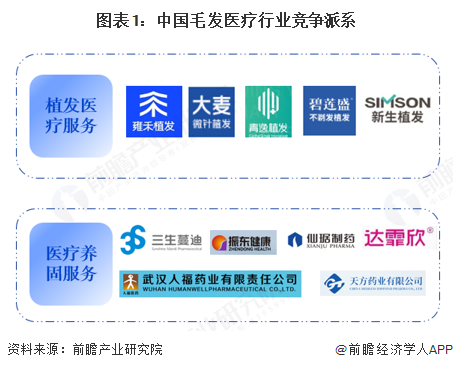
Core Insights - The article discusses the competitive landscape of the hair medical industry in China, highlighting key players and market dynamics [1][5]. Group 1: Competitive Landscape - The Chinese hair medical industry features various competitive factions, with companies like Yonghe Medical, Damaik, and Qingyi focusing on hair transplant medical services, while SanSheng Pharmaceutical, Zhendong Pharmaceutical, and Xianju Pharmaceutical are involved in medical nurturing services [1]. - In the hair transplant sector, the first tier consists of leading national chain brands such as Yonghe Medical, Bilian Sheng, and Damaik, which collectively hold a significant market share and possess nationwide direct chain layouts, mature technology systems, and strong brand recognition [1]. Group 2: Hair Growth Pharmaceuticals - In the hair growth pharmaceuticals market, the first tier includes SanSheng Pharmaceutical, Zhendong Pharmaceutical, and Merck, with the former two holding major shares in the minoxidil market, while Merck is recognized as the original manufacturer of finasteride [5]. - The second tier comprises Xianju Pharmaceutical, Kang En Bei, and Xiamen Meishang Pharmaceutical, which have accelerated the launch of minoxidil and finasteride products in recent years, gaining notable market recognition [5]. Group 3: Sales Performance - In the online pharmacy sector, Zhejiang SanSheng's minoxidil tincture product achieved sales exceeding 1 billion yuan, while Zhendong Anxin's minoxidil lotion surpassed 300 million yuan in sales, and SanSheng's minoxidil foam also exceeded 100 million yuan [9]. - In the offline market during the first quarter of 2025, Zhejiang SanSheng's minoxidil tincture and Zhendong Anxin's minoxidil lotion both recorded sales above 20 million yuan, with market shares of 50.61% and 38.82%, respectively [10]. - The sales ranking for minoxidil products shows Zhejiang SanSheng's minoxidil tincture leading with over 34 million yuan in sales (50.61% market share), followed by Zhendong Anxin's minoxidil lotion with over 26 million yuan (38.82% market share) [11].



跨国药企疯抢中国创新药
2 1 Shi Ji Jing Ji Bao Dao· 2026-01-02 06:37
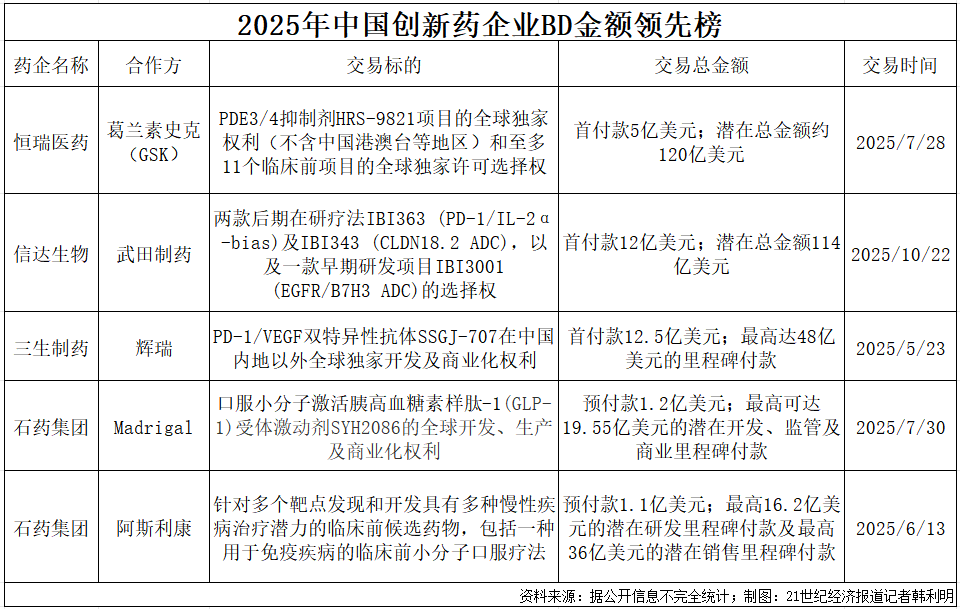
Core Insights - The BD (Business Development) sector in China's biotech industry has experienced unprecedented growth, with the total amount of domestic innovative drug licensing exceeding $100 billion by November 18, 2025, doubling compared to 2024 [1][5] - The strong performance of BD transactions reflects the increasing competitiveness and value of Chinese pharmaceutical assets globally, marking a critical period for the industry [1][2] - The focus is shifting from the quantity and value of signed agreements to the realization of product value post-agreement, influenced by factors such as global clinical progress and competitive landscape changes [1][2] Industry Trends - The compound annual growth rate (CAGR) for external BD by Chinese innovative drug companies is expected to decline over the next five years but will still maintain double-digit growth [2] - Future BD transactions will show two main characteristics: an increase in late-stage pipeline proportions and a shift from pure technology transfer to "licensing + joint development + commercialization participation" [2][9] Major Transactions - Significant BD deals in 2025 include: - A $5 billion upfront payment from GSK to Hengrui Medicine for the global exclusive rights to a PDE3/4 inhibitor project, with a potential total value of $12 billion [3] - A $12.5 billion upfront payment from Pfizer to 3SBio for a PD-1/VEGF bispecific antibody, with milestone payments potentially reaching $48 billion [3][5] - A $12 million upfront payment from Takeda to Innovent Biologics for a global strategic partnership, with a total potential value of $114 billion [3][10] Market Dynamics - The BD market is characterized by a growing interest from multinational corporations in early-stage innovative pipelines from China, driven by cost-effectiveness and potential efficacy [7] - The License-out model remains the dominant transaction mode, accounting for 91% of upfront payments and 99% of total amounts in related transactions in the first half of the year [9][10] Future Outlook - The next wave of BD opportunities is expected to arise from advancements in second-generation technologies, such as ADCs and CAR-T therapies, which are anticipated to meet unmet clinical needs [14][15] - The overall BD market is projected to continue its momentum into 2026, with a focus on high-quality pipelines and the potential for significant transactions [16][17]
跨国药企疯抢中国创新药
21世纪经济报道· 2026-01-02 06:29
Core Viewpoint - The article highlights the unprecedented surge in business development (BD) activities in China's biotech sector, with the total amount of domestic innovative drug licensing exceeding $100 billion by November 18, 2025, marking a doubling compared to 2024. This trend reflects the increasing global competitiveness and value of Chinese pharmaceutical assets, while also prompting a deeper examination of transaction quality and product value realization post-agreement [1][2]. Summary by Sections BD Market Dynamics - The BD market in China is experiencing a significant boom, with a projected compound annual growth rate (CAGR) for external BD activities expected to remain in double digits over the next five years, despite a forecasted decline in growth rate [2]. - Key characteristics of future transactions include an increase in late-stage pipeline contributions and a shift from pure technology transfer to models involving "licensing + co-development + commercialization" [2]. Major Transactions - Notable transactions in 2025 include: - Hengrui Medicine's collaboration with GSK, involving a total potential amount of approximately $120 billion, with an upfront payment of $500 million [3]. - Innovent Biologics' agreement with Takeda, with a potential total of $114 billion and an upfront payment of $1.2 billion [3]. - A record-setting deal between 3SBio and Pfizer, with an upfront payment of $12.5 billion and potential milestone payments reaching $48 billion [5][6]. Global Interest in Chinese Biotech - Chinese innovative drugs are gaining significant traction in global markets, with multinational corporations increasingly sourcing early-stage innovation pipelines from China due to cost-effectiveness and potential efficacy [7][8]. - The trend indicates a shift where Chinese biotech firms are evolving from technology providers to value co-creators in the global pharmaceutical landscape [7]. Transaction Models - The dominant transaction model remains "License-out," which accounted for 91% of upfront payments and 99% of total amounts in related transactions in the first half of the year [10]. - NewCo models are gaining popularity, allowing companies to inject parts of their product pipelines into newly formed entities with foreign capital, reflecting a flexible asset operation strategy [10][11]. Future Outlook - The BD market is expected to continue thriving, driven by the need for multinational companies to replenish their pipelines as many blockbuster drugs face patent expirations, creating a significant market opportunity [15]. - Emerging technologies, particularly in ADCs and bispecific antibodies, are anticipated to dominate future BD transactions, with a notable interest in metabolic and autoimmune products [16][17]. Challenges and Considerations - Despite the growth, challenges remain in ensuring compliance with international standards and protecting intellectual property during global collaborations [13]. - The market is expected to stabilize, with a rational return to expectations regarding BD transactions, as the industry matures and the focus shifts from explosive growth to sustainable value creation [17].