
海尔

Search documents
双丰韩柏:0.01℃控温精度背后的“黑科技”
Qi Lu Wan Bao· 2025-12-31 01:52
Core Viewpoint - Weihai Shuangfeng Hanbai Temperature Intelligent Control Co., Ltd. specializes in the research, production, and sales of temperature control devices, breaking foreign technology monopolies with its innovative products [1][3]. Group 1: Company Overview - The company produces key components for refrigerators, including temperature sensors, and has established long-term partnerships with major appliance manufacturers such as LG, Electrolux, Haier, Hisense, Gree, and others [3]. - The annual production capacity exceeds 30 million units, with products exported to Europe, Australia, and Southeast Asia [3]. Group 2: Product Innovation - The company has developed high-precision NTC temperature sensors that can achieve a measurement accuracy of ±0.01°C, surpassing the industry standard of ±0.05°C, enhancing product stability and energy efficiency [3][4]. - The high-precision intelligent defrosting temperature control CSJX system is essential for mid-to-high-end refrigerators, enabling automatic defrosting without manual intervention, which has contributed to a 10% reduction in domestic mid-to-high-end refrigerator prices [3]. Group 3: Research and Development - The company invests 5.5% of its sales revenue annually in R&D, supported by a team of 13 specialized technicians, leading to over 40 national patents and industry-leading innovation capabilities [4]. - Ongoing R&D includes segmented heating technology and applications for automotive seat heating, indicating a commitment to expanding its technological portfolio [6]. Group 4: Market Expansion - With the domestic market nearing saturation, the company plans to enter emerging markets in Southeast Asia and Eastern Europe, establishing local production bases to meet global brand demands [7]. - The company anticipates a 10% increase in annual output value compared to the previous year, with projections to exceed 100 million yuan in the next three years, supported by multiple new technologies under development [7].

周十条丨多地陶企宣布涨价、王宁担任居然之家董事长兼CEO、友邦吊顶筹划控制权变更……
Sou Hu Cai Jing· 2025-12-29 09:17
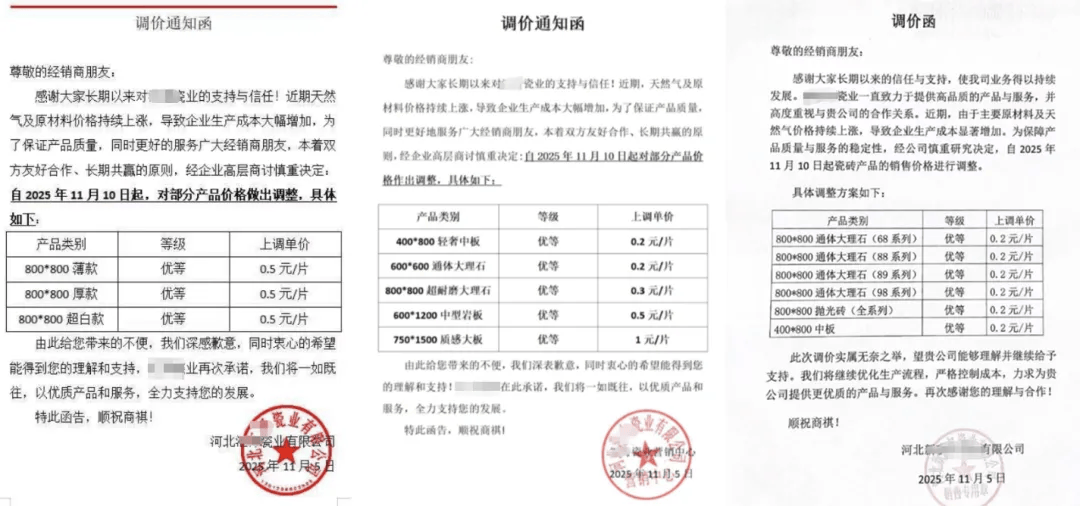
Price Increase in the Ceramics Industry - The ceramics industry is experiencing a wave of price increases as companies in Shandong, Hebei, Sichuan, Guangxi, and Chongqing announce price hikes for tiles and roofing products [1] - The primary reasons for the price increase are seasonal rises in energy costs, such as natural gas, and the upward trend in raw material costs, which are increasing production pressure on companies [1] - Additionally, some companies facing operational challenges have reduced or halted production, leading to a shift in supply and demand dynamics [1] Specific Price Adjustments - Various product categories have seen price adjustments, including: - 800*800 thin tiles: increased by 0.5 yuan per piece - 800*800 thick tiles: increased by 0.5 yuan per piece - 800*800 ultra-white tiles: increased by 0.5 yuan per piece - 400*800 luxury medium boards: increased by 0.2 yuan per piece - 600*600 full-body marble: increased by 0.2 yuan per piece - 800*800 ultra-wear-resistant marble: increased by 0.3 yuan per piece - 600*1200 medium-sized boards: increased by 0.5 yuan per piece - 750*1500 large boards: increased by 1 yuan per piece [3] - Additional adjustments include: - 800*800 full-body marble (68 series): increased by 0.2 yuan per piece - 800*800 full-body marble (88 series): increased by 0.2 yuan per piece - 800*800 full-body marble (89 series): increased by 0.2 yuan per piece - 800*800 full-body marble (98 series): increased by 0.2 yuan per piece - 800*800 polished tiles (entire series): increased by 0.2 yuan per piece - 400*800 medium boards: increased by 0.2 yuan per piece [4] Corporate Developments - Aoyuan Ceiling announced a suspension of trading due to plans for a change in control, which may lead to a change in the company's controlling shareholder [5] - Juran Home announced a board reshuffle, electing Wang Ning as the new chairman and CEO [8] - Bull Group is suing a competitor for 4.2 million yuan over misleading advertising claims [10] - Several home furnishing companies, including Gujia Home and Arrow Home, have announced guarantees for their subsidiaries, reflecting a trend of financial support as year-end funding needs rise [12] - Mona Lisa Group provided a guarantee of up to 100 million yuan for its wholly-owned subsidiary, indicating ongoing financial strategies to support business operations [18]


2025年全球彩电市场微跌 中国双雄进一步逼近三星
Di Yi Cai Jing· 2025-12-29 02:12
Group 1: Market Trends - The global TV market is expected to see a slight decline in shipments, with a projected total of 221 million units in 2025, down 0.7% year-on-year [1][2] - In contrast, leading Chinese companies TCL and Hisense are expected to increase their market shares, with TCL's shipments projected to reach 30.41 million units (up 5.4%) and Hisense's to 29.26 million units (up 1.4%) [1][2] - The market share of TCL is expected to grow to 13.8%, while Hisense's will reach 13.3%, narrowing the gap with Samsung [1] Group 2: Mini LED Opportunity - The Mini LED TV segment is anticipated to experience significant growth, with global shipments expected to rise by 57.8% to 12.39 million units in 2025, capturing a market share of 6% [2] - In China, Mini LED TV shipments are projected to surge by 92.7% to 8.02 million units, achieving a market share of 23.9% [2] - TCL and Hisense are capitalizing on this trend, with TCL's Mini LED TV shipments increasing by 153.3% and Hisense's by over 76% in the first three quarters of the year [3] Group 3: Competitive Landscape - Samsung's global TV shipments are expected to remain flat at 35.27 million units in 2025, with a minimal market share increase of 0.1% [3] - The competitive advantage of Samsung over Chinese brands is diminishing, as evidenced by Hisense's introduction of RGB-Mini LED TVs, prompting responses from other major brands [3] - Chinese brands are gaining ground in the global market, with TCL, Hisense, Xiaomi, and others occupying multiple spots in the top ten global TV manufacturers [6] Group 4: Supply Chain and Market Strategy - The changing tariff policies are impacting manufacturing bases in China and Southeast Asia, affecting retail prices and consumer demand [4] - TCL and Hisense are expanding their presence in emerging markets like Southeast Asia and Latin America while leveraging local production capabilities to mitigate tariff impacts [4][5] - TCL's average TV selling price in North America has increased by over 15%, with significant growth in larger TV segments [5] Group 5: Future Outlook - The year 2026 is expected to drive TV demand due to major sporting events, with TCL and Hisense sponsoring the 2026 Milan Winter Olympics and World Cup [7] - The RGB-Mini LED TV segment is projected to expand, with anticipated shipments reaching 500,000 units in 2026 [7] - Chinese leading companies are expected to challenge for the top global TV sales position within three years, focusing on core technology and supply chain resilience [7]
年终盘点|2025年全球彩电市场微跌,中国双雄进一步逼近三星
Di Yi Cai Jing· 2025-12-28 02:36
Core Insights - The market share gap between TCL, Hisense, and Samsung in the global TV market has narrowed to 2.2 and 2.7 percentage points respectively [1] Group 1: Market Trends - Despite a slight decline in overall global TV sales, leading Chinese companies are gaining market share, with TCL and Hisense approaching Samsung's dominance [4] - Global TV shipment volume is projected to decrease by 0.7% to 221 million units in 2025, while TCL's shipments are expected to grow by 5.4% to 30.41 million units, increasing its market share to 13.8% [4] - Hisense is projected to ship 29.26 million units in 2025, a 1.4% increase, raising its market share to 13.3% [4] Group 2: Mini LED Opportunity - The global TV market is under pressure, but there is significant growth potential in Mini LED TVs, with shipments expected to rise by 57.8% to 12.39 million units globally in 2025 [5] - In China, Mini LED TV shipments are projected to surge by 92.7% to 8.02 million units, capturing a market share of 23.9% [5] - TCL and Hisense are capitalizing on this opportunity, with TCL's Mini LED TV shipments increasing by 153.3% to 2.24 million units in the first three quarters of the year [6] Group 3: Competitive Landscape - Samsung's global TV shipment volume is expected to remain stable at 35.27 million units in 2025, with a slight market share increase of 0.1% to 16% [6] - The competitive advantage of Samsung over Chinese brands is diminishing, as Hisense is set to launch RGB-Mini LED TVs, prompting responses from Samsung and Sony [6] - Chinese brands are increasingly challenging the dominance of Korean brands in the high-end TV market, particularly with the rise of Mini LED technology [6] Group 4: Supply Chain and Market Expansion - Changing tariff policies are impacting manufacturing bases in China and Southeast Asia, affecting retail prices and consumer demand [7] - TCL and Hisense are expanding their market presence in North America and Europe while leveraging production capabilities in Vietnam, Brazil, and Mexico to mitigate tariff impacts [7] - Hisense is enhancing its localized operations and expanding production capacity in Vietnam to target Southeast Asia and the EU markets [8] Group 5: Brand Performance - Chinese brands like TCL, Hisense, Xiaomi, and others are gaining market share, while Japanese brands like LG and Sony are experiencing declines [9] - TCL and Hisense are positioned to challenge for the top global TV sales spot within three years, driven by technological advancements and market strategies [11] - The upcoming 2026 sports events, including the World Cup and Winter Olympics, are expected to boost TV demand, with TCL and Hisense sponsoring these events [10]
立德教育(01449.HK):黑龙江工商学院订立售后回租合同(海尔)及谘询服务合同(海尔)
Ge Long Hui· 2025-12-18 10:20
Core Viewpoint - The announcement by Lide Education (01449.HK) regarding a sale and leaseback agreement with Haier for assets valued at RMB 20 million, with total lease payments amounting to RMB 21.9781 million, aims to secure financial resources for the construction of the group's campus and general operational funding without affecting its operations [1] Group 1 - The sale and leaseback contract with Haier is set for December 18, 2025, involving a sale price of RMB 20 million and total lease payments of RMB 21.9781 million [1] - The financing lease arrangement allows the group to obtain financial resources while maintaining operational continuity, as the leased assets will be immediately leased back to the group [1] - The arrangement does not transfer ownership or usage rights of the assets to Haier, and according to international financial reporting standards, it does not constitute an asset sale, thus no gains or losses will be recorded in the group's income statement [1]
立德教育(01449):黑龙江工商学院与海尔就售后回租租赁资产(海尔)订立售后回租合同(海尔)及咨询服务合同(海尔)
智通财经网· 2025-12-18 10:20
Core Viewpoint - The announcement by Lide Education (01449) regarding a sale and leaseback agreement with Haier for assets valued at RMB 20 million and total lease payments of RMB 21.9781 million highlights a strategic move to secure financial resources for campus construction and operational needs without affecting current operations [1] Group 1: Financial Arrangement - The sale and leaseback contract involves various assets including computers, projectors, audio equipment, multimedia devices, blackboards, network switches, routers, books, water dispensers, and sofas [1] - The financing lease arrangement allows the company to obtain financial resources while maintaining operational continuity, as the assets will be immediately leased back to the company [1] - The arrangement does not transfer ownership or usage rights of the assets to Haier, and according to international financial reporting standards, it does not constitute an asset sale, thus no gains or losses will be recorded in the company's income statement [1] Group 2: Accounting Treatment - At the end of the lease term, the company will pay a nominal retention fee to reclaim the leased assets, making the arrangement similar to borrowing against a secured loan in both practical and accounting terms [1]
立德教育:黑龙江工商学院与海尔就售后回租租赁资产(海尔)订立售后回租合同(海尔)及咨询服务合同(海尔)
智通财经网· 2025-12-18 10:19
Core Viewpoint - The announcement by Lide Education (01449) regarding a sale and leaseback agreement with Haier for assets valued at RMB 20 million and total lease payments of RMB 21.9781 million highlights a strategic move to secure financial resources for campus construction and operational needs without affecting current operations [1] Group 1: Financial Arrangement - The sale and leaseback contract involves various assets including computers, projectors, audio equipment, multimedia devices, blackboards, network switches, routers, books, water dispensers, and sofas [1] - The financing lease arrangement allows the company to obtain financial resources while maintaining operational continuity, as the assets will be immediately leased back to the company [1] - The arrangement does not transfer ownership or usage rights of the assets to Haier, and according to international financial reporting standards, it does not constitute an asset sale, thus no gains or losses will be recorded in the company's income statement [1] Group 2: Accounting Treatment - At the end of the lease term, the company will pay a nominal retention fee to reclaim the leased assets, making the arrangement similar to a secured loan from an accounting perspective [1]
摩洛哥跑步进入“黄金五年”,中国企业海外淘金涌入北非明珠
Hua Xia Shi Bao· 2025-12-18 09:45
Group 1 - Morocco is positioning itself as a prime investment destination, especially for Chinese companies, due to its unique geographical advantages and upcoming major events like the 2026 Africa Cup and the 2030 World Cup, which are expected to create a "golden five years" of development opportunities [2][5][7] - The Moroccan government has invested over $8 billion in infrastructure over the past decade, enhancing the investment environment and making it attractive for foreign investors [5][7] - The new Investment Charter offers targeted and attractive subsidy schemes, including a 17.5% preferential tax rate for companies registered in specific areas, and significant tax exemptions for companies in industrial acceleration zones [13][14] Group 2 - Morocco's economy is projected to grow at an average rate of 2.5% from 2015 to 2024, with an expected increase to 4.0% in 2025, enhancing its appeal as an investment destination [7][10] - The country has signed free trade agreements with 56 countries, allowing products to bypass trade barriers and directly access both African and European markets [10][12] - The automotive industry is a key sector, with Morocco becoming Africa's largest vehicle manufacturer and the leading exporter of cars to the EU, supported by companies like Renault and Chinese firms such as CITIC Dicastal [16][19] Group 3 - The renewable energy sector, particularly in electric vehicle battery production, is highlighted as a significant opportunity, with Morocco possessing vast phosphate reserves essential for lithium iron phosphate batteries [16][19] - The establishment of industrial zones like the Tangier Tech City, which is a collaboration between Chinese companies and the Moroccan government, aims to attract more Chinese enterprises in sectors such as automotive, textiles, and renewable energy [19][20] - The presence of Chinese companies in Morocco is growing, with numerous firms already operating in various sectors, indicating a strong bilateral economic relationship [17][19]

有色钢铁行业周观点(2025年第50周):看好产业逻辑支撑的金铜铝持续上行-20251215
Orient Securities· 2025-12-15 05:41
Investment Rating - The report maintains a "Positive" investment rating for the non-ferrous and steel industries [9]. Core Viewpoints - The report emphasizes the sustained upward trend of copper, gold, and aluminum driven by industrial logic, despite uncertainties regarding future interest rate cuts by the Federal Reserve [9][14]. - It suggests that the primary driver for non-ferrous metal pricing will shift from interest rate expectations to industrial demand growth, presenting ongoing investment opportunities [9][14]. - The report highlights the potential for gold prices to rise due to increased liquidity from the Federal Reserve's asset purchase program, which may weaken the dollar's credit [9][14]. - It notes that tight supply conditions are expected to support copper prices in the medium term, with significant inventory shortages in non-American regions [9][15]. - The aluminum sector is poised to benefit from the accelerated industrialization of aluminum as a substitute for copper in air conditioning systems, driven by rising copper prices [9][15]. Summary by Sections Non-Ferrous Metals - The report anticipates a super cycle for industrial metals, particularly copper, gold, and aluminum, supported by strong industrial demand [9][14]. - It recommends focusing on investment opportunities in the gold sector, particularly companies with improving production metrics [9][14]. - For copper, it highlights companies with significant resource reserves and ongoing production expansion as attractive investment targets [9][15]. Steel Industry - The steel sector is experiencing weak supply-demand fundamentals during the off-season, leading to pressure on steel profitability [16][20]. - Weekly rebar consumption has decreased significantly, with a 6.40% decline compared to the previous week and a 14.55% drop year-on-year [20]. - Steel prices have shown a slight overall decline, with the average price index for common steel dropping by 1.14% [32][33]. New Energy Metals - Lithium carbonate production in October 2025 saw a substantial year-on-year increase of 67.28%, indicating strong supply growth [37]. - The demand for new energy vehicles remains robust, with significant year-on-year growth in production and sales [41]. - Prices for lithium and cobalt have risen, reflecting increased demand and supply constraints in the market [46][48].




日企在华布局的“进与退”
Jing Ji Guan Cha Wang· 2025-12-12 07:28
Core Insights - Japanese brands are strategically adjusting their presence in the Chinese market, with notable exits from various sectors while simultaneously increasing investments in high-tech industries [1][12]. Group 1: Market Exit and Shrinking Presence - Sony's Xperia mobile business announced its exit from the Chinese market in November 2025, while Sharp has removed several mobile products this year [1][2]. - Mitsubishi Motors officially ceased production and sales in China at the beginning of 2025, closing its joint venture factory in Changsha, Hunan [1][3]. - Japanese automotive brands have seen their market share in China drop to 10.8%, a decline of over 50% from peak levels, while Chinese brands surged to 58.3% [2]. - In the home appliance sector, Japanese brands collectively hold less than 8% of the market, with Haier and Midea dominating at 72% [2]. Group 2: Strategic Investment in High-Tech Industries - Despite the market exits, Japanese investment in China increased by 55.5% in the first nine months of 2025, with a focus on high-tech manufacturing and energy-saving sectors [1][12]. - Japanese companies are investing in digital AI, industrial IoT, and biomedicine, collaborating with Chinese firms to develop innovative solutions [12]. - Panasonic is shifting its focus from low-end consumer appliances to high-end care appliances and commercial equipment, closing several production lines for low-end products [4]. Group 3: Challenges and Market Dynamics - Japanese brands have struggled to adapt to changing consumer preferences in China, leading to a misalignment with local market demands [9][10]. - The perception of Japanese products has shifted, with consumers becoming more price-sensitive and less reliant on the "import halo" [9]. - Japanese companies face high labor costs and lengthy decision-making processes, putting them at a disadvantage in competitive price wars [11]. Group 4: Future Outlook and Strategic Realignment - Japanese firms are not entirely retreating but are instead selectively withdrawing from low-end manufacturing while investing in emerging industries [12][13]. - The focus on high-quality products and advanced manufacturing indicates a strategic realignment to maintain competitiveness in the evolving market landscape [12][13].