Mobileye

Search documents
20万和10万表现一个样?这项功能真能成为“新时代自动挡”?
电动车公社· 2025-12-27 16:23
Core Viewpoint - The article discusses the strategic shift of Horizon Robotics from being primarily an autonomous driving chip supplier to expanding into the robotics sector, highlighting its recent developments and future ambitions in both fields [7][9][20]. Group 1: Company Background and Developments - Horizon Robotics has successfully transitioned from focusing solely on autonomous driving to also developing robotics technologies, maintaining a dedicated robotics division throughout its journey [11][12]. - The company has achieved significant milestones in the automotive sector, becoming the leading supplier of ADAS (Advanced Driver Assistance Systems) in China by 2024, surpassing Mobileye [14][28]. - The launch of the Journey 6 series chips marks a pivotal moment for Horizon, enabling it to expand into higher-level autonomous driving markets and significantly increasing its product shipment volume [21][25][26]. Group 2: Robotics and AI Integration - Horizon Robotics has introduced the "Diguo Robot" and its latest chip offerings, which support a wide range of robotic applications, including humanoid robots and service robots [19]. - The company aims to position itself as a foundational platform for the robotics era, similar to "Wintel" in the computing world, by leveraging its advancements in autonomous driving technology to enhance robotic capabilities [39]. - The integration of autonomous driving models into robotics is seen as a key strategy, with the belief that success in autonomous driving is crucial for establishing a foothold in the robotics market [41]. Group 3: Future Outlook and Market Trends - The article emphasizes the importance of the Journey 6 series chips in facilitating the transition to a new era of robotics and autonomous driving, with expectations for rapid advancements in technology and deployment [46][49]. - Horizon Robotics is committed to significantly increasing computational power and model capacity with each new generation of chips, aiming for a tenfold improvement [47]. - The company anticipates that the widespread adoption of advanced driver assistance systems will mirror the historical transition from manual to automatic transmissions in vehicles, making such technologies accessible to a broader consumer base [55][63].

地平线机器人_花旗 2025 中国峰会新动态_2026 年展望
花旗· 2025-11-24 01:46
Investment Rating - The investment rating for Horizon Robotics is "Buy" with a high risk designation [7]. Core Insights - Horizon Robotics expects significant growth in shipments for 2026, projecting high-end shipments between 300,000 to 500,000 units, mid-end shipments around 3 million units, and low-end shipments approximately 2 million units. Key contributors to high-end shipments are anticipated to be Chery and Chang'an, accounting for 50% of the total [1][2]. - The company maintains its guidance to ship 4 million units of automotive-grade processing hardware in 2025, with mid-to-high end products making up 50% of this total [2]. - Horizon Robotics has secured design wins for its high-end ADAS solution from Chery and Chang'an, with mass production of the first models expected in the second half of 2025 [3]. - The average selling price (ASP) for various products is detailed as follows: HSD (J6P) at US$700, HSD (dual J6M) at US$400, mid-end ADAS at US$90-100, and low-end ADAS at US$20-30 [4]. - The gross margin for the J6P chip is around 50%, while the software component has a gross margin close to 100% [5]. - Horizon Robotics has established collaborations with overseas tier-1 suppliers such as Bosch, Continental, and Denso to enhance its competitiveness in international markets [5]. - The company aims to increase its market share with BYD's God's Eye C solution in 2026 and plans to explore additional solutions [9]. - Horizon Robotics believes its HSD offers a competitive edge over Huawei's ADAS solution due to its high value for money, making it suitable for mass-market models [10]. - The deployment of HSD is expected to facilitate the development of Robotaxi systems, with a partnership announced with Hello Inc. in September 2025 [11]. - The valuation of Horizon Robotics is based on projected strong growth in the ADAS market from 2025 to 2030, with a target price set at HK$12.30, reflecting a potential return of 49.1% [12].

黑芝麻智能(02533.HK):物理AI芯片黑马 迎来产品与客户双拐点
Ge Long Hui· 2025-10-28 19:28
Core Viewpoint - The automotive industry is experiencing a significant transformation driven by advancements in intelligent driving technology, with a notable increase in demand for mid-to-high-end SoC chips expected by 2025 [1][2]. Industry Summary - The intelligent driving technology is evolving through a dual approach of upward breakthroughs and downward popularization, with a clear iterative path emerging [1]. - The market for ADAS SoC chips is projected to reach 496 billion CNY in China and 925 billion CNY globally by 2028, with a compound annual growth rate (CAGR) of 28.6% and 27.5% from 2023 to 2028, indicating a high market demand [1]. - The push for "intelligent driving equality" among domestic OEMs is leading to a price war, with mainstream brands focusing on models priced below 200,000 CNY, which may open up the mid-to-high-end chip market [1]. Company Summary - Long-term prospects suggest that only leading automakers will develop their own chips, while third-party chip manufacturers may see greater market opportunities than expected [2]. - The pursuit of full-stack self-research in intelligent driving reflects a desire for efficient data processing, supply chain security, and cost reduction in intelligent driving solutions [2]. - The competitive landscape for different levels of intelligent driving solutions will be determined by factors such as cost efficiency, supplier support, and the strategic choices of companies in their self-research journeys [2]. - Black Sesame Intelligence's competitive position in the SoC ecosystem is relatively weak, but the company has strong hardware capabilities and is forming alliances to enhance its algorithmic capabilities [2]. - The management team has a forward-looking approach, with strategic plans in cross-domain computing chips and robotics, which may become a second growth driver for the company [2]. - As of the end of H1 2025, the company had a net cash position of 1.97 billion CNY, providing a solid foundation for ongoing product development and exploration of new business scenarios [2]. Financial Forecast - Revenue projections for the company from 2025 to 2027 are 850 million CNY, 1.616 billion CNY, and 2.344 billion CNY, with year-on-year growth rates of 79.23%, 90.12%, and 45.05% respectively [3]. - The company is currently in a phase of high R&D investment and customer expansion, making it difficult to achieve profitability in the short term [3]. - A price-to-sales (PS) valuation method is used for the company, with comparable companies showing an average PS of approximately 17.8x for 2025 [3]. - The company is rated as a "buy" due to its complete product ecosystem and the potential for key customer breakthroughs to drive long-term growth [3].

Is Intel Back?
Yahoo Finance· 2025-10-27 12:15
Core Viewpoint - Intel has shown signs of recovery with better-than-expected third-quarter results, although revenue growth remains weak, indicating low market expectations [2]. Financial Performance - Revenue increased by 3% to $13.7 billion, surpassing the consensus estimate of $13.14 billion [2]. - Adjusted gross margin improved significantly by 22 percentage points to 40%, driven by a favorable product mix, reduced inventory reserves, and increased revenue [3]. - Operating margin rose by 29 percentage points to 11.2%, aided by a reduction in research and development and general and administrative expenses from $4.8 billion to $3.9 billion [3]. - Adjusted earnings per share reached $0.23, a turnaround from a loss of $0.46 per share in the same quarter last year [3]. Strategic Changes - CEO Lip-Bu Tan has focused on strengthening the balance sheet, raising $12.9 billion through various stake sales, including to the federal government, Nvidia, and Softbank [4]. - The company repaid $4.3 billion in debt and added $20 billion in net assets since the beginning of the year, reflecting the success of these initiatives [4]. - Intel has undergone significant restructuring, including job cuts and management refreshment, to foster an engineering-first mindset [6]. Future Outlook - For the fourth quarter, Intel anticipates revenue between $12.8 billion and $13.8 billion, representing a 3% sequential decline and a 6.3% year-over-year decline [7]. - Despite efforts to streamline operations, Intel continues to face growth challenges compared to competitors like Nvidia, AMD, and Arm, which are capitalizing on the AI boom [7].

Ouster vs. Innoviz: Which LiDAR Powerhouse is a Safer Bet?
ZACKS· 2025-10-24 17:51
Industry Overview - LiDAR technology is gaining traction in the automotive sector, particularly in premium vehicles and robotaxis, due to its capabilities in 3D mapping and object detection, enhancing advanced driver-assistance systems (ADAS) and autonomous driving applications [1][2] - The market for LiDAR is projected to reach a $19 billion addressable market by 2030, indicating significant growth potential [5] Company Analysis: Ouster, Inc. (OUST) - Ouster is positioned to capitalize on the increasing adoption of LiDAR across various sectors, including automotive, industrial, robotics, and smart infrastructure [4] - The 2023 merger with Velodyne has expanded Ouster's product lineup and customer base, with a target of achieving over $75 million in annual cost synergies [4] - The company is transitioning from hardware sales to software-driven solutions, aiming for recurring revenue through products like the Gemini perception platform and BlueCity analytics suite [5] - Ouster anticipates annual revenue growth of 30-50% and gross margins of 35-40%, supported by significant contracts and partnerships [5] - Despite revenue growth, Ouster remains unprofitable and expects cash burn through at least 2026, although it has a solid balance sheet with $171 million in cash and no debt [6] - OUST shares have increased by 170% year to date [6] Company Analysis: Innoviz Technologies (INVZ) - Innoviz aims to be a leading supplier of LiDAR solutions for autonomous driving, with strategic partnerships with major automotive players like BMW, Volkswagen, and Mobileye [7] - The company is focused on ramping up production of InnovizTwo and developing InnovizThree, targeting revenues of $50 million to $60 million by 2025 [8] - Innoviz is also unprofitable and expects continued cash burn, but is committed to managing expenses to improve its cash burn rate [8] - The company has launched a $75 million at-the-market program to support general business purposes, including R&D and production [10] - INVZ shares have gained 17.2% year to date [10] Financial Estimates - The Zacks Consensus Estimate for OUST's 2025 revenues and EPS indicates a year-over-year increase of 24% and 29.8%, respectively [11] - For INVZ, the estimates imply a year-over-year revenue increase of 189.8% and EPS growth of 44.7% for 2025 [12] Valuation Metrics - Ouster is trading at a forward 12-month price-to-sales multiple of 9.73, significantly above its median of 3.22 over the past three years [13] - Innoviz is trading at a forward price-to-sales multiple of 2.63, also above its median of 2.4 over the last three years [13] Conclusion - Ouster's broad product lineup and focus on software-led solutions position it well for future growth in the LiDAR market [15] - Innoviz is well-positioned in the automotive LiDAR market, particularly with the acceleration of Level 4 robotaxi deployments [15] - Both companies hold a Zacks Rank 3, but Innoviz is viewed as a safer investment option amid sector growth [16]



摩根大通:从芯片到汽车:深入探讨高级驾驶辅助系统与无人驾驶出租车的报告
欧米伽未来研究所2025· 2025-10-23 04:26
Core Insights - The report from J.P. Morgan highlights that autonomous driving technology is becoming a decisive trend, with its maturity potentially outpacing the realization of zero-emission goals [2] - The global autonomous driving market is on the brink of explosion, with the penetration rate of high-level autonomous vehicles (Level 3 to Level 5) expected to rise from less than 5% in 2025 to approximately 15% by 2030, and around 45% by 2040 [2][3] Global Market Dynamics - The report outlines a tri-polar structure in the global autonomous driving landscape, focusing on the strategies of major players in China, the U.S., and Europe [4] - China is positioned as a future leader in Level 4/5 autonomous driving, with significant players like Baidu and Pony.ai leading the Robotaxi services [5] - The U.S. market exhibits a dual-track system, with companies like Waymo focusing on Level 4 Robotaxi technology, while Tesla leads in the consumer market with Level 2+ systems [6] - Europe leads in Level 3 consumer systems but lags in Level 4 Robotaxi development due to stringent regulations and public trust issues [7] Technological and Economic Challenges - The report identifies two core obstacles to achieving the autonomous driving vision: the need for technological maturity and a significant reduction in the costs of technology and hardware [3] - J.P. Morgan estimates that a Robotaxi must achieve at least 80% utilization to break even, highlighting the economic challenges in scaling deployment [3][15] Ecosystem and Competitive Landscape - The autonomous driving ecosystem consists of five key layers: OEMs, AV technology and software suppliers, fleet operators, financial stakeholders, and demand platforms [9] - Nvidia is currently the dominant player in the semiconductor space, with its "cloud-to-car" vertical integration providing a competitive edge [10] - Rideshare platforms like Uber and Didi are seen as essential participants in the autonomous driving ecosystem, facilitating demand and supply matching [11] Future Implications for Industries - The rise of autonomous driving will not only transform transportation but also disrupt related industries such as insurance [13] - The insurance industry is expected to shift from retail to commercial models due to the transfer of accident liability from drivers to manufacturers or technology providers [14] - The report warns that insurance companies heavily reliant on traditional retail models may face elimination risks as autonomous vehicle adoption increases [14]

理想智驾的2020年:封闭强势的Mobileye,左右为难的易航智能
雷峰网· 2025-10-22 10:57
Core Insights - The article emphasizes the importance of supply chain collaboration in the evolution of the smart automotive industry, highlighting that without past cooperation, the current advancements in smart vehicles would not be possible [32]. Group 1: Historical Context and Key Players - The article discusses the pivotal role of Li Auto's early partnership with EasyGo Intelligent, which was the only mass-produced smart driving solution provider in 2019, crucial for the success of the Li One vehicle [4][6]. - EasyGo's founder, Chen Yuhang, demonstrated foresight by choosing to collaborate with Li Auto when the company was still small, which later led to significant growth and valuation increases [6][7]. - The partnership allowed EasyGo to develop critical components for Li One's smart driving features, showcasing a successful collaboration between a car manufacturer and a technology supplier [9][10]. Group 2: Challenges and Shifts in Collaboration - The relationship between Li Auto and EasyGo began to strain due to conflicts arising from the self-research route of car manufacturers versus the strong supplier model represented by Mobileye [14][31]. - Li Auto's desire to upgrade its smart driving system led to complications, as EasyGo was caught between the demands of Li Auto and the restrictions imposed by Mobileye [15][16]. - The article notes that EasyGo's decision to pivot towards a more open platform, like Horizon Robotics, was influenced by the limitations imposed by Mobileye, indicating a strategic shift in response to market dynamics [19][31]. Group 3: Future Directions and Industry Impact - Following the split from Li Auto, EasyGo has successfully engaged with other automotive companies, indicating its resilience and adaptability in the smart driving sector [25][29]. - The article highlights that Li Auto's focus on self-research and development has positioned it among the top players in the smart driving field, showcasing the competitive landscape of the industry [24][31]. - The ongoing collaboration between Li Auto and EasyGo, despite their separation, underscores the enduring significance of supplier relationships in the automotive industry [31].


以色列,重塑全球芯片版图
半导体芯闻· 2025-09-28 09:47
Core Viewpoint - Israel has transformed from a "startup nation" to a global semiconductor powerhouse, playing a crucial role in reshaping the global chip landscape, with around 200 semiconductor companies and an annual export exceeding $10 billion, accounting for 5% of the national export [1][3]. Historical Development - The pivotal year for Israel's semiconductor industry was 1964 when Motorola established the first semiconductor R&D center in Israel, laying the foundation for the industry [3]. - Over the next decade, major companies like Microsoft and National Semiconductor entered Israel, enhancing local technological capabilities and establishing manufacturing facilities [3][4]. - The 1980s to 2000s marked a significant growth period, highlighted by Intel's development of the 8088 processor in 1984, which became a key component in the rise of the global PC industry [4]. Local Innovations - Israeli companies have made significant contributions, such as Galileo Technology's development of the first true flash file system in 1990, which revolutionized storage devices [5]. - Mobileye's introduction of the first ADAS-specific processor in 2004 established Israel as a leader in automotive technology, culminating in its acquisition by Intel for $15.3 billion [6]. Key Industry Players - Major global companies like Intel have played a significant role in Israel's semiconductor landscape, establishing R&D centers and manufacturing facilities that integrate local talent and technology into global supply chains [9]. - Mobileye's trajectory exemplifies the successful transition from R&D to commercialization, with its technology being widely adopted in the automotive industry [10]. - Other notable companies include Mellanox, acquired by NVIDIA for $6.9 billion, and Habana Labs, acquired by Intel for approximately $2 billion, both enhancing their respective parent companies' capabilities in AI and data center technologies [11][12]. Emerging Technologies - Israel's semiconductor industry is well-positioned to capitalize on emerging technologies such as AI, with the generative AI chip market projected to reach $125 billion by 2024 [30]. - The rise of edge computing and IoT aligns with Israel's strengths in sensor and edge computing chip development, presenting opportunities for commercialization in various sectors [30]. Competitive Advantages - Israel's semiconductor industry benefits from a strong local ecosystem supported by multinational companies, high R&D investment (4.3% of GDP), and a vibrant startup culture with around 70 semiconductor startups raising $5.5 billion [28][29]. - The education system emphasizes engineering and technology, producing a skilled workforce that supports innovation and aligns with global industry standards [28]. Future Outlook - The future of Israel's semiconductor industry will depend on its ability to leverage opportunities while addressing challenges such as talent retention, geopolitical risks, and competition from other regions [32][33]. - By focusing on its strengths in design and R&D, Israel can enhance its position as a "technology innovation node" in the global semiconductor landscape, particularly in AI and edge computing [33].
以色列,重塑全球芯片版图
半导体行业观察· 2025-09-28 01:05
Core Viewpoint - Israel has transformed from a "startup nation" to a global semiconductor powerhouse, playing a crucial role in reshaping the global chip landscape [1][2]. Group 1: Historical Development - The establishment of Motorola's semiconductor R&D center in Israel in 1964 marked the beginning of the country's semiconductor industry [3]. - The entry of major tech companies like Microsoft and National Semiconductor in the 1970s helped build a robust industry framework, transitioning Israel from a pure R&D hub to a base with both R&D and manufacturing capabilities [3][4]. - The 1980s to 2000s saw significant breakthroughs, including Intel's development of the 8088 processor, which became a key component in the rise of the global PC industry [4]. Group 2: Key Players and Innovations - Israeli companies have made notable innovations, such as Galileo Technology's development of the first true flash file system in 1990, which revolutionized storage devices [5]. - Mobileye's introduction of the first ADAS-specific processor in 2004 established it as a leader in the automotive semiconductor sector, culminating in its acquisition by Intel for $15.3 billion [6][9]. - Other significant acquisitions include Mellanox by NVIDIA for $6.9 billion and Habana Labs by Intel for approximately $2 billion, enhancing their respective positions in data center and AI chip markets [11][12]. Group 3: Competitive Advantages - Israel's semiconductor industry benefits from a strong local ecosystem supported by multinational companies, high R&D investment (4.3% of GDP), and a vibrant startup culture with around 70 semiconductor startups raising $5.5 billion [30][31]. - The education system emphasizes engineering and technology, producing a skilled workforce that supports the industry's growth [30]. Group 4: Opportunities and Challenges - Emerging technologies like AI chips and IoT align well with Israel's existing technological capabilities, presenting growth opportunities [33]. - However, challenges such as talent retention, geopolitical risks, and increasing global competition pose significant threats to the industry [34][36]. Group 5: Future Outlook - The future of Israel's semiconductor industry hinges on its ability to leverage existing strengths while addressing challenges, with potential for growth in AI and edge computing sectors [36][37]. - Strategies to enhance talent retention, diversify supply chains, and focus on design and R&D rather than full-scale manufacturing will be crucial for maintaining its competitive edge [37].
博泰车联开启招股:中国高端智能座舱龙头企业
Xin Lang Cai Jing· 2025-09-23 02:47
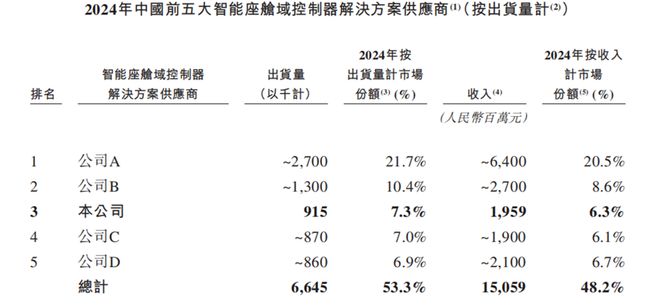
Core Viewpoint - 博泰车联科技 is a leading player in the automotive intelligence sector in China, officially launching its IPO on the Hong Kong Stock Exchange with a planned global offering of 10.4369 million H-shares at a price of HKD 102.23 per share, aiming to raise significant capital to support its growth and expansion in the smart cockpit solutions market [1][2]. Company Overview - Founded in 2009 and headquartered in Shanghai, 博泰车联 focuses on the automotive intelligence sector, being one of the earliest developers of smart cockpit solutions in China. The company has established a comprehensive industry chain covering R&D, production, and sales [5]. - 博泰车联 has a unique "software + hardware + cloud service" integrated model, providing customized smart cockpit solutions to meet diverse OEM and Tier 1 customer needs, with a growing international market presence [5][11]. Financial Performance - The company has experienced rapid revenue growth, with total revenue increasing from RMB 1.218 billion in 2022 to RMB 2.557 billion in 2024, representing a compound annual growth rate (CAGR) of 44.9%. The revenue from domain controllers, a key product, grew at a CAGR of 70.5% during the same period [9][10]. - For the five months ending May 31, 2025, revenue reached RMB 754 million, a year-on-year increase of 34.4%, driven by steady growth in domain controller shipments and an increase in high-end product sales [9]. Market Position and Competitive Advantage - 博泰车联 ranks as the third largest supplier of smart cockpit domain controller solutions in China, holding a market share of 7.3% as of 2024, with significant competitive advantages in technology and innovation [6][15]. - The company has established strategic partnerships with major automotive manufacturers and technology firms, enhancing its market position and enabling rapid response to market demands [11][15]. Industry Outlook - The Chinese automotive smart cockpit solutions market is projected to grow significantly, with an expected market size of RMB 129 billion in 2024, increasing to RMB 299.5 billion by 2029, reflecting a CAGR of 18.4% [13]. - The penetration rate of domain controllers in passenger vehicles is anticipated to rise from 13.7% in 2020 to over 90% by 2029, indicating substantial growth opportunities for leading companies like 博泰车联 [13]. Valuation Analysis - The IPO price of HKD 102.23 per share implies a market capitalization of HKD 15.334 billion. Based on the latest revenue figures, the company's price-to-sales (P/S) ratio is 5.1, which is significantly lower than the median P/S ratio of comparable companies at 13.04, suggesting that the company is undervalued [16].