汇丰银行

Search documents
迎利好!蚂蚁国际与ISDA在新加坡推出跨境支付通证化存款行业框架
Guang Zhou Ri Bao· 2025-07-04 11:53
Core Insights - Ant Group and ISDA have jointly released a white paper on the application of tokenized deposits in transaction banking, supported by the Monetary Authority of Singapore, aiming to enhance cross-border payment and foreign exchange settlement [1] - The framework is expected to reduce cross-border transaction costs by 12.5%, potentially saving businesses over $50 billion by 2030 [1] - The global cost of cross-border transaction fees is currently estimated at $120 billion annually [1] Group 1 - The white paper outlines the design principles and industry standards for tokenized deposits, ensuring interoperability [1] - It discusses key risks associated with payment systems based on shared ledger technology and measures to address them [1] - The feasibility of the proposed system is validated through practical use cases in transaction banking [1] Group 2 - Ant Group's Whale platform utilizes blockchain, encryption, and AI to facilitate real-time multi-currency settlement, reducing the settlement period from 1-3 days to minutes or even seconds [2] - Over one-third of the $1 trillion in funds processed by Ant International in 2024 will be through the Whale platform, with partnerships established with major banks [2] - Ant Group and ISDA plan to expand the application scenarios for shared ledger and tokenized deposits, ensuring benefits for both large and small enterprises [2]
投资圈都在学习“稳定币”,浓度最高的指数是哪只?
Sou Hu Cai Jing· 2025-07-03 07:39
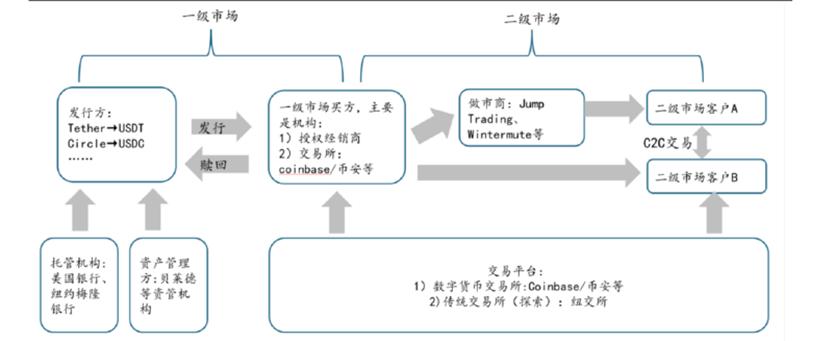
Group 1 - The core focus of the news is the increasing interest and regulatory developments surrounding stablecoins, particularly in the U.S. and Hong Kong [2][3][5] - The U.S. GENIUS Act passed in May 2023 establishes a regulatory framework for stablecoins, while Hong Kong's stablecoin regulations will take effect on August 1, 2023 [2][3] - Market reactions to stablecoin-related stocks have been significant, with notable price increases for companies like Guotai Junan International and Circle [4][5] Group 2 - The stablecoin industry is seeing participation from traditional banks and tech companies, with major players in Hong Kong including Standard Chartered, JD.com, and Ant Group [7][8] - The global stablecoin market has a total market capitalization of nearly $250 billion, with USDT holding approximately 62% market share and USDC around 24% [12] - The business model for stablecoins includes issuance, custody, and technology support, with key roles played by financial institutions and tech companies [10][13] Group 3 - The financial technology ETF (159851) is highlighted as a significant investment vehicle, with over 20% of its components related to stablecoins and digital currencies [16] - The ETF has shown high volatility and resilience, outperforming the broader market indices in recent years [19][27] - The ETF's components include companies involved in digital currency infrastructure, payment systems, and blockchain technology, indicating a strong alignment with financial innovation [18][20]

★跨境支付通明起上线 内地香港居民可实时跨境转账
Zheng Quan Shi Bao· 2025-07-03 01:55
Core Viewpoint - The launch of the "Cross-Border Payment Link" between the People's Bank of China and the Hong Kong Monetary Authority is a significant step in enhancing financial cooperation between mainland China and Hong Kong, aimed at improving the efficiency and convenience of cross-border payments [1][2]. Group 1: Overview of Cross-Border Payment Link - The Cross-Border Payment Link connects the mainland's online payment interbank clearing system with Hong Kong's Fast Payment System, allowing for efficient, convenient, and secure cross-border payment services for residents of both regions [1]. - The service is set to go live on June 22, enhancing the international financial center status of Hong Kong and promoting the use of the Renminbi in cross-border transactions [1][2]. Group 2: Operational Details - The Cross-Border Payment Link focuses on small-amount, convenient remittances, allowing residents to make cross-border transfers without submitting business background information [2]. - The service supports remittances for various purposes, including tuition payments, medical fees, and salary disbursements, with participating institutions determining transaction limits based on risk management [2][3]. Group 3: Efficiency and Cost Reduction - Compared to traditional cross-border remittance methods, the new system significantly shortens the remittance chain, improves efficiency, and reduces costs by minimizing intermediaries [3]. - The system allows for real-time transactions for certain amounts under the current account, enhancing the overall user experience for residents [3]. Group 4: Compliance and Risk Management - Participating institutions must adhere to regulations regarding cross-border fund settlements and implement anti-money laundering and counter-terrorism financing measures to mitigate potential risks [3]. - A risk monitoring mechanism will be established to ensure the smooth operation of the Cross-Border Payment Link and to monitor suspicious transactions [3].
从银行保险价值重估看本轮牛市的起点
雪球· 2025-07-02 08:22
Core Viewpoint - The rise in asset prices is fundamentally a monetary phenomenon, reflecting where funds are directed. The stock market is currently experiencing this shift after the real estate market. The bull market is driven not by a sudden surge in corporate profits but by a systematic redirection of funds from traditional sectors to undervalued core assets in the secondary market, creating a mismatch between liquidity and asset supply [1]. Group 1: Market Dynamics - The banking and insurance sectors in China have undergone a significant value reassessment since last year, accelerating since May 2023, indicating a trend not driven by retail investors [2]. - The valuation of Chinese banking and insurance stocks has been at unprecedented lows, with major banks' price-to-book ratios dropping significantly, such as Bank of China at 0.40 and Agricultural Bank of China at 0.40, marking a historical low [4][5]. - The insurance sector has faced even harsher conditions, with China Life's price-to-embedded value ratio at 0.22 and a price-to-book ratio of 0.6, placing it in the lowest 5% of its historical range [4]. Group 2: Valuation Comparisons - In contrast to Chinese financial institutions, major global banks like JPMorgan have a price-to-book ratio of 2.4, while European and Japanese banks hover around 1.0, highlighting a significant undervaluation of Chinese financial stocks [5]. - The extreme undervaluation of Chinese financial stocks, coupled with dividend yields of 6% to 8%, presents a unique investment opportunity in the global financial market [5]. Group 3: Regulatory Environment and Market Recovery - Since 2020, China's financial system has been in deep adjustment, focusing on reducing shadow banking and addressing real estate and local government debt risks, which has pressured profitability and valuation [6]. - Despite the challenges, this period has led to improved asset quality, with banks achieving a provisioning coverage ratio above 200% and stable capital adequacy ratios [6][7]. - The current policy environment is actively directing liquidity into the equity market, with regulatory measures encouraging insurance companies to allocate a significant portion of new premiums to A-shares [8][9]. Group 4: Future Outlook - The ongoing valuation recovery is seen as just the beginning, with continued monetary supply and a focus on undervalued, high-dividend financial blue-chip stocks expected to absorb market liquidity [10]. - The market is anticipated to experience a gradual bull market, characterized by steady index increases and reduced volatility, until a new phase of large-scale equity financing or a shift in interest rate cycles occurs [10].

机构看金市:7月2日
Xin Hua Cai Jing· 2025-07-02 04:01
Group 1 - The core viewpoint is that precious metals, particularly gold, are experiencing a rebound, influenced by economic data and market conditions, with a focus on upcoming U.S. employment data [1][2][3] - Guotou Futures notes that the recent drop in the dollar to a three-year low has supported the rebound in precious metals, although there was a slight pullback after the release of economic data [1] - HSBC has raised its average gold price forecast for 2025 from $3015 to $3215 per ounce, citing increased market risks and rising U.S. government debt [3] Group 2 - New Lake Futures indicates that the London spot gold price has continued its upward trend, surpassing $3300 per ounce, with attention shifting towards tariffs as the 90-day exemption period approaches [2] - Marex analysts suggest that rising U.S. debt and inflationary pressures from proposed tax cuts and spending will likely benefit gold prices, as gold is traditionally viewed as a safe-haven asset [3] - The market anticipates that central bank gold purchases will slow if prices exceed $3300 per ounce, but demand may increase if prices correct to around $3000 per ounce [3]
2025年上半年中资离岸债承销排行榜
Wind万得· 2025-07-01 22:23
Core Viewpoint - The article highlights the diversification of currency structures in offshore bond issuance by Chinese enterprises, with a notable increase in non-US dollar bonds such as offshore RMB, Euro, and Hong Kong Dollar bonds. The total issuance in the first half of 2025 reached 399.04 billion USD, marking a 12.74% increase year-on-year, despite significant refinancing pressures in the market [1]. Group 1: Offshore Bond Market Overview - The offshore bond market for Chinese enterprises saw a total of 837 new bonds issued in the first half of 2025, amounting to 3990.44 billion USD, reflecting a 12.74% growth compared to the same period last year [1]. - The market continues to experience a significant net financing gap, indicating ongoing refinancing pressures from existing debt [1]. Group 2: Underwriting Rankings - In the underwriting rankings for offshore bonds, Bank of China led with 56.3 billion USD from 115 bonds, followed by HSBC with 51.8 billion USD from 83 bonds, and Guotai Junan International with 43.1 billion USD from 155 bonds [3][4]. - The total underwriting amount for the top three institutions reflects the competitive landscape in the offshore bond market [3][4]. Group 3: Project Count Rankings - CITIC Securities topped the project count rankings with 227 bonds underwritten, followed by Haitong International with 180 bonds, and CITIC Jianan with 165 bonds [8][9]. - This indicates a strong performance in terms of the number of projects handled by these institutions in the offshore bond market [8][9]. Group 4: Bank Underwriting Rankings - The bank underwriting rankings show Bank of China at the top with 56.3 billion USD from 115 bonds, followed by HSBC with 51.8 billion USD from 83 bonds, and CITIC Bank with 35.5 billion USD from 151 bonds [17][18]. - This highlights the dominance of these banks in the offshore bond underwriting space [17][18]. Group 5: Securities Firm Underwriting Rankings - Guotai Junan International led the securities firm rankings with 43.1 billion USD from 155 bonds, followed by CICC with 27.1 billion USD from 127 bonds, and CITIC Lyon with 26.7 billion USD from 170 bonds [20][21]. - This showcases the competitive positioning of securities firms in the offshore bond market [20][21]. Group 6: Specific Bond Type Rankings - For offshore municipal bonds, Guotai Junan International ranked first with 14.9 billion USD from 57 bonds, followed by Dongfang Securities with 9.8 billion USD from 39 bonds, and CITIC Bank with 9.5 billion USD from 55 bonds [30]. - In the offshore financial bond category, Bank of China led with 34.4 billion USD from 62 bonds, followed by HSBC with 20.6 billion USD from 41 bonds [34]. - For green bonds, Bank of China also ranked first with 6.2 billion USD from 17 bonds, closely followed by Industrial and Commercial Bank of China with 6.1 billion USD from 17 bonds [38].




中安科: 2025年第一次临时股东大会会议资料
Zheng Quan Zhi Xing· 2025-06-25 16:13
Group 1 - The company will hold a shareholders' meeting on July 9, 2025, with both on-site and online voting options available for shareholders [4][3] - The agenda includes proposals for providing guarantees for financing, amending the company’s articles of association, and electing a new independent director [6][9][7] - The company plans to provide a total of HKD 277 million in financing guarantees for its wholly-owned subsidiaries [4][5] Group 2 - The company proposes to abolish the supervisory board, transferring its responsibilities to the audit committee of the board of directors [6] - The company will revise its internal governance rules, including the rules for shareholders' meetings and board meetings [7] - The independent director candidate, Mr. Xue Wei, has a strong background in finance and accounting, with no current shareholding in the company [9][10]
内地-香港跨境支付通上线,"金融高铁"再提速|政策与监管
清华金融评论· 2025-06-25 10:30
Core Viewpoint - The launch of the Cross-Border Payment System on June 22 by the People's Bank of China and the Hong Kong Monetary Authority marks a significant advancement in financial cooperation between mainland China and Hong Kong, aiming to enhance cross-border remittance services and reduce reliance on the SWIFT system [2][3]. Group 1: System Overview - The Cross-Border Payment System is built on the Memorandum of Understanding for cross-border payment connectivity between mainland China and Hong Kong, facilitating efficient and secure remittance services by connecting the mainland's Interbank Payment System (IBPS) with Hong Kong's Faster Payment System (FPS) [3]. - The system aims to address the growing demand for cross-border financial services as economic and trade ties between the Greater Bay Area and Hong Kong deepen [2]. Group 2: Advantages of the Cross-Border Payment System - The system offers several advantages, including support for interbank remittances, various payment purposes, real-time transactions, low transaction costs, and the ability to use mobile numbers for remittance [5][12]. - Unlike the traditional SWIFT system, which can take 1-2 business days for transactions, the new system allows for instant transfers, significantly improving efficiency [7]. - The Cross-Border Payment System reduces costs associated with SWIFT, where fees can reach 1%-3% of the transaction amount, by eliminating intermediaries and offering promotional zero-fee services [7]. Group 3: Operational Details - The initial participants in the Cross-Border Payment System include six major banks from mainland China and six from Hong Kong, enhancing the system's operational capacity [11][12]. - There are specific remittance limits: Hong Kong residents can remit up to 200,000 HKD annually and 10,000 HKD daily, while mainland residents can remit up to 50,000 USD annually and 300,000 RMB daily [12]. - The system currently focuses on person-to-person (P2P) transactions, with plans to expand to business and government transactions in the future [12]. Group 4: Strategic Implications - The Cross-Border Payment System is expected to strengthen Hong Kong's role as an offshore RMB hub and enhance the city's financial center status by increasing RMB deposits [13]. - The People's Bank of China plans to collaborate with the Hong Kong Monetary Authority to ensure the smooth operation of the system and promote high-quality development of the cross-border payment framework [13].

外汇展业改革参与银行增至18家 江苏银行和摩根大通入列
2 1 Shi Ji Jing Ji Bao Dao· 2025-06-24 13:09
Core Viewpoint - The recent reforms in bank foreign exchange operations in China have led to increased participation from banks, enhancing efficiency and convenience for enterprises while maintaining risk control [1][2]. Group 1: Reform Progress - The number of banks participating in foreign exchange operations has increased from 4 to 18, covering a nationwide scope [1]. - The participating banks include 3 large banks, 9 joint-stock banks, 3 city commercial banks, and 3 foreign banks [1]. - New additions to the participating banks this year include Jiangsu Bank and JPMorgan Chase [1]. Group 2: Operational Changes - The reform emphasizes the identification of clients and risk monitoring, allowing high-quality clients to process foreign exchange transactions without document review [2]. - The pilot departments for foreign exchange operations in banks are typically the International Business Department and Transaction Banking Department [2]. - The reforms have significantly reduced the operational costs and improved efficiency in processing foreign exchange transactions [2]. Group 3: Policy Framework - The foreign exchange operation reform is a key component of the "more integrity, more convenience" policy framework [2]. - The People's Bank of China aims to enhance foreign exchange services for the real economy and has outlined three key areas of focus [3]. - The focus areas include supporting innovation and small enterprises, optimizing the management framework for foreign exchange operations, and establishing evaluation mechanisms for foreign exchange management policies [3].

中原地产:预计香港第二季二手私人住宅现楼按揭约4100宗 环比下跌15%
智通财经网· 2025-06-24 12:37
Group 1 - The core viewpoint indicates a recovery in the second-hand residential mortgage market, with a slight monthly increase in registrations and an expectation for further growth in June [1][2] - In May 2025, there were 1,356 registrations for second-hand residential mortgages, reflecting a monthly increase of 61 or 4.7%, driven by renewed buyer interest post-New Year [1] - The total number of registered mortgage contracts for buildings (excluding pre-sale) was 4,920 in May, marking a rebound after two months of decline, reaching a three-month high [1] Group 2 - The one-hand mortgage market saw a significant monthly increase of 1,382 registrations or 53.0%, with a total of 3,992 registrations in May, largely due to new developments [2] - The number of registered mortgage contracts for new residential properties was 1,972, while the second-hand market accounted for 1,356, indicating a strong performance in both segments [2] - The number of registered mortgages for subsidized housing and other plans surged to 751, a monthly increase of 315 or 72.2%, attributed to new housing projects coming online [2]