
申洲国际

Search documents
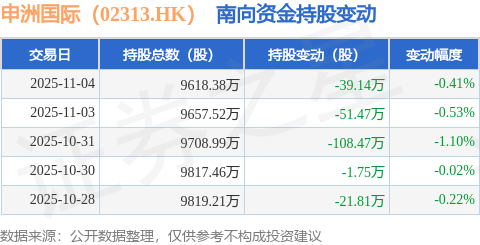
申洲国际(02313.HK):11月4日南向资金减持39.14万股
Sou Hu Cai Jing· 2025-11-04 19:36
Core Viewpoint - Southbound funds have reduced their holdings in Shenzhou International (02313.HK) by 391,400 shares on November 4, indicating a trend of net selling over recent trading days [1] Group 1: Shareholding Changes - In the last five trading days, southbound funds have reduced their holdings for five days, with a total net reduction of 2,226,400 shares [1] - Over the past 20 trading days, there were 11 days of net increases in holdings, totaling 2,111,200 shares [1] - As of now, southbound funds hold 96,183,800 shares of Shenzhou International, accounting for 6.39% of the company's total issued ordinary shares [1] Group 2: Trading Data - On November 4, 2025, the total number of shares held was 96,183,800, with a decrease of 391,400 shares, representing a change of -0.41% [2] - On November 3, 2025, the total number of shares held was 96,575,200, with a decrease of 514,700 shares, representing a change of -0.53% [2] - On October 31, 2025, the total number of shares held was 97,089,900, with a decrease of 1,084,700 shares, representing a change of -1.10% [2] Group 3: Company Overview - Shenzhou International Group Holdings Limited primarily engages in the production and sale of knitted apparel products [2] - The company's main business involves manufacturing knitted products through a combination of OEM (Original Equipment Manufacturer) and ODM (Original Design Manufacturer) services [2] - The product categories include sportswear, casual wear, underwear, and other knitted products, with operations in both domestic and international markets [2]

Presentation:洞察消费者变迁,挖掘结构性机会
Haitong Securities International· 2025-11-04 08:06
Group 1: Market Performance - The A+H apparel stocks have underperformed the market since the beginning of the year, with A-share textile and apparel sector rising by 11.1%, lagging behind the CSI 300 index by 8.8 percentage points [14][16]. - The Hong Kong textile and apparel sector has seen a significant increase of 59.9%, outperforming the Hang Seng Index, which rose by 29.1% [15][16]. - The performance of overseas apparel stocks has been mixed, with luxury brands leading the market [17]. Group 2: Industry Analysis - From January to September 2025, the retail sales growth of clothing, shoes, and textiles in China was 3.1%, below the overall retail sales growth of 4.5% [22][23]. - The export growth of textiles and apparel from China was 2.1% and -2.5% respectively, while Vietnam's textile and footwear exports grew by 12.0% and 7.4% [25][27]. - Cotton prices have remained stable, while wool prices have surged since July, and goose down prices have fluctuated [28][31]. Group 3: Company Fundamentals - In Q3 2025, A-share brands showed a sequential improvement in performance, particularly in the home textile sector, with companies like Luolai Life and Mercury Home Textiles performing well [42][48]. - The Hong Kong sports brands faced pressure in Q3, but niche outdoor segments maintained high growth rates [45][47]. - The net profit consensus for most brands has been revised downward, with home textiles and outdoor sports experiencing relatively smaller adjustments [48][49]. Group 4: Trend Outlook - The textile manufacturing sector is expected to recover in 2026 due to tariff reductions, improved visibility, and enhanced operational efficiency [4]. - The Chinese sports market is viewed positively, particularly for growth brands in niche segments, while the luxury sector is expected to benefit from changes in customer demographics and innovative mid-range brands [4][48]. - The sleep economy presents significant growth potential, with leading home textile brands leveraging technology to drive growth [4].
国泰海通:25Q3品牌服饰端家纺表现亮眼 纺织制造降幅收窄
智通财经网· 2025-11-04 07:48
Core Viewpoint - The A-share apparel sector has shown a positive revenue growth in Q3 2025, with significant net profit growth, primarily due to a lower base in Q3 2024. The home textile segment performed particularly well, while the textile manufacturing sector saw a narrowing decline in both revenue and profit [1][3]. Industry Review - Demand Side: - Online retail sales of clothing in China from January to September increased by 2.8% year-on-year, accelerating compared to the previous months [2]. - In the U.S., retail sales of clothing and accessories rose by 8.3% year-on-year in August, marking an acceleration from July, with continuous month-on-month growth since May [2]. - Export Side: - China's textile and apparel exports in September decreased by 1.5% year-on-year, with textile exports up by 6% and garment exports down by 8% [2]. - Vietnam's textile and footwear exports in September increased by 9% year-on-year, showing an acceleration compared to August [2]. Apparel Sector Q3 2025 Summary - Performance Review: - The A-share apparel sector's revenue growth turned positive in Q3 2025, with a net profit increase of 10.6% compared to a decline of 22.0% in Q2 [3]. - The home textile segment, particularly brands like Luolai and Mercury, showed significant revenue and profit growth [3]. - Operational Efficiency: - Most brands experienced an increase in inventory turnover days year-on-year, except for Ge Li Si, Youngor, Luolai Life, and Mercury Home Textile, which saw a decrease [3]. Textile Manufacturing Q3 2025 Summary - Performance Review: - The revenue decline in the A-share textile manufacturing sector narrowed in Q3 2025, with a decrease of 0.4% compared to 1.9% in Q2 [5]. - Profit decline also narrowed, with a decrease of 11.2% in Q3 compared to 20.4% in Q2, with companies like Nanshan Zhishang and Fuchun Dyeing leading in growth [5]. - Future Outlook: - The impact of short-term tariffs is expected to end by year-end, with future order demand being a key variable. Most overseas brands completed price increases in Q3, making Q4 U.S. consumption trends an important observation [5]. - The concentration of orders and capacity advantages for midstream OEMs with mature overseas production capabilities will become more prominent [5]. - The efficiency of new production capacity and the pace of improvement need to be monitored, with a balanced production line allocation mechanism being crucial [5]. Investment Recommendations - For 2026, the performance recovery logic for the export manufacturing sector appears clearer, driven by the implementation of U.S. tariff policies, reduced pressure on brands, and ongoing efficiency improvements [6]. - Recommended stocks include: - For home textiles: Luolai Life, Mercury Home Textile, and Fuanna [6]. - For light luxury: Prada and Samsonite [6]. - For undervalued high-dividend stocks: Bosideng, Jiangnan Buyi, and Taobo [6].

纺织服装业:Q3品牌端家纺表现亮眼,制造降幅收窄
Haitong Securities International· 2025-11-04 07:42
Investment Rating - The report suggests a positive outlook for the export manufacturing sector, indicating a clearer recovery logic for 2026 due to several factors, including the implementation of U.S. tariff policies and improved operational efficiencies [3][44]. Core Insights - The brand segment showed significant revenue and profit growth in Q3 2025, particularly in home textiles, while the manufacturing segment experienced a narrowing decline in revenue and profit compared to Q2 [3][44]. - Key focus areas include home textiles, affordable luxury, and low valuation high dividend stocks, with specific companies highlighted for potential investment [3][44]. Summary by Sections Industry Review - Domestic online retail for apparel increased by 2.8% year-on-year from January to September 2025, while U.S. apparel retail sales rose by 8.3% in August [3][45]. - In terms of exports, China's textile and apparel exports decreased by 1.5% year-on-year in September, with textiles up by 6% and apparel down by 8% [3][45]. Brand Apparel Q3 2025 Summary - The A-share apparel sector saw a revenue growth turnaround in Q3 2025, with a notable increase in net profit, attributed to a low base from Q2 2024 [3][46]. - Home textiles performed well, with significant growth reported by companies like Luolai and Shanghai Shuixing [3][46]. Textile Manufacturing Q3 2025 Summary - Revenue decline in the textile manufacturing sector narrowed in Q3 2025, with leading companies such as Shandong Nanshan and Huafu Fashion showing improved performance [3][47]. - The report emphasizes the importance of future order trends and the impact of tariff policies on the sector's recovery [3][47].
阿迪羽绒服波司登造 你怎么看?
Mei Ri Jing Ji Xin Wen· 2025-11-04 07:18
Group 1 - The recent revelation that Adidas down jackets are actually produced by the domestic company Bosideng has sparked public attention [1] - Consumers are questioning the price premium of international brands when domestic brands offer similar products at lower prices [1] - The perception of value in clothing extends beyond functionality to include emotional and aesthetic considerations, leading consumers to pay a premium for brand names [1] Group 2 - The fact that international brands are outsourced to local companies highlights the importance of Chinese enterprises in the global apparel supply chain and affirms the quality of Chinese manufacturing [2] - Bosideng has seen its stock price rise continuously, with its OEM business becoming a significant revenue source, alongside its own brand [2] - Other notable garment manufacturers in the Hong Kong market include Shenzhou International, which has a market capitalization nearing HKD 100 billion, and reached a peak of nearly HKD 300 billion in 2021 [2] Group 3 - There is a significant divergence in stock performance among Chinese apparel companies, with 361 Degrees showing a nearly 50% increase this year, while Li Ning and Anta Sports have underperformed [3] - The potential for brand value enhancement and stock market growth for Chinese apparel companies is seen as inevitable given their strong manufacturing capabilities [3]
大消费组十一月消费金股:提高消费率,布局消费股
CMS· 2025-11-04 05:34
Investment Rating - The report maintains a "Recommended" rating for the industry, indicating a positive outlook for the sector's fundamentals and expected performance relative to market benchmarks [2]. Core Insights - The report emphasizes the importance of consumer spending recovery and highlights various sectors within the consumer industry, including agriculture, food and beverage, textiles, home appliances, retail, pharmaceuticals, and social services [1][6][20][22][25]. - Key recommendations include focusing on high-quality breeding stocks in agriculture, structural growth opportunities in consumer goods, and the potential for recovery in textile manufacturing orders due to stable overseas demand [6][9][20][25]. Summary by Relevant Sections Agriculture - The report suggests a continued recommendation for high-quality breeding stocks, emphasizing food security and the ongoing reduction in pig breeding capacity, which is expected to elevate future pork prices [25][26]. Food and Beverage - The food and beverage sector is highlighted for its structural growth, particularly in the liquor market, where demand is expected to stabilize. Companies like Ximai Foods are noted for their strong revenue growth and innovative product launches [7][8]. Textiles - The textile sector is recommended for its recovery potential, with a focus on leading manufacturers benefiting from improved order conditions as global demand stabilizes [9][10]. Home Appliances - The home appliance sector shows signs of recovery, with companies like Huabao New Energy and XGIMI Technology expected to experience significant growth due to expanding market demands and improved operational efficiencies [14][15]. Retail - The retail sector is experiencing a boost in store openings and same-store sales improvements, particularly in the snack food segment, indicating a positive trend in consumer spending [18][19]. Pharmaceuticals - The pharmaceutical industry is recommended for its innovative upstream and CXO chains, with companies like WuXi AppTec and Kanglong Chemical showing strong performance and growth potential [20][21]. Social Services - The report identifies investment opportunities in the restaurant and OTA sectors, particularly in brands that are expected to benefit from ongoing consumer trends and government support for consumption [22][23].
11月港股金股:静待风起青萍末
Soochow Securities· 2025-11-04 04:04
Group 1 - The report suggests that the Hong Kong stock market is entering an adjustment phase at the end of the year, but it remains in a long-term upward trend [1] - The report emphasizes a continued positive outlook on AI technology, predicting a marginal recovery in Hong Kong's EPS in the first quarter of next year [2] - There is an increased allocation towards dividend stocks due to a decline in market sentiment and a historical trend showing higher win rates for dividend stocks in November and December [2] - The report maintains a favorable view on innovative pharmaceuticals, citing benefits from potential Federal Reserve interest rate cuts and a clear trend in the innovative drug industry [2] Group 2 - The report lists a selection of "golden stocks" with detailed financial metrics, including Alibaba, XPeng Motors, CICC, Shenzhou International, Innovent Biologics, Kelun-Biotech, 3SBio, Gree Power, Sinopec, and Guoquan [3][8] - Alibaba is highlighted for its leadership in AI and cloud computing, with significant revenue growth expected from its cloud business [11][12] - XPeng Motors is projected to achieve substantial revenue growth, with a focus on developing a platform for mass-market vehicles [17][19] - CICC is expected to benefit from a recovering IPO market and increased trading activity, enhancing its competitive position in investment banking and wealth management [24][26] - Shenzhou International is anticipated to see sales growth driven by strong demand from major clients like Adidas and Nike [30][32] - Innovent Biologics is expected to achieve profitability in 2025, with a strong pipeline of innovative drugs [35][40] - Kelun-Biotech is advancing its clinical trials and commercialization efforts, maintaining a positive outlook [44][46] - 3SBio is positioned for growth with its innovative drug pipeline and international expansion [48][50] - Gree Power is expected to improve its financial performance through increased cash flow and dividend potential [52][56] - Sinopec is focusing on upstream exploration and development, with a strong outlook for its natural gas segment [60][62] - Guoquan is experiencing improved same-store sales and expansion in rural areas, indicating strong operational capabilities [66][68]
小吊牌藏着“利润剪刀差”:高端服饰定价倍率超10倍
Mei Ri Jing Ji Xin Wen· 2025-11-03 13:33
Core Viewpoint - The article discusses the transformation of China's manufacturing industry, particularly in the apparel sector, where local companies like "Xuezhongfei" and Shenzhou International are becoming strategic partners for international brands like Adidas and Nike, challenging the traditional brand premium model [1][2][3]. Group 1: Changes in Consumer Behavior - Consumers are increasingly skeptical of brand premiums and are focusing on the actual quality-to-price ratio of apparel products [1][6]. - The rise of information transparency has led consumers to compare product specifications, such as fill power and material quality, rather than relying solely on brand reputation [6][7]. Group 2: Evolution of the Chinese Manufacturing Sector - Chinese manufacturers have evolved from being mere "workshops" for international brands to becoming key players with core competencies in design, quality control, and supply chain management [11][12]. - The local industry is now capable of meeting international standards, with companies like "Xuezhongfei" recognized for their manufacturing capabilities [3][4]. Group 3: Profit Distribution and Market Dynamics - The profit distribution model in the manufacturing sector is shifting from brands taking the majority share to manufacturers like Bosideng and Shenzhou International gaining more negotiating power [8][9]. - Bosideng's OEM and ODM businesses have shown significant growth, with a reported revenue of approximately 3.373 billion yuan, marking a 26.4% year-on-year increase [8]. Group 4: Strategic Partnerships and Supply Chain Flexibility - Adidas has acknowledged the importance of Chinese suppliers in enhancing its flexible supply chain capabilities, which is crucial for local market adaptation [3][4]. - The collaboration between international brands and local manufacturers is becoming more strategic, with a focus on leveraging local expertise for better market responsiveness [11][12]. Group 5: Future Outlook - The article suggests that future leading companies in the consumer sector may emerge from China's supply chain, as local firms continue to innovate and enhance their competitive edge [11][12]. - The next challenge for these manufacturers will be to integrate data, processes, and standards into their operations to maintain their competitive advantage [12].
周其仁:没本事的企业家早晚被淘汰,有本事的才实现“剩者为王”
和讯· 2025-11-03 09:35
Group 1 - The article discusses the significant changes in the global landscape, emphasizing the uncertainty and unpredictability of future events, particularly in the context of geopolitical tensions and economic shifts [5][6][13] - It highlights the historical context of major geopolitical conflicts and their impact on economic centers, noting that such conflicts can lead to new markets and opportunities for growth [7][8] - The article stresses the importance of companies adapting their strategies to global changes, with examples of successful businesses that have diversified their operations internationally to mitigate risks [9][10] Group 2 - Companies are encouraged to focus on customer needs rather than merely competing with rivals, suggesting that understanding and addressing customer demands can lead to a competitive advantage [11][12] - The article provides examples of companies that have successfully navigated challenges by innovating and aligning their products with customer expectations, such as IKEA and ASML [10][11] - It emphasizes the necessity for businesses to establish research and development centers globally to better understand diverse customer bases and foster innovation [12] Group 3 - The article categorizes events into three types: certain events, predictable events based on past experiences, and completely unpredictable events, stressing the need for companies to prepare for uncertainty [13][14] - It discusses the concept of "capital" in business, defining it as both financial resources and the capabilities of entrepreneurs to manage and utilize those resources effectively [21][20] - The importance of having a solid financial foundation and skilled management is highlighted as essential for companies to survive and thrive in uncertain environments [21][19]

申洲国际(02313) - 截至二零二五年十月三十一日止之股份发行人的证券变动月报表
2025-11-03 06:16
FF301 股份發行人及根據《上市規則》第十九B章上市的香港預託證券發行人的證券變動月報表 截至月份: 2025年10月31日 狀態: 新提交 公司名稱: 申洲國際集團控股有限公司 (於開曼群島註冊成立的有限公司) 呈交日期: 2025年11月3日 I. 法定/註冊股本變動 | 1. 股份分類 | 普通股 | 股份類別 | 不適用 | | | 於香港聯交所上市 (註1) | | 是 | | | --- | --- | --- | --- | --- | --- | --- | --- | --- | --- | | 證券代號 (如上市) | 02313 | 說明 | | | | | | | | | | | 法定/註冊股份數目 | | | 面值 | | | 法定/註冊股本 | | | 上月底結存 | | | 3,000,000,000 | HKD | | 0.1 | HKD | | 300,000,000 | | 增加 / 減少 (-) | | | | | | | HKD | | | | 本月底結存 | | | 3,000,000,000 | HKD | | 0.1 | HKD | | 300,000,000 ...