名创优品

Search documents
经济越来越差,这八大行业越赚爆!
创业家· 2026-01-23 10:27
Core Insights - The article discusses how certain industries are thriving despite a general perception of economic downturn, highlighting eight key sectors that present significant business opportunities in a low-desire society [3][4]. Group 1: Key Industries - **Second-Hand Economy**: The second-hand luxury market in Japan, represented by companies like Daikokuya, has seen a surge in revenue. In China, platforms like Hongbulin and Panghu are experiencing similar growth, indicating a shift in consumer spending towards second-hand goods [6][7][8][9]. - **Pet Economy**: With declining birth rates, young people are investing more in pets, leading to a boom in pet food and healthcare products. Companies like Inaba in Japan and Guobao in China are capitalizing on this trend [11][12][14][15]. - **Adult Care Products**: The adult diaper market in Japan has surpassed $10 billion, indicating a growing demand for adult care products in China, with companies like Kexin showing potential for growth [16][17][18]. - **Health Food and Beverages**: The rise in health consciousness has led to increased sales of sugar-free beverages and functional drinks in both Japan and China, with brands like Suntory and Dongpeng gaining traction [21][22]. - **Beauty Economy**: The demand for beauty products, including collagen supplements and at-home beauty devices, remains strong, with companies like Jinbo Biological achieving significant market valuations [23][25]. - **Outdoor Recreation**: The outdoor equipment market is thriving, with brands like Snow Peak in Japan and various Chinese brands experiencing rapid sales growth, as consumers seek leisure activities despite economic constraints [25][26][27]. - **Emotional Economy**: Brands that provide emotional comfort, such as Labubu and Rio, are gaining popularity, reflecting a consumer willingness to spend on small pleasures even in tough times [28][29][30]. - **Convenience Economy**: The demand for convenience products, such as frozen foods and smart home appliances, is increasing as younger generations prioritize time-saving solutions [33][35][36]. Group 2: Market Trends - The article emphasizes that the current low-desire economic environment does not equate to a lack of opportunities. Instead, it suggests that businesses that can identify and invest in counter-cyclical sectors will emerge as winners [39].


官方错标价格,消费者称被强制退款!立白致歉:启动流程升级
Nan Fang Du Shi Bao· 2026-01-23 04:38
Core Viewpoint - The company faced backlash from consumers due to a pricing error that led to forced refunds for products purchased at significantly lower prices than intended [1][2][6]. Group 1: Incident Details - Multiple consumers reported that they were forced to refund purchases of laundry detergent from the company's official flagship store, where a 10 kg pack was mistakenly priced at 6.9 yuan instead of the original price of 90.8 yuan [2][4]. - The pricing error occurred during a brief promotional event that lasted approximately five minutes, leading to numerous complaints on social media [3][6]. - The company acknowledged the issue was due to an internal operational oversight during the SKU change process, which resulted in abnormal orders [6]. Group 2: Company Response - The company issued an apology and provided a 5 yuan cash compensation to affected consumers, citing the pricing error as the reason for the refunds [1][6]. - The company has initiated a process upgrade to enhance price verification and implement multi-level reviews to prevent similar issues in the future [6]. - The company expressed gratitude for media and user oversight and committed to improving service quality [6]. Group 3: Company Background - The company, established in 1994, is a leading player in the daily chemical industry, with a reported annual revenue of 31.241 billion yuan in 2022, reflecting a year-on-year growth of 2.13% [6]. - The company’s product range includes fabric care, dish cleaning, oral care, and personal care items [6].
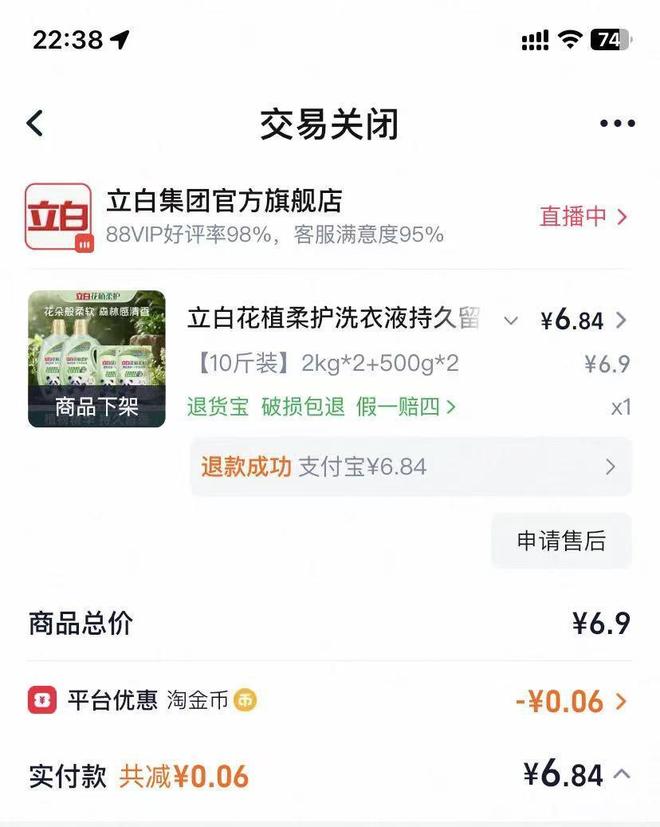
上海去年入境消费额150亿美元 马年新春入境旺季又将至 升级服务接住入境消费增量
Jie Fang Ri Bao· 2026-01-23 01:34
Core Insights - Shanghai is emerging as a prominent destination for inbound tourism, with a projected 9.36 million inbound visitors in 2025, representing a year-on-year increase of 39.58% [1] - The total inbound consumption in Shanghai is expected to reach $15 billion in 2025, reflecting a growth of approximately 35%, primarily driven by dining, accommodation, and retail sectors [1] Group 1: Market Growth - The inbound tourism market in Shanghai is experiencing rapid growth, not only in visitor numbers but also in overall consumption levels [2] - The expansion of consumption scenarios includes a shift from high-end shopping in core business districts to more everyday experiences, appealing to a broader range of tourists [2] Group 2: Policy Support and Tax Refunds - The sales volume of tax refunds for departing tourists in Shanghai is projected to increase by about 80% in 2025, with "immediate refund" sales surging by 15.7 times [3] - The number of tax refund stores has exceeded 1,800, marking a year-on-year increase of 140%, enhancing the convenience and efficiency of tax refund services [3] Group 3: Retail and Consumer Experience - The "immediate refund" service at Xinyi Taikoo Hui has seen transaction numbers grow by approximately 700% in the second half of 2025 compared to the first half, with a nearly 400% increase in consumption amount [4] - Promotional activities during the Spring Festival at Xinyi Taikoo Hui will offer dual benefits of consumption vouchers and tax refunds, potentially providing a total discount of up to 12% for tourists [4] Group 4: Overall Impact - Shanghai is actively enhancing its status as an international consumption center, aiming to solidify its reputation as "China's Inbound Consumption Capital" through various initiatives and improvements [5]
永辉“胖改”20个月:单店业绩回暖,难抵整体亏损
经济观察报· 2026-01-22 13:55
Core Viewpoint - Yonghui Supermarket is undergoing a significant transformation process, referred to as "Pang Donglai" reform, which is expected to impact its financial performance negatively in the short term, leading to a projected net loss of 2.14 billion yuan for 2025, marking the fifth consecutive year of losses for the company [2][6]. Group 1: Financial Performance and Losses - The company reported a net loss of 2.14 billion yuan for 2025, compared to a loss of 1.47 billion yuan in the previous year [2][6]. - From 2021 to 2024, Yonghui Supermarket's net profits were -3.944 billion yuan, -2.763 billion yuan, -1.329 billion yuan, and -1.465 billion yuan respectively [2]. - The company closed 381 stores and underwent significant adjustments to 315 stores, incurring costs related to asset write-offs and renovation losses totaling approximately 910 million yuan [6][7]. Group 2: Store Adjustments and Performance - The adjustments made to the stores have shown initial positive results, with 31 reformed stores achieving sales of 4.662 billion yuan in the first nine months of 2025, a 71% increase year-on-year [7]. - Despite the improvements in adjusted stores, their overall contribution to the company's net profit remains limited due to their low proportion in total operations and high initial costs [7]. - The company plans to close about 25 stores and adjust around 50 stores in 2026, expecting a reduction in the negative impact on pre-tax profits to 170 million yuan [7]. Group 3: Fundraising and Shareholder Actions - To support the transformation, Yonghui Supermarket initiated a targeted fundraising plan, initially aiming to raise 3.992 billion yuan for upgrading 298 stores, later adjusted to 3.114 billion yuan for 216 stores [9][10]. - The company's financial pressure is evident, with cash reserves at 3.358 billion yuan as of September 30, 2025, the lowest in nearly a decade [10]. - In contrast to the fundraising efforts, significant shareholders, including the chairman, have been reducing their stakes, with plans to sell up to 90.75 million shares [11]. Group 4: Organizational and Supply Chain Adjustments - To address ongoing operational pressures, Yonghui Supermarket has implemented organizational changes, including a new management structure to enhance efficiency [13]. - The company is focusing on supply chain reforms, aiming to increase the sales of private label products to 40% of total sales over the next 3-5 years [13][14]. - A commitment to transparency in supplier relationships has been emphasized, with measures to combat corruption and ensure fair practices in supplier selection [14]. Group 5: Industry Context and Strategic Alignment - Yonghui Supermarket's adjustments align with broader industry trends, as highlighted by the China Chain Store & Franchise Association, which indicates a focus on optimizing procurement channels and enhancing online and offline integration [15].

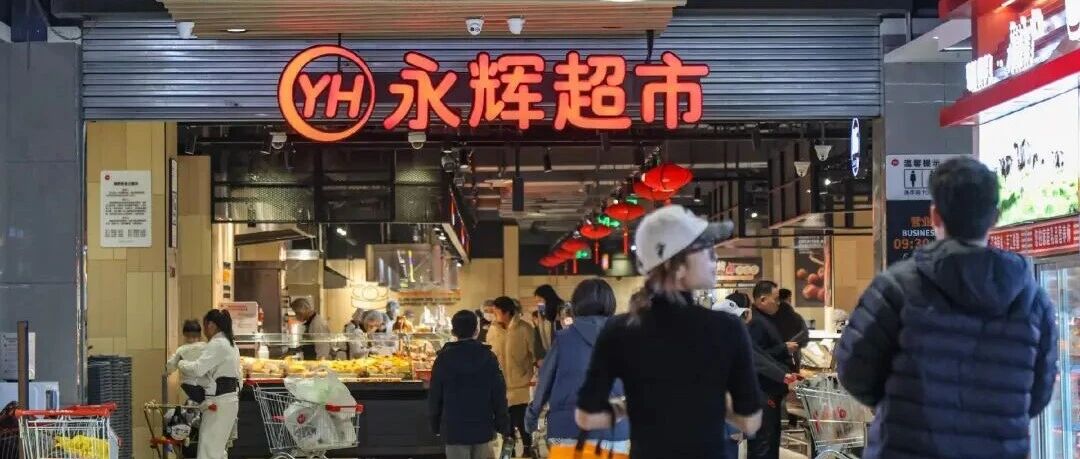
永辉“胖改”20个月:单店业绩回暖,难抵整体亏损
Jing Ji Guan Cha Wang· 2026-01-22 13:04
Core Viewpoint - Yonghui Supermarket is undergoing a significant transformation process, referred to as "Pang Donglai" reform, which has entered a critical phase after approximately 20 months. The company anticipates a net loss of 2.14 billion yuan for 2025, marking its fifth consecutive year of losses, while efforts to improve store performance are ongoing [1][2]. Group 1: Financial Performance - Yonghui Supermarket reported a projected net loss of 2.14 billion yuan for 2025, compared to a net loss of 1.47 billion yuan in the previous year [1]. - The company has experienced consecutive losses from 2021 to 2024, with net profits of -3.944 billion yuan, -2.763 billion yuan, -1.329 billion yuan, and -1.465 billion yuan respectively [1]. - The transformation efforts have led to a significant increase in sales and profits for the 31 stores that completed renovations in 2024, achieving a total sales of 4.662 billion yuan, a 71% increase year-on-year, and a profit of 104 million yuan, a 112% increase year-on-year [5]. Group 2: Store Adjustments - Yonghui Supermarket has closed 381 stores and deeply reformed 315 stores, with a total of nearly 60% of its stores closed over the past three years [4]. - The company plans to close approximately 25 stores and reform about 50 stores in 2026, with the impact on pre-tax profit expected to decrease to -170 million yuan [5]. - The adjustments have incurred significant costs, including asset write-offs and losses from store closures, totaling approximately 910 million yuan [4]. Group 3: Fundraising and Shareholder Actions - To support the transformation, Yonghui Supermarket initiated a targeted fundraising plan to raise 3.992 billion yuan for upgrading 298 stores, later adjusting the number to 216 stores with a total fundraising cap of 3.114 billion yuan [6]. - The company's financial pressure is evident, with cash reserves at 3.358 billion yuan as of September 30, 2025, the lowest in nearly a decade [7]. - In contrast to the fundraising efforts, significant share reductions by major shareholders, including the chairman and other stakeholders, have been noted, indicating a lack of confidence in the company's future [8]. Group 4: Organizational Changes - Yonghui Supermarket has implemented a series of organizational and management adjustments to enhance operational efficiency, including a new three-tier management structure [9]. - The founder of Miniso, Ye Guofu, has been appointed to lead the reform efforts, focusing on supply chain transformation and establishing long-term partnerships with core suppliers [9][10]. - The company has also appointed a new CEO, Wang Shoucheng, who is expected to integrate successful reform experiences into the overall corporate strategy [10]. Group 5: Industry Context - The adjustments made by Yonghui Supermarket align with broader industry trends, as highlighted by a survey from the China Chain Store & Franchise Association, which indicates a focus on optimizing procurement channels and enhancing online and offline integration [11].
我驻菲大使:中国把菲当做朋友、邻居,真心相助,不求回报
Xin Lang Cai Jing· 2026-01-22 13:01
Group 1 - The Philippines and China are working towards managing maritime disputes through diplomatic dialogue, with both sides expressing a desire to avoid conflict and maintain communication channels [2][5] - The Philippines has been a significant trade partner for China, with a notable trade deficit, but China encourages the Philippines to export more products, especially high-quality agricultural goods [2][4] - Recent developments include the successful completion of infrastructure projects, such as the Bucana Bridge, which enhances transportation and economic development in the region [4][6] Group 2 - There is a growing interest in Chinese technology and investment in the Philippines, particularly in sectors like renewable energy and waste management, which could benefit the local economy [3][4] - The recent announcement of a 14-day visa exemption for Chinese citizens is seen as a positive step towards increasing tourism and strengthening bilateral relations [5][6] - The Chinese embassy emphasizes the importance of constructive dialogue and the role of media in fostering a positive narrative around China-Philippines relations [6][7]
多家公司“排队” 卡牌潮玩赛道迎来上市潮
Zheng Quan Shi Bao Wang· 2026-01-22 12:07
Core Insights - The card and trendy toy sector is experiencing a new wave of IPO applications, with companies like Sannisen Di and Suplay recently submitting their applications to list on the Hong Kong Stock Exchange [1][2]. Group 1: Company Developments - Sannisen Di, an IP toy company from Hunan, has gained recognition for launching IP-authorized figurines following the release of the animated film "Nezha: Birth of the Demon Child" in early 2025. The company reported revenues of 107 million yuan in 2023 and 245 million yuan in 2024, with a significant increase to 386 million yuan in the first three quarters of 2025, driven by popular IP products [2]. - Suplay, which focuses on collectible cards, has also seen rapid revenue growth, reporting 146 million yuan in 2023 and 281 million yuan in 2024, with 283 million yuan in the first three quarters of 2025. The company ranks first in the collectible non-battle card market in China based on GMV for 2024 [3]. Group 2: Market Trends - The card and trendy toy sector is expanding, with multiple companies, including KAYOU and 52TOYS, also in the process of going public. KAYOU's revenue is projected to reach 10 billion yuan in 2024, significantly up from 934 million yuan in 2023, while 52TOYS has seen its revenue grow from 463 million yuan in 2022 to 630 million yuan in 2024 [4]. - The market for card and trendy toys is expected to grow significantly, with the global entertainment merchandise market projected to reach $82.2 billion by 2024, maintaining a compound annual growth rate (CAGR) of approximately 17.1% over the next five years. The Chinese market for non-card trendy toys is expected to grow from 53.3 billion yuan in 2024 to 151.9 billion yuan by 2029, with a CAGR of 23.3% [7]. Group 3: Cultural and Product Innovations - The trend of incorporating Chinese cultural elements into products is gaining traction, with companies like 52TOYS collaborating with cultural institutions to create innovative products. For instance, 52TOYS has developed a series of creative products in partnership with the National Museum, showcasing traditional artifacts in a modern context [8].
策展式零售新范本:名创优品MINISO在渝打造沉浸式兴趣消费引力场
Sou Hu Cai Jing· 2026-01-21 17:14
Core Insights - MINISO has strategically launched its innovative store format MINISO LAND in Chongqing, marking its first entry into the southwestern market with the opening of two flagship stores in key commercial districts [1][4]. Group 1: Strategic Expansion - The dual-store opening in Chongqing targets two major commercial engines: the Jiefangbei-Chaotianmen area, known for its cultural and tourism significance, and the Guanyinqiao shopping district, recognized as a fashion trendsetter [4]. - This strategic positioning allows MINISO to cover both tourist and local young consumer demographics, enhancing its market penetration and influence in the southwestern region [4]. Group 2: Retail Experience Innovation - MINISO LAND redefines the retail experience through immersive and curated spaces, with the Jiefangbei store spanning over 1,600 square meters and featuring an artistic wonderland, while the Guanyinqiao store, themed "Interstellar Paradise," covers over 1,400 square meters with a blend of virtual and real design elements [6]. - The stores are designed to facilitate exploration and social interaction, aligning with the aesthetic preferences of Generation Z, thus transforming traditional shopping into an experience-driven environment [6]. Group 3: IP Strategy and Brand Value - The Chongqing stores leverage a dual IP strategy, featuring over 80% of products from globally recognized IPs such as Hello Kitty and Harry Potter, with more than 6,100 SKUs available [8]. - This approach not only attracts consumer traffic but also fosters emotional connections through exclusive experiences, reinforcing MINISO's transition from a retail channel to an IP content ecosystem operator [8]. Group 4: Future Expansion Outlook - The successful performance of the Chongqing stores during the trial period validates MINISO's business model and IP strategy, indicating potential for replication in other markets [10]. - By establishing immersive IP landmarks in high-potential urban areas, MINISO aims to drive innovation in urban commerce and enhance consumer quality, with plans for further expansion across the country and globally [10].
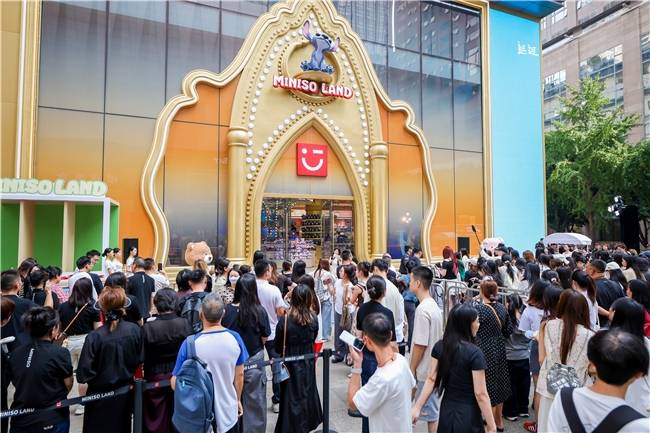
中概股深夜拉升,美国芯片股大涨,英特尔涨超9%,特朗普:不会以武力夺取格陵兰岛
2 1 Shi Ji Jing Ji Bao Dao· 2026-01-21 15:23
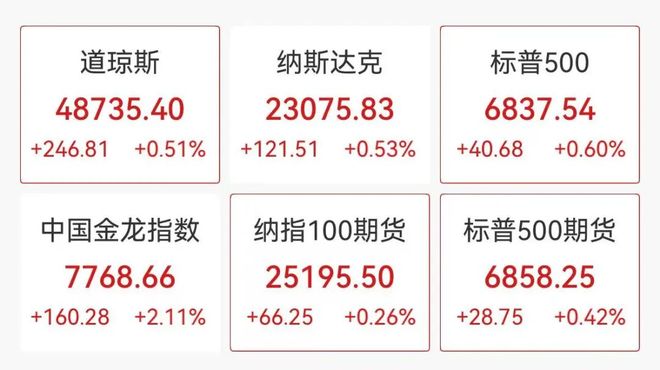
Market Overview - US stock indices opened higher, with the Dow Jones up 0.51%, Nasdaq up 0.53%, and S&P 500 up 0.6% as of 22:55 Beijing time [1] Chip Sector - Chip stocks strengthened, with Intel's share price rising over 9%, reaching a three-year high; Bernstein raised its target price from $35 to $36 [3] - ARM increased by over 6%, while Western Digital and Micron Technology rose over 3%, and SanDisk gained nearly 3% [3] Tech Sector - Tech stocks generally rose, with Tesla, Google, and Nvidia seeing gains [4] - Netflix fell by 5.5% due to a disappointing Q1 profit guidance, with EPS guidance over 7% lower than analyst expectations; the company paused its buyback to acquire Warner [4] Chinese Stocks - The Nasdaq Golden Dragon China Index rose over 2%, with popular stocks like Bilibili and Baidu increasing over 6%, and iQIYI, Kingsoft Cloud, and Miniso rising over 4% [4] - Goldman Sachs expressed optimism about Chinese assets, predicting a GDP growth rate of 4.8% for China in 2026, supported by strong export growth [4] - The firm also projected a year-end target of 100 points for the MSCI China Index and 5200 points for the CSI 300 Index, with a forecast of $200 billion (approximately 1.4 trillion yuan) in net inflows from southbound funds by 2026 [4] Commodity Market - Spot gold prices rose, reaching a high of $4888 per ounce on the 21st, approaching the $4900 mark [6] Cryptocurrency Market - Major cryptocurrencies saw declines, with Bitcoin down 1.48% below $90,000, Ethereum down 3.07%, and Dogecoin down 0.18%; over 170,000 liquidations occurred in the past 24 hours [8][9]
永辉超市亏损暴增45%,转型阵痛还是生存危机?
3 6 Ke· 2026-01-21 12:18
Core Viewpoint - Yonghui Supermarket is facing significant financial challenges as it transitions from "scale expansion" to "quality growth," with projected net losses for 2025 expected to reach -2.14 billion yuan, a 45.58% increase in losses compared to the previous year [1] Financial Performance - Yonghui Supermarket announced a projected net profit loss of -2.14 billion yuan for 2025, worsening from a loss of 1.47 billion yuan in the previous year [1] - The company plans to close 381 stores that do not align with its future strategic positioning, while also undergoing deep adjustments to 315 stores [1] - The financial impact of store adjustments includes approximately 910 million yuan in asset write-offs and one-time costs, along with an estimated 300 million yuan in gross profit losses due to store closures [3] Strategic Adjustments - In response to its financial crisis, Yonghui Supermarket has initiated a supply chain reform focused on transparency, quality, and efficiency, aiming to address traditional supply chain pain points [6] - The company is undergoing a significant restructuring, which includes closing underperforming stores and implementing a "surgical" approach to clear risks and prepare for future profitability [7][10] - The leadership changes, including the appointment of a new CEO, signal a shift towards a more youthful and dynamic management style, with a focus on product quality and customer experience [18][20] Market Position and Challenges - Yonghui Supermarket's traditional advantages in fresh produce supply chains have been diluted by competitors like Hema and Sam's Club, leading to a decline in store productivity [1] - The company is experiencing a structural decline in its large supermarket model due to competition from e-commerce and community group buying, which has eroded its market share in lower-tier cities [11][15] - The ongoing adjustments and reforms are seen as necessary but may not be sufficient to address deeper systemic issues such as low traffic, inefficient supply chains, and lagging digital transformation [16] Future Outlook - Analysts suggest that Yonghui Supermarket's ability to focus on core areas and develop a high-density, efficient store network could lead to regional profitability [10] - The company is expected to face a challenging 2026, with potential for a "loss reduction year" before possibly achieving profitability in 2027, contingent on stabilizing gross margins and reducing debt levels [10][20]