嘉实基金管理有限公司

Search documents
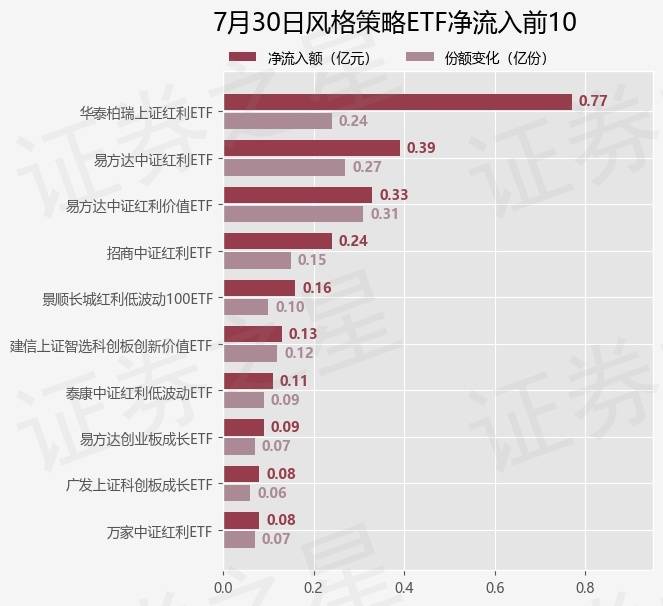
【ETF观察】7月30日风格策略ETF净流入0.04亿元
Sou Hu Cai Jing· 2025-07-31 00:29
Summary of Key Points Core Viewpoint - On July 30, the style strategy ETF funds experienced a net inflow of 3.75 million yuan, with a cumulative net inflow of 810 million yuan over the past five trading days, indicating a positive trend in investor sentiment towards these funds [1]. Fund Inflows - A total of 19 style strategy ETFs saw net inflows, with the Huatai-PB SSE Dividend ETF (510880) leading the inflow, increasing by 23.5 million shares and a net inflow of 76.78 million yuan [1][3]. - The latest scale of the Huatai-PB SSE Dividend ETF reached 18.05 billion yuan, reflecting its popularity among investors [3]. Fund Outflows - Conversely, 26 style strategy ETFs experienced net outflows, with the Huatai-PB CSI Dividend Low Volatility ETF (512890) having the largest outflow, decreasing by 56 million shares and a net outflow of 66.91 million yuan [1][4]. - The latest scale of the Huatai-PB CSI Dividend Low Volatility ETF is 21.41 billion yuan, indicating a significant reduction in investor interest [5]. Performance Metrics - The performance of various ETFs on July 30 showed slight increases for some, such as the Huatai-PB SSE Dividend ETF (0.34% increase) and the E Fund CSI Dividend ETF (0.35% increase), while others like the Huatai-PB CSI Dividend Low Volatility ETF saw a 0.42% increase despite the outflow [3][5]. - The overall trend indicates a mixed performance among the ETFs, with some gaining traction while others are losing investor confidence [4][5].

重磅会议召开!这些基金年内涨超100%!
天天基金网· 2025-07-30 11:30
Core Viewpoint - The article discusses the recent performance of the A-share market, highlighting a recovery in the Shanghai Composite Index after a political bureau meeting that released positive signals for the economy and investment opportunities in the innovative pharmaceutical sector [1][2][8]. Group 1: A-share Market Performance - The A-share market experienced a pullback but rebounded in the afternoon, with the Shanghai Composite Index closing in the green, reaching a new high for the year [2][7]. - The market showed significant structural differentiation, with consumer and banking sectors rising while technology and new energy sectors faced declines [6][7]. - The trading volume exceeded 1.84 trillion yuan, indicating active market participation [5]. Group 2: Political Bureau Meeting Insights - The Central Political Bureau meeting emphasized the need to "stably resolve local government debt risks" and introduced a roadmap for "clearing financing platforms," alleviating systemic risk concerns [9]. - The meeting also highlighted the importance of stimulating domestic demand and implementing actions to boost consumption, positively impacting sectors like tourism, retail, and food and beverage [10]. - A focus on technological innovation was reiterated, aiming to foster new competitive industries and integrate technological advancements with industrial development [12]. Group 3: Investment Opportunities in Innovative Pharmaceuticals - A significant number of funds have achieved over 100% returns this year, particularly in the innovative pharmaceutical sector, with several funds listed showing substantial year-to-date performance [17]. - Fund managers suggest a cautious yet optimistic approach to the innovative pharmaceutical sector, advising investors to match risk and return expectations and avoid excessive chasing of high-flying stocks [18][19]. - Key guidelines for selecting funds include focusing on long-term performance stability, understanding investment strategies, and aligning with personal risk preferences [20].
水产养殖板块涨幅居前,16位基金经理发生任职变动
Sou Hu Cai Jing· 2025-07-30 09:23
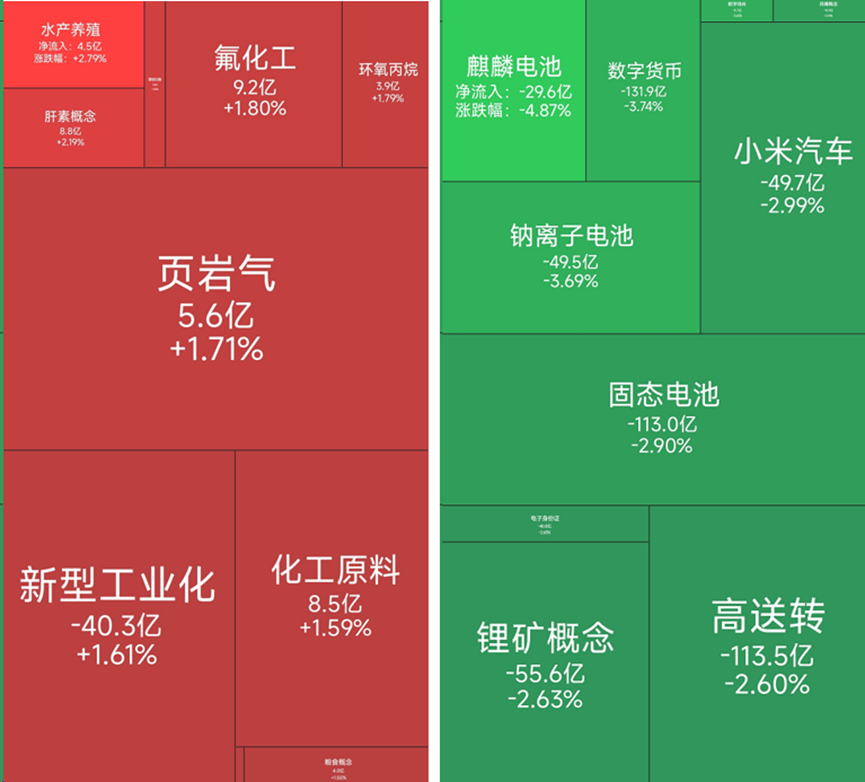
Market Performance - On July 30, A-shares showed mixed performance with the Shanghai Composite Index rising by 0.17% to 3615.72 points, while the Shenzhen Component Index fell by 0.77% to 11203.03 points, and the ChiNext Index decreased by 1.62% to 2367.68 points [1] Fund Manager Changes - In the past 30 days (June 30 - July 30), a total of 443 fund managers changed positions across various funds, with 10 announcements made on July 30 alone [3] - Reasons for fund manager departures included work changes (2 managers), personal reasons (2 managers), and product expiration (1 manager) [3] - Notable fund managers include Yu Peng from Fortune Fund, managing assets worth 287 million yuan, with a top-performing fund yielding a 71.20% return over 7 years and 250 days [3] New Fund Managers - New fund manager Cai Chengfeng from Harvest Fund manages assets totaling 613 million yuan, with a top-performing fund achieving a 186.53% return over 3 years and 54 days [4] Fund Research Activity - Fortune Fund led in company research with 47 companies surveyed, followed by Bosera Fund and Southern Fund, each with 44 companies, and Huaxia Fund with 43 companies [6] - The most researched industry was communication equipment with 193 surveys, followed by chemical pharmaceuticals with 158 [6] Recent Stock Focus - The most focused stock in the past month was Zhongji Xuchuang in the optical communication module sector, with 75 fund management companies participating in its research [6] - In the past week (July 23 - July 30), Haida Group in the feed industry was the most researched company, with 45 fund institutions involved [7]
哪些科创债已经调整出性价比?
INDUSTRIAL SECURITIES· 2025-07-29 14:02
Report Industry Investment Rating No relevant content provided. Core Viewpoints - In the week from July 21 - 25, 2025, the bond market adjusted. The net value of benchmark market - making credit bond ETFs and science - innovation bond ETFs declined significantly, and the overall net subscription of science - innovation bonds was 5.56 billion yuan. Institutions may have redeemed ETF shares to cope with liquidity shocks [4]. - After the adjustment, some science - innovation bonds have fallen to a point where they offer value. For allocation portfolios, some exchange - traded science - innovation bonds with a remaining term of 4 - 5 years are worth considering; for trading portfolios, short - term index component science - innovation bonds are more attractive [4]. - The science - innovation bond ETF is expected to expand further. After the adjustment, index component science - innovation bonds with a widening relative spread have certain value, and investors can participate at the current adjusted points and wait for the spread to recover [46]. Summary by Directory I. First Batch of Science - Innovation Bond ETFs Expanded Rapidly in One Week after Listing - On July 17, 2025, 10 science - innovation bond ETFs were listed. By July 25, the total scale exceeded 100 billion yuan, with a growth rate of over 250% [15]. - The 10 products were all raised on July 7, 2025, and the total raised scale was about 29 billion yuan, indicating strong market demand [15]. - There are differences in product elements such as redemption methods, product durations, and component bond capacities among these 10 science - innovation bond ETFs [20]. II. Index Component Bonds of Science - Innovation Bond ETFs Led the Decline in this Adjustment - In terms of net value fluctuations, the net value of benchmark market - making credit bond ETFs and science - innovation bond ETFs declined by about 0.3% in a week [29]. - In terms of subscription and redemption data, the overall net subscription of science - innovation bonds was 5.56 billion yuan, while short - term financing ETFs and benchmark market - making credit bond ETFs with good liquidity were more affected by redemptions, suggesting that institutions may have redeemed shares for liquidity reasons [4]. - In terms of the performance of underlying component bonds, science - innovation bond index component bonds had a faster adjustment speed and a larger adjustment range. Exchange - traded non - science - innovation index component science - innovation bonds and inter - bank science - innovation bonds were relatively more resilient [35]. III. Which Science - Innovation Bonds Have Fallen to an Attractive Level? - After the adjustment, the overall yield of science - innovation bonds increased, and the inversion between the average valuation of short - term component bonds and the 1 - year AAA certificate of deposit yield improved significantly. However, the yields of 1 - year - below and 1 - 2 - year science - innovation bond index component bonds of AAA grade were still 1 - 2 BP lower than the 1 - year AAA certificate of deposit yield [39]. - The relative spread between exchange - traded and inter - bank science - innovation bonds of the same issuer showed differentiation. Index component science - innovation bonds with a widening relative spread have certain value, and investors can participate at the current adjusted points [44]. - For allocation portfolios, some exchange - traded science - innovation bonds with a remaining term of 4 - 5 years are worth considering due to the relatively large increase in valuation compared to their inter - bank counterparts and the attractive static coupon income [46]. - For trading portfolios, it is more advisable to focus on 1 - 2 - year index component science - innovation bonds that have adjusted significantly, have a large outstanding scale, and a valuation higher than 1.67% [49].
宏信证券ETF日报-20250729
Hongxin Security· 2025-07-29 09:03
Market Overview - The Shanghai Composite Index rose 0.33% to close at 3609.71 points, the Shenzhen Component Index rose 0.64% to close at 11289.41 points, and the ChiNext Index rose 1.86% to close at 2406.59 points. The total trading volume of A-shares in the two markets was 1829.6 billion yuan [2][6]. - The top-performing sectors were communications (3.29%), steel (2.59%), and pharmaceutical biology (2.06%), while the bottom-performing sectors were agriculture, forestry, animal husbandry and fishery (-1.36%), banking (-1.19%), and beauty care (-0.71%) [2][6]. Stock ETF - The top-trading-volume stock ETFs were Huaxia Shanghai Science and Technology Innovation Board 50 ETF (up 1.35% with a discount rate of 1.37%), Huaxia CSI A500 ETF (up 0.59% with a discount rate of 0.60%), and Southern CSI A500 ETF (up 0.56% with a discount rate of 0.62%) [3][7]. - The table shows detailed information of the top ten trading-volume stock ETFs, including code, fund name, price, change rate, tracking index, IOPV, discount rate, trading volume, and latest share reference [8]. Bond ETF - The top-trading-volume bond ETFs were Haifutong CSI Short-term Financing Bond ETF (down 0.00% with a discount rate of -0.02%), Huaxia CSI AAA Science and Technology Innovation Corporate Bond ETF (down 0.14% with a discount rate of -0.31%), and Fuguo China Bond 7 - 10 Year Policy Financial Bond ETF (down 0.25% with a discount rate of -0.28%) [4][9]. - The table presents information of the top five trading-volume bond ETFs, including code, fund name, price, change rate, discount rate, and trading volume [10]. Gold ETF - Gold AU9999 fell 0.53% and Shanghai Gold fell 0.44%. The top-trading-volume gold ETFs were Bosera Gold ETF (down 0.34% with a discount rate of -0.42%), Huaan Gold ETF (down 0.34% with a discount rate of -0.43%), and E Fund Gold ETF (down 0.48% with a discount rate of -0.55%) [12]. - The table provides details of several gold ETFs, including code, fund name, price, change rate, trading volume, IOPV, and discount rate [13]. Commodity Futures ETF - Huaxia Feed Soybean Meal Futures ETF fell 0.21% with a discount rate of -0.48%, Jianxin Yisheng Zhengzhou Commodity Exchange Energy and Chemical Futures ETF rose 0.36% with a discount rate of -1.15%, and Dacheng Non-ferrous Metals Futures ETF fell 0.23% with a discount rate of -0.36% [13]. - The table shows information of commodity futures ETFs, including code, fund name, price, change rate, trading volume, IOPV, discount rate, tracking index, and tracking index change rate [14]. Cross - border ETF - The previous trading day, the Dow Jones Industrial Average fell 0.14%, the Nasdaq rose 0.33%, the S&P 500 rose 0.02%, and the German DAX fell 1.02%. Today, the Hang Seng Index fell 0.15% and the Hang Seng China Enterprises Index fell 0.34%. - The top-trading-volume cross - border ETFs were E Fund CSI Hong Kong Securities Investment Theme ETF (up 0.69% with a discount rate of 1.11%), GF CSI Hong Kong Innovative Drug ETF (up 4.42% with a discount rate of 4.63%), and HTF Guozheng Hong Kong Stock Connect Innovative Drug ETF (up 4.02% with a discount rate of 4.39%) [15]. - The table shows the top five trading-volume cross - border ETFs, including code, fund name, trading volume, change rate, and discount rate [16]. Money ETF - The top-trading-volume money ETFs were Yin Hua Ri Li ETF, Hua Bao Tian Yi ETF, and Money ETF Jian Xin Tian Yi [17]. - The table presents the top three trading-volume money ETFs, including code, fund name, and trading volume [19].
世界人工智能大会亮点纷呈,如何布局?
Datong Securities· 2025-07-29 07:59
Market Review - The equity market indices experienced significant gains last week, with the Sci-Tech 50 index leading at an increase of 4.63% [5][6] - The bond market saw both short and long-term interest rates rise, with the 10-year government bond yield increasing by 6.72 basis points to 1.732% [8][10] - The majority of the 31 sectors in the Shenwan index reported gains, particularly in the cyclical sectors such as construction materials (up 8.20%) and coal (up 7.98%) [5][6] Equity Product Allocation Strategy - Event-driven strategies include focusing on funds related to the "Promoting Agricultural Product Consumption Implementation Plan" and the "2025 World Artificial Intelligence Conference" [12][13] - The asset allocation strategy suggests a balanced core with a barbell approach, emphasizing dividend and technology sectors [16][17] - Recommended funds include those with a focus on dividend value, balanced styles, and technology growth [16][17] Stable Product Allocation Strategy - The central bank's net injection of 129.5 billion yuan indicates a shift from a tight to a loose monetary stance [18] - The July LPR remained unchanged at 3.0% for the one-year rate and 3.5% for the five-year rate, aligning with market expectations [18][19] - Focus on short-term bond funds while being cautious of high valuations in convertible bonds [19][23] Key Focus Products - Recommended funds include Nord Short Bond A and Huazheng Pure Bond A, with specific attention to their bond and stock allocations [24]
基金市场周报:建筑材料板块表现较优,主动投资混合基金平均收益相对领先-20250728
Shanghai Securities· 2025-07-28 11:22
Group 1 - The core viewpoint of the report indicates that the construction materials and coal industries performed well during the period, with the Shanghai Composite Index rising by 1.67% and the Shenzhen Component Index increasing by 2.33% [2][9] - In the recent 12 periods, the comprehensive and pharmaceutical industries showed strong performance, suggesting potential investment opportunities in these sectors [9] - Active equity funds focusing on electronics and coal industries also demonstrated superior performance during this period [14] Group 2 - Among various fund types, actively managed stock funds increased by 1.55%, while mixed funds rose by 1.63%, and bond funds saw a slight decline of 0.16% [2] - The average return of convertible bond funds was notably high at 12.46% year-to-date, indicating a strong performance in this category [17] - QDII funds, particularly those focused on Asia-Pacific and emerging markets, led the performance with an increase of 2.56% during the period [19][21]
QDII基金高频提醒溢价风险,更有产品单月发布20余次提示公告
Bei Jing Shang Bao· 2025-07-28 10:56
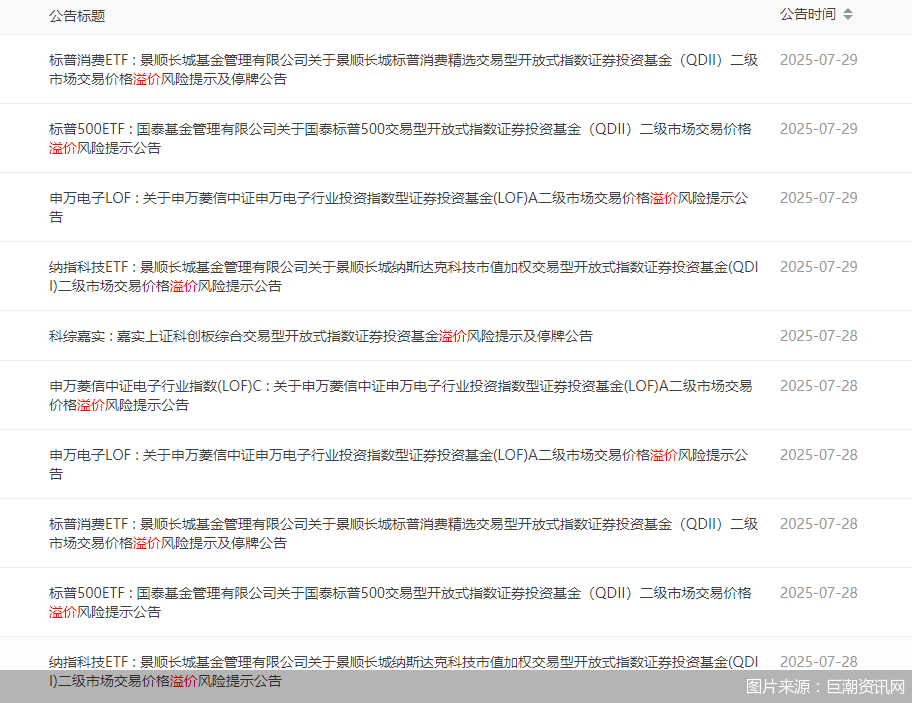
Core Viewpoint - Multiple funds have issued premium risk alerts, particularly QDII funds, indicating a significant increase in premium risk notifications since July, with a notable impact on investor decisions [1][3]. Group 1: Premium Risk Alerts - As of July 28, five funds issued premium risk alerts, contributing to over 70 notifications in July alone, with six out of ten being QDII funds [1][3]. - The Guotai S&P 500 ETF (QDII) and the Invesco Great Wall S&P Consumer ETF (QDII) have issued 21 premium risk alerts since July [1][3]. - The premium rates for the aforementioned funds reached 7.95% and 20.64% respectively as of July 28 [3]. Group 2: Market Performance and Fund Returns - The three major U.S. stock indices have shown year-to-date gains of 5.54%, 9.31%, and 8.62% respectively [4]. - The performance of QDII funds has been notable, with the Huatai-PineBridge Hong Kong Advantage Selected Mixed Fund (QDII) achieving a year-to-date return of 135.58%, ranking first among all market products [4]. - Other QDII funds in the healthcare and innovation sectors have also reported year-to-date returns exceeding 80% [4]. Group 3: Market Valuation and Investment Considerations - The forward P/E ratio of the S&P 500 index has reached 23.3, indicating limited valuation attractiveness [5]. - Market analysts suggest that while the U.S. market may continue to trend upward, uncertainties remain, and significant investments should be approached with caution due to high premium risks [5]. - Investors are advised to monitor premium rates closely, with alerts for rates exceeding 5% and heightened caution for rates above 10% due to potential liquidity risks [5].
嘉实基金管理有限公司 关于终止大华银行(中国)有限公司办理本公司旗下基金销售业务的公告
Zhong Guo Zheng Quan Bao - Zhong Zheng Wang· 2025-07-27 23:11
Group 1 - The company will terminate its cooperation with Dahua Bank (China) in fund sales business effective from July 29, 2025, which includes subscription, purchase, regular investment, and conversion services [1] - Investors who purchased and held the company's funds through Dahua Bank (China) must complete the transfer or redemption of their fund shares by 15:00 on July 28, 2025, or their holdings will be transferred to the company's direct sales platform [1] - The company will resume normal subscription (including conversion and regular investment) services for individual investors in its bond fund starting from July 30, 2025, to meet investor demand [4] Group 2 - The company has signed an open-end fund sales agreement with several securities firms, including GF Securities, Huatai Securities, and CITIC Securities, allowing these institutions to handle cash subscription and account opening for the company's Hang Seng Technology Theme Index Fund starting from July 28, 2025 [4]

嘉实中证央企创新驱动ETF投资价值分析:一键布局具有创新活力的优质央企
Guotou Securities· 2025-07-27 10:29
Quantitative Models and Construction Methods Model Name: Central Enterprise Innovation Index (000861.CSI) - **Model Construction Idea**: The index selects 100 representative listed companies under the State-owned Assets Supervision and Administration Commission (SASAC) based on their innovation and profitability to reflect the overall performance of innovative central enterprises[8] - **Model Construction Process**: - **Sample Space**: All listed companies under SASAC[9] - **Step 1**: Rank the securities in the sample space by average daily trading volume over the past year and exclude the bottom 20%[9] - **Step 2**: Select the remaining securities controlled by SASAC and its subsidiaries[9] - **Step 3**: Exclude securities with negative operating cash flow in the past year and negative net profit excluding non-recurring items in the past two years[9] - **Step 4**: Calculate the innovation score for non-financial companies based on R&D expenditure, R&D personnel ratio, patent quality score, and participation in national or industry standards. For financial companies, use revenue, net profit, patent quality score, and participation in standards[9] - **Step 5**: Rank the remaining securities by innovation score and select the top 50% as innovation-themed securities[9] - **Step 6**: Calculate the quality score for non-financial companies based on ROE, net profit growth, earnings quality, and financial leverage. For financial companies, use ROE and net profit growth. Combine the quality score with the scale score (based on market cap) to get a comprehensive score[9] - **Step 7**: Select the top 100 securities by comprehensive score as index samples[9] - **Adjustment**: The index samples are adjusted semi-annually[9] - **Model Evaluation**: The index is designed to reflect the performance of innovative central enterprises, with a focus on maintaining representativeness and accuracy through regular adjustments[8][9] Model Backtesting Results - **Central Enterprise Innovation Index**: - **Cumulative Return Since Inception**: 138.08%[5][10] - **Excess Return Over Major Indices**: - CSI 300: 79.25%[5] - SSE Composite Index: 83.67%[5] - CSI 500: 54.40%[5] - CSI 800: 74.09%[5] - **5-Year Cumulative Return**: 33.70%[10] - **Excess Return Over Major Indices in 5 Years**: - CSI 300: 49.24%[10] - SSE Composite Index: 29.47%[10] - CSI 800: 47.94%[10] Quantitative Factors and Construction Methods Factor Name: Innovation Score - **Factor Construction Idea**: Evaluate the innovation capability of non-financial and financial companies based on specific indicators[9] - **Factor Construction Process**: - **Non-Financial Companies**: - R&D expenditure to market cap ratio (40% weight) - R&D personnel ratio (10% weight) - Patent quality score (40% weight) - Participation in national or industry standards (10% weight)[9] - **Financial Companies**: - Revenue (40% weight) - Net profit (10% weight) - Patent quality score (40% weight) - Participation in national or industry standards (10% weight)[9] - **Calculation**: Sum the weighted scores to get the innovation score[9] Factor Name: Quality Score - **Factor Construction Idea**: Assess the financial quality of companies based on profitability and financial stability[9] - **Factor Construction Process**: - **Non-Financial Companies**: - ROE (30% weight) - Net profit growth (35% weight) - Earnings quality (25% weight) - Financial leverage (10% weight)[9] - **Financial Companies**: - ROE (50% weight) - Net profit growth (50% weight)[9] - **Calculation**: Sum the weighted scores to get the quality score[9] Factor Backtesting Results - **Innovation Score**: - **Top 50% Selection**: Used to identify innovation-themed securities[9] - **Quality Score**: - **Comprehensive Score Calculation**: Combined with scale score to select top 100 securities[9]