
鹏华基金

Search documents
ETF市场跟踪与配置周报-20260117
Xiangcai Securities· 2026-01-17 12:21
Report Industry Investment Rating No relevant content provided. Core Views - PB-ROE framework's ETF rotation strategy recommends next week to focus on the communication, agriculture, forestry, animal husbandry, and transportation industries, corresponding to their industry ETFs; the ETF redemption sentiment indicator model suggests focusing on the Science and Technology Innovation 50 ETF, SSE 50 ETF, Medical ETF, Photovoltaic ETF, and Robot ETF [9][40] - Combining PB and ROE for industry configuration may be a better choice; the third quadrant's high PB high ROE and the fifth quadrant's low PB medium ROE are key focus areas; combining the third and fifth quadrants to construct a comprehensive PB-ROE strategy has an annualized return of 11.93% and an annualized excess return of 13.22% [32][33] Summary by Directory 1. Recent Market Overview (January 12 - January 16, 2026) - Index performance: Shanghai Composite Index closed at 4101.91, down 0.45% for the week; Shenzhen Component Index closed at 14281.08, up 1.14%; ChiNext Index closed at 3361.02, up 1.00%; Beijing Stock Exchange 50 closed at 1548.33, up 1.58%; Hang Seng Index closed at 26844.96, up 2.34%. The average daily trading volume of the Shanghai and Shenzhen stock markets was 34250.96 billion yuan, and the total trading volume for the week was 17.13 trillion yuan [12] - Industry performance: Among 31 Shenwan primary industries, 13 industries rose and 18 fell. The top three gainers were computer (up 3.82%), electronics (up 3.77%), and non-ferrous metals (up 3.03%); the top three losers were national defense and military industry (down 4.92%), real estate (down 3.52%), and agriculture, forestry, animal husbandry, and fishery (down 3.27%) [5][12] - Main funds: Main funds had net outflows for 5 trading days and no net inflows, with a total net outflow of 2752.39 billion yuan for the week. The industries with more net inflows were banks, public utilities, and coal; the industries with more net outflows were national defense and military industry, power equipment, and computer [5][13] 2. Recent ETF Market Performance (January 12 - January 16, 2026) - Overall situation: As of January 16, 2026, there were 1411 ETFs in the Shanghai and Shenzhen stock markets, with a total asset management scale of 60766.01 billion yuan. There were 1101 equity ETFs (38892.41 billion yuan), 53 bond ETFs (7479.66 billion yuan), 27 money market ETFs (1529.88 billion yuan), 17 commodity ETFs (2751.84 billion yuan), 207 cross-border ETFs (10070.46 billion yuan), and 6 unlisted ETFs (41.76 billion yuan) [20] - Newly listed and established ETFs: 8 ETFs were newly listed, all equity ETFs; 7 ETFs were newly established, with a total issuance scale of 51.24 billion yuan [21] - Equity ETFs: The median weekly increase or decrease was 0.59%. Science and technology semiconductor ETFs and semiconductor equipment ETFs performed well, with the Science and Technology Semiconductor ETF Peng Hua rising the most at 12.46%; aerospace and high-end equipment ETFs performed poorly, with the Aerospace ETF falling the most at 6.88%. The average weekly share change was a decrease of 19.4716 million shares. Software ETFs and media ETFs had more share increases, while the Science and Technology Innovation 50 ETF and CSI 300 ETF had more share decreases [24] - Bond ETFs: The median weekly increase or decrease of 53 bond ETFs was 0.12%. The convertible bond ETF had the highest increase of 0.91%, while the science and technology innovation bond ETF had the highest decrease of 0.00%. As of January 16, 2026, the Haifutong CSI Short-term Financing ETF had the largest scale of 631.50 billion yuan [27] - Cross-border ETFs: The median weekly increase or decrease was 1.18%. The China-South Korea Semiconductor ETF and Hong Kong Stock Connect Internet ETF had the highest increases, with the China-South Korea Semiconductor ETF rising 6.11%; the Hong Kong Securities ETF and Nasdaq Biotechnology ETF had the highest decreases, with the Hong Kong Securities ETF falling 2.28%. Since the beginning of the year, the median increase or decrease was 3.82%, with the China-South Korea Semiconductor ETF and Hong Kong Medical ETF having higher increases, and the Nasdaq ETF and Nasdaq Technology ETF having higher decreases [29] 3. PB-ROE Framework's ETF Rotation Strategy Tracking - Factor effectiveness: PB factor and PB quantile factor show certain stratification ability, and PB quantile factor is more effective; ROE factor's effectiveness declined after 2018; using ROE factor is better than ROE quantile factor; expected ROE factor is better than expected ROE year-on-year factor. Combining PB and ROE for industry configuration may be a better choice [32] - Key quadrants: The third quadrant's high PB high ROE and the fifth quadrant's low PB medium ROE are key focus areas. From 2017 to February 2024, the compound annualized excess returns of the third and fifth quadrant portfolios were 4.27% and 1.55% respectively [32] - Strategy improvement: After supplementing the PB-ROE framework with four dimensions, the annualized excess returns of the third and fifth quadrant strategies were 4.78% and 3.94% respectively. Combining the two strategies, the annualized return was 11.93% and the annualized excess return was 13.22% [33] - Recent performance: This week, the strategy focused on the communication, agriculture, forestry, animal husbandry, and transportation industries, with a cumulative return of -0.86%, and an excess return of -0.29% compared to the CSI 300 Index [8][34] - Performance since 2023: The cumulative return was 26.03%, with an excess return of 3.81% compared to the CSI 300 Index [8][36] - Performance since 2022: The cumulative return was 7.77%, with an excess return of 11.99% compared to the CSI 300 Index [39] 4. Investment Recommendations - PB-ROE framework: Focus on the communication, agriculture, forestry, animal husbandry, and transportation industries next week, corresponding to their industry ETFs [9][40] - ETF redemption sentiment indicator model: Focus on the Science and Technology Innovation 50 ETF, SSE 50 ETF, Medical ETF, Photovoltaic ETF, and Robot ETF next week [9][40]
公募基金能否接下这50万亿?
投中网· 2026-01-17 07:03
Core Viewpoint - The article discusses the significant inflow of funds into public offerings, particularly focusing on "fixed income +" and Fund of Funds (FOF) products, as a response to the upcoming maturity of a large volume of fixed deposits, estimated to be between 30 trillion to 60 trillion yuan by 2026, with an average forecast of around 50 trillion yuan [4]. Group 1: Performance of Multi-Asset Products - The "fixed income +" and FOF products have shown impressive performance, with the total management scale of public FOF funds reaching 238.3 billion yuan by the end of 2025, marking a historical high with an annual growth of 100 billion yuan [5]. - The "fixed income +" funds reached a scale of 2.53 trillion yuan, growing over 700 billion yuan within the year, indicating a strong market demand for these products [5][20]. - Notable performances include the "fixed income +" fund from China Universal, which achieved a return of 37% in 2025, and the FOF fund from Guotai, which returned 66.14% [6][17]. Group 2: Trends in Public Fund Products - There are two prominent trends in public fund products: the toolization of products, particularly ETFs, and the multi-asset allocation strategy that aims for stable performance across different market conditions [9][10]. - The toolization trend is evident in both equity and bond products, with a significant increase in bond ETFs, which have surpassed 700 billion yuan [9]. - The multi-asset allocation strategy seeks to balance investments between stocks and bonds based on market conditions, enhancing the potential for stable returns [10][12]. Group 3: Market Dynamics and Future Outlook - The growth of multi-asset products is expected to continue, driven by the increasing acceptance of "fixed income +" and FOF products among retail and institutional investors [22]. - The public fund industry is witnessing a shift towards more systematic and quantitative asset allocation strategies, moving away from reliance on subjective judgment [24][27]. - The competitive landscape is changing, with companies like China Universal and Invesco Great Wall rapidly expanding their multi-asset offerings, indicating a potential shift in market leadership [38][41].


岁末年初,公募密集布局这类ETF
Sou Hu Cai Jing· 2026-01-17 06:48
Core Viewpoint - The precious metals market has seen significant price increases since the beginning of 2026, leading to heightened interest and investment in related ETFs, with public funds actively launching products in this sector [1][2]. Group 1: Market Performance - Since the beginning of 2025, the precious metals index has increased by nearly 107% [3]. - As of January 16, 2026, related ETFs have attracted a total of 242.93 billion yuan in investments this year [3]. - The Southern Precious Metals ETF has seen a growth of 129.9 billion yuan, reaching a total size of 335.50 billion yuan [4]. Group 2: Fund Launches - A total of 15 precious metals-related fund products have been reported since early December 2025, with major fund companies like Huatai-PineBridge, Huaxia, and Ping An among those launching new ETFs [3]. - The focus on upstream rare resources in the precious metals mining sector has been highlighted as a strong performer [3]. Group 3: Market Dynamics - Short-term volatility in the precious metals sector is expected to increase, driven by high market sentiment and rising margin balances [5][6]. - Despite recent price corrections, the long-term value proposition of the sector remains intact, supported by expectations of interest rate cuts and strong demand from energy transition and digital infrastructure [7]. Group 4: Supply and Demand Factors - Supply constraints are evident due to declining ore grades, insufficient capital expenditure, and geopolitical risks, while demand is bolstered by the explosive growth in electric vehicles and renewable energy sectors [7]. - The competition for resources in high-end manufacturing, including AI and semiconductors, is expected to further support metal prices [7]. Group 5: Risks and Uncertainties - Investors are advised to be cautious of multiple uncertainties, including potential volatility from high valuations and geopolitical tensions affecting supply chains [9]. - The market is also sensitive to changes in monetary policy and economic growth rates, which could impact the sector's performance [9].
挖掘超额收益新路径!ETF申报与发行成基金布局新风向标?
券商中国· 2026-01-17 04:58
Core Viewpoint - The boundary between passive investment ETFs and actively managed funds is increasingly blurring, with ETFs becoming a key indicator for active equity funds in identifying industry trends and market turning points [1][2]. Group 1: ETF and Active Equity Fund Interaction - The direction of ETF applications is becoming a "barometer" for many active equity funds, reflecting market demand and profitability [2]. - Active equity funds are increasingly adopting ETF-like characteristics, with top-performing products in 2025 showing high concentration in specific sectors, often exceeding 90% in positions [2]. - The issuance of ETFs is often seen as a precursor to industry booms, as evidenced by the rapid rise of the robotics sector following the launch of several ETFs [2]. Group 2: Sector-Specific Trends - The commercial aerospace sector has gained attention from active equity funds following the launch of the first satellite ETF, indicating a shift in investment focus [3]. - A decrease in ETF applications for consumer sectors has led to a corresponding reduction in active equity fund allocations to these areas, demonstrating a synchronized response to market trends [3]. Group 3: ETF as a Research Tool - The logic behind ETF applications has evolved from merely capturing flows to predicting industry turning points, thereby enhancing the research capabilities of active equity funds [4]. - The recent surge in chemical ETFs reflects a strategic shift in product development, aligning with active fund managers' anticipations of market reversals [5]. Group 4: Confidence in Market Recovery - ETF applications serve as confidence anchors during industry downturns, with recent ETF launches in the solar and battery sectors signaling potential market recoveries [6]. - The issuance of ETFs during low points in the market suggests a strategic approach to capitalize on upcoming industry recoveries, supported by favorable policy changes [6]. Group 5: Collaborative Advantages - The synergy between ETF product development and research departments is becoming a significant advantage for public funds, enhancing their ability to identify and capitalize on niche opportunities [7]. - The evolving role of ETFs as precursors to active fund investments provides liquidity for sectors that are undervalued and poised for recovery, creating a closed loop of investment strategy [7].

多只新基金提前结募宽基ETF频现天量成交
Shang Hai Zheng Quan Bao· 2026-01-16 18:34
Group 1 - The market is experiencing a mixed trend in fund flows, with equity funds announcing early closure of fundraising due to high subscription amounts exceeding their limits [1] - Several broad-based ETFs have seen significant trading volumes but are also facing substantial redemptions [1] - Industry experts believe that while equity assets still hold investment value, caution is advised to avoid blindly chasing high prices and to focus on quality targets based on industry trends [1] Group 2 - New fund issuance has accelerated, with multiple equity funds announcing early closure of fundraising, some within a single day [2] - For instance, Penghua Fund's ETF for industrial and non-ferrous metals closed fundraising early on January 15, having met the necessary conditions [2] - The trend of shortening fundraising periods indicates that fund managers aim to establish funds quickly and capitalize on market momentum [2] Group 3 - The issuance of equity funds has seen significant interest, with notable funds like E Fund's enhanced index fund raising 2.15 billion and Robeco's fund raising 1.262 billion [3] - However, there is a noticeable decline in fund flows for ETFs, with a net redemption of 68.5 billion on January 15 and 8.8 billion on January 14 [3] - Specific ETFs faced large redemptions, including Huatai-PB CSI 300 ETF with a net redemption of 20.157 billion and E Fund's Sci-Tech 50 ETF with 10.479 billion [3] Group 4 - On January 16, several broad-based ETFs continued to see significant trading volumes, with Huaxia CSI 300 ETF achieving a record trading volume of 22.7 billion [4] - Huatai-PB CSI 300 ETF also recorded a trading volume of 25.9 billion, ranking second only to a previous high [4] - Experts predict increased market volatility in 2026 but highlight the presence of structural opportunities, particularly in sectors like AI, solid-state batteries, robotics, and innovative pharmaceuticals [4]
资金流向,新变化
Zhong Guo Zheng Quan Bao· 2026-01-16 13:13
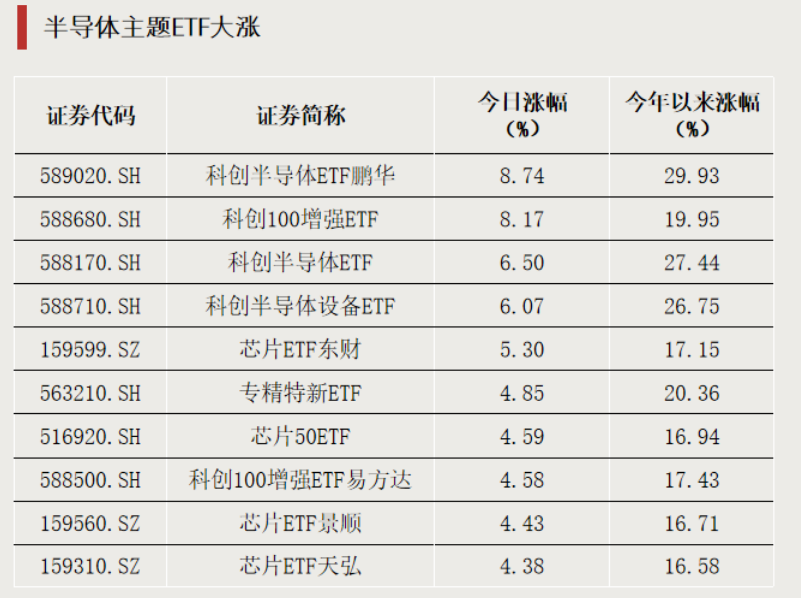
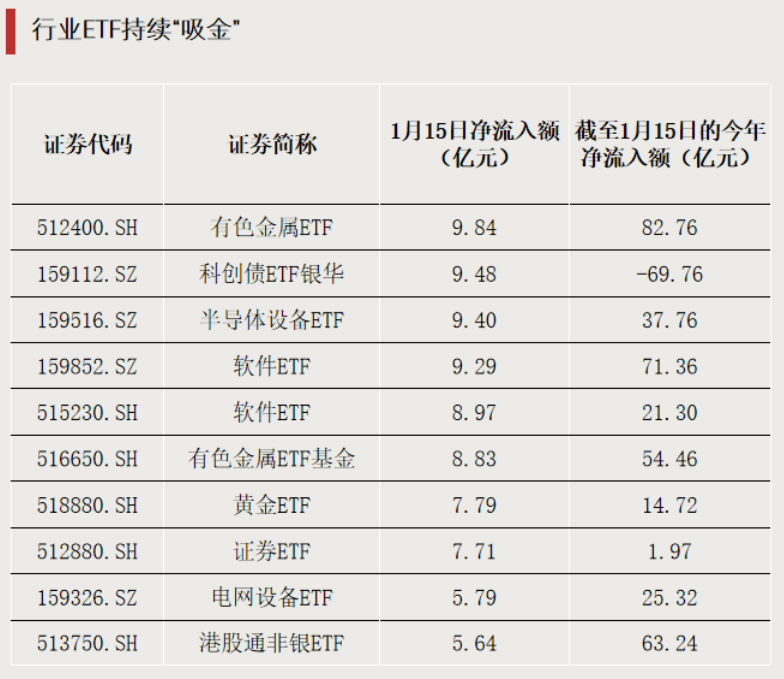
Market Overview - On January 16, the overall ETF market experienced a decline, with semiconductor-themed ETFs showing strong performance, as several products rose against the trend and made it to the top ten gainers of the day [1] - The total trading volume of ETFs exceeded 750 billion yuan, setting a historical record, with 23 ETFs having a single-day trading volume exceeding 10 billion yuan [2][12] - The ETF market saw a significant net outflow of over 68 billion yuan, marking the highest single-day outflow of the year, with a clear divergence in fund flows [3][8] Semiconductor ETFs Performance - On January 16, semiconductor-themed ETFs rose sharply, with seven out of the top ten gainers being ETFs focused on semiconductors, tracking the Shanghai Stock Exchange's Sci-Tech Innovation Board Semiconductor Materials and Equipment Index and the CSI Chip Industry Index [4] - The Penghua Sci-Tech Semiconductor ETF (589020) led the gains with an 8.74% increase, bringing its year-to-date gain to 29.93%, making it the highest-performing ETF in the same period [5][4] - All top ten ETFs by year-to-date performance are focused on the semiconductor sector, with gains exceeding 20%, primarily targeting semiconductor materials and equipment [4] Media and Entertainment ETFs Performance - Media and entertainment-themed ETFs experienced a notable decline, occupying the top six positions for the largest losses, with declines exceeding 4% [6] - The two leading media ETFs saw declines of over 5%, with their market trading prices showing significant discounts [6][7] Fund Flow Dynamics - The ETF market experienced a significant net outflow of over 68 billion yuan, with stock-type ETFs facing the majority of the outflows, exceeding 67 billion yuan [8] - Industry ETFs continued to attract capital, with nine products making it to the top ten net inflows, primarily in sectors such as non-ferrous metals, semiconductor equipment, software, gold, securities, and electric grid [8] - The top net inflow was recorded by the Non-Ferrous Metals ETF (512400) with a net inflow of 9.84 billion yuan, totaling over 8 billion yuan in net inflows year-to-date [9][8] Notable ETFs and Their Performance - The following ETFs were highlighted for their performance: - Penghua Sci-Tech Semiconductor ETF (589020): +8.74% today, +29.93% YTD [5] - Sci-Tech 100 Enhanced ETF (588680): +8.17% today, +19.95% YTD [5] - Media ETF (159805): -5.61% today, +18.84% YTD [7] - Film and Television ETF (516620): -5.07% today, +9.74% YTD [7]
资金流向,新变化!
Zhong Guo Zheng Quan Bao· 2026-01-16 13:06
Group 1: ETF Market Overview - On January 16, the overall ETF market experienced a decline, with semiconductor-themed ETFs showing strong performance, as several products rose against the trend and entered the top ten gainers of the day [1][4] - The total trading volume of ETFs exceeded 750 billion yuan, setting a historical record, with 23 ETFs having a single-day trading volume exceeding 10 billion yuan [2][12] - The ETF market saw a significant net outflow of over 68 billion yuan, marking the highest single-day outflow of the year, with a clear divergence in fund flows [3][8] Group 2: Sector Performance - Semiconductor-themed ETFs surged, with seven out of the top ten gainers focusing on the semiconductor sector, particularly tracking the Shanghai Stock Exchange's semiconductor materials and equipment index [4][5] - The leading semiconductor ETF, Penghua (589020), rose by 8.74% on the day and has accumulated a year-to-date increase of 29.93%, making it the highest-performing ETF in the same period [4] - Conversely, media and entertainment-themed ETFs experienced a notable decline, with the top six losers all dropping over 4%, and some trading at a discount [6][7] Group 3: Fund Flow Dynamics - The net outflow from the ETF market was primarily driven by stock-type ETFs, which saw a net outflow of over 67 billion yuan, while industry ETFs continued to attract capital [8][9] - Among the top ten net inflows, several industry ETFs focused on non-ferrous metals, semiconductor equipment, software, gold, and securities [8] - The non-ferrous metals ETF (512400) led with a net inflow of 9.84 billion yuan, with a year-to-date net inflow exceeding 8 billion yuan, ranking second in the market [9] Group 4: Future Industry Insights - The investment outlook for the AI industry chain is high, with expectations of significant growth driven by AI, supply chain restructuring, and structural inflation [10] - The storage industry is anticipated to perform well in 2026, driven by AI-induced supply-demand imbalances, with increasing demand for advanced storage solutions [10]
基金公司以“高比例分红”为卖点,助机构投资者避税,监管出手
Mei Ri Jing Ji Xin Wen· 2026-01-16 11:49
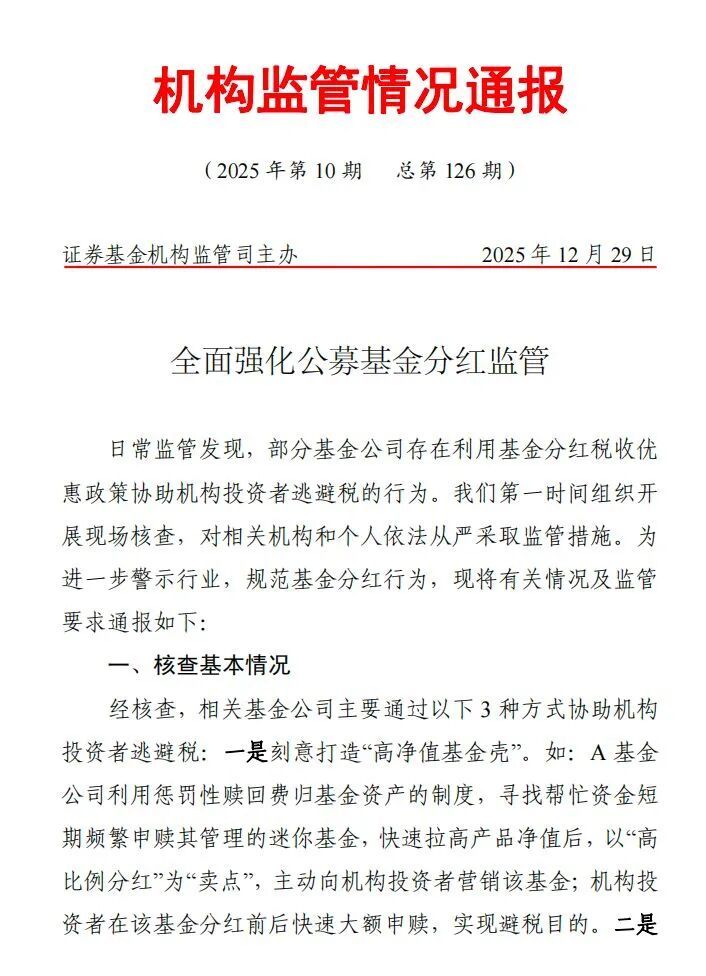
Core Viewpoint - Recent regulatory documents have reported that some fund companies are using dividend tax incentives to assist institutional investors in tax evasion, leading to strict penalties for the violating institutions [1][2][9] Group 1: Regulatory Actions - Regulatory scrutiny has focused on three specific behaviors of fund companies that facilitate tax evasion through dividend strategies [2][9] - The regulatory body has emphasized the importance of compliance and has previously reprimanded executives for similar practices [9][10] Group 2: Tax Planning Strategies - Institutions often incorporate dividend income into corporate revenue as a tax planning strategy, as dividends are not subject to corporate income tax, unlike capital gains [8][10] - Many investment institutions are increasingly considering high-dividend products as essential for their asset allocation [8][10] Group 3: Industry Trends - Despite concerns over some improper dividend practices, the trend towards regular dividends remains strong, with over 400 funds having distributed dividends since the beginning of the year [11][12] - The number of funds implementing dividends has increased, with 7,674 funds distributing a total of 2,424.78 billion yuan in 2025, although the instances of single high-dividend distributions have decreased [10][11] Group 4: Innovations in Dividend Mechanisms - Fund companies are accelerating the pace of dividend distributions, with many now incorporating dividend mechanisms directly into fund contracts, enhancing the regularity and predictability of dividends [11][12] - The introduction of structured dividend policies, such as minimum annual distributions and specific timing for dividends, is becoming more common, which may enhance product attractiveness [12]
部分基金公司以“高比例分红”为“卖点”,协助机构投资者避税,监管出手:对违规机构从严惩处!
Mei Ri Jing Ji Xin Wen· 2026-01-16 11:05
Core Viewpoint - Recent regulatory documents have reported that some fund companies are using dividend tax incentives to assist institutional investors in tax evasion, leading to strict penalties for the violating institutions [1][4]. Group 1: Regulatory Findings - The regulatory review identified three main methods used by fund companies to help institutional investors evade taxes: creating "high-net-worth fund shells," leaking dividend information, and implementing dividends based on specific client requests [3][4]. - The review highlighted that some fund companies deliberately inflate fund net values to market high dividend payouts, which institutional investors exploit for tax evasion [4][5]. Group 2: Industry Response and Trends - Despite the identified violations, the overall trend in the industry remains towards healthy dividend practices, supported by policy encouragement and innovative dividend mechanisms from fund managers [2][8]. - The number of funds implementing dividends has increased, with 7,674 funds distributing dividends in 2025, up from 6,805 in 2024, indicating a shift towards more compliant dividend distributions [8]. Group 3: Dividend Mechanisms and Strategies - Many funds are now incorporating dividend mechanisms directly into their contracts, ensuring that dividends are a standardized practice rather than an ad-hoc decision [9][10]. - The introduction of minimum dividend frequency requirements and specific payout ratios in fund contracts is becoming common, enhancing the attractiveness of these products [10]. Group 4: Future Outlook - Analysts predict that both equity and bond funds will continue to see stable and optimized dividend distributions, with a focus on sustainable practices that align with actual earnings [11].

科创债ETF鹏华(551030)今日成交额超90亿,货币宽松预期下有望带来债市修复行情
Xin Lang Cai Jing· 2026-01-16 09:52
Group 1 - The central bank's monetary policy will continue to focus on structural measures, with a reduction of 0.25 percentage points in various structural monetary policy tool rates to lower social financing costs and support key sectors [1] - There is room for interest rate cuts and reserve requirement ratio reductions, which will be used flexibly and efficiently [1] - The central bank will dynamically adjust the scale of bond purchases based on market conditions to prevent sharp market fluctuations [1] Group 2 - The Penghua Science and Technology Innovation Bond ETF (551030) is one of the first ten such ETFs, tracking the Shanghai Stock Exchange AAA-rated technology innovation corporate bond index [2] - Compared to single bond investment strategies, the ETF offers advantages such as low fees, low trading costs, high transparency, high diversification, and efficient "T+0" redemption, which helps to mitigate investment portfolio risks and improve capital efficiency [2] - Penghua Fund has established a long-term strategy for fixed income tools since the second half of 2018, actively positioning itself in various fixed income index products and aiming to become a domestic expert in fixed income indices [2]