三花智控

Search documents
主力资金丨机器人概念热门股尾盘遭主力大幅砸盘
Zheng Quan Shi Bao Wang· 2026-01-22 12:16
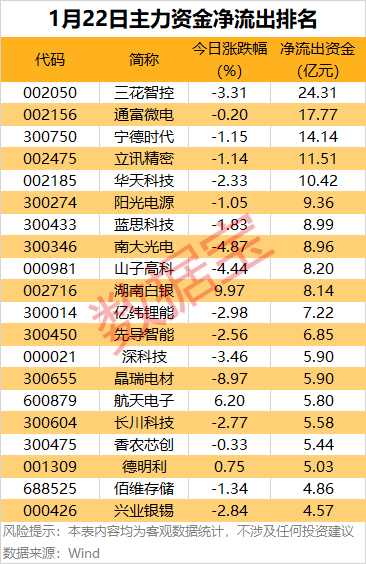
Market Overview - On January 22, A-shares saw all three major indices rise collectively, with significant gains in sectors such as aerospace, mining, shipbuilding, glass fiber, gas, oil, photovoltaic equipment, coal, and cement [1] - The main funds in the Shanghai and Shenzhen markets experienced a net outflow of 10.442 billion yuan, while 14 industries saw net inflows [1] Sector Performance - The telecommunications, defense, and non-bank financial sectors had the highest net inflows, amounting to 7.884 billion yuan, 2.916 billion yuan, and 1.371 billion yuan respectively [1] - In contrast, the electronics, power equipment, non-ferrous metals, and basic chemicals sectors faced the largest net outflows, totaling 7.979 billion yuan, 5.42 billion yuan, 2.773 billion yuan, and 2.077 billion yuan respectively [1] Individual Stock Highlights - A total of 51 stocks received net inflows exceeding 200 million yuan, with nine stocks seeing inflows over 600 million yuan [1] - The top three stocks attracting main fund inflows were New Yisheng, Zhongji Xuchuang, and Tianfu Communication, with net inflows of 2.193 billion yuan, 2.188 billion yuan, and 1.337 billion yuan respectively [1] Earnings Forecast - Tianfu Communication announced an earnings forecast for 2025, expecting a net profit attributable to shareholders of approximately 1.881 billion to 2.15 billion yuan, representing a year-on-year growth of 40% to 60% [2] Tail-End Fund Movements - In the tail-end trading session, the main funds saw a net inflow of 1.797 billion yuan, with the telecommunications sector leading with over 1 billion yuan in inflows [5] - Notable stocks with significant tail-end inflows included China Great Wall, New Yisheng, and Industrial Fulian, each exceeding 200 million yuan [5] Notable Outflows - The robot concept stock Sanhua Intelligent Control experienced a net outflow exceeding 400 million yuan, while other companies like Ningde Times and Tongfu Microelectronics also saw significant outflows [7]







汽车行业投资策略:复盘20年汽车行情,探寻总量红利消退期的投资机遇
Guoxin Securities· 2026-01-22 10:50
Investment Rating - The automotive industry is rated as "Outperform" [1][4][5] Core Insights - The report explores the relationship between the automotive industry's prosperity (sales growth) and the valuation of the automotive sector, indicating that while the industry faces pressures from diminishing total growth, it also encounters transformative opportunities from rapid AI model iterations [1][2] - The correlation between industry prosperity and sector valuation has weakened since 2019, leading to two key effects: decoupling effect and asymmetric effect, where high prosperity can drive valuation increases, but low prosperity does not necessarily lead to valuation declines [2][21] - The automotive industry is transitioning to a low growth phase, with total sales expected to stabilize, while structural opportunities arise from exports, smart vehicles, and robotics [3][52] Summary by Sections Relationship Between Valuation and Prosperity - There is a long-term positive correlation between automotive sector valuation and industry prosperity, with valuation showing a leading indicator effect on sales growth [11][15] - Monthly valuation of the automotive sector has a strong correlation with monthly sales growth, indicating that current valuations reflect future sales growth expectations [19][15] Decoupling and Asymmetric Effects - The relationship between prosperity and valuation has decoupled since 2019, with high prosperity not being a necessary condition for high valuation [21][23] - High prosperity can enhance valuation, while low prosperity does not necessarily suppress it, indicating a structural shift in valuation dynamics [35][36] Three-Cycle Theory - The automotive industry is influenced by three cycles: macroeconomic cycle, industrial technology cycle, and policy cycle, which together affect the industry's fundamentals and valuation [39][48] - The shift in dominant cycles from macroeconomic and policy cycles to industrial technology cycles has led to a redefinition of valuation logic, emphasizing structural opportunities over total growth [40][49] Future Outlook - The automotive industry is expected to enter a phase of normalized low growth, with total sales projected to stabilize around 34.89 million units in 2025, reflecting a growth rate of approximately 11% [52][56] - The report highlights the potential for structural growth driven by advancements in AI and smart vehicle technologies, which are anticipated to become new engines of valuation growth [3][52]
【今日龙虎榜】游资联手量化抢筹三角防务, 机构狂买湖南白银!
摩尔投研精选· 2026-01-22 10:17
Core Viewpoint - The article highlights the significant inflow of funds into the communication sector, with notable trading activity in various ETFs and stocks, particularly in the commercial aerospace and gas turbine sectors, indicating potential investment opportunities [1][3][10]. Group 1: Sector Performance - The communication sector led the net inflow of funds, amounting to 75.03 billion, with a net inflow rate of 5.42% [3]. - Other sectors with substantial net inflows included national defense (56.75 billion, 3.44%) and electric power equipment (16.66 billion, 2.11%) [3]. - Conversely, the electronic sector experienced the highest net outflow, totaling -132.93 billion, with a net outflow rate of -2.41% [4][6]. Group 2: ETF Trading Activity - The Standard & Poor's Oil and Gas ETF (159518) saw a remarkable increase in trading volume, with a 185% rise compared to the previous trading day, reaching a transaction amount of 4.24 billion [9]. - Other ETFs with significant growth included the Chemical 50 ETF (159.60%) and the Sci-Tech Innovation 50 ETF (147.05%) [9]. Group 3: Stock-Specific Fund Flows - The top stocks with net inflows included Zhongji Xuchuang (25.14 billion, 10.36%), Xinyi Liu (24.12 billion, 13.69%), and Industrial Fulian (14.36 billion, 10.43%) [5]. - In contrast, the stocks with the highest net outflows were Sanhua Intelligent Control (-23.76 billion, -20.48%) and Tongfu Microelectronics (-17.54 billion, -10.80%) [6][7]. Group 4: Institutional and Retail Activity - Institutional investors showed significant activity, with Hunan Silver receiving 3.83 billion from four institutions, while Godewei saw a 19.95% increase in stock price with 2.39 billion bought by one institution [10]. - Retail investors were also active, with Triangular Defense reaching a 20% limit up, supported by a 1.09 billion purchase from a leading retail investor [13].



数据复盘丨132股获主力资金净流入超1亿元 龙虎榜机构抢筹16股
Zheng Quan Shi Bao Wang· 2026-01-22 09:50
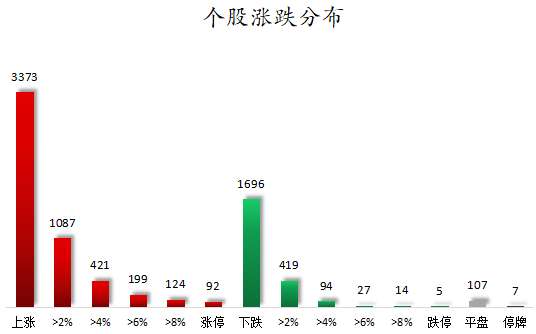
Market Overview - The Shanghai Composite Index closed at 4122.58 points, up 0.14%, with a trading volume of 1201.8 billion yuan [1] - The Shenzhen Component Index closed at 14327.04 points, up 0.5%, with a trading volume of 1489.968 billion yuan [1] - The ChiNext Index closed at 3328.65 points, up 1.01%, with a trading volume of 686.176 billion yuan [1] - The STAR Market 50 Index closed at 1541.64 points, up 0.41%, with a trading volume of 114.5 billion yuan [1] - The total trading volume of the Shanghai and Shenzhen markets was 2691.768 billion yuan, an increase of 91.051 billion yuan compared to the previous trading day [1] Sector Performance - Strong sectors included construction materials, defense and military, oil and petrochemicals, telecommunications, coal, steel, chemicals, and environmental protection [2] - Active concepts included oil and gas services, helium, aircraft carriers, nanomaterials, commercial aerospace, 6G, glyphosate, controlled nuclear fusion, and marine economy [2] - Weak sectors included beauty and personal care, non-ferrous metals, precious metals, pharmaceuticals and biotechnology, insurance, and automotive [2] Individual Stock Performance - A total of 3373 stocks rose, while 1696 stocks fell, with 107 stocks remaining flat and 7 stocks suspended [2] - Among the stocks that hit the daily limit, 92 stocks rose to the limit, while 5 stocks fell to the limit [2] - The stock with the most consecutive limit-ups was Fenglong Co., with 17 consecutive limit-ups [5] Capital Flow - The net outflow of main funds in the Shanghai and Shenzhen markets was 10.442 billion yuan [6] - The communication sector saw the highest net inflow of main funds, amounting to 7.884 billion yuan [6] - The defense and military, non-bank financial, and machinery sectors also experienced significant net inflows of 2.916 billion yuan, 1.371 billion yuan, and 689 million yuan, respectively [6] Notable Stocks - 132 stocks received net inflows of over 1 billion yuan, with Xinyi Sheng receiving the highest net inflow of 2.193 billion yuan [8] - The stocks with the highest net outflows included Sanhua Intelligent Control, with a net outflow of 2.431 billion yuan [11] - Institutional investors net bought 16 stocks, with Hunan Baiyin being the most purchased stock at approximately 363.341 million yuan [14]


赛力斯港股跌2.75%创新低 林园基金广发基金浮亏22%
Zhong Guo Jing Ji Wang· 2026-01-22 09:03
中国经济网北京1月22日讯 赛力斯(港股代码09927.HK)港股收报102.50港元,跌幅2.751%,创 港股上市以来新低。赛力斯港股上市累计跌幅22.05%。 赛力斯的基石投资者为重庆产业母基金、林园基金及华泰资本投资(与华泰背对背总回报掉期及林 园总回报掉期有关)、广发基金管理有限公司及广发国际资产管理有限公司(统称为"广发基金")、 New China Asset Management、BESS Broadway、Sanhua (Hong Kong)、中升、Zhink International、Gold Wings、达安投资、Hichain Logistics HK、施罗德、Mirae Securities、New Alternative、中邮理财、Skyler International、星宇香港、中国美东、Ghisallo Fund、Jump Trading、 Jain Global Master Fund Ltd、China Alpha Fund。 其中,New China Asset Management由新华人寿保险股份有限公司(简称"新华保险", 1336.HK,601336.SH)直 ...

家电零部件板块1月22日跌1.07%,三花智控领跌,主力资金净流出23.36亿元
Zheng Xing Xing Ye Ri Bao· 2026-01-22 09:01
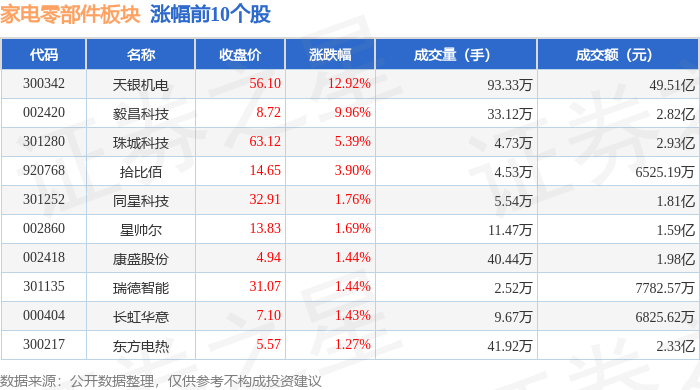
证券之星消息,1月22日家电零部件板块较上一交易日下跌1.07%,三花智控领跌。当日上证指数报收于4122.58,上涨0.14%。深证成指报收于 14327.05,上涨0.5%。家电零部件板块个股涨跌见下表: | 代码 | 名称 | 收盘价 | 涨跌幅 | 成交量(手) | 成交额(元) | | | --- | --- | --- | --- | --- | --- | --- | | 300342 | 天银机电 | 56.10 | 12.92% | 93.33万 | | 49.51亿 | | 002420 | 毅昌科技 | 8.72 | 9.96% | 33.12万 | | 2.82亿 | | 301280 | 珠城科技 | 63.12 | 5.39% | 4.73万 | | 2.93亿 | | 920768 | 拾比値 | 14.65 | 3.90% | 4.53万 | | 6525.19万 | | 301252 | 同星科技 | 32.91 | 1.76% | 5.54万 | | 1.81亿 | | 002860 | 星帅尔 | 13.83 | 1.69% | 11.47万 | | 1.59亿 | | ...
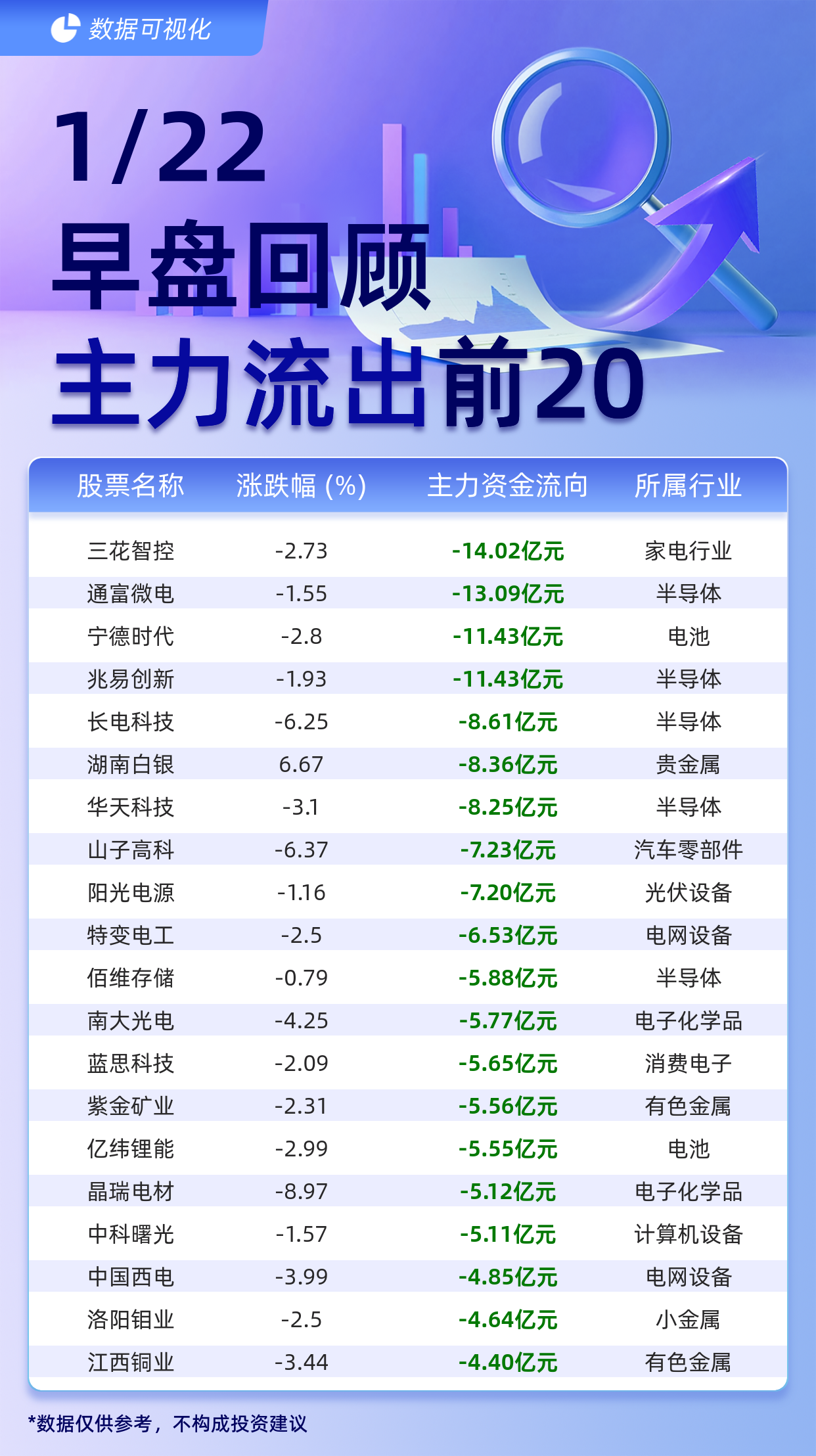
主力个股资金流出前20:三花智控流出14.02亿元、通富微电流出13.09亿元
Jin Rong Jie· 2026-01-22 03:45
Core Viewpoint - The data indicates significant outflows of capital from various stocks, with notable amounts withdrawn from companies across different industries, suggesting a potential shift in investor sentiment and market dynamics [1][2][3] Group 1: Major Stocks with Capital Outflows - Sanhua Intelligent Control experienced a capital outflow of 1.402 billion, with a decline of 2.73% in stock price [2] - Tongfu Microelectronics saw a capital outflow of 1.309 billion, with a decrease of 1.55% [2] - Contemporary Amperex Technology reported a capital outflow of 1.143 billion, with a drop of 2.8% [2] - Zhaoyi Innovation also faced a capital outflow of 1.143 billion, with a decline of 1.93% [2] - Changdian Technology had a significant outflow of 861 million, with a sharp decrease of 6.25% [2] Group 2: Other Notable Stocks - Hunan Silver experienced a capital outflow of 836 million, but its stock price increased by 6.67% [2] - Huada Technology saw an outflow of 825 million, with a decline of 3.1% [2] - Yango Technology faced a capital outflow of 723 million, with a significant drop of 6.37% [2] - Sungrow Power Supply had an outflow of 720 million, with a decrease of 1.16% [2] - TBEA reported a capital outflow of 653 million, with a decline of 2.5% [2] Group 3: Additional Stocks with Capital Outflows - Baiwei Storage experienced a capital outflow of 588 million, with a slight decrease of 0.79% [2] - Nanda Optoelectronics saw an outflow of 577 million, with a decline of 4.25% [3] - Lens Technology faced a capital outflow of 565 million, with a decrease of 2.09% [3] - Zijin Mining reported an outflow of 556 million, with a decline of 2.31% [3] - EVE Energy experienced a capital outflow of 555 million, with a drop of 2.99% [3]


中国人形机器人 - AI 机器人与电力实地调研要点:2026-2027 年通过务实垂直整合推动出货量数倍增长-China Humanoid Robot_ AI Robotics & Power Field Trip takeaways_ Driving multi-fold shipment growth through pragmatic verticalization into 2026-2027E
2026-01-22 02:44
Summary of the Conference Call on the Humanoid Robot Industry Industry Overview - The humanoid robot industry is shifting towards "dedicated-purpose" commercial deployments, focusing on specific vertical applications such as security, guest services, and logistics tasks like pick-and-place and sorting [2][8] - This strategic pivot is expected to drive significant growth in shipment volumes, with projections indicating a multi-fold increase by 2026-2027, from an estimated 15,000-20,000 units in 2025 [2][3] Shipment Volume Projections - Global humanoid robot shipments in 2025 are anticipated to be around 15,000-20,000 units, with Chinese manufacturers contributing significantly to these figures [3] - The targets for 2026 and 2027 are set in the thousands to tens of thousands, supported by a mature supply chain and optimized cost structures [3] Technological Advancements - Significant progress in motion control has been observed, with improvements in robustness and flexibility of humanoid robots, including the achievement of 'cerebellum-level' whole-body control [7] - The product iteration cycle has accelerated to approximately 6-8 months per generation, largely due to high in-house component design capabilities [7] Challenges and Limitations - The industry faces challenges such as the reliance on simulated data, which often fails to translate effectively to real-world scenarios, leading to a 'sim-to-real' gap [8] - The complexity of dexterous manipulation remains a limitation, confining the utility of humanoid robots in industrial applications to simpler logistics tasks [8] Data Strategies and AI Integration - Manufacturers are standardizing their approaches by integrating with established Large Language Models (LLM) and Vision-Language Models (VLM) to enhance robotic intelligence [9] - A 'data recipe' arms race is underway, with companies focusing on three primary data inputs: teleoperated demonstrations, simulation, and real-world video datasets [9] Market Differentiation and Profit Models - Two distinct profit models have emerged: 2C (business-to-consumer) focusing on user experience and emotional value, and 2B (business-to-business) emphasizing ROI through efficiency improvements [11][12][13] - For 2B applications, robots must achieve approximately 50% of a human worker's throughput to justify investment, with acceptable payback periods ranging from two to three years [13] Investment Recommendations - The report recommends a selective investment approach, advising to "Buy" Sanhua H and "Sell" Moon's Electric, citing high market expectations and the need for realistic volume projections [14] - The year 2026 is viewed as a critical period for validating volume expectations and market share dynamics within the humanoid robot sector [14] Conclusion - The humanoid robot industry is poised for significant growth driven by technological advancements and strategic market shifts, but faces challenges that could impact the realization of ambitious shipment targets and investment returns [2][3][14]
宏观对话行业-科技叙事还能走多远
2026-01-22 02:43
Summary of Key Points from Conference Call Records Industry Overview - **Macro Industry**: The discussion centers around the technology sector, particularly the impact of AI on the macroeconomic landscape in the U.S. and China, as well as investment opportunities in various sub-sectors like commercial aerospace and humanoid robotics [1][3][17][19]. Core Insights and Arguments AI and Economic Growth - AI capital expenditures are projected to drive U.S. economic growth, with major tech companies expected to spend approximately $350 billion to $360 billion by 2025, accounting for about 1% of GDP and growing at a rate of 60%-70% [1][3]. - The contribution of AI to macroeconomic growth is estimated to be around 0.6%-0.7% [1][3]. - By 2026, capital expenditures from the top five U.S. tech companies are expected to reach $500 billion to $510 billion, indicating sustained investment-driven growth, albeit at a potentially slower pace [3][5]. AI's Impact on Various Industries - AI technology is having a comprehensive impact on the semiconductor industry, leading to price increases in mature processes and the rise of domestic computing power [1][12][14]. - The storage sector is also benefiting from AI, with new technologies driving demand for NAND and DRAM [11][12]. - In the commercial aerospace sector, investment opportunities are concentrated in rocket assembly, core aerospace engines, and satellite payloads, with companies like BoLite and Zhenlei Technology highlighted as key players [1][17]. Concerns and Risks - There are growing concerns about a potential bubble in the AI sector, particularly as discussions around the transition from short-term to long-term economic benefits intensify [6][9][13]. - The stability of macroeconomic policies is crucial to ensure a smooth transition and to mitigate risks associated with the AI narrative [5][6]. China's Technological Landscape - China has surpassed Japan in R&D spending, becoming the second-largest globally, and leads in PCT patent applications, indicating significant advancements in technology [8][7]. - However, the impact of these advancements on labor productivity remains limited, primarily reflecting in capital markets rather than the real economy [7][8]. Additional Important Insights - The humanoid robotics industry is transitioning from component manufacturing to key assembly stages, with companies in Tesla's supply chain, such as Sanhua and Topband, being noteworthy [2][20][21]. - Investment opportunities in the commercial aviation sector are expected to rise due to increased domestic production capabilities, particularly in engine manufacturing [18]. - AI applications in retail are opening new growth avenues, with companies leveraging AI tools to enhance operational efficiency and consumer engagement [25]. - The development of AI glasses is anticipated to grow significantly, with a projected increase in global shipments and sales exceeding 50% over the next five years [26]. Conclusion - The overall sentiment is cautiously optimistic regarding the future of AI and its integration into various industries, with a focus on the importance of stable macroeconomic policies and the potential for significant technological advancements to drive productivity and economic growth [15][16].



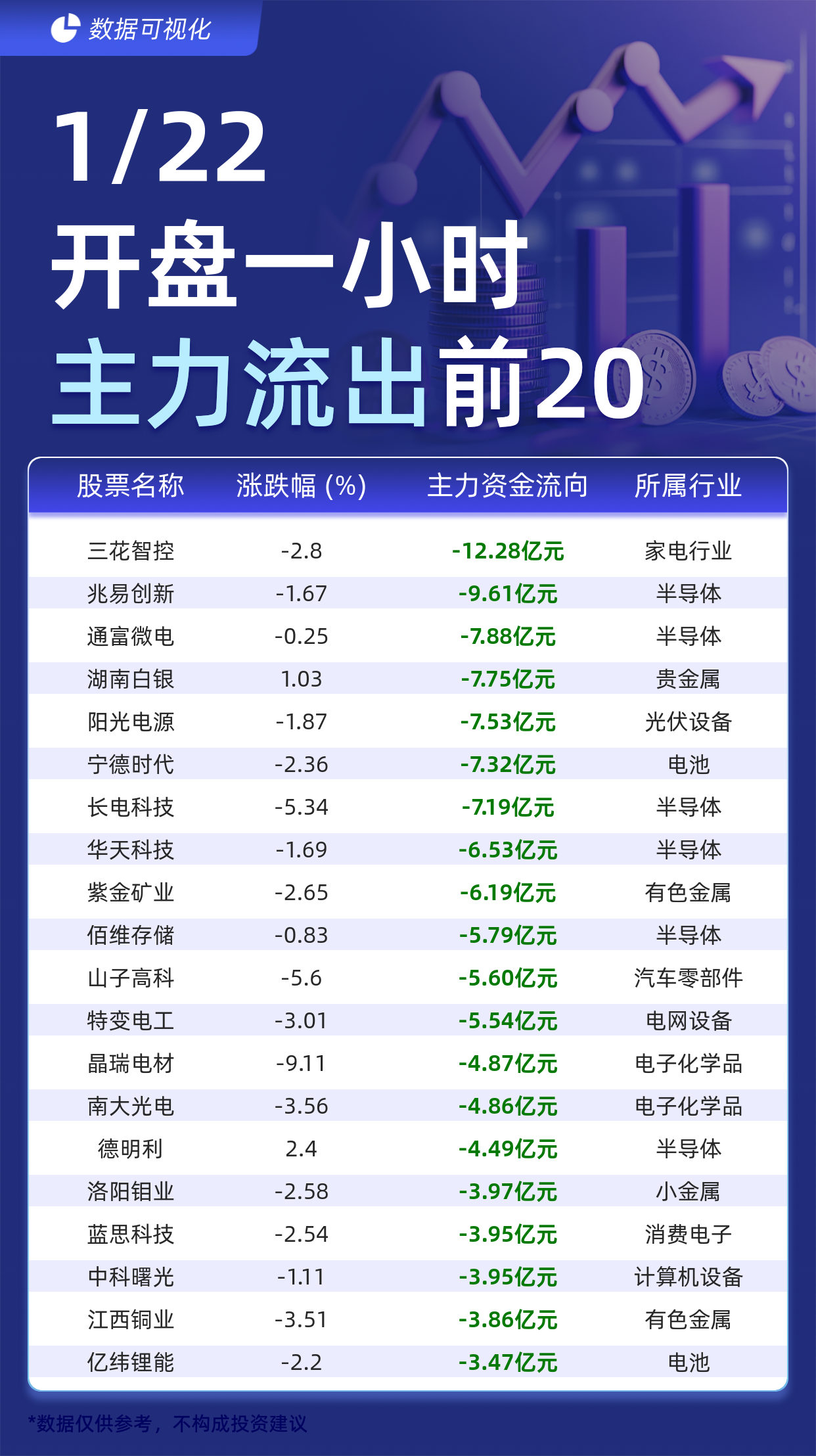
主力个股资金流出前20:三花智控流出12.28亿元、兆易创新流出9.61亿元
Jin Rong Jie· 2026-01-22 02:43
| 特变电工 | -3.01 | -5.54亿元 | 电网设备 | | --- | --- | --- | --- | | 晶瑞电材 | -9.11 | -4.87亿元 | 电子化学 | | 南大光电 | -3.56 | -4.86亿元 | 电子化学 | | 德明利 | 2.4 | -4.49亿元 | 未营体 | | 洛阳钼业 | -2.58 | -3.97亿元 | 小金属 | | 蓝思科技 | -2.54 | -3.95亿元 | 消费电- | | 中科曙光 | -1.11 | -3.95亿元 | 计算机设 | | 江西铜业 | -3.51 | -3.86亿元 | 有色金属 | | 亿纬锂能 | -2.2 | -3.47亿元 | 电池 | *数据仅供参考,不构成投资建议 | 股票名称 | 涨跌幅 (%) | 主力资金流向 | 所属行) | | --- | --- | --- | --- | | 三花智控 | -2.8 | -12.28亿元 | 家电行业 | | 兆易创新 | -1.67 | -9.61亿元 | 未营体 | | 通富微电 | -0.25 | -7.88亿元 | 未营体 | | 湖南白银 | 1. ...