青岛银行

Search documents
银行净息差专题报告:负债管理能力成为业绩分化的关键
GUOTAI HAITONG SECURITIES· 2025-12-11 08:03
Investment Rating - The report assigns an "Overweight" rating for the banking sector [7]. Core Insights - The report emphasizes the significant improvement in the cost of liabilities for banks in 2025, with a notable decrease of 28 basis points (bp) in the first half of the year, compared to only 4 bp in the same period last year. This improvement is primarily driven by reductions in deposit and interbank liabilities costs, contributing 19 bp and 7 bp respectively [3][11]. - The net interest margin (NIM) is expected to decline by approximately 5 bp in 2026, with the downward pressure on margins continuing to ease marginally, suggesting that some banks may stabilize their NIMs [2][10]. Summary by Sections 1. Liability Cost Improvement in 2025 - The first half of 2025 saw a significant reduction in the cost of interest-bearing liabilities, with the cost rate dropping to 1.70%, a decrease of 28 bp from 2024. This was supported by improvements in both deposit and interbank liability costs [11]. 2. Liability Side: Deposit Maturity and Repricing Benefits 1) **Term Structure**: The proportion of long-term deposits entering the repricing cycle has increased, with the share of deposits with a remaining maturity of 1-5 years declining by 1.5 percentage points (pct) to 22.6% by the end of Q2 2025. Some banks, such as those in Ningbo and Chongqing, experienced declines exceeding 10 pct [4]. 2) **Price Factors**: Regulatory focus on maintaining reasonable NIM levels has increased, with expectations of further interest rate cuts. The maximum reduction for three-year deposits could exceed 100 bp, indicating substantial room for cost improvement [5]. 3. Asset Side: Yield Pressure Expected to be Better than 2025 1) **Loans**: The repricing pressure on loans is expected to ease, with the five-year Loan Prime Rate (LPR) declining by only 10 bp in 2025, significantly less than the 50 bp drop the previous year [6]. 2) **Debt Replacement**: The shift from high-interest to low-interest debt is anticipated to have a limited impact on net interest margins, estimated to drag down margins by about 4 bp [6]. 3) **Bond Maturity**: The widening gap between new bond issuance rates and existing bond yields is expected to exert downward pressure on investment yields, with an estimated drag of 6 bp on margins from the reallocation of bonds maturing within one year [6]. 4. NIM Projections - The report forecasts a 5 bp decline in NIM for 2026, with the downward trend continuing to converge. The asset yield is expected to decrease by 17 bp, while the cost of liabilities is projected to improve by 13 bp, with deposit costs improving by 17 bp [7][10].






青岛食品股份有限公司关于使用部分闲置募集资金进行现金管理到期赎回并继续进行现金管理的进展公告
Shang Hai Zheng Quan Bao· 2025-12-10 19:15
Core Viewpoint - The company has approved the use of idle raised funds for cash management, specifically to invest up to 280 million RMB in high-security, liquid financial products, ensuring that it does not affect the construction of investment projects [1] Group 1: Cash Management Progress - The company has redeemed the financial products purchased with idle raised funds and has used 180 million RMB to buy structured deposit financial products from Qingdao Bank [2] Group 2: Investment Risk and Control Measures - The financial products purchased are bank principal-protected products, which are influenced by macroeconomic policies [3] - The company will monitor economic conditions and financial market changes to manage investments, acknowledging potential market volatility [4] - Risk control measures include investing in low-risk, short-term bank principal-protected products, with a focus on safety and compliance with regulations [5] - The finance department will conduct pre-investment risk assessments and monitor the status of investment products, taking action if risks are identified [5] - The internal audit department will oversee the use and custody of funds, reporting any anomalies to the board for control measures [6] Group 3: Impact on Daily Operations - The investment of idle raised funds in financial products is conducted under the premise of ensuring fund safety and will not affect the progress of investment projects or the company's main business operations, thereby improving the efficiency and returns of raised funds [6]
积极补充资本 中小银行股权结构持续优化
Zheng Quan Ri Bao· 2025-12-10 16:10
Core Insights - Since December, regional city commercial banks and rural commercial banks have accelerated capital replenishment through external shareholders and targeted placements, with local state-owned assets becoming the main force in filling capital gaps and optimizing equity structures [1][2] Group 1: Capital Replenishment Trends - The pace of capital increase and expansion among small and medium-sized banks has intensified, with several banks announcing significant capital increases, such as Suzhou Bank increasing its capital by 10 billion yuan and Long'an Bank planning to raise up to 26.11 billion shares [2][3] - The core drivers for the capital replenishment include increased credit issuance and capital consumption due to risk management, leading to a sustained high demand for capital in the future [1][4] Group 2: Regulatory Environment and Challenges - Many regional banks have received regulatory approval for their capital increase plans, indicating a supportive regulatory environment for capital replenishment [3] - However, small and medium-sized banks face challenges such as weak internal capital accumulation capabilities, regulatory rating restrictions, and low investor confidence, which hinder their ability to issue capital instruments [4][5] Group 3: Future Outlook - Experts predict that the demand for capital replenishment among small and medium-sized banks will remain high, with a clear trend of structural differentiation emerging within the industry [4][5] - The ease of future capital replenishment will be closely linked to the banks' operational quality and regional development environments, with well-governed banks likely to attract more market and policy support [5]

探寻利率方向(4):从M2看2026年债市流动性
GF SECURITIES· 2025-12-10 11:48
Investment Rating - The report assigns a "Buy" rating for the banking sector, indicating an expectation that stock prices will outperform the market by more than 10% over the next 12 months [40]. Core Insights - The growth of M2 is primarily driven by government and corporate leverage, with government leverage's contribution increasing from 23.9% in 2015 to 45.5% in 2025, while corporate leverage is expected to contribute 63.6% to M2 growth in 2025 [5][14]. - The report highlights a divergence between the social financing (社融) and M2 growth rates, indicating a liquidity accumulation in the financial system when the demand for financing from the real economy is insufficient, which can lead to a decline in bond yields [5][19]. - The expected social financing-M2 differential for 2026 is projected to be 0.56%, with a quarter-on-quarter increase of 33 basis points [32]. Summary by Sections M2 and Liquidity Analysis - M2 includes cash, personal deposits, corporate deposits, non-bank deposits, and deposits from non-deposit financial institutions. The main contributors to M2 growth are government and corporate leverage [5][13]. - The report discusses the relationship between the social financing-M2 differential and bond market performance, noting a shift in correlation since the second half of 2022 [5][19]. Social Financing Projections - For 2026, the report forecasts a total of 16.3 trillion yuan in new loans under the social financing framework, with a growth rate of 8.11% [32][34]. - The report anticipates that the net issuance of government bonds will reach 14.8 trillion yuan in 2026, with a focus on maintaining a proactive fiscal policy [34]. M2 Growth Forecast - The M2 growth rate for 2026 is projected at 7.55%, influenced by factors such as net fiscal deposits, the strengthening of the equity market, and cross-border capital flows [32][36].
11月金融数据前瞻(2025.11.10-2025.12.09):新增信贷和社融或延续同比少增
China Post Securities· 2025-12-10 08:48
Investment Rating - The industry investment rating is "Outperform" and is maintained [1] Core Insights - The report indicates that the credit demand remains weak, with November's new credit expected to decrease by approximately 250 billion yuan year-on-year, totaling around 330 billion yuan [3][12] - The social financing scale for November is projected to be about 2.1 trillion yuan, reflecting a year-on-year decrease of approximately 200 billion yuan [25][30] - The report suggests that the upcoming months will see a significant amount of fixed-term deposits maturing, which may lead to a further decline in risk-free interest rates for residents [5][30] Summary by Sections Industry Overview - The closing index is at 4215.44, with a 52-week high of 4670.31 and a low of 3730.31 [1] Credit Market Analysis - New credit in November is expected to be around 330 billion yuan, with a year-on-year decrease of about 250 billion yuan [12][19] - The demand for corporate loans is slightly improving, but overall credit demand remains low, particularly for residential loans due to weak consumer confidence [4][21] - The PMI for November shows slight improvement but remains below the threshold, indicating ongoing pressure in the corporate sector [12][19] Investment Recommendations - The report recommends focusing on banks with significant maturing deposits and potential for margin improvement, such as Chongqing Bank, China Merchants Bank, and Bank of Communications [5][30] - It also suggests paying attention to city commercial banks that will benefit from improvements in fixed asset investments, including Jiangsu Bank, Qilu Bank, and Qingdao Bank [5][30]
12月8日晚间突袭!5家上市公司股东拟减持超2%,A股再现密集减持潮
Sou Hu Cai Jing· 2025-12-09 16:23
Core Viewpoint - The article highlights a significant trend in the A-share market where major shareholders are increasingly reducing their holdings, indicating a potential divergence between market optimism and insider sentiment regarding company valuations [2][10][22]. Group 1: Shareholder Reduction Trends - Since the second half of 2025, major shareholders in the A-share market have reduced their holdings by nearly 90 billion yuan, with a net reduction of approximately 66.2 billion yuan from July to September [2][4]. - In the first half of 2025, 428 companies experienced 1,315 reduction events, with a total reduction amount nearing 60 billion yuan, marking a doubling in both the number of events and the amount compared to the same period in 2024 [4][10]. - The trend accelerated in the latter half of the year, with 270 companies reporting 544 reduction events in July alone, followed by 224 companies with 435 events by August 25 [5][6]. Group 2: Sector and Company Specifics - The semiconductor and AI sectors are among those most affected, with significant reductions observed across various popular sectors, including new energy and biomedicine [4][10]. - The National Big Fund's reduction of shares in 12 companies, amounting to 4.662 billion yuan, has drawn particular attention, especially given the high average return of 7.38 times over an average holding period of 7.62 years [10][12]. - Individual shareholders are also reducing their stakes for personal financial needs, as seen in cases like Xiangfenghua and Tianji shares, where reductions were explicitly linked to personal funding requirements [12][14]. Group 3: Market Reactions and Implications - The reduction announcements have led to market volatility, with some companies experiencing significant stock price declines following shareholder announcements, as seen with Tonghuashun [14][17]. - The alternative reduction method of inquiry transfer has gained traction, with 147 companies engaging in 162 transactions, amounting to nearly 100 billion yuan, indicating a shift in how shareholders are exiting positions [17][19]. - The article suggests that the current reduction trend reflects a broader divergence between the long-term value creation focus of industrial capital and the short-term profit realization focus of financial capital [19][22].

政治局会议定调2026货币政策,解读来了
21世纪经济报道· 2025-12-09 14:40
记者丨唐婧 编辑丨张星 中央政治局会议定调, 2026年的货币政策基调仍是适度宽松。 中共中央政治局12月8日召开会议,分析研究2026年经济工作。会议指出,明年经济工作要坚 持稳中求进、提质增效,继续实施更加积极的财政政策和适度宽松的货币政策,发挥存量政 策和增量政策集成效应,加大逆周期和跨周期调节力度,切实提升宏观经济治理效能。 对于适度宽松的货币政策如何落实,中国人民银行行长潘功胜在不久前的2025金融街论坛年 会上已有所表态。潘功胜当时表示,央行将继续坚持支持性的货币政策立场,实施好适度宽 松的货币政策, 综合运用多种货币政策工具 ,提供短期、中期、长期流动性安排,保持社会 融资条件相对宽松。同时, 继续完善货币政策框架 ,强化货币政策的执行和传导。 "加大逆周期和跨周期调节力度"的提法也颇受市场关注。 多名受访经济学家告诉记 者,逆周期调节与跨周期调节是宏观经济调控中两种互补的政策工具,前者侧重短期 经济波动的对冲,后者则更注重长期结构性问题的化解。此次重提跨周期调节,可见 经济的长期稳定发展更多地被纳入考量,未来政策重心或从短期稳增长转向兼顾中长 期结构优化。 继续实施适度宽松的货币政策 青岛银行 ...
2026年货币政策定调:逆周期与跨周期并重,推动新旧动能转换
2 1 Shi Ji Jing Ji Bao Dao· 2025-12-09 12:37
21世纪经济报道记者唐婧 北京报道 中央政治局会议定调,2026年的货币政策基调仍是适度宽松。 中共中央政治局12月8日召开会议,分析研究2026年经济工作。会议指出,明年经济工作要坚持稳中求进、提质增效,继续实施更加积极的财 政政策和适度宽松的货币政策,发挥存量政策和增量政策集成效应,加大逆周期和跨周期调节力度,切实提升宏观经济治理效能。 "此外,本次会议还重点强调了'提质增效',"芦哲认为,这意味着2026年货币政策将更加注重在多目标间寻求平衡,既要保持流动性充裕和融 资条件适度宽松,也要防范资产价格大幅波动,并引导金融资源更多流向国民经济薄弱环节,提升货币政策传导的精准性与有效性。 青岛银行首席经济学家刘晓曙向记者表示,12月中央政治局会议中的货币政策定调呈现出两个"不变"与三大"调整"。"不变"主要体现在两个方 面:一是延续"适度宽松"的总体基调,降准降息等总量型工具仍有运用空间;二是结构性工具支持重点领域的导向未发生改变。 对于适度宽松的货币政策如何落实,中国人民银行行长潘功胜在不久前的2025金融街论坛年会上已有所表态。潘功胜当时表示,央行将继续坚 持支持性的货币政策立场,实施好适度宽松的货币政策 ...
多家银行公告:增资扩股!地方国资成“主力军”
Jin Rong Shi Bao· 2025-12-09 10:14
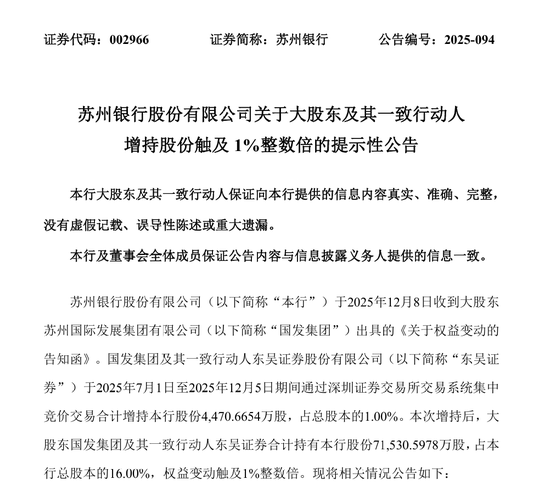
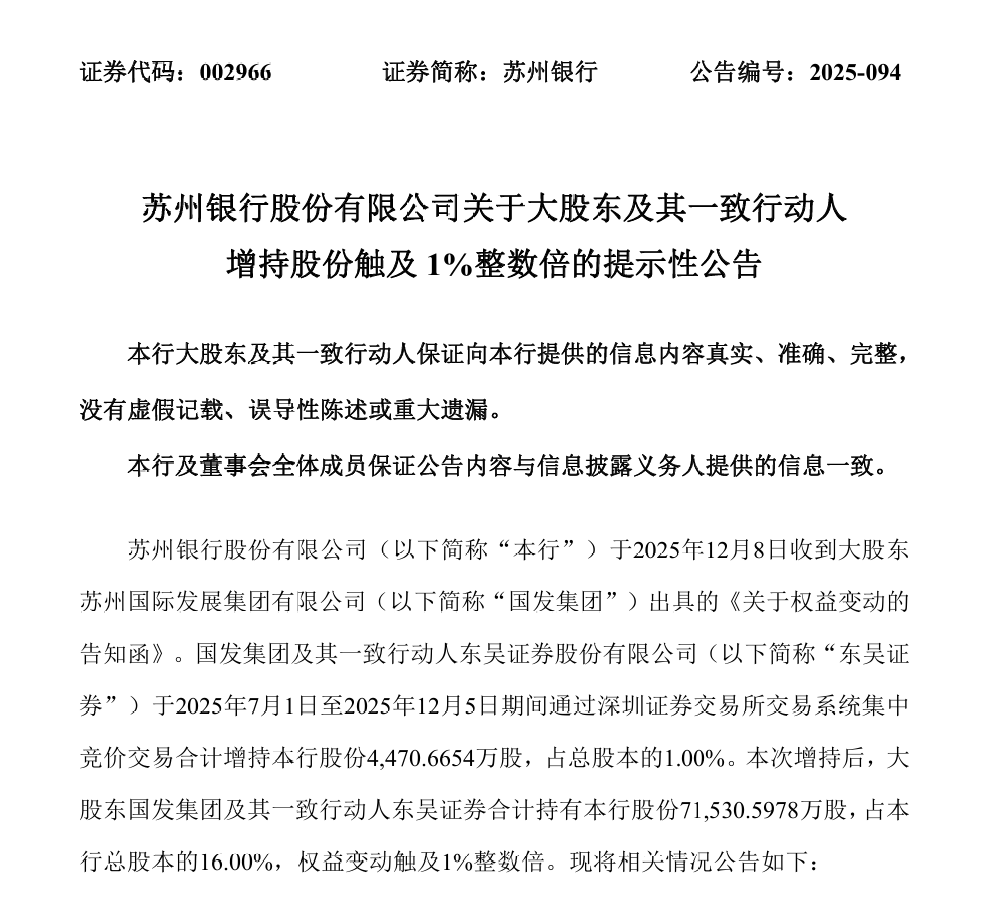
年末将至,中小银行资本补充进入"冲刺期",增资扩股、定向募股成为主流"补血"方式,新一轮资本补充潮正加速袭来。 12月8日,苏州银行发布公告称,该行于当日收到大股东苏州国际发展集团有限公司(以下简称"国发集团")出具的《关于权益变动的告知 函》。 公告显示,国发集团及其一致行动人东吴证券股份有限公司于2025年7月1日至2025年12月5日期间通过深圳证券交易所交易系统集中竞价交易 合计增持苏州银行股份4470.6654万股,占总股本的1.00%。 12月4日,湖南银行增资扩股工作正式收官的消息也引发了行业关注。湖南银行发布的公告显示,该行于近日收到湖南金融监管局批复,批准 该行增加注册资本10亿元人民币。 记者查询天眼查工商信息发现,目前,湖南银行已经发生工商变更,注册资本由约77.5亿元人民币增至约87.5亿元人民币,增幅近13%。 此次增资的"含金量"颇高。据湖南银行透露,该行本次向9家特定对象发行10亿股普通股,共募集资金人民币40.1亿元,扣除发行费用后,募 集资金净额为人民币40.09亿元。其中,计入实收股本人民币10亿元,计入资本公积人民币30.09亿元。在本次增资完成后,该行资本充足率将 提升 ...
多家银行公告:增资扩股!
Xin Lang Cai Jing· 2025-12-09 09:32
Core Viewpoint - The capital replenishment of small and medium-sized banks is entering a "sprint period" as they increasingly rely on methods such as capital increase and targeted fundraising to address capital adequacy pressures, with a new wave of capital replenishment accelerating [1][4]. Group 1: Recent Developments in Capital Increases - On December 8, Suzhou Bank announced that its major shareholder, Suzhou International Development Group, would increase its holdings by 44.7 million shares, accounting for 1.00% of the total share capital, between July 1, 2025, and December 5, 2025 [1]. - Hunan Bank has completed its capital increase, receiving approval to raise its registered capital by 1 billion RMB, increasing from approximately 7.75 billion RMB to about 8.75 billion RMB, a nearly 13% increase [3][8]. - Hunan Bank issued 1 billion shares to nine specific entities, raising a total of 4.01 billion RMB, with a net amount of 4.009 billion RMB after deducting issuance costs [3][8]. Group 2: Capital Adequacy and Regulatory Context - As of the end of Q3 2025, the capital adequacy ratio for commercial banks (excluding foreign bank branches) was 15.36%, with tier one capital adequacy at 12.36% and core tier one capital adequacy at 10.87% [4][9]. - The capital adequacy ratios for city commercial banks and rural commercial banks were 12.40% and 13.20%, respectively, which are lower than the average levels of 17.99% for large commercial banks and 13.48% for joint-stock commercial banks [4][9]. Group 3: Role of Local State-owned Capital - Local state-owned capital has become a significant force in the current wave of capital increases among small and medium-sized banks, with Hunan Bank's issuance entirely directed to state-owned entities [10][11]. - The involvement of local state-owned capital not only provides immediate financial support but also contributes to long-term capital generation effects, as local governments often promote such investments [5][11].