百威亚太

Search documents
华润啤酒(00291):2022半年报点评:行业龙头韧性十足,核心盈利能力跃升
Haitong Securities International· 2025-08-21 08:06
Investment Rating - The report maintains an "Outperform" rating for the company [2][7][16] Core Views - The company demonstrated robust resilience in the first half of 2025, with a revenue of RMB 23.94 billion (+0.8% YoY) and a net profit of RMB 5.79 billion (+23.0% YoY) [4][13] - The beer business achieved volume and price growth, leading the industry in premiumization, with beer revenue of RMB 23.16 billion (+2.6% YoY) and sales volume of 6.487 million kiloliters (+2.2% YoY) [5][14] - The baijiu business is undergoing significant adjustments, with revenue declining to RMB 780 million (-33.7% YoY), prompting a strategic restructuring [6][15] Financial Performance Summary - The company reported a gross margin of 48.9% (+2.0 percentage points YoY) and a net margin of 24.2% (+4.4 percentage points YoY) in 1H25 [4][13] - Core EBIT reached RMB 7.11 billion (+11.3% YoY), with an EBITDA margin improvement of 3.1 percentage points to 34.8% [4][13] - The forecasted EPS for 2025-2027 is RMB 1.72, RMB 1.80, and RMB 1.91 respectively, with a target price maintained at HK$36 [2][16] Business Segment Analysis - The beer segment showed strong performance with a price per ton of RMB 3,570 (+0.4% YoY) and a significant increase in premium product sales [5][14] - The baijiu segment faced challenges due to government consumption restrictions, leading to a strategic shift towards more flexible pricing and product strategy adjustments [6][15] Market Position and Valuation - The company is positioned as the largest beer enterprise in China, with significant advantages in channels, costs, and brand recognition [7][16] - The current P/E ratio of 15 is below the industry average, indicating substantial valuation recovery potential [7][16]

失速与换挡:百威亚太中国市场待破局
Sou Hu Cai Jing· 2025-08-20 10:03
Core Insights - Budweiser APAC's performance in the first half of the year shows a significant decline, with net profit down 24.4%, sales down 6.1%, and revenue down 5.6% [1][3][4] - The company faces intense competition in the high-end beer market from local brands such as China Resources Beer, Tsingtao Beer, and Yanjing Beer, which have gained market share [1][5][7] - Budweiser APAC's reliance on on-premise channels like restaurants and nightlife venues has been a major factor in its declining performance, as these channels are increasingly competitive [6][8] Financial Performance - In the first half of the year, Budweiser APAC reported revenue of $3.136 billion, a decrease of 5.6% year-on-year, and a net profit of $409 million, down 24.4% [3][4] - Total sales volume reached 4.363 billion liters, reflecting a 6.1% decline compared to the previous year [3][4] - The company's net profit has been on a downward trend for three consecutive years, with figures of $913 million, $852 million, and $726 million from 2022 to 2024, representing declines of 3.89%, 6.7%, and 14.8% respectively [3][4] Market Dynamics - Budweiser APAC's market share in China's high-end beer segment has dropped from approximately 50% to 42% [7] - The company has struggled to adapt to changing consumer preferences and increased competition in the high-end market, leading to a significant decline in sales of high-end and super high-end products [7][8] - The shift in consumer behavior towards home consumption and instant retail has resulted in non-on-premise channels becoming more significant, now accounting for about 60% of beer sales in China [10] Strategic Adjustments - Budweiser APAC is undergoing a strategic transformation under its new CEO, focusing on channel transformation, product adjustments, and marketing innovation [8][9] - The company aims to target the mid-range market by reallocating resources from the super high-end segment to the 8-10 yuan price range [8][9] - Non-on-premise channels are becoming a key focus, with the company recognizing the need to catch up in this area, as it currently lags behind industry standards [9][10]


酒行业周度市场观察-20250820
Ai Rui Zi Xun· 2025-08-20 08:29
Investment Rating - The report does not explicitly provide an investment rating for the industry Core Insights - The liquor industry is experiencing significant changes, with major brands diversifying into craft beer and other segments to attract younger consumers [3][5] - The market for light bottle liquor has surpassed 150 billion yuan, with expectations to exceed 200 billion yuan by 2025, indicating a competitive landscape [3][5] - The industry is undergoing a transformation towards user-driven strategies, focusing on consumer experiences and emotional connections [8][19] Industry Environment - Major liquor brands are entering the craft beer market, leveraging their existing channels and brand recognition to appeal to younger demographics [3] - The light bottle liquor market is rapidly growing, with new products priced under 60 yuan being launched by various companies [3][5] - The industry is facing challenges such as high inventory levels and changing consumer preferences, necessitating strategic shifts towards innovative marketing and product offerings [5][8] Brand Dynamics - Now is a critical time for brands like Guojing to expand their national presence, with a focus on quality and cultural integration [11] - The success of brands like Changyu and Xifeng in local markets demonstrates the importance of cultural relevance and innovative marketing strategies [20] - Companies are increasingly utilizing digital assets and experiential marketing to enhance brand engagement and drive sales [10][19]




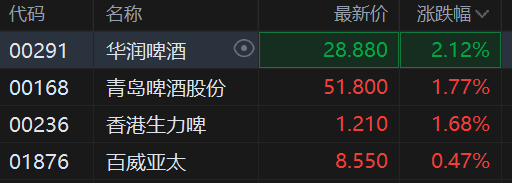
港股异动丨啤酒股逆势上涨 业绩利好发酵华润啤酒续涨超2%
Ge Long Hui· 2025-08-20 02:25
Group 1 - The core viewpoint of the article highlights the resilience of Hong Kong beer stocks, particularly the continued rise of China Resources Beer, which saw a 2.12% increase following a previous day’s surge of over 6% [1] - China Resources Beer announced a revenue of 23.942 billion RMB for the first half of 2025, reflecting a year-on-year increase of 0.8%, while net profit reached a record high of 5.789 billion RMB, up 23% [1] - Nomura's research report indicates that China Resources Beer's overall performance in the first half of the year was stable, with revenue growth of 1%, sales up by 2.2%, and an average price increase of 0.4%, demonstrating the effectiveness of its premiumization strategy [1] Group 2 - The China Alcoholic Drinks Association reports that the craft beer market in China surpassed 80 billion RMB in 2024, with a year-on-year growth rate exceeding 30% [1] - Products incorporating Chinese innovative elements have increased their market share from 5% to 18%, becoming a significant driver of industry growth [1]
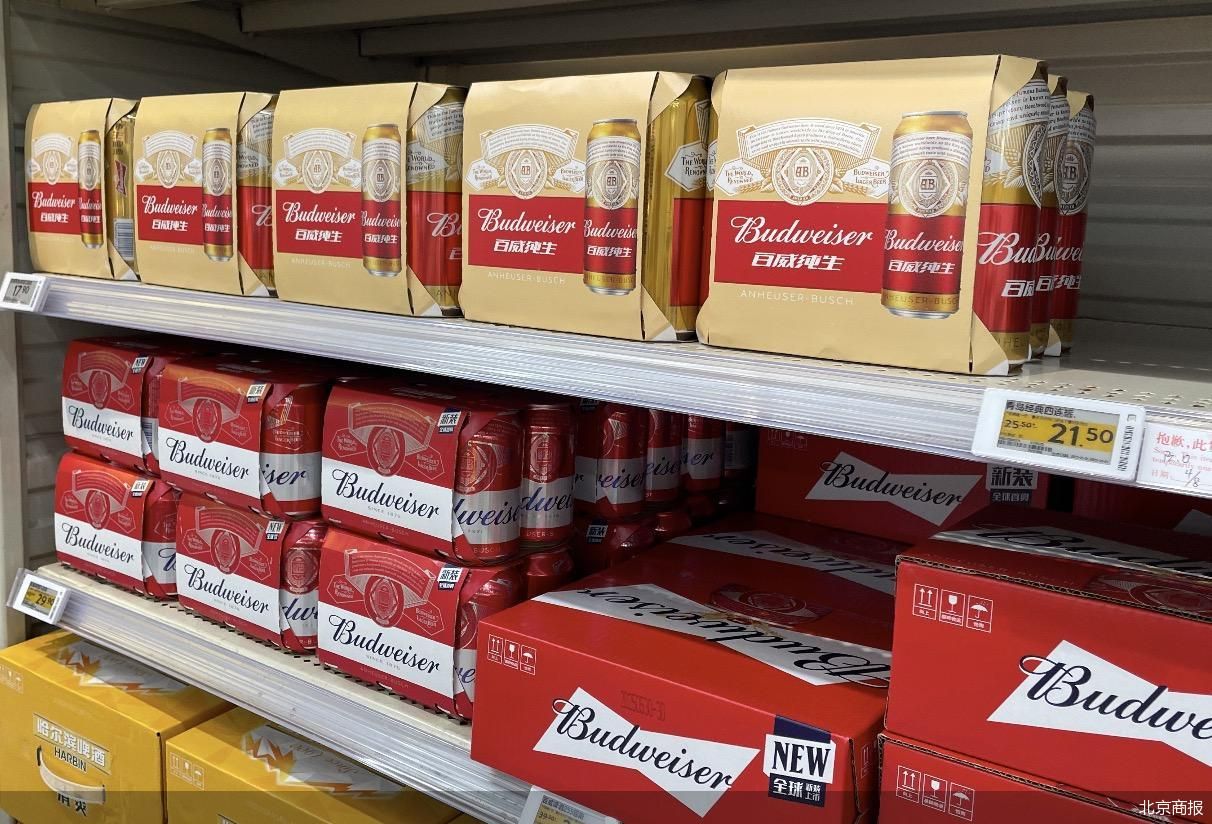
失速与换挡 百威亚太中国市场待破局
Bei Jing Shang Bao· 2025-08-19 16:16
Core Insights - Budweiser APAC's performance in the first half of the year shows a significant decline, with net profit down 24.4%, sales down 6.1%, and revenue down 5.6% [1][2] - The company faces intense competition in the high-end beer market from local brands like China Resources Beer, Tsingtao Beer, and Yanjing Beer, which have gained market share [1][2][5] Financial Performance - In the first half of the year, Budweiser APAC reported revenue of $3.136 billion, a decrease of 5.6% year-on-year, and a net profit of $409 million, down 24.4% [1][2] - Total sales volume reached 4.363 billion liters, reflecting a 6.1% decline compared to the previous year [1][2] - The company's net profit has been declining for three consecutive years, with figures of $913 million, $852 million, and $726 million projected for 2022-2024, representing year-on-year declines of 3.89%, 6.7%, and 14.8% respectively [2] Market Challenges - Budweiser APAC's reliance on on-premise channels like restaurants and nightclubs has been detrimental, as these channels face increasing competition [3][4] - The company's market share in the high-end beer segment has dropped from approximately 50% to 42% [4] - The shift in consumer preferences towards non-on-premise channels has further complicated Budweiser's market position [7] Strategic Adjustments - The newly appointed CEO, Cheng Yanjun, is focusing on strategic transformation, emphasizing channel transformation, product adjustment, and marketing innovation [6] - Budweiser APAC is shifting its product strategy to target the mid-range market, particularly the 8-10 yuan price segment, which has seen increased competition from other major brands [6][7] - The company aims to enhance its non-on-premise channel presence, which currently accounts for about 50% of its business in China, compared to the industry average of 60% [7] Future Outlook - The beer industry is entering a phase of moderate growth, and Budweiser APAC must adapt to maintain its competitive edge [3][4] - Analysts suggest that while Budweiser's strategy to penetrate the mid-range market is late, there are still opportunities for growth if the company can effectively build brand recognition and channel presence [6][7]
“失速”与“换挡” 百威亚太中国市场待破局
Bei Jing Shang Bao· 2025-08-19 14:49
Core Insights - Budweiser APAC reported a decline in net profit by 24.4%, a 6.1% drop in sales volume, and a 5.6% decrease in revenue for the first half of 2025, indicating ongoing challenges in the market [1][3] - The company faces pressure from both traditional dining and nightlife channels and the rise of local brands like China Resources Beer and Tsingtao Brewery in the high-end market [1][4] Financial Performance - For the first half of 2025, Budweiser APAC's revenue was $3.136 billion, down 5.6% year-on-year, with net profit at $409 million, a 24.4% decrease, and total sales volume at 4.363 billion liters, down 6.1% [3][4] - The company's net profit has been on a downward trend for three consecutive years, with figures of $913 million, $852 million, and $726 million from 2022 to 2024, reflecting declines of 3.89%, 6.7%, and 14.8% respectively [3][4] Market Challenges - Budweiser APAC's sales in the Chinese market decreased by 8.2%, with revenue per hundred liters dropping by 9.5% and overall revenue down by 6.4% in the second quarter due to weak business layout and channel performance [4][5] - The company is experiencing increased competition in the high-end market, with its market share dropping from approximately 50% to 42% in 2024 [6][7] Strategic Adjustments - The CEO has initiated a strategic transformation focusing on channel restructuring, product adjustments, and marketing innovation to address the challenges faced in the Chinese market [7][8] - Budweiser APAC is shifting its product strategy to target the mid-range market, particularly in the 8-10 yuan price segment, which has seen increased competition from other major brands [7][8] Channel Strategy - Non-drinking channels are becoming a key focus, with Budweiser APAC's non-drinking channel business accounting for about 50% of its operations in China, compared to the industry average of 60% [8] - The non-drinking channel's share of the Chinese beer market reached 52% in 2024 and expanded to approximately 60% in the first half of 2025, driven by a shift in consumer behavior towards home consumption and instant retail [8]
华润啤酒上半年净利增长23%:新零售合作出拉格爆品,白酒承诺给经销商兜底,将发力100-200元价位
Cai Jing Wang· 2025-08-19 13:36
Core Viewpoint - The high-end beer market still has significant growth potential, and the company will continue to prioritize high-end strategies while also exploring personalized and niche products [1][3][14] Financial Performance - In the first half of 2025, the company reported revenue of RMB 239.42 billion, a year-on-year increase of 0.8% [2] - The company's pre-tax profit and net profit attributable to shareholders were RMB 76.91 billion and RMB 57.89 billion, reflecting year-on-year growth of 20.8% and 23.0% respectively [2] - Beer business revenue reached RMB 231.61 billion, with a year-on-year increase of 2.6% [2] Market Position - The company has surpassed Budweiser APAC in revenue, which declined by 5.6% to USD 31.36 billion (approximately RMB 225.63 billion) in the same period [2] - High-end products such as Heineken, Old Snow, and Red Duke saw sales growth exceeding 20%, 70%, and 100% respectively in the first half of the year [3] New Retail Strategy - The company has experienced significant growth in online and instant retail, with overall transaction value increasing by 40% and 50% year-on-year [5] - Collaborations with major platforms like Alibaba, Meituan, JD.com, and Ele.me have been established to enhance consumer engagement and product development [5] Product Innovation - The company is focusing on flexible supply and personalized products, with new offerings such as 1L craft beers and various flavored lagers [6] - The introduction of local brands and products is seen as a way to meet consumer demand for personalization [7] Industry Trends - The beer industry is witnessing a shift towards high-end and personalized products, while the low-end segment faces challenges from both high-end and budget brands [6] - The company acknowledges the competitive landscape and the need for continuous innovation to maintain market relevance [6][14] Consumer Behavior - Changes in consumer purchasing behavior have been noted, with a shift towards online and instant retail channels, particularly among younger demographics [5][8] - The company is adapting to these changes by enhancing its product offerings and marketing strategies to cater to evolving consumer preferences [5][8]
华润啤酒上半年净利润同比增23%,白酒销售收入降三成
Xin Lang Cai Jing· 2025-08-19 13:24
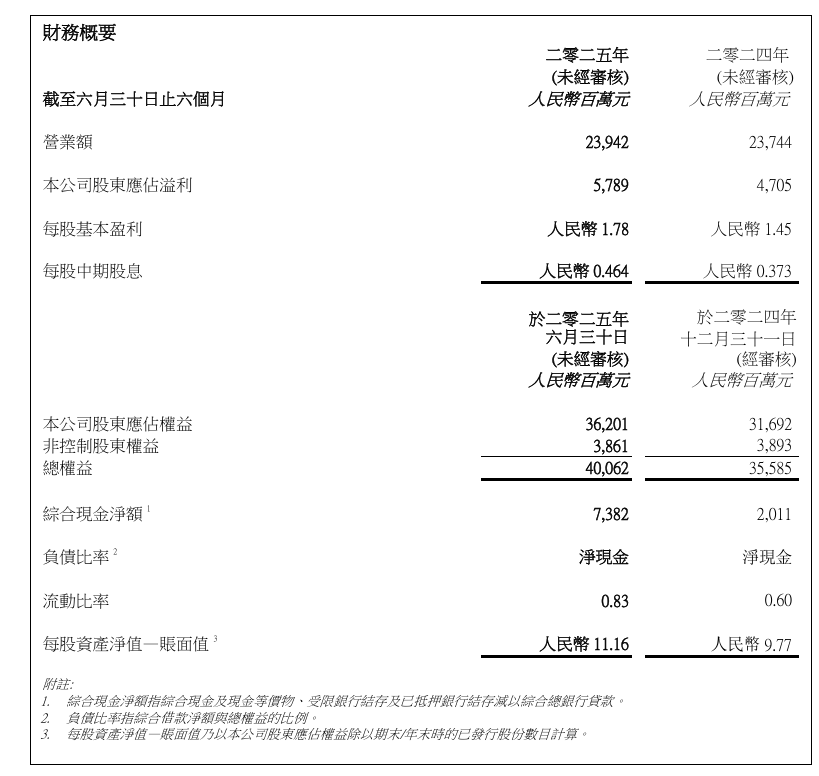
Core Viewpoint - China Resources Beer Holdings Company Limited reported a 20% year-on-year increase in net profit for the first half of 2025, while its liquor sales revenue declined by 30% [1][5]. Financial Summary - The group's total revenue for the first half of 2025 was RMB 23.942 billion, a 0.8% increase from RMB 23.744 billion in the same period of 2024 [2]. - Shareholders' profit attributable to the company was RMB 5.789 billion, up 23% from RMB 4.705 billion [2]. - Basic earnings per share increased to RMB 1.78 from RMB 1.45 [2]. - The interim dividend per share was set at RMB 0.464, a 24.4% increase from RMB 0.373 [2]. - The company's total equity reached RMB 40.062 billion, compared to RMB 35.585 billion at the end of 2024 [2]. Beer Business Performance - The beer segment achieved sales volume of approximately 6.487 million kiloliters, a 2.2% increase year-on-year [3]. - Revenue from the beer business was RMB 23.161 billion, reflecting a 2.6% growth [3]. - The gross margin for the beer business rose by 2.5 percentage points to 48.3%, driven by high-end product sales and cost savings [3][4]. - High-end beer products saw sales growth exceeding 10%, with brands like "Heineken" and "Red Baron" experiencing significant increases in sales [3]. Liquor Business Performance - The liquor segment's revenue was RMB 0.781 billion, down 33.7% from RMB 1.178 billion in the previous year [4]. - The major product "Abstract" accounted for nearly 80% of the liquor segment's revenue [4]. - The liquor business currently contributes only 3.26% to the total revenue of the company [4]. Strategic Initiatives - The company is focusing on long-term strategies to strengthen its liquor business despite short-term market fluctuations [5]. - Plans include price restructuring and enhanced cost control measures [5]. - The company aims to expand the coverage and sales of mid-range and light bottle liquor products through established beer distribution channels [5]. Industry Context - The overall beer industry in China is undergoing a contraction, with a 0.3% decline in production for the first half of 2025 [6]. - Among major beer companies, China Resources Beer and Yanjing Beer reported year-on-year revenue and profit growth, while others like Budweiser APAC and Chongqing Beer faced declines [6]. New Product Development - The company is actively developing new products to align with changing consumer trends, including specialty beers and high-end offerings [7]. - Online sales and instant retail business saw significant growth, with GMV increasing by nearly 40% and 50% respectively [7]. Leadership Changes - The company announced the resignation of Chairman Hou Xiaohai, who had been in charge for nine years, with the position currently vacant [7].
上半年啤酒股业绩分化局势复杂,业内忙出圈业外忙入局
Di Yi Cai Jing· 2025-08-19 10:44
Core Viewpoint - The domestic beer industry in China is experiencing a complex situation with performance divergence between domestic and foreign brands, as domestic companies continue to grow through premiumization while foreign brands face stagnation or decline [2][3]. Group 1: Performance of Domestic Beer Companies - China Resources Beer reported a revenue of 23.94 billion RMB, a year-on-year increase of 0.8%, and a net profit of 5.79 billion RMB, up 23% [3]. - The beer business revenue reached 23.16 billion RMB, growing by 2.6%, with premium and above beer sales increasing by over 10% [3]. - Yanjing Beer achieved a revenue of 8.56 billion RMB, a 6.4% increase, and a net profit of 1.1 billion RMB, up 45.5% [4]. Group 2: Performance of Foreign Beer Brands - Budweiser APAC saw a decrease in sales volume in China by 8.2%, with revenue and revenue per hectoliter down by 9.5% and 1.4%, respectively [3]. - Chongqing Beer reported a revenue of 8.839 billion RMB, a slight decline of 0.2%, and a net profit of 870 million RMB, down 4% [3]. Group 3: Market Trends and Consumer Behavior - The beer market is shifting from traditional social drinking to home consumption, with retail beer sales now accounting for over 60% of total beer consumption [5][6]. - The rise of e-commerce and instant retail has contributed to double-digit growth in new retail channels for beer [5][6]. - The beer industry is facing intense competition, with a reported 0.3% decline in production among large-scale breweries in the first half of 2025 compared to the previous year [8]. Group 4: Industry Diversification and New Entrants - Companies from other industries, such as Wuliangye and Three Squirrels, are entering the beer market, particularly in the craft beer segment, which is seen as a key area for future premiumization [7][8]. - Beer companies are diversifying their product offerings to include beverages and spirits to adapt to market changes and consumer preferences [8][9]. - The competitive landscape is evolving, with a focus on meeting diverse consumer needs through innovative and differentiated products [9].
半年盘点|上半年啤酒股业绩分化局势复杂,业内忙出圈业外忙入局
Di Yi Cai Jing· 2025-08-19 10:08
Core Insights - The domestic beer industry is experiencing a complex and differentiated landscape in the first half of 2025, with domestic companies showing rapid profit growth while foreign brands face stagnation or decline [1][2] - The growth in the beer market is primarily driven by the high-end product upgrade, with domestic brands continuing to expand in this segment [2][4] Financial Performance - China Resources Beer reported a revenue of 23.94 billion RMB, a year-on-year increase of 0.8%, and a net profit of 5.79 billion RMB, up 23% [2] - The beer business revenue reached 23.16 billion RMB, growing by 2.6%, with high-end beer sales increasing by over 10% [2] - Budweiser APAC saw a sales decline of 8.2% in the Chinese market, with revenue per hectoliter decreasing by 9.5% [4] Market Trends - The beer consumption landscape is shifting from traditional social drinking to home consumption, with retail channels now accounting for over 60% of beer sales [5][6] - The rise of e-commerce and instant retail has contributed to double-digit growth in beer sales through new retail channels [5][6] Competitive Landscape - The beer industry is facing intense competition, with a reported 0.3% decline in production among large-scale breweries in the first half of 2025 compared to the previous year [6] - Domestic companies are increasingly focusing on high-end product offerings, while foreign brands are losing their competitive edge in this segment [5][6] Strategic Adjustments - Companies are diversifying their product lines to include beverages and enter the liquor market to adapt to market changes [6][7] - China Resources Beer is accelerating the launch of craft and specialty products to meet diverse consumer preferences [7]