
DeepSeek

Search documents
DeepSeek开源OCR2模型
Cai Jing Wang· 2026-01-27 08:05
Core Viewpoint - The DeepSeek team has released a paper titled "DeepSeek-OCR2: Visual Causal Flow" and has open-sourced the DeepSeek-OCR2 model, which utilizes an innovative DeepEncoder V2 method to enable AI to dynamically rearrange parts of an image based on its meaning, aligning more closely with human visual encoding logic [1]. Group 1 - The DeepSeek-OCR2 model represents a significant advancement in AI's ability to interpret and manipulate visual information [1]. - The innovative DeepEncoder V2 method is a key feature that enhances the model's performance in visual tasks [1]. - The open-sourcing of the model allows for broader access and potential collaboration within the AI research community [1].

指数有点绷不住了,个股提前下行!热点遇冷,还有哪些投资机会?
Sou Hu Cai Jing· 2026-01-27 08:03
Group 1 - Hang Seng Index Company will announce the results of the Hang Seng Index series review for Q4 2025 on February 13, with changes effective from March 9 [1] - A total of 43 companies meet the inclusion criteria for the Hong Kong Stock Connect, with leading market capitalization companies including JD Industrial, Innovation Industry, Dipo Technology, and others [1] - 25 existing Hong Kong Stock Connect companies face delisting risks due to market capitalization not meeting standards, including previously popular stocks like Fenbi and Beijing Automotive [1] Group 2 - Recent events in the AI application sector include the listings of Zhiyu and MiniMax on the Hong Kong Stock Exchange, which are expected to transition the industry from technology validation to commercial value realization [3] - DeepSeek plans to launch its latest flagship model V4 in mid-February, showing superior performance in code generation compared to existing mainstream models [3] - The demand for AI computing power has led to tight supply and significant price increases in storage chips, with expectations of continued price hikes in the first and second quarters of this year [3] Group 3 - The current copper cycle is influenced by the "AI leap" and "century change," with historical analysis indicating that copper prices have not yet reached the heights of previous super cycles when adjusted for inflation [5] - The restructuring of the international monetary order is weakening the dollar's role as a price anchor, with the current copper-to-gold ratio at historical lows [5] - Investment strategies should focus on the long-term value of copper, particularly in resource sectors, quality mining companies, and industries closely related to electricity and AI infrastructure [5] Group 4 - The Shanghai Composite Index's inability to reach new highs raises concerns about potential declines as the Spring Festival approaches, with capital withdrawal expected [9] - Historical data shows that when the Producer Price Index (PPI) returns to positive territory, the revenue growth for the entire A-share market could see significant increases [9] - The TMT and consumer sectors are expected to exhibit resilience in revenue growth, with projections for A-share revenue growth of 4.78% and 10.98% in 2025 and 2026, respectively [9]

DeepSeek发布DeepSeek-OCR 2 让AI学会“人类视觉逻辑”
Zhi Tong Cai Jing· 2026-01-27 07:53
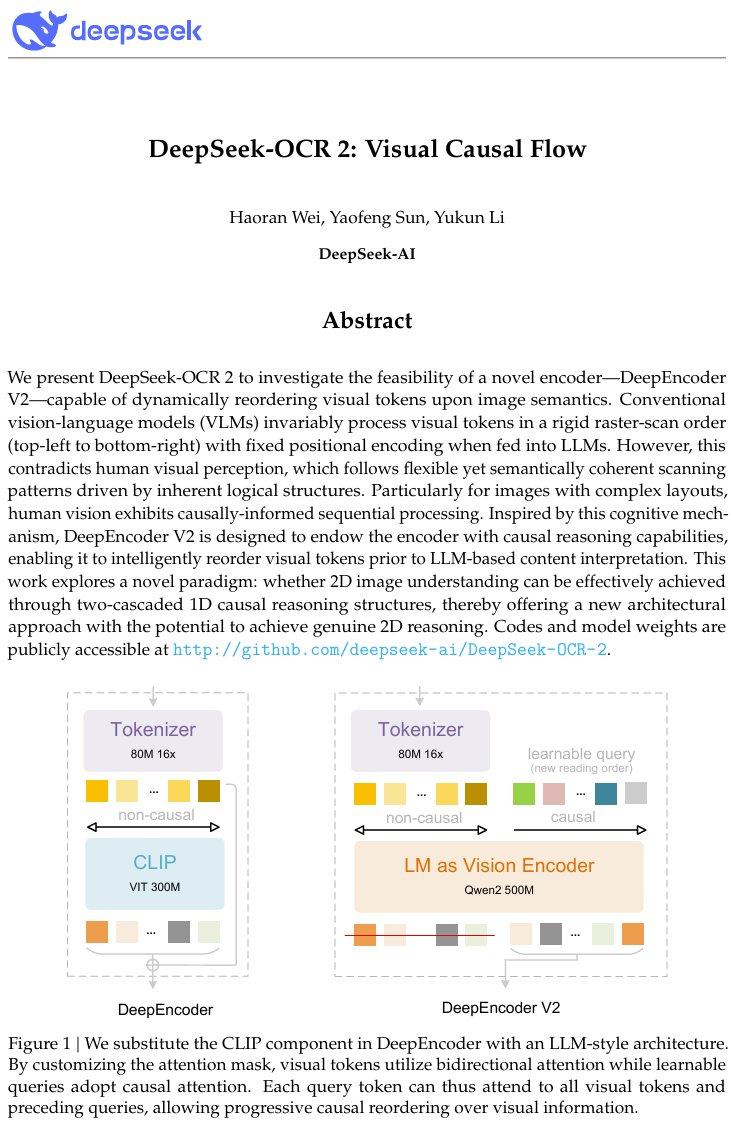
Core Insights - DeepSeek has launched the new DeepSeek-OCR2 model, which utilizes the innovative DeepEncoder V2 method to dynamically rearrange image components based on their meaning, enhancing visual understanding beyond traditional left-to-right scanning methods [1][2] - The model significantly outperforms traditional visual-language models (VLM) in processing complex layouts, achieving a score of 91.09% on the OmniDocBench v1.5 benchmark, which is a 3.73% improvement over its predecessor [1] Group 1 - The DeepSeek-OCR2 model maintains high accuracy while controlling computational costs, with visual token counts limited between 256 and 1120, aligning with Google’s Gemini-3Pro [2] - In practical applications, the model shows a reduction in repetition rates of 2.08% for online user logs and 0.81% for PDF pre-training data, indicating high practical maturity [2] Group 2 - The release of DeepSeek-OCR2 represents not only an upgrade in OCR performance but also significant architectural exploration, validating the potential of using language model architectures as visual encoders [2] - The DeepEncoder V2 architecture inherits advancements from the LLM community, such as mixture of experts (MoE) architecture and efficient attention mechanisms [2]
DeepSeek发布新模型
财联社· 2026-01-27 06:20
DeepSeek团队发布《DeepSeek-OCR 2: Visual Causal Flow》论文,并开源DeepSeek-OCR 2模型,采用创新的DeepEncoder V2方法,让AI能够根据图 像的含义动态重排图像的各个部分,更接近人类的视觉编码逻辑。 下载财联社APP获取更多资讯 准确 快速 权威 专业 7x24h电报 头条新闻 VIP资讯 实时盯盘 ...
DeepSeek概念股短线拉升,OCR 2重磅发布,让AI学会“人类视觉逻辑”
Jin Rong Jie· 2026-01-27 06:18
Core Insights - DeepSeek's release of the DeepSeek-OCR2 model has led to a short-term surge in related stocks, with companies like YunSai ZhiLian and Hongjing Technology hitting their upper trading limits [1] - The DeepSeek-OCR2 model utilizes the innovative DeepEncoder V2 method, allowing AI to dynamically rearrange image components based on their meanings, closely mimicking human visual encoding logic [1][6] Technology Advancements - The DeepSeek-OCR2 model breaks the limitations of traditional OCR by improving semantic understanding of images, significantly enhancing recognition accuracy in complex layouts, distortions, and occlusions [6] - In the OmniDocBench v1.5 benchmark test, the model achieved a score of 91.09%, a 3.73% improvement over its predecessor [6] - The model maintains high precision while controlling computational costs, with visual token counts limited to between 256 and 1120, aligning with Google's Gemini-3 Pro [6][7] Architectural Significance - The release of DeepSeek-OCR2 represents not just an upgrade in OCR performance but also a significant exploration of architecture, validating the potential of using language model architectures as visual encoders [7] - The model's "two cascaded 1D causal reasoning" approach may signify a breakthrough in achieving true 2D reasoning by decomposing 2D understanding into complementary sub-tasks [7] Industry Implications - The launch of the DeepSeek-OCR2 model provides a technological upgrade direction for the OCR industry, enabling companies involved in graphic information processing and digital transformation services to optimize their products and expand business opportunities in finance, healthcare, and government sectors [8] - DeepSeek's commitment to an open-source technology route and the continuous release of high-performance model products will benefit developers and enterprises focusing on secondary development and deployment services [8] - The adaptation of DeepSeek's model on edge devices is pushing AI capabilities towards the edge, creating growth opportunities for companies involved in edge hardware development and edge computing solutions [8]
DeepSeek发布DeepSeek-OCR 2
Mei Ri Jing Ji Xin Wen· 2026-01-27 06:15
每经AI快讯,1月27日消息,DeepSeek发布全新DeepSeek-OCR2模型,采用创新的DeepEncoder V2方 法,让AI能够根据图像的含义动态重排图像的各个部分,而不再只是机械地从左到右扫描。这种方式 模拟了人类在观看场景时所遵循的逻辑流程。最终,该模型在处理布局复杂的图片时,表现优于传统的 视觉-语言模型,实现了更智能、更具因果推理能力的视觉理解。 ...
谁能接住马化腾的红包?
Sou Hu Cai Jing· 2026-01-27 06:08
Group 1 - The core viewpoint of the article is that the domestic AI industry in China is expected to undergo three major changes in 2026: significant technological investment, intense competition differentiation, and market segmentation [1][30]. - The competition among major internet companies is intensifying, with Tencent, Baidu, and ByteDance engaging in a "red envelope war" during the Spring Festival, reminiscent of past marketing battles [3][6][7]. - Tencent announced a cash giveaway of 1 billion yuan through its Yuanbao app, while Baidu and ByteDance also made significant marketing moves, indicating a shift from pure model competition to application and entry competition [7][21]. Group 2 - In 2025, major companies are heavily investing in AI, with ByteDance's capital expenditure expected to reach 300 billion yuan, while Alibaba plans to invest 380 billion yuan over three years, setting a record for domestic AI spending [14][15]. - The competitive landscape is characterized by a "Warring States" model, with major players like ByteDance, Alibaba, Tencent, and Baidu each having distinct strengths and strategies [17][20]. - The article highlights that the current competition is not just about AI models but also encompasses the entire ecosystem from cloud services to applications, with companies like Alibaba focusing on creating a comprehensive application ecosystem [21][24].



DeepSeek概念股短线拉升,云赛智联直线触及涨停
Xin Lang Cai Jing· 2026-01-27 06:02
Group 1 - DeepSeek concept stocks experienced a short-term surge, with YunSai ZhiLian hitting the daily limit up, Hongjing Technology reaching a 20% limit up, and KaiPuYun, Shiji Hengtong, and Parallel Technology also seeing short-term increases [1] - The surge in stock prices is attributed to the release of the DeepSeek-OCR 2 model by DeepSeek [1]

刚刚,DeepSeek又探索新架构了,开源OCR 2
机器之心· 2026-01-27 06:00
机器之心编辑部 嘿!刚刚,DeepSeek 又更新了! 这次是更新了十月份推出的 DeepSeek-OCR 模型(参见: 太强了!DeepSeek 刚刚开源新模型,用视觉方式压缩一切 )。 当时 DeepSeek-OCR 的出世,引起了大家对视觉压缩的关注与讨论,而这一次,DeepSeek 对视觉编码下手了。 可以说,刚刚发布的 DeepSeek-OCR 2 通过引入 DeepEncoder V2 架构,实现了视觉编码从「固定扫描」向「语义推理」的范式转变! 当然,和 DeepSeek 几乎每次发布一样,这一次同样也是模型和技术报告齐开源。 这种设计打破了传统模型必须按从左到右、从上到下的栅格顺序处理图像的限制,赋予了编码器根据图像语义动态重排视觉 Token 的能力。通过这种两级级联的 1D 因果推理结构(编码器重排与译码器解析),模型能够更精准地还原复杂文档(如带表格、公式和多栏布局)的自然阅读逻辑。 这就像是为机器装上了「人类的阅读逻辑」,让 AI 不再只是生搬硬套地扫描图像。对比之下,传统的 AI 就像一个死板的复印机,不管页面内容多复杂,都只能 从左上角到右下角按行扫描。 在维持极高数据压缩效率的同 ...

DeepSeek发布DeepSeek-OCR 2,AI能够以与人类相同的逻辑顺序“看”一张图片
Hua Er Jie Jian Wen· 2026-01-27 05:52
风险提示及免责条款 市场有风险,投资需谨慎。本文不构成个人投资建议,也未考虑到个别用户特殊的投资目标、财务状况或需要。用户应考虑本文中的任何 意见、观点或结论是否符合其特定状况。据此投资,责任自负。 DeepSeek发布全新DeepSeek-OCR 2模型,采用创新的DeepEncoder V2方法,让AI能够根据图像的含义 动态重排图像的各个部分,而不再只是机械地从左到右扫描。这种方式模拟了人类在观看场景时所遵循 的逻辑流程。最终,该模型在处理布局复杂的图片(如文档或图表)时,表现优于传统的视觉-语言模 型,实现了更智能、更具因果推理能力的视觉理解。 ...