
西部矿业

Search documents
工业有色ETF(560860)盘中涨近3%,近5日累计“吸金”超4亿元
Xin Lang Cai Jing· 2025-12-31 02:43
2025年12月31日早盘,有色金属板块盘中拉升,截至 09:53,中证工业有色金属主题指数(H11059)强势 上涨2.78%,成分股江西铜业上涨9.95%,云南铜业上涨7.25%,紫金矿业上涨5.45%,铜陵有色、洛阳 钼业等个股跟涨。工业有色ETF(560860)上涨2.74%。 规模方面,截至2025年12月30日,工业有色ETF最新规模达83.30亿元。资金流入方面,工业有色ETF最 新资金净流入2.54亿元。拉长时间看,近5个交易日内有4日资金净流入,合计"吸金"4.32亿元。 数据显示,截至2025年11月28日,中证工业有色金属主题指数前十大权重股分别为洛阳钼业、北方稀 土、中国铝业、云铝股份、兴业银锡、华友钴业、铜陵有色、江西铜业、神火股份、西部矿业,前十大 权重股合计占比54.56%。 工业有色ETF(560860)紧密跟踪中证工业有色金属主题指数,覆盖铜、铝、稀土等战略资源龙头,场 外投资者可通过联接(A类:018489;C类:018490)布局顺周期与政策红利共振机遇。 MACD金叉信号形成,这些股涨势不错! 在供需紧平衡背景下,宏观因素对工业金属价格走势影响显著。国泰君安证券指出,货 ...
ETF盘中资讯|太强了!有色“夺冠在望”! 有色ETF华宝(159876)拉升2.5%再创新高!近5日狂揽8571万元!紫金矿业涨超4%
Sou Hu Cai Jing· 2025-12-31 02:24
Core Viewpoint - The non-ferrous metal sector has shown strong performance, leading the market with a net inflow of 4.8 billion yuan on the last trading day of 2025, indicating positive investor sentiment towards this sector [1][6]. Group 1: Market Performance - The non-ferrous metal sector recorded a remarkable increase of over 92% in 2025, outperforming the second-ranked communication sector by 5.37 percentage points [6]. - The Huabao Non-Ferrous Metal ETF (159876) saw a price increase of over 2.5% during trading, reaching a new high since its listing [1]. - The Huabao ETF has attracted a net subscription of 2.4 million units, reflecting strong investor confidence in the non-ferrous metal sector [1]. Group 2: Investment Drivers - The strong performance of the non-ferrous metal sector is attributed to macroeconomic financial policies and structural changes in supply and demand, with a global easing of monetary policy and a weakening dollar leading to increased liquidity [2]. - Emerging demands in sectors such as AI and new energy, along with domestic policies aimed at regulating industry competition, have stimulated demand for non-ferrous metals [2]. - The current bull market is driven by new productive forces, integrating global energy transitions, technological revolutions, and industrial upgrades, with new energy, new materials, AI, and aerospace being key growth drivers [3]. Group 3: Investment Strategy - A diversified investment approach through the Huabao Non-Ferrous Metal ETF and its associated funds is recommended to capture the overall sector's performance while mitigating risks associated with individual metal investments [4].


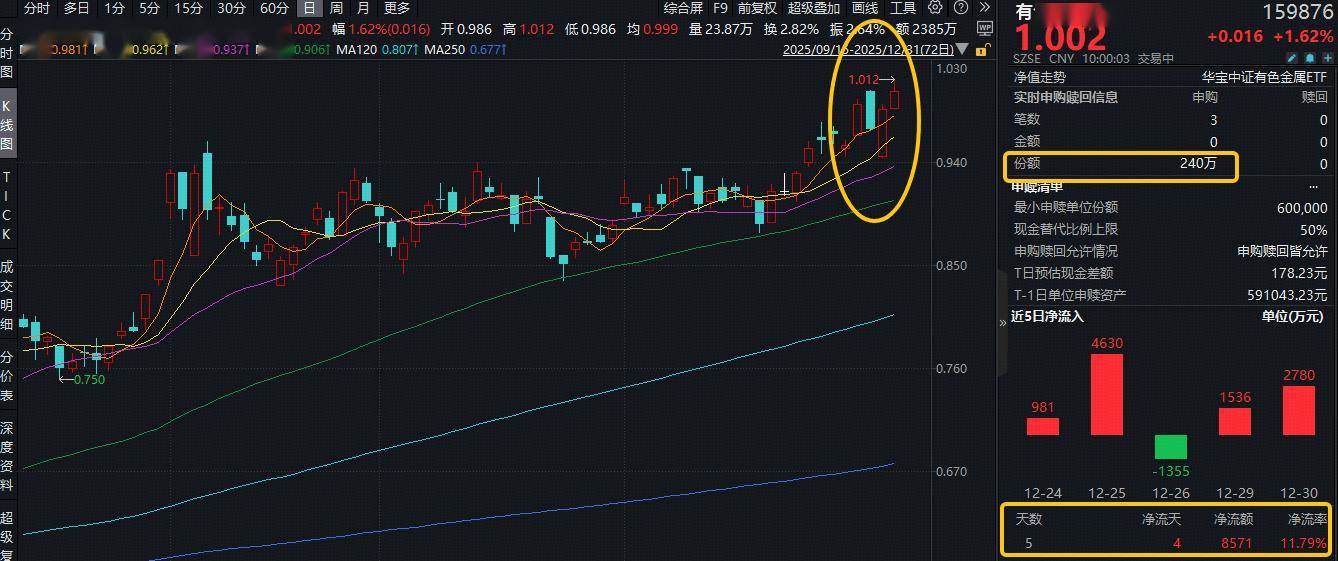
太强了!有色“夺冠在望”! 有色ETF华宝(159876)拉升2.5%再创新高!近5日狂揽8571万元!紫金矿业涨超4%
Xin Lang Cai Jing· 2025-12-31 02:12
Core Viewpoint - The non-ferrous metal sector has shown strong performance, leading the market with a net inflow of 4.8 billion yuan on the last trading day of 2025, indicating investor confidence in the sector's future performance [1][9]. Group 1: Market Performance - The non-ferrous metal sector recorded a remarkable increase of over 92% in 2025, outperforming the second-best sector, communications, by 5.37 percentage points [4][15]. - Major stocks in the sector, such as Jiangxi Copper, Yunnan Copper, and Shengxin Lithium Energy, have seen significant gains, with Jiangxi Copper leading with over 9% increase [3][11]. Group 2: Investment Trends - The Huabao Non-Ferrous Metal ETF (159876) has attracted substantial investment, with a net subscription of 2.4 million units and 85.71 million yuan in the past five days, reflecting strong market interest [1][9]. - Analysts attribute the strong performance of the non-ferrous metal sector to macroeconomic policies and structural changes in supply and demand, alongside a global easing of monetary policy and a weakening dollar [2][12]. Group 3: Future Outlook - The non-ferrous metal sector is expected to continue its strong performance into 2026, driven by emerging demands in AI, new energy, and other innovative sectors, as well as domestic policies aimed at regulating industry competition [2][5]. - The current bull market is characterized by a shift towards "new quality productivity," integrating global energy transitions and technological advancements, which are key drivers for the demand in the non-ferrous metal sector [5][13]. Group 4: Investment Strategy - A diversified investment approach through the Huabao Non-Ferrous Metal ETF and its associated funds is recommended to capture the overall sector's performance while mitigating risks associated with individual metal investments [6][16].
并购与获取采矿权双轮驱动 上市公司矿业资源整合加速
Zheng Quan Ri Bao Wang· 2025-12-30 12:44
Core Viewpoint - The mining sector is experiencing a wave of mergers and acquisitions, driven by the increasing strategic value of mineral resources, which enhances companies' resource reserves and optimizes product structures, thereby improving profitability and risk resilience [1][2][8]. Group 1: Company Actions - Baodi Mining plans to acquire 82% of the shares of Xinjiang Congling Energy Co., Ltd. and 5% from JAAN INVESTMENTS CO.LTD., aiming to increase its iron ore resources from 3.8 billion tons to approximately 4.6 billion tons, representing a 21.75% increase [2][3]. - Guocheng Mining intends to acquire 60% of Guocheng Industrial, which will allow it to diversify its product offerings by adding molybdenum concentrate to its existing portfolio of zinc, lead, and copper concentrates [4]. - Western Mining's subsidiary has obtained a mining license for various minerals, including iron and copper, which will help the company quickly increase its resource reserves and broaden its resource variety [5]. Group 2: Policy Support - Recent policies from central and local governments are providing strong support for mineral resource exploration and industry consolidation, creating a favorable environment for market activity [6][7]. - The Ministry of Natural Resources has issued guidelines to promote a new round of exploration breakthroughs, while the National Development and Reform Commission encourages large enterprises to engage in mergers and acquisitions to enhance competitiveness [7]. - The macroeconomic environment, including expectations of interest rate cuts and rising geopolitical risks, is increasing demand for scarce resources, particularly in sectors like electric vehicles and energy storage [7][8]. Group 3: Industry Outlook - The integration and high-quality development of the mining sector are expected to continue, driven by both policy support and market operations, enhancing the scale effects and bargaining power of leading companies [8]. - The strategic resource sector is particularly important for companies to secure a favorable position in global resource competition, improving the industry's resilience to market fluctuations [8].


有色金属“王者归来”:一场结构性牛市,还是情绪交易?
Sou Hu Cai Jing· 2025-12-30 08:10
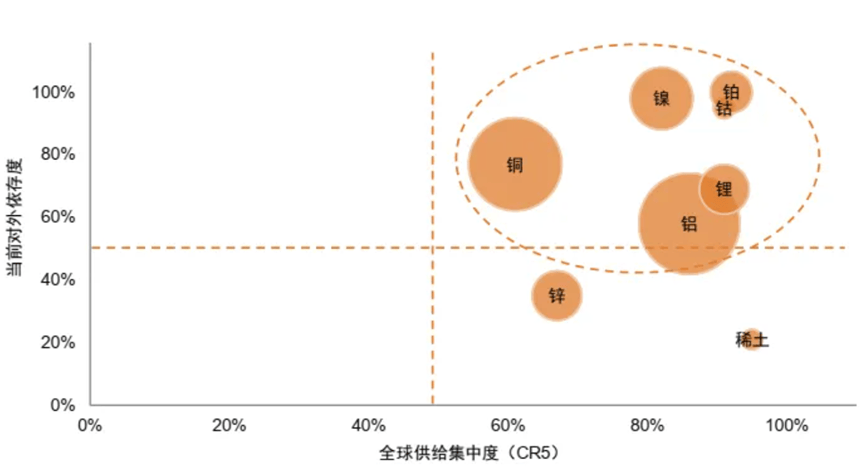
Group 1 - The core viewpoint of the article is that the significant rise of the China Nonferrous Metals Index (H11059.CSI) by approximately 90% this year is driven by improvements in supply-demand structure, changes in the global macro environment, and elevated national strategic priorities [1][2] - Nonferrous metals, which include copper, aluminum, zinc, nickel, tin, and rare earths, possess notable industrial, strategic, and scarcity attributes, making them essential in the current economic landscape [3] - The current uptrend in nonferrous metals is not merely a cyclical phenomenon but is also influenced by structural themes such as high external dependence on strategic minerals, with many resources having over 50% reliance on imports, raising security risks [5][6] Group 2 - The sustainability of the current market trend is questioned, with a focus on which metals are worth monitoring and how ordinary investors can participate more rationally [6] - The article highlights that the demand for nonferrous metals is closely tied to macroeconomic conditions, industrial investment, and high-end manufacturing, with a cyclical pattern of price-capital expenditure-supply-demand rebalancing [6][12] - The Chinese government has initiated a new round of strategic mineral exploration and has implemented reforms to activate mining companies, indicating a strong commitment to resource security and development [9][11] Group 3 - The article identifies two major drivers for the nonferrous market in 2025: the real demand from AI and high-tech industries, which will increase the consumption of copper, aluminum, and rare earths, and the ongoing accumulation of gold reserves by central banks, which enhances gold's attractiveness [12][17] - Economic recovery in China is anticipated by 2026, which may boost demand for industrial nonferrous metals, while global resource distribution and tightening policies in key resource countries are expected to keep supply tight [12][13] - The article discusses the macroeconomic environment, indicating that a loose monetary policy and rising demand for safe-haven assets will likely support nonferrous metal prices [17][19] Group 4 - The article predicts a mid-term bull market for the nonferrous industry driven by a triple resonance of monetary policy, demand, and supply [16][17] - The article emphasizes the preference for the Industrial Nonferrous Metals Index (H11059.CSI) due to its clear index positioning, strong manufacturing attributes, and solid industrial value, which is expected to outperform broader indices [20][21] - The index has shown impressive long-term returns, with a nearly 102.8% return over the past five years, indicating strong profitability and growth potential among leading companies in the sector [26][28] Group 5 - Ordinary investors are advised to avoid chasing hot stocks and instead consider index-based and leading company investments, with specific recommendations for ETFs that align with the Industrial Nonferrous Metals Index [30]
有色金属“王者归来”:一场结构性牛市,还是情绪交易?
老徐抓AI趋势· 2025-12-30 07:56
Group 1 - The core viewpoint of the article is that the recent surge in the CSI Industrial Nonferrous Index is driven by improvements in supply-demand structure, changes in the global macro environment, and elevated national strategic priorities, indicating potential sustainability in this market trend [1][10] - The article emphasizes that nonferrous metals are a typical cyclical industry, with prices determined by supply and demand, and are closely tied to macroeconomic conditions and industrial investment [1][11] - The current rise in nonferrous metals is not only cyclical but also influenced by structural themes such as national strategic security, new technology cycles, economic recovery, and changes in global liquidity [1][10] Group 2 - China's strategic mineral resources face two significant issues: high dependence on foreign sources and lack of cost competitiveness in domestic resources [3][4] - The article outlines several national policies aimed at enhancing resource security and promoting high-quality development in the copper, aluminum, and gold industries, with specific targets for resource growth and production capacity [8][9] - Investment in the nonferrous mining sector is projected to reach 208.9 billion yuan in 2024, marking a ten-year high, with significant increases in fixed investment expected in the coming years [9] Group 3 - The article identifies two major drivers for the nonferrous market in 2025: the real demand for metals driven by AI and the increasing gold reserves held by central banks amid a trend towards de-dollarization [11][12] - Economic recovery in China is anticipated to boost demand for industrial nonferrous metals, while global supply constraints and domestic capacity controls are expected to keep supply tight [12][13] - The article highlights the importance of inventory depletion in supporting prices, with specific examples of lithium and aluminum inventory trends [14] Group 4 - The macroeconomic environment is characterized by a potential easing of monetary policy, with expectations of multiple interest rate cuts by the Federal Reserve in 2026, which could enhance the attractiveness of nonferrous metals [15][16] - The article predicts a mid-term bull market for nonferrous metals driven by a combination of monetary easing, demand growth from emerging sectors, and supply-side constraints [18][20] - The industrial nonferrous index is favored for its clear focus on manufacturing and strong performance compared to broader indices, with significant historical returns and robust profitability metrics [21][25][27] Group 5 - Ordinary investors are advised to consider specific ETFs and mutual funds that focus on the industrial nonferrous sector, emphasizing a strategy of index-based and leading company investments [31][33]

华龙证券:有色行业资金做多意愿强烈 沪铜续创历史新高
Zhi Tong Cai Jing· 2025-12-30 03:59
Group 1 - The core viewpoint is that the copper market is experiencing strong demand and supply mismatch, with optimistic economic expectations supporting price increases, while caution is advised regarding short-term price volatility [1][2][3] - On December 26, major metal prices surged, with COMEX copper rising by 4.96% to $5.8515 per pound and Shanghai copper increasing by 3.33% to 101,380 yuan per ton, marking a new historical high [1][2] - Factors contributing to the strong market sentiment include supply chain disruptions, resource nationalism, and a gradual economic recovery in major economies, leading to a strong willingness to buy copper [2] Group 2 - The economic outlook for 2026 is moderately optimistic, with the Federal Reserve projecting GDP growth of 2.1%-2.5%, which is expected to support industrial metal demand and further increase copper prices [3] - Despite the positive outlook, there are concerns about inflation and potential impacts on Federal Reserve interest rate policies, which could affect copper prices [3] - Investment recommendations include leading industrial metal companies such as Zijin Mining, Luoyang Molybdenum, Western Mining, Tongling Nonferrous Metals, Yunnan Copper, Jiangxi Copper, and Jincheng Mining [3]




西部矿业涨2.03%,成交额7.74亿元,主力资金净流出2152.06万元
Xin Lang Cai Jing· 2025-12-30 03:16
Core Viewpoint - Western Mining has shown significant stock performance with an 80.03% increase year-to-date, indicating strong market interest and potential growth in the mining sector [1]. Group 1: Stock Performance - As of December 30, Western Mining's stock price reached 27.13 CNY per share, with a trading volume of 7.74 billion CNY and a market capitalization of 646.51 billion CNY [1]. - The stock has increased by 4.67% over the last five trading days, 13.99% over the last 20 days, and 26.07% over the last 60 days [1]. Group 2: Financial Performance - For the period from January to September 2025, Western Mining reported a revenue of 484.42 billion CNY, reflecting a year-on-year growth of 31.90% [2]. - The net profit attributable to shareholders for the same period was 29.45 billion CNY, representing a year-on-year increase of 7.80% [2]. Group 3: Shareholder Information - As of December 19, the number of shareholders for Western Mining was 113,500, a decrease of 0.79% from the previous period, while the average circulating shares per person increased by 0.79% to 20,995 shares [2]. - The company has distributed a total of 107.23 billion CNY in dividends since its A-share listing, with 69.11 billion CNY distributed over the last three years [3]. Group 4: Institutional Holdings - As of September 30, 2025, Hong Kong Central Clearing Limited was the third-largest circulating shareholder, holding 112 million shares, a decrease of 5.16 million shares from the previous period [3]. - Southern CSI 500 ETF ranked as the eighth-largest circulating shareholder with 24.32 million shares, down by 525,900 shares compared to the previous period [3].
资金做多意愿强烈,沪铜续创历史新高 | 投研报告
Sou Hu Cai Jing· 2025-12-30 01:28
来源:中国能源网 华龙证券近日发布有色金属行业点评报告:12月26日,美铜上涨4.96%,沪铜上涨3.33%至10.138万元/ 吨,突破10万元大关,续创历史新高。美联储12月初议息会议对2026年经济也表示乐观,上调了9月份 经济增速预测,预计2026年GDP实际增速2.1%-2.5%;据2025年亚洲铜业周预测,2026年中国铜需求仍 将保持韧性。 12月26日,主要金属价格持续上扬,金、银、铜等大涨。COMEX铜涨4.96%至5.8515美元/磅,沪铜上 涨3.33%至10.138万元/吨。 以下为研究报告摘要: 评级与投资建议:美国经济表现较好、预期乐观,国内2026年铜需求有韧性,铜的供需错配正在从预期 转向现实,市场交易热度高、做多意愿强烈。但随着美铜大涨、沪铜突破10万元大关续创历史新高,应 注意铜价短期波动的风险。维持行业"推荐"评级。建议关注工业金属龙头紫金矿业(601899.SH)、洛 阳钼业(603993.SH)、西部矿业(601168.SH)、铜陵有色(000630.SZ)、云南铜业(000878.SZ)、 江西铜业(600362.SH)、金诚信(603979.SH)等。 事件: 风 ...
电解铜2026年报:供弱需强格局逐步巩固,铜价将不断挑战新高
Fo Shan Jin Kong Qi Huo· 2025-12-29 03:01
1. Report Industry Investment Rating No relevant content provided. 2. Core Viewpoints - In 2026, the price of electrolytic copper may show an inverted "V" trend throughout the year. It may fluctuate strongly in the first half of the year, challenging new highs, and weakly in the second half. The volatility of copper prices is expected to converge to a limited extent, and call options remain highly suitable. The main influencing factors include the Fed's monetary policy, Sino - US relations, changes in copper concentrate TC, and energy storage demand [4]. 3. Summary by Directory 3.1 2025 Copper Market Review - In 2025, copper prices showed a generally strong and fluctuating trend. By December 10, the Shanghai copper main - continuous contract had risen by nearly 25% during the year. The copper futures market went through four stages: in the first stage (January - March), the first wave of price increase was driven by the tightening supply of copper concentrate and the market's expectation of rising US inflation. In the second stage (April - mid - September), after hitting bottom, the price rebounded and then consolidated for a long time, affected by trade wars, Fed rate - cut expectations, and other factors. In the third stage (late September - mid - November), the second wave of price increase occurred due to the supply shortage of copper concentrate and positive market news. In the fourth stage (mid - November - present), the price repeatedly broke through historical highs, driven by market concerns about the Fed's future policies [7]. 3.2 Macroeconomic Environment Outlook 3.2.1 Fed Policy May Remain Loose - In 2025, the Fed's policy experienced multiple adjustments, including rate cuts and the end of the balance - sheet reduction plan. Looking ahead, according to the dot - plot after the December meeting, there is still one rate cut expected in 2026 and 2027. The market is concerned about whether the Fed will continue to expand its balance sheet and the independence of the Fed after Powell's term ends [11][12]. 3.2.2 Sino - US Game Will Continue - In 2025, Sino - US tariff disputes went through several rounds of escalation and mitigation. The US used tariff hikes as a bargaining chip. In the future, Sino - US tariff disputes are expected to continue, and the US may focus on issues such as fentanyl and rare - earth exports [13][15]. 3.3 Demand Side: Emerging Demands Show Obvious Increases and May Explode in 2026 3.3.1 Traditional Industries Have Limited Growth - **Real Estate Remains in a Downturn**: In 2025, despite a series of policies, real - estate investment, new construction, and completion data continued to decline. In 2026, although the government will continue to promote real - estate stability policies, the real - estate market is expected to continue to drag down copper demand in the short term [16][19]. - **White Goods Production and Sales First Strong Then Weak**: In 2025, with the support of the "trade - in" policy, white - goods production and sales were strong in the first half of the year but weakened later. In 2026, with the possible continuation of the policy and the replacement cycle, the year - on - year growth rate of production and sales of three major white goods is expected to be higher than in 2025. However, the year - on - year growth rate of exports of white goods has declined overall compared to last year, and its contribution to copper demand growth has weakened [23][24]. 3.3.2 Emerging Demands Will Gradually Become the Main Force of Copper Demand - **AI and Computing Power May Boost Future Power Grid Demand**: In 2025, power and grid infrastructure investment showed a trend of first increasing and then decreasing. In the future, AI and computing - power industries will become important demand drivers for power and grid infrastructure [29]. - **New - energy Vehicles Provide Stable Increases Despite Slower Growth**: In 2025, new - energy vehicle production and sales maintained a relatively high year - on - year growth rate, providing stable copper demand. In 2026, although the subsidy for new - energy vehicle purchase tax will be halved, the year - on - year growth rate of production and sales is still expected to remain at a relatively high level [32][34]. - **Photovoltaic Installation in China Has Stable Increases and Exports Are Impressive**: In 2025, due to policy changes, there was a "rush - to - install" phenomenon in the first five months, and the year - on - year growth rate of cumulative new installations and cumulative installations showed an inverted "V" trend. In 2026, the year - on - year growth rate of photovoltaic installation may be lower than in 2025 but will still be high. Photovoltaic cell exports are expected to maintain a high growth rate [35][37]. - **Energy Storage Demand May Explode**: In 2025, the new energy - storage installation volume in China is expected to increase by 24% year - on - year. In 2026, it is expected to reach 230GWh, with a year - on - year growth rate close to 70%. Globally, the new energy - storage installation volume in 2026 is expected to reach 480GWh, with a year - on - year growth rate of 60%, providing significant copper demand growth [44][47]. 3.4 Supply Side: Mine - end Shortage Persists, and Smelter Production Cuts May Expand 3.4.1 Frequent Overseas Mine Incidents Lead to Continuous Decline in Copper Concentrate TC - In 2025, overseas copper mines experienced many incidents, causing copper concentrate TC to decline continuously. CSPT called on domestic smelters to jointly cut production in the fourth quarter. In 2026, the global copper concentrate increment is expected to be 45 - 56 tons, mainly concentrated in the second half of the year. The shortage of copper concentrate will persist in the first half of 2026, and TC may remain at a very low level [49][62]. 3.4.2 Copper Mine Shortage Has Limited Impact on the Smelting End - In 2025, although copper concentrate was in short supply, the global and Chinese electrolytic copper production basically maintained the highest level in the same period of the past five years. In 2026, the shortage of copper concentrate may be difficult to ease in the first half of the year, and the domestic smelting industry may have a larger - scale joint production cut than in Q4 2025 [63]. 3.4.3 The Siphon Effect of US Copper Continues, and Spot Supplies of Shanghai and London Copper Are Tight - In 2025, due to factors such as tariffs, COMEX copper was at a significant premium, leading to a change in the global copper trade pattern. Copper flowed into the US, causing the inventory of COMEX copper to rise continuously, while the inventory of Shanghai and London copper decreased, resulting in a long - term tight spot supply and high prices [68][70]. 3.4.4 High Copper Prices Pressure Downstream Demand, and Social Inventory Remains at a High Level - In 2025, electrolytic copper social inventory increased to a high level in September, but it had little pressure on copper prices, which were mainly driven by macro factors and low copper concentrate TC [77]. 3.5 Future Outlook and Supply - Demand Balance Sheet 3.5.1 Global Copper Concentrate Supply - Demand Balance Remains Tight - In 2025, the global copper concentrate supply - demand balance was expected to be - 35 tons. In 2026, it is expected to be - 40 tons, with the supply gap widening compared to 2025. The shortage will persist in Q1 2026 and gradually ease in the later quarters [79][80]. 3.5.2 Electrolytic Copper Supply - Demand Balance - **Global**: In 2025, the global electrolytic copper supply - demand balance was in a tight state at - 5 tons. In 2026, it is expected to be - 21 tons, with the gap widening. - **China**: In 2025, the supply - demand balance of Chinese electrolytic copper was - 20.04 tons, with the gap nearly doubling compared to 2024. In 2026, it may decline slightly to - 30 tons, with the gap widening slightly compared to 2025 [81][83].