
华润置地

Search documents
周期论剑|地产链,逻辑再梳理
2026-01-26 02:50
Summary of Conference Call Industry Overview - The conference focused on the real estate chain logic and investment opportunities within the real estate sector, highlighting the recent strong performance of real estate-related stocks [1][2]. Key Points and Arguments Market Sentiment - The speaker emphasized a positive outlook for the market, predicting a potential rise to 4200 points before the Spring Festival, indicating a strong market sentiment despite regulatory interventions [2][3]. - The speaker noted that while 300 stocks appeared constrained, the majority of stocks performed well, suggesting a broader market strength [2][3]. Real Estate Sector Insights - The real estate sector has seen significant declines, with residential investment as a percentage of GDP dropping to 4.5%, and real estate investment growth decreasing by nearly 60% [6]. - Sales area has fallen by approximately 50% from peak levels, and housing prices have decreased by 30% to 40% [6]. - The speaker highlighted the critical role of stabilizing the real estate market for national economic stability and internal demand growth, especially in the face of external uncertainties [6][7]. Investment Opportunities - The speaker identified three key investment directions: 1. Quality real estate companies with a price-to-book (PB) ratio below one, indicating deep discounts [9]. 2. Companies in the real estate supply chain, particularly in construction materials, chemicals, and appliances, which have seen improved competitive dynamics due to market consolidation [10]. 3. Urban renewal projects that will drive demand for construction materials and related services [10]. Regulatory Environment - The speaker discussed the regulatory environment, suggesting that early interventions by regulators could lead to a more stable market and longer-term growth [4][5]. Additional Insights - The real estate and related sectors currently represent only 8.1% of the total A-share market capitalization, while consumer goods account for 9.4% despite contributing 43% to GDP [8]. - The speaker noted that the current low expectations and stock valuations create a favorable environment for potential recovery in the real estate sector [8]. Transportation Sector Insights - The transportation sector, particularly aviation and oil shipping, is expected to see increased demand during the upcoming Spring Festival, with passenger traffic projected to reach 9.5 billion, a 5% increase from the previous year [12][13]. - The oil shipping market has seen a significant rise in freight rates, with expectations for continued profitability in Q1 2026 [14]. Chemical Sector Insights - The chemical sector is closely tied to the real estate chain, with optimism regarding demand recovery for products like MDI, PVC, and soda ash due to improving internal demand [17][18]. - Key companies in the chemical sector, such as Wanhua Chemical and Boryung Chemical, are highlighted for their competitive advantages and growth potential [19][21]. Metal Sector Insights - The metal sector remains bullish, with expectations for continued price increases driven by supply disruptions and strong demand from sectors like AI and renewable energy [26][29]. - Industrial metals, particularly copper and aluminum, are seen as strategic resources with strong long-term demand prospects [29][30]. Energy Sector Insights - Oil prices are expected to remain stable around $60-$65 per barrel, with limited downside risk due to production cost considerations [34][35]. - The speaker noted that geopolitical factors could temporarily influence prices, but the overall supply-demand balance suggests a bearish outlook for the next 1-2 years [35][36]. Coal Sector Insights - The coal market is experiencing fluctuations due to seasonal demand, with expectations for price pressures in the spring as new projects commence [42][43]. - The speaker indicated that without significant fiscal stimulus, coal prices may face downward pressure in the upcoming quarters [42][43].
科顺股份20260123
2026-01-26 02:49
Summary of Key Points from the Conference Call of Keshun Co., Ltd. Company Overview - **Company**: Keshun Co., Ltd. (科顺股份) - **Industry**: Waterproofing materials and construction materials Core Insights and Arguments - **Price Increase Strategy**: Keshun plans to raise prices of its phenolic waterproof products by 5%-10% to counteract a 5-6% increase in raw material costs, expecting a 2% increase in gross margin by 2026 [2][6] - **Revenue Growth Projections**: The company anticipates a 10% revenue growth in 2026, amounting to approximately 600 million yuan. The civil construction sector (C-end retail) is expected to grow by 30% (around 300 million yuan), while overseas business is projected to grow by 50% (around 200 million yuan) [2][12] - **Tile Adhesive Business**: Keshun's tile adhesive revenue is expected to reach nearly 500 million yuan in 2025, with a growth rate of 20%-30% anticipated for 2026. The company sees significant growth potential in the tile adhesive market over the next 3-5 years [2][17] - **Overseas Market Strategy**: The company plans to adopt a light asset operation model for its overseas business, establishing small factories in Malaysia, Central Asia, and the Middle East through joint ventures and leasing existing facilities [2][22] Financial Performance and Projections - **2025 Financials**: Keshun's overseas revenue is projected to be around 450 million yuan, with a gross margin of 32%-33% and a net profit margin of 7%-8% (excluding impairments) [2][24] - **Credit Impairment Management**: The company aims to limit credit impairment to within 100 million yuan in 2026, with a focus on preparing for potential bad debts in 2025 [4][28] - **Cash Flow Expectations**: Keshun expects positive operating cash flow in 2025, similar to the 300 million yuan range seen in 2024 [4][29] Market Dynamics and Competitive Landscape - **Market Demand for Tile Adhesives**: The tile adhesive market is expected to continue growing, with a market size of approximately 60-70 billion yuan. The industry is fragmented, with leading companies like Deko and Yuhong having sales of 2-4 billion yuan each [19][20] - **Price Competition**: There is a small price difference among leading brands, while significant differences exist between leading brands and smaller companies. Keshun plans to expand its market share through channel collaboration and acquisitions of local small manufacturers [20] Challenges and Risks - **Customer Acceptance of Price Increases**: Some customers, particularly in the public construction sector, may resist price increases due to reduced business volume and intense competition [8][9] - **Implementation of Price Increases**: The company has successfully implemented price increases for its roll products, with a gradual realization of price adjustments expected to improve margins over time [10][11] Future Growth and Investment Plans - **Investment in New Materials**: Keshun is exploring high-end new materials in sectors like semiconductors and robotics to diversify its business and enhance resilience against market cycles [4][30] - **Convertible Bond Strategy**: The company aims to complete the conversion of all convertible bonds by 2026, targeting a market capitalization of around 10 billion yuan and a share price of approximately 9 yuan [4][32] - **Long-term Revenue Goals**: Keshun aims to return to a revenue scale of 10 billion yuan within 3-5 years, contingent on industry stabilization and recovery [34] Conclusion Keshun Co., Ltd. is strategically positioning itself for growth through price adjustments, expansion into overseas markets, and diversification into new materials. The company is focused on improving its financial health while navigating challenges in customer acceptance and market competition.

地产板块的性价比出现-未来可能的催化是什么
2026-01-26 02:49
Summary of Conference Call on Real Estate Sector Industry Overview - The real estate sector has shown signs of improvement since early 2026, ranking 18th among 31 Shenwan industries, indicating a positive shift in market sentiment and liquidity [1][4] - Despite a 45% increase in the Shenzhen Foreign Real Estate Index, it still underperformed compared to the Shanghai Composite Index, suggesting potential for catch-up in undervalued segments [1][5] Key Insights and Arguments - **Market Performance**: The new housing market remains weak, with transaction volumes significantly down year-on-year, and a projected overall decline in transaction area for the year, although the rate of decline may slow [1][6] - **Policy Dependency**: The recovery of the new housing market is heavily reliant on policy support, such as easing measures in first-tier cities and adjustments to the Loan Prime Rate (LPR) [1][7] - **Inventory Levels**: The inventory of unsold new homes in 70 cities is at a historical high, with varying de-stocking cycles across cities, indicating significant pressure on overall inventory [1][8] - **Land Market Trends**: The land market has seen a decline in transaction area and revenue, exacerbating supply-demand imbalances and limiting new housing supply [1][9] Additional Important Points - **Second-Hand Housing Market**: The second-hand housing market has also experienced a decline in transaction volume, with expectations of price stability but potential for slight decreases due to increased listings and stagnant purchasing power [1][10] - **Policy Impact**: Current policies are insufficient for a substantial turnaround in the real estate market, with only minor measures being implemented [1][11][12] - **Investor Sentiment**: There are mixed expectations among investors regarding the real estate sector, with some anticipating a recovery in 2026 while others remain cautious due to poor new housing data [1][13] - **Investment Opportunities**: Companies like Beike and developers such as Binhai Group and China Merchants Shekou are highlighted as potential beneficiaries of demand-side policies [1][14] - **Risks**: Ongoing declines in new housing sales and construction data pose risks to the sector, although the current market position still offers a favorable risk-reward ratio for investments [1][15]
环球房产周报:两部门发文支持城市更新行动,70城房价出炉,2026年北京供地计划公布……
Huan Qiu Wang· 2026-01-26 02:31
Policy News - The Ministry of Natural Resources and the Ministry of Housing and Urban-Rural Development issued measures to support urban renewal, emphasizing a sustainable model involving government guidance, market operations, and public participation [1] - The Minister of Housing and Urban-Rural Development, Ni Hong, stated that the focus this year will be on stabilizing the real estate market and implementing precise policies to support reasonable financing needs of real estate companies and housing demands of residents [1] - Shanghai's 15th Five-Year Plan suggests a dual approach of renting and purchasing to meet diverse housing needs, increasing the supply of affordable housing, and promoting high-quality real estate development [2] Market News - The January Loan Prime Rate (LPR) remains unchanged at 3.0% for the one-year term and 3.5% for the five-year term, effective until the next announcement [7] - In December 2025, the average sales price of new residential properties in first-tier cities decreased by 0.3% month-on-month, with Shanghai seeing a 0.2% increase while Beijing, Guangzhou, and Shenzhen experienced declines [8] - National real estate development investment in 2025 was 82,788 billion yuan, a year-on-year decrease of 17.2%, with residential investment down by 16.3% [9] Company News - Vanke's proposal to extend the repayment of an 11 billion yuan bond was approved, allowing for a 40% immediate repayment and a 60% extension for one year, which will alleviate short-term repayment pressure [13] - China Resources Land plans to issue a public bond of up to 2 billion yuan, with a three-year term and no credit enhancement measures [14] - The Flower Year Group announced the suspension of five domestic bonds due to the approval of an extension plan by bondholders, with the resumption date to be determined [14]
深度调整 动态筑底 2025年房地产行业数据解读
Zhong Guo Jing Ji Wang· 2026-01-26 00:14
Core Viewpoint - The real estate industry in China is undergoing a deep adjustment, with significant declines in investment, sales area, and sales revenue in 2025, indicating a challenging market environment [1][3][9]. Investment and Sales Data - In 2025, national real estate development investment reached 82,788 billion yuan, a year-on-year decrease of 17.2% [1]. - The sales area of new commercial housing was 88,101 million square meters, down 8.7% year-on-year, while the sales revenue was 83,937 billion yuan, reflecting a 12.6% decline [1][9]. - The construction area for real estate developers was 659,890 million square meters, a decrease of 10.0% year-on-year, with residential construction down 10.3% [3]. Construction Activity - New construction area was 58,770 million square meters, down 20.4%, with residential new construction area at 42,984 million square meters, a decline of 19.8% [4]. - The completion area was 60,348 million square meters, down 18.1%, with residential completions at 42,830 million square meters, a decrease of 20.2% [4]. Market Dynamics - The market is still in a "de-inventory" phase due to declining new home sales and significantly reduced land transactions over the past two years [5]. - Some central and state-owned enterprises are maintaining orderly construction activities, and there is still demand for well-located properties, which is boosting market confidence [6]. Financial Policies and Support - Local governments are enhancing "guarantee delivery" efforts, with recent financial policies aimed at stabilizing financing for projects on the "white list," which will support the delivery of homes [7]. Leading Companies - In 2025, ten real estate companies achieved sales exceeding 100 billion yuan, with four surpassing 200 billion yuan. These include major players like Poly Development, China Overseas Land & Investment, and Vanke [9]. - The top ten companies by investment are primarily state-owned enterprises, with significant investments from China Overseas, China Resources, Poly Development, and China Merchants Shekou, indicating a strategic positioning during market adjustments [9]. Market Trends - December 2025 showed signs of improvement, with new commercial housing sales area increasing by 39.87% month-on-month and sales revenue rising by 44.07% [10]. - The average price of new residential properties in first-tier cities saw a slight decrease, with Shanghai experiencing a minor increase, while other cities like Beijing and Guangzhou reported declines [10][11]. - The second-hand housing market is also seeing a shift, with increased transactions in second-hand homes as buyers seek more affordable options [12].





广发策略:从不买就跑输到买了就跑输——再看南下定价权
智通财经网· 2026-01-25 23:38
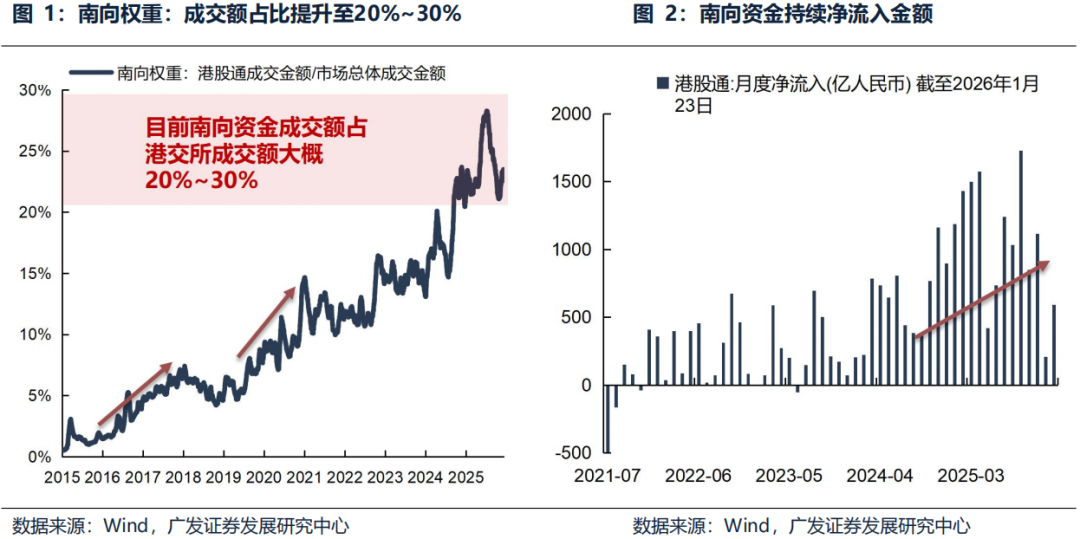
Group 1 - Since September 2024, the proportion of southbound capital transactions has rapidly increased to 20%-30%, nearly doubling compared to before 2024 [2][5] - In 2025, both active and passive foreign capital have become synchronous indicators of the Hong Kong stock market, showing no leading characteristics [2][5] - During sharp declines or corrections in the Hong Kong stock market, southbound capital tends to buy against the trend [2][5] Group 2 - Each round of pricing power competition typically begins with the optimization of the Stock Connect policy or the influx of incremental capital, which usually flows into dividend and scarce assets [5] - Net outflows of southbound capital often occur in response to adverse industry policies or external macroeconomic environments, particularly in sectors where foreign capital pricing power is increasing, such as software services, hardware equipment, consumer services, and discretionary retail [5][12] - Industries less likely to experience significant net outflows include those favored by long-term capital, such as banking, telecommunications, and public utilities, unless there are clear adverse policies affecting the sector [5][12] Group 3 - The proportion of medium to long-term capital in the current round of southbound capital inflow into Hong Kong stocks has increased, with insurance capital making 41 stakes, 35 of which are in H-shares, marking the highest record in the past decade [8] - Key industries for increased holdings include discretionary retail, finance (banking, insurance), innovative pharmaceuticals, software services, and hardware equipment [8] Group 4 - Current industries with pricing power for southbound capital and Chinese capital include semiconductors and dividend stocks, while industries lacking pricing power include internet, hardware equipment, software services, home appliances, and media [11][12] - Active management public funds have low pricing power in the Hong Kong stock market, focusing heavily on AI-related CSP giants, electronics, and innovative pharmaceuticals [16]

东吴证券晨会纪要2026-01-26-20260126
Soochow Securities· 2026-01-25 23:30
Macro Strategy - The report highlights the investment value of the GF CSI Media ETF (512980.SH), which is closely tracking the CSI Media Index (399971.SZ) and has a management fee of 0.5% per year and a custody fee of 0.1% per year. As of January 16, 2026, the ETF has a circulation scale of 10.759 billion yuan and an annualized return of 29.47% with a volatility ratio of 0.89, indicating reasonable risk control capabilities [1][12] - The underlying index focuses on AI applications, with a significant weight of 31.43% in GEO concept stocks, including key companies like BlueFocus, Yanshan Technology, and Kunlun Wanwei. The top ten weighted stocks account for 51.52% of the index, indicating a high concentration of component stocks [1][12] - The report emphasizes that the current media bull market is driven by AI technology transformation and the assetization of data factors, contrasting with the previous bull market driven by mobile internet traffic. The media sector's valuation is at a historical low, providing a high margin of safety for investors [1][12] Non-Bank Financial Industry - The report indicates that the non-bank financial sector is experiencing an upward trend in market conditions, with public fund holdings in the sector increasing to 2.42% by the end of 2025, up 0.82 percentage points from the previous quarter. However, the sector remains underweight compared to the market [5][16] - The report recommends key stocks such as China Life, Ping An, New China Life, China Pacific Insurance, and CITIC Securities, highlighting their potential to benefit from the improving market environment [5][16] - The average daily trading volume of equity funds reached 34.444 trillion yuan, a year-on-year increase of 155%, indicating a significant improvement in market activity [5][16] Real Estate Industry - The report notes that the real estate market is gradually stabilizing, with a narrowing decline in sales and construction metrics compared to 2024. The total development investment in 2025 was 8.3 trillion yuan, down 17.2% year-on-year, while the new construction area was 5.9 million square meters, down 20.4% [6][18][19] - Sales figures show a cumulative sales area of 8.8 million square meters, down 8.7% year-on-year, with a cumulative sales amount of 8.4 trillion yuan, down 12.6%. The decline in sales is narrowing, particularly in first-tier cities [6][18][19] - Investment recommendations include China Resources Land, China Merchants Shekou, and New City Holdings, with a focus on property management companies like China Resources Mixc Life and Greentown Service [6][18][19] Environmental Industry - The report discusses the growth potential of the waste incineration sector, particularly in Southeast Asia and India, where an estimated 500,000 tons per day of waste incineration capacity is expected, corresponding to an investment scale of approximately 250 billion yuan [7][20] - Companies like Weiming Environmental and Sanfeng Environment are highlighted for their overseas expansion and operational stability, with significant revenue increases driven by high electricity prices and processing fees in international markets [7][20] - The report emphasizes the importance of cost control in overseas projects, with potential for significant profit margins compared to domestic projects, particularly in Indonesia where new projects are expected to yield higher returns [7][20]
房地产开发2026W3:2025全年房价盘点,新房房价-3.0%,二手房价-6.1%
GOLDEN SUN SECURITIES· 2026-01-25 14:24
Investment Rating - The report maintains an "Overweight" rating for the real estate industry [4] Core Views - The real estate market is experiencing a structural downturn, with new home prices decreasing by 3.0% year-on-year and second-hand home prices down by 6.1% in 2025 [1][2] - Core cities are showing signs of a small-scale structural market, with cities like Shanghai and Hangzhou experiencing some price stability or increases, while most other cities are seeing declines [1][2] - The report emphasizes the importance of policy changes and economic indicators, suggesting that real estate remains a key economic barometer [4] Summary by Sections New Home Market - In December 2025, new home prices in 70 cities fell by 0.4% month-on-month, with a year-on-year decline of 3.0% [1] - New home prices in first, second, and third-tier cities decreased by 1.7%, 2.5%, and 3.7% respectively [1] - The new home transaction area in 30 cities was 117.7 million square meters, down 1.3% month-on-month and 38.1% year-on-year [3][25] Second-Hand Home Market - Second-hand home prices in 70 cities fell by 0.7% month-on-month and 6.1% year-on-year, with all cities experiencing price declines [2][12] - The transaction area for second-hand homes in 15 sample cities was 213.9 million square meters, showing a 3.9% increase month-on-month but a 4.0% decrease year-on-year [3][36] Market Performance - The report notes that the real estate index increased by 5.2%, outperforming the Shanghai and Shenzhen 300 index by 5.83 percentage points [2][17] - The report highlights the performance of specific stocks, with notable increases in companies like Zhongrun Resources and Wanze Shares [17][20] Investment Recommendations - The report suggests focusing on real estate-related stocks, particularly in first-tier and select second-tier cities, as these are expected to perform better in the current market environment [4] - Recommended stocks include Green Town China, China Overseas Development, and Poly Development among others [4]
2026W3:2025全年房价盘点,新房房价-3.0%,二手房价-6.1%
GOLDEN SUN SECURITIES· 2026-01-25 13:27
Investment Rating - The report maintains an "Overweight" rating for the real estate industry, indicating a positive outlook for investment opportunities in this sector [4][6]. Core Insights - The report highlights that the new home prices in 70 cities decreased by 3.0% year-on-year, while second-hand home prices fell by 6.1% in 2025, with core cities experiencing a significant decline [1][2]. - The report emphasizes that the real estate sector serves as an early economic indicator, suggesting that investments in this area can reflect broader economic trends [4]. - It notes that the competitive landscape in the industry is improving, with leading state-owned enterprises and select private firms performing well in land acquisition and sales [4]. Summary by Sections New Home Market - In December 2025, new home prices in 70 cities decreased by 0.4% month-on-month and 3.0% year-on-year, with first, second, and third-tier cities showing price changes of -1.7%, -2.5%, and -3.7% respectively [1][11]. - The report indicates that new home prices increased in 5 cities while decreasing in 65 cities throughout the year, with Shanghai showing a consistent month-on-month increase [1]. Second-Hand Home Market - The second-hand home prices in 70 cities fell by 0.7% month-on-month and 6.1% year-on-year, with all cities experiencing a decline [2][12]. - The report notes that after a brief stabilization in some cities post-September 2024, the second-hand home prices resumed their downward trend starting in the second quarter of 2025 [2]. Transaction Volume - For new homes, the transaction volume in 30 cities was 117.7 million square meters, reflecting a 1.3% decrease month-on-month and a 38.1% decrease year-on-year [3][25]. - In the second-hand market, the transaction volume in 15 cities totaled 213.9 million square meters, showing a 3.9% increase month-on-month but a 4.0% decrease year-on-year [3][36]. Investment Recommendations - The report suggests focusing on real estate-related stocks, particularly in first-tier and select second-tier cities, as these areas are expected to benefit from policy changes and market dynamics [4]. - Specific companies recommended for investment include Green Town China, China Resources Land, and Poly Developments among others [4].



房地产开发与服务26年第4周:乐观情绪不断发酵,板块行情持续性可期
GF SECURITIES· 2026-01-25 11:19
Core Insights - The report indicates a sustained optimistic sentiment in the real estate sector, suggesting that the market performance is likely to continue positively throughout the year [1]. Group 1: Policy Environment - Central policies have seen few new measures, maintaining a loose stance towards the real estate sector. Recent actions include the extension of tax incentives for public rental housing and a reduction in the minimum down payment for commercial properties from 50% to 30% [5][16]. - Local policies focus on long-term strategies in major cities, with initiatives aimed at urban renewal and optimizing land use policies [5][16]. Group 2: Transaction Performance - New home transactions remain low, with a year-on-year decline of 31.3% in the first 22 days of January, while second-hand home transactions have shown a year-on-year increase of 14.1% [5][9]. - The number of second-hand home subscriptions has increased significantly, with a year-on-year growth of 59.8% in the same period [5][9]. Group 3: Market Conditions - The new housing supply is in a seasonal downturn, with a 12% decrease in new home launches week-on-week. However, the transaction volume slightly exceeds the supply, indicating a market adjustment [5][9]. - The land supply and transaction scale have contracted sharply, with a 67% year-on-year decrease in land transaction value [5][9]. Group 4: Sector Performance - The real estate sector has shown strong performance, with a 5.2% increase in the SW real estate index, outperforming the CSI 300 index by 5.8 percentage points [5][9]. - Major real estate companies have experienced notable stock price increases, with leading firms like Greentown and China Merchants Shekou seeing significant gains [5][9]. Group 5: C-REITs Overview - The C-REITs sector has seen a 2.29% increase in the comprehensive return index, with 68 out of 78 REITs reporting gains this week [5][9].
