
中国卫星

Search documents
未知机构:周二商业航天概念再遭暴击高点下来跌了多少-20260121
未知机构· 2026-01-21 02:15
通宇通讯,-43%, 三维通信,-40%, 顺灏股份,-43%, 航天环宇,-38%, 航天发展,-39%, 神剑股份,-39%, 中国卫通,-36%, 中国卫星,-23%, 中天火箭,-30%, 航天晨光,-29%, 航天科技,-28%, 航天智装,-28%, 周二,商业航天概念再遭暴击,高点下来跌了多少? 周二,商业航天概念再遭暴击,高点下来跌了多少? ...
一键精准布局卫星全产业链
量化藏经阁· 2026-01-21 00:08
Group 1 - The commercial aerospace sector has significant market potential, with the global space economy expected to reach $612 billion in 2024, of which commercial aerospace revenue is projected to be $480 billion, accounting for 78% [2][4] - China's commercial aerospace market has rapidly grown from approximately 0.38 trillion yuan in 2015 to 2.3 trillion yuan in 2024, with an annual compound growth rate of about 22%. The market is expected to reach between 7 trillion and 10 trillion yuan by 2030 [4][6] - Countries are accelerating their efforts to secure satellite frequency and orbital resources, which are considered strategic assets. The "first come, first served" rule by the International Telecommunication Union (ITU) reshapes the competition landscape [6][8] Group 2 - The CSI Satellite Industry Index (931594.CSI) includes up to 50 listed companies involved in satellite manufacturing, launching, ground equipment, navigation, and communication, reflecting the overall performance of the satellite industry [16] - The index is heavily weighted towards the defense and military industry, with a weight of 59.26%. Companies within the index generally have high R&D expenditures, with 38% of constituent stocks spending over 20% of their revenue on R&D [18][21] - The index's revenue growth is projected at 18.12% for 2024, with net profit growth expected to be 222.01% in 2025, 48.86% in 2026, and 32.34% in 2027 [25] Group 3 - The China Securities Index Satellite Industry ETF (159218) is designed to track the CSI Satellite Industry Index and was established on May 14, 2025. The fund aims to minimize tracking deviation and error [42][43] - As of January 13, 2026, the ETF's circulation reached 2.115 billion shares, with a scale of 4.744 billion yuan, indicating significant recent growth and investor interest [44] - The fund manager, Ms. Xu Rongman, has extensive experience in managing index funds, overseeing products with a total scale exceeding 40 billion yuan [46]





A股尾盘强势拉升,释放什么信号?
Guo Ji Jin Rong Bao· 2026-01-20 15:16
Core Viewpoint - The A-share market is experiencing a structural adjustment, with a shift in investment focus from speculative themes to a combination of policy and performance-driven strategies. Short-term fluctuations are expected as the market digests excess supply, suggesting a cautious approach to high-concept stocks and a preference for high-quality investments [1][5][7]. Market Performance - The Shanghai Composite Index closed down 0.01% at 4113.65 points, while the ChiNext Index fell 1.79% to 3277.98 points. The Shenzhen Component Index dropped nearly 1%, and the Northbound 50 Index decreased by 2% [2]. - Trading volume across the Shanghai, Shenzhen, and Beijing markets reached 2.8 trillion yuan, an increase of 72 billion yuan from the previous trading day. The margin balance in the Shanghai and Shenzhen markets slightly decreased to 2.72 trillion yuan as of January 19 [2][5]. Sector Performance - High-performing sectors such as real estate, oil, and chemicals provided support during the market's downturn, while technology sectors, particularly communications and aerospace, saw significant declines [2][4]. - Notable individual stock movements included China Western Power and TBEA rising against the trend, while companies like Cambricon Technologies and Gree Electric Appliances faced substantial losses [2][3]. Investment Strategy - Analysts recommend a cautious approach, advising investors to reduce holdings in purely speculative stocks and to consider reallocating to high-quality stocks. The focus should be on sectors with solid fundamentals, such as new production capabilities and undervalued cyclical stocks [5][7]. - The market is expected to remain in a "slow bull" phase, with ongoing adjustments needed to digest previous gains. Investors are encouraged to adopt a strategy of gradual positioning and to avoid chasing high-risk stocks [7][8]. Future Outlook - The upcoming two weeks will see a surge in annual report forecasts, which may increase the importance of fundamental factors in stock pricing. Analysts suggest focusing on growth sectors like AI and semiconductors, as well as industries benefiting from policy support [8]. - Despite recent volatility, the overall market trend remains upward, supported by favorable macroeconomic policies and potential positive developments from upcoming political meetings [8].
国泰海通 · 晨报260121|宏观、地产、商业航天
国泰海通证券研究· 2026-01-20 14:03
Macro - The Chinese economy achieved its annual target for 2025, with a GDP growth of 5.0% for the year and a quarterly growth rate of 4.5% in Q4, slightly down due to base effects [3] - Economic characteristics in Q4 showed continued dual differentiation: strong industrial production but structural mismatches in capacity and demand, and a divergence between external and internal demand, with external demand supported by optimized export structures while internal demand lagged due to slow recovery in consumption and investment [3] - The production side showed bright spots, with industrial growth in December reversing previous slowdowns, driven by high-end manufacturing and green transformation, while the service sector's production index grew by 5.0% year-on-year [3] - Consumption showed structural optimization but faced year-end pressure, with rural consumption, online shopping, and upgraded goods performing well, while major consumption sectors like automobiles and real estate showed average performance [3] - Investment continued to face pressure due to funding constraints, insufficient project reserves, and weak demand, leading to a policy focus on expanding domestic demand and promoting new infrastructure and equipment updates to counter external uncertainties and internal weaknesses [3] Real Estate - The rental yield for residential properties has increased from 1.5% to 1.9% from 2020 to 2025, but remains low compared to international standards, with inflation-adjusted yields being a more effective comparison metric [7][8] - In Q4 2025, rental yields plus CPI in second-tier cities began to stabilize and improve, with projections indicating a recovery from 2.3% in 2023 to 2.6% in 2024 and maintaining that level in 2025 [9] - The proportion of residents willing to buy homes increased to about 16% by the end of December, reflecting improved market confidence, although the proportion of declining listing prices rose to about 19% [10] - Real estate investment is expected to decrease further in 2026, focusing on quality over quantity, with a shift in attention from financial risks to economic contributions from the real estate sector [15][16][17] Aerospace - The launch cadence of the Long March 12 rocket has accelerated, indicating a steady growth in China's commercial space industry, with a record 92 launches in 2025 [22][23] - The commercial space sector is expected to experience rapid development in 2026, with new rocket types set to debut and increased capabilities for satellite internet constellation deployment [23]

焦点访谈|是“考验”更是“机会” 看中国航天在突发状况下创造奇迹
Yang Shi Wang· 2026-01-20 13:32
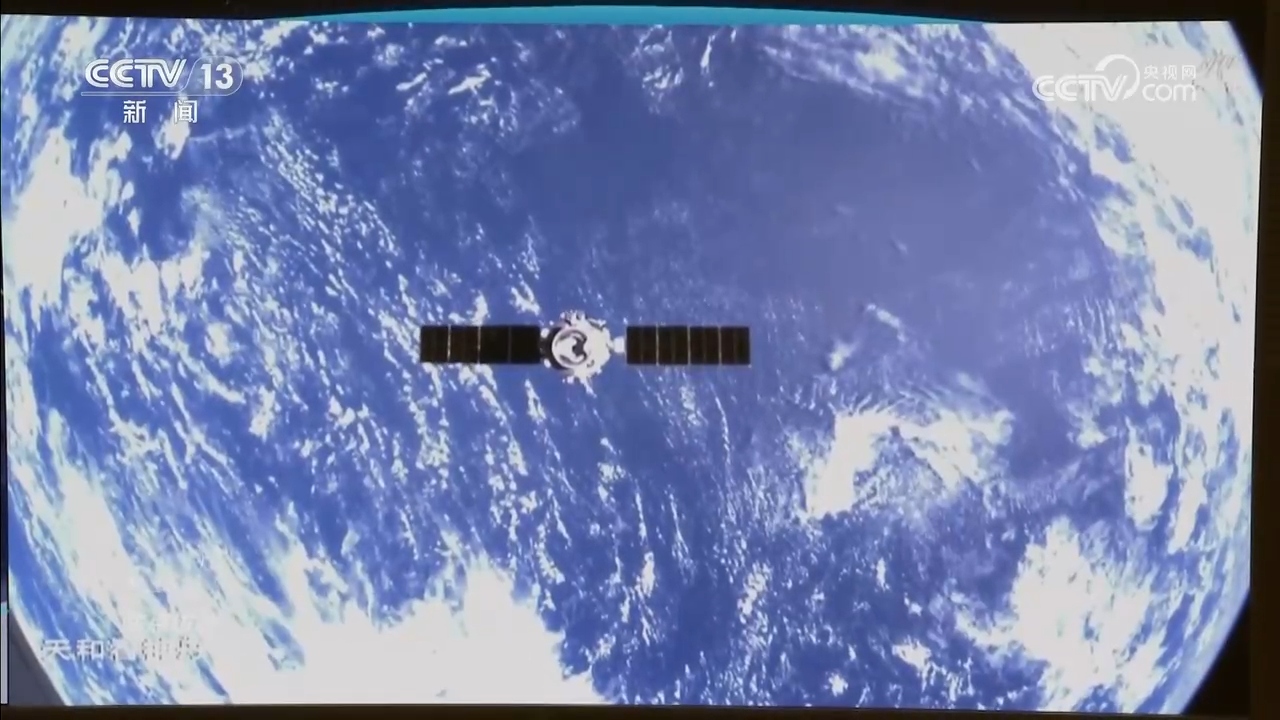
Core Viewpoint - The Shenzhou-20 spacecraft successfully returned to Earth after an extended stay in space, marking a significant milestone in China's manned space program, particularly as it was the longest duration for a Shenzhou spacecraft in orbit at 9 months [1][3][15]. Group 1: Mission Details - The Shenzhou-20 spacecraft was originally scheduled to return in early November but was delayed due to a crack found in the spacecraft's window [5][9]. - The decision was made to prioritize the safety of the astronauts, leading to the crew returning on the Shenzhou-21 spacecraft instead [1][13]. - The Shenzhou-20 spacecraft remained in a stable condition and was able to continue its mission in space for an additional three months [11][15]. Group 2: Technical Aspects - The spacecraft's ability to remain in orbit for 9 months was validated through ground experiments, and this mission provided real-time data on the effects of prolonged space exposure on the spacecraft's systems [17][26]. - The return of the Shenzhou-20 allowed for the transport of larger cargo, including a new generation of space suits and other equipment, which would aid in the development of future space missions [19][22]. Group 3: Future Implications - The successful return of the Shenzhou-20 spacecraft contributes valuable data for the development of next-generation manned spacecraft, enhancing the understanding of long-duration spaceflight [26]. - The mission's completion signifies a successful emergency response capability for China's space program, reinforcing the importance of adaptability in space exploration [26].
长十二火箭发射周期再缩短事件点评:火箭发射节奏持续加快,商业航天产业稳步提速
GUOTAI HAITONG SECURITIES· 2026-01-20 11:40
Investment Rating - The report assigns an "Accumulate" rating for the industry [4]. Core Insights - The launch cycle of the Long March 12 rocket has been shortened, indicating a potential acceleration in China's commercial space launch rhythm. The report anticipates that by 2026, China's commercial space sector will experience rapid growth, becoming a core investment direction in the military industry during the 14th Five-Year Plan [2][4]. Summary by Sections Industry Overview - The Long March 12 rocket, developed by the China Aerospace Science and Technology Corporation, has demonstrated strong performance with a near-Earth orbit capacity of at least 12 tons and a 700 km sun-synchronous orbit capacity of at least 6 tons. The rocket's launch cycle has been optimized, reducing the time by 4 days, showcasing high efficiency in testing and launch operations [4]. Future Outlook - By 2025, significant breakthroughs in manned spaceflight, deep space exploration, and commercial space sectors are expected, with a projected total of 92 launches, setting a historical record. The report highlights that 2026 will bring further surprises and advancements in China's space endeavors, including the construction of space stations and lunar exploration [4]. Investment Recommendations - The report recommends specific stocks for investment, including Aerospace Electronics, Shaanxi Huada, Zhimin Da, Guobo Electronics, Guangwei Composite, and AVIC High-Tech. Related stocks mentioned include Chaojie Co., Zhenlei Technology, China Satellite, Aerospace Electric, Zhongtian Rocket, and Srey New Materials [4].


从大涨到大跌,军工坐上“过山车”!商业航天再杀跌,军工ETF华宝(512810)放量巨震6%,调整到位了吗?
Xin Lang Cai Jing· 2026-01-20 11:32
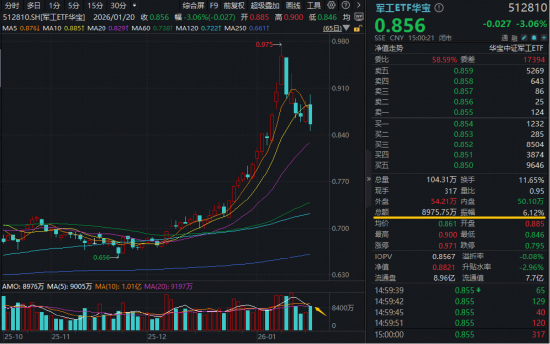
Core Viewpoint - The market experienced a collective decline on January 20, with a shift in investment style from high-valuation growth sectors to value sectors, leading to significant volatility in the military industry, particularly in the aerospace and low-altitude economy themes [1][5]. Military Industry Performance - The military ETF Huabao (512810) saw a trading range of 6.12% throughout the day, closing down 3.06%, erasing previous gains, with a trading volume of 89.76 million yuan [1][5]. - Leading stocks in the military ETF, particularly in commercial aerospace, faced significant declines, with Zhenlei Technology dropping nearly 9% and China Satellite Communications falling 7%, while several others dropped over 6% [3][13]. Market Analysis - Analysts attribute the volatility in the military sector to cautious liquidity expectations ahead of the Spring Festival and institutional portfolio adjustments, which have heightened risk aversion [5][15]. - The military sector is characterized by high growth potential, with small-cap stocks (market cap below 50 billion yuan) making up 56.47% of the military ETF's index, indicating high elasticity and volatility [5][15]. Investment Opportunities - The military sector is viewed as having high configuration value, with potential for investment during price dips, driven by historical opportunities in military trade, new quality-driven growth, and key timing catalysts [6][16]. - The global arms race is intensifying, with conflicts like India-Pakistan showcasing China's advanced equipment manufacturing capabilities, suggesting a historical opportunity for military trade to become a second growth curve for the industry [6][17]. - The new quality of combat power, characterized by intelligence, systematization, and informatization, is becoming a critical factor in strategic competition among major powers, with new production capabilities in commercial aerospace and low-altitude economy expected to further enhance military growth [7][16]. Future Outlook - The year 2026 marks the beginning of the "14th Five-Year Plan" and is a critical year for achieving the centenary goals of the military, indicating a potential new upward cycle for the military industry [6][17]. - The traditional military sector is expected to benefit from advantageous positioning, event catalysts, and improving fundamentals, presenting a significant opportunity for investment [7][17].


航天装备板块1月20日跌5.5%,航天环宇领跌,主力资金净流出33.85亿元
Zheng Xing Xing Ye Ri Bao· 2026-01-20 09:00
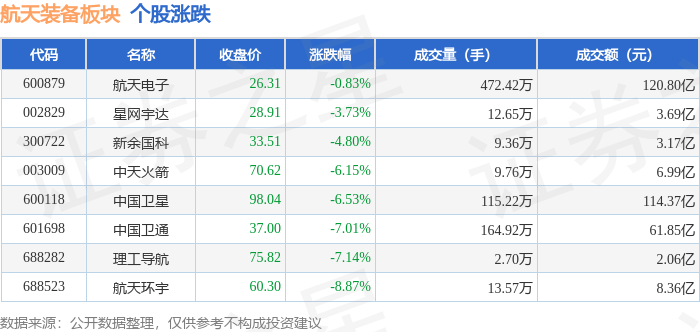
Market Overview - The aerospace equipment sector experienced a decline of 5.5% on January 20, with Aerospace HuanYu leading the drop [1] - The Shanghai Composite Index closed at 4113.65, down 0.01%, while the Shenzhen Component Index closed at 14155.63, down 0.97% [1] Stock Performance - Key stocks in the aerospace equipment sector showed the following closing prices and percentage changes: - Aerospace Electronics (600879): 26.31, -0.83% - Xingwang Yuda (002829): 28.91, -3.73% - Xinyu Guoke (300722): 33.51, -4.80% - Zhongtian Rocket (003009): 70.62, -6.15% - China Satellite (600118): 98.04, -6.53% - China Satcom (601698): 37.00, -7.01% - Ligong Navigation (688282): 75.82, -7.14% - Aerospace HuanYu (688523): 60.30, -8.87% [1] Capital Flow - The aerospace equipment sector saw a net outflow of 3.385 billion yuan from institutional investors, while retail investors had a net inflow of 3.481 billion yuan [1] - Detailed capital flow for key stocks includes: - Xinyu Guoke (300722): Institutional net outflow of 17.66 million yuan, retail net inflow of 16.89 million yuan - Ligong Navigation (688282): Institutional net outflow of 30.54 million yuan, retail net inflow of 32.30 million yuan - Xingwang Yuda (002829): Institutional net outflow of 49.15 million yuan, retail net inflow of 40.51 million yuan - Aerospace HuanYu (688523): Institutional net outflow of 92.41 million yuan, retail net inflow of 35.86 million yuan - Zhongtian Rocket (003009): Institutional net outflow of 96.91 million yuan, retail net inflow of 1.30 million yuan - Aerospace Electronics (600879): Institutional net outflow of 44.20 million yuan, retail net inflow of 82.70 million yuan - China Satcom (601698): Institutional net outflow of 101.00 million yuan, retail net inflow of 10.55 million yuan - China Satellite (600118): Institutional net outflow of 164.70 million yuan, retail net inflow of 134.47 million yuan [2]




两头堵 | 谈股论金
水皮More· 2026-01-20 08:49
Market Overview - The A-share market showed a mixed performance today, with the Shanghai Composite Index slightly down by 0.01% closing at 4113.65 points, while the Shenzhen Component Index fell by 0.97% to 14155.63 points, and the ChiNext Index dropped by 1.79% to 3277.98 points [2][6] - The total trading volume in the Shanghai, Shenzhen, and Beijing markets reached 280.44 billion, an increase of 72 billion compared to the previous day [2] Market Dynamics - The market is experiencing a cooling trend, which can occur through either active or passive means. Currently, the market is responding rationally to regulatory signals, with state-owned entities playing a significant role in guiding market trends [4] - The broad-based ETFs, particularly the CSI 1000 ETF, have taken a leading role in market movements, indicating a shift in investment focus towards low-valuation sectors [4] Sector Performance - Significant outflows were observed in sectors such as CPU-related stocks, with NewEase ranked first in capital outflow. The photovoltaic sector also saw over 7 billion in outflows, affecting major stocks like Longi Green Energy and Tongwei Co. [5] - In contrast, sectors related to real estate, such as building materials and construction, showed relative stability, suggesting a migration of funds towards undervalued sectors [5] Regulatory Impact - The current regulatory approach aims to suppress excessive speculation in individual stocks by allowing indices to adjust moderately, which is intended to maintain a stable market environment leading up to the Spring Festival [6] - The overall market sentiment reflects a clear cooling trend, with a net outflow of nearly 100 billion in major funds, indicating the core objective of regulatory measures [6]

股评两头堵 | 谈股论金
Xin Lang Cai Jing· 2026-01-20 08:39
Group 1 - The market is experiencing a cooling trend, which can occur through either active or passive means, with the current situation reflecting a relatively rational market response to regulatory signals [1] - The China Securities 1000 ETF played a leading role in the market today, influencing the overall market trend alongside other major ETFs [1] - Structural differences in the market are notable, with major state-owned enterprises and financial stocks maintaining positive performance, while broad-based ETFs exerted downward pressure on speculative stocks [1] Group 2 - Significant capital outflows were observed in sectors such as CPU-related stocks and the photovoltaic sector, with over 7 billion yuan flowing out of the latter [2] - In contrast, sectors related to real estate, such as building materials and construction, showed relative stability, indicating a shift of funds towards undervalued sectors [2] - The regulatory goal is to suppress excessive speculation in individual stocks by gradually adjusting major indices to influence market sentiment [2] Group 3 - The market indices showed a clear cooling trend, with the Shanghai Composite Index down 0.01%, the Shenzhen Component down 0.97%, and the ChiNext Index down 1.79% [3] - The total trading volume reached 2.77 trillion yuan, with a net outflow of nearly 100 billion yuan, reflecting the core objective of regulatory cooling [3] - The current adjustment aims to maintain a stable market outlook before the Spring Festival while avoiding excessive market bubbles [3]