
小红书

Search documents
科技周报|京东提供15万套小哥之家;国补政策持续
Di Yi Cai Jing· 2025-12-14 02:11
Group 1: JD's Housing Initiative - JD announced the provision of 15,000 "Little Brother Homes" for delivery personnel over the next five years, investing 22 billion yuan through various support methods [1] - The initiative aims to improve living conditions for delivery workers, which is crucial for maintaining service quality and market competitiveness [1] - This move reflects a strategic choice to stabilize core human resources and enhance fulfillment capabilities amid intense competition [1] Group 2: National Subsidy Policy - The Central Economic Work Conference confirmed the continuation of national subsidies next year, focusing on optimizing the "two new" policies [2] - There is a call for improved subsidy application processes to alleviate the financial burden on offline retailers [2] - Suggestions include allowing consumers to claim subsidies directly through government platforms to streamline the process [2] Group 3: Air Conditioning Industry Standards - Major air conditioning companies are pushing for the implementation of "aluminum instead of copper" standards due to rising copper prices [3] - New group standards for aluminum heat exchangers have been published, with additional standards in development [3] - The initiative aims to enhance consumer trust and address technical challenges related to aluminum heat exchangers [3] Group 4: SpaceX IPO Confirmation - Elon Musk indirectly confirmed SpaceX's plans for an IPO next year, citing the need for funding to support rising AI-related expenses [4] - SpaceX's projected revenue for next year is between 22 billion to 24 billion USD, indicating strong financial performance [4] - The IPO could invigorate the global aerospace industry's capital narrative and set a precedent for other high-investment tech companies [4] Group 5: Xiaohongshu's "Little Red Card" Suspension - Xiaohongshu announced the suspension of its "Little Red Card" service starting January 1, 2026, due to insufficient user satisfaction [6] - The service, launched in September, faced challenges in competing with established players in the local lifestyle market [6] - Users will receive full refunds without needing to take any action, reflecting the company's commitment to customer service [6] Group 6: Cloud Deep Technology Financing - Cloud Deep Technology completed over 500 million yuan in C-round financing, with participation from various financial institutions and strategic investors [7] - The funding indicates a shift in the robotics industry from exploration to practical application [7] - The involvement of industry capital may support Cloud Deep's future market strategies and capital movements [7] Group 7: Successful Launch of CubeSat by Sun Yat-sen University - A student team from Sun Yat-sen University successfully launched the "Yixian-A" CubeSat, marking a significant achievement in satellite technology [8] - The satellite will conduct various scientific experiments and technology validations during its six-month mission [8] - This project highlights the university's contributions to new engineering education and talent development [8] Group 8: Whirlpool's Acquisition of Galanz Washing Machine Assets - Whirlpool announced plans to acquire washing machine assets from its controlling shareholder Galanz for 74.6193 million yuan [9] - The acquisition aims to resolve competition issues between Whirlpool and Galanz in the washing machine sector [9] - Galanz's washing machine products have a production capacity of 2 million units annually and are sold in over 200 countries [9]


从投出小红书到被朱啸虎炮轰,清华才女能否带领Kimi挤上IPO牌桌?
凤凰网财经· 2025-12-12 13:08
Core Viewpoint - The article discusses the rise of Zhang Yutong, a prominent figure in the AI startup "Moon's Dark Side," highlighting her transition from investor to CEO and the company's rapid valuation growth as it prepares for a potential IPO by 2026 [1][10]. Group 1: Zhang Yutong's Background and Role - Zhang Yutong, a Tsinghua University graduate and former partner at Sequoia Capital, has a notable investment history, including investments in high-profile projects like Xiaohongshu, which is valued over $31 billion [3][4]. - Her appointment as CEO marks a significant shift from being a behind-the-scenes investor to leading the company's operations and strategy [4][5]. Group 2: Controversies and Disputes - A key controversy involves Zhang's departure from Sequoia Capital after securing over $1 billion from Alibaba for Moon's Dark Side, which increased the company's valuation from $300 million to $2.5 billion [5][6]. - Former colleague Zhu Xiaohu has publicly criticized Zhang, alleging she concealed important information regarding her equity stake in the new venture, which has led to ongoing disputes [8][9]. Group 3: Capital Market Activity - Moon's Dark Side has rapidly raised over 3 billion yuan in five funding rounds since June 2023, attracting major investors like Sequoia China and Tencent, with its valuation soaring from nearly 2 billion yuan to approximately $2.5 billion [11][12]. - The latest funding round is expected to push the company's valuation to around $4 billion (approximately 28 billion yuan) [12]. Group 4: Market Position and Challenges - Despite significant capital influx, Moon's Dark Side faces challenges in user engagement, ranking sixth among AI assistants with about 9 million active users, trailing behind competitors [13]. - The company aims to launch a new generation of its AI model, Kimi K2 Thinking, which promises to enhance its technological capabilities and address commercialization challenges [13].


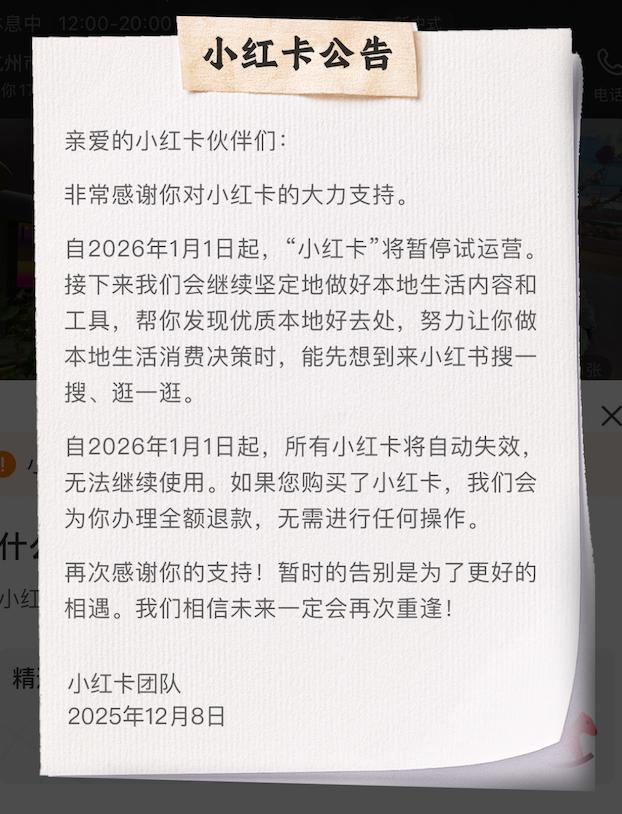
小红卡成“弃子”,小红书本地生活再试错
3 6 Ke· 2025-12-12 11:18
Core Insights - Xiaohongshu has decided to suspend the trial operation of its membership product "Xiaohong Card" starting January 1, 2026, indicating a strategic retreat from its local lifestyle business [1][5][21] - The Xiaohong Card, launched in September during the third Xiaohongshu Street Life Festival, aimed to provide a "selected card for food, drink, and entertainment" but faced challenges in user engagement and merchant satisfaction [2][3][10] Product Performance - The Xiaohong Card was introduced in three cities: Shanghai, Hangzhou, and Guangzhou, partnering with thousands of selected stores but lacked significant subsidies, leading to limited user appeal [2][3] - Users reported that the card's benefits were minimal, with discounts not competitive enough compared to other platforms, resulting in low usage after initial interest [8][9][10] Merchant Feedback - Merchants involved in the Xiaohong Card program expressed disappointment, noting that the initiative did not drive significant customer traffic or sales, leading to a lack of enthusiasm for the program [10][12] - Many merchants were unaware of the card's operational issues and were not incentivized to promote it due to insufficient customer flow and high operational costs [19][20] Strategic Implications - The suspension of the Xiaohong Card reflects Xiaohongshu's recognition of the challenges in transitioning from a community-driven platform to a transactional model in the local lifestyle sector [5][13][21] - Despite the setback, Xiaohongshu plans to continue exploring opportunities in the local lifestyle market, emphasizing the importance of community engagement and user experience in future initiatives [21][25][26] Market Context - The local lifestyle service market in China is projected to grow significantly, with estimates suggesting a market size of 35.3 trillion yuan by 2025, highlighting the competitive landscape that Xiaohongshu is navigating [25] - Competitors like Meituan and Douyin have established strong footholds in the local lifestyle sector, making it imperative for Xiaohongshu to leverage its community strengths to differentiate itself [20][26]
5171亿!广州摘下“直播电商第一城”
Nan Fang Du Shi Bao· 2025-12-12 08:11
Core Insights - Guangzhou has emerged as the leading city in live e-commerce in China, with a retail sales figure of 517.1 billion yuan in 2024, accounting for over 8% of total orders on Douyin, reflecting a growth of over 37% from the previous year [1][2] - The city's robust supply chain, consisting of over 600 specialized markets and 110,000 small and medium-sized enterprises, has redefined the industry landscape [1][2] Supply Chain Foundation - Guangzhou's strong supply chain is pivotal to its success in live e-commerce, enabling a "48-hour rapid response" mechanism that enhances competitiveness [2][3] - The textile market in Guangzhou, particularly in the Haizhu District, features 61 wholesale markets with approximately 16,000 businesses, generating an annual transaction volume of around 200 billion yuan [2] Flexible Supply Chain Model - The "sales-driven production" model reduces inventory risks and enhances repurchase rates by allowing quick adjustments based on live order feedback [3] - The beauty industry in Guangdong accounts for over 50% of the national market, with Guangzhou contributing over 100 billion yuan in annual output [3] Innovative Store-Broadcasting Model - The "store-broadcasting" model, where small business owners act as hosts, constitutes 70% of live e-commerce participants in Guangzhou, significantly shortening decision-making timelines [4][5] - This decentralized approach allows for lower costs and higher profit margins compared to traditional models reliant on top influencers [5] Ecosystem Development - Guangzhou is building a comprehensive live e-commerce ecosystem, supported by government policies aimed at digital transformation and industry standards [6][7] - The city aims to facilitate the digital transformation of 100 traditional markets by 2027, with online retail sales projected to exceed 310 billion yuan [6] Platform and Resource Aggregation - Major e-commerce platforms are increasingly focusing on Guangzhou, with companies like ByteDance and Xiaohongshu establishing significant operations in the city [7] - The collaborative ecosystem formed by government initiatives, platforms, and industries is accelerating the upgrade of the live e-commerce sector [7]
小红书的困局和柯南的理想主义
3 6 Ke· 2025-12-12 07:46
Core Insights - Xiaohongshu recently suspended its local life membership service "Xiaohong Card" after only three months, indicating a failed attempt to penetrate the local life transaction segment with a light model of "paid membership + selected merchants" [1] - The company acknowledged insufficient preparation and plans to focus on enhancing the influence of local life content and transaction tools rather than directly pushing for transaction closures [1] - The suspension highlights Xiaohongshu's ongoing struggle between its high valuation of $31 billion and the operational challenges it faces in achieving a successful business model [1][2] Business Model and Financial Performance - Xiaohongshu's revenue structure remains heavily reliant on advertising, accounting for nearly 80% of total revenue, while its e-commerce business has not yet reached a scale sufficient to support its high valuation [4] - The company's e-commerce GMV is projected to exceed 400 billion yuan in 2024, with a year-on-year growth of 45%, but it still lags behind competitors like Douyin and Kuaishou [5] - Despite a significant increase in valuation and profit expectations, Xiaohongshu's path to IPO remains complicated due to external market volatility and stringent regulatory scrutiny [2][3] Strategic Challenges - The company faces a fundamental challenge in converting its content ecosystem into effective e-commerce capabilities, with a significant gap in the conversion from "grass planting" to actual purchases [6][11] - Xiaohongshu's community-driven model creates a unique competitive advantage but also limits its ability to standardize transactions and ensure quality control, leading to user dissatisfaction regarding pricing and service [10][11] - The recent organizational restructuring aims to integrate commercial and e-commerce teams to optimize financial models ahead of a potential IPO, reflecting the need for a coherent business strategy [5][12] User Experience and Community Dynamics - The platform's core strategy is to serve as a guide for consumer decision-making rather than a direct sales platform, which complicates its monetization efforts [6][9] - Maintaining a balance between community experience and commercialization is crucial, as excessive advertising could undermine user trust and the authenticity of shared content [6][12] - The challenge of aligning user expectations with commercial objectives is heightened by the diverse interests of over 350 million monthly active users, necessitating a careful approach to content and advertising [14]
AI作图+仅退款,正在围猎电商卖家
创业邦· 2025-12-12 04:49
Core Viewpoint - The article discusses the increasing issue of fraudulent refund claims in e-commerce due to the misuse of AI technology, highlighting a case where a customer used AI-generated content to deceive a seller into issuing a refund. This situation reflects a broader trend where both consumers and sellers are caught in a cycle of deception facilitated by AI tools. Group 1: Fraudulent Activities - A case in Jiangsu involved a seller who faced a refund request for "6 dead crabs," which was later revealed to be a scam using AI-generated videos [6][10] - The rise of AI image editing has made it easier for consumers to create convincing fake evidence to support refund claims, leading to significant challenges for sellers [7][12] - The cost of creating fake images has become nearly zero, allowing consumers to exploit refund policies with minimal effort [12][14] Group 2: Seller Challenges - Many sellers report that even obvious fake images are often accepted by e-commerce platforms, leading to financial losses [8][16] - The rapid approval of refund requests, sometimes within minutes, has left sellers vulnerable to fraudulent claims [10][16] - Sellers are forming mutual aid groups to share experiences and strategies for identifying fake claims and protecting their businesses [25][26] Group 3: Consumer Experience - Consumers are also facing challenges as AI-generated images can misrepresent products, leading to dissatisfaction upon receiving items that do not match their expectations [18][20] - The use of AI digital models in marketing has created confusion among consumers regarding the actual quality of products [18][23] Group 4: Regulatory Response - A commitment has been made by major e-commerce platforms to establish guidelines for the ethical use of AI technology, aiming to address the issues of fraud and misrepresentation [24][26] - Despite existing regulations, enforcement remains a challenge, and sellers often find themselves needing to fight for their rights [25][26] - E-commerce platforms are beginning to develop AI detection capabilities to combat fraudulent activities, but these measures are still in the early stages [26]

“双11”都那样了,为什么我们还需要“双12”?
Xin Lang Cai Jing· 2025-12-12 03:50
Core Insights - The significance of the "Double 12" shopping festival is being redefined as it faces challenges in consumer engagement and competition with "Double 11" [1][3] - E-commerce platforms are adopting a more subdued approach to "Double 12," focusing on gradual promotions rather than aggressive marketing [3][5] - Content platforms like Douyin and Kuaishou are integrating "Double 12" into a broader "Year-End Carnival," shifting the focus from a single promotional event to a longer engagement period [5][9] E-commerce Platforms' Strategies - Major platforms such as Taobao and JD.com have started "Double 12" quietly, without extensive advertising, creating a low-pressure shopping environment [3][4] - Pinduoduo continues to emphasize its competitive pricing strategy rather than focusing on specific promotional events, maintaining a consistent value proposition [3][4] - The approach of content platforms contrasts sharply, as they aim to create a continuous shopping atmosphere rather than a singular event, thereby reducing the urgency associated with traditional sales [5][9] Consumer Behavior and Market Trends - Consumers are exhibiting a shift from impulsive buying to more deliberate purchasing decisions, seeking tailored solutions rather than responding to promotional pressure [1][3] - The "Double 12" festival is seen as a necessary anchor in the year-end shopping cycle, catering to ongoing consumer needs that arise after "Double 11" [10][14] - The festival serves as a critical period for merchants to clear inventory and meet year-end sales targets, highlighting its practical importance in the retail calendar [10][14] Future of "Double 12" - The festival's role is evolving from a peak sales event to a stabilizing force in the e-commerce landscape, ensuring continuous engagement and managing consumer expectations [14] - As promotional events become more commonplace, "Double 12" is positioned as a key transitional point in the annual sales cycle, helping to maintain platform activity and brand visibility [14] - The overall market is experiencing a slowdown in growth, making the steady presence of "Double 12" more relevant as a reliable sales milestone [14]

基于 SGlang RBG + Mooncake 打造生产级云原生大模型推理平台
AI前线· 2025-12-12 00:40
Core Insights - The article emphasizes the rapid evolution of large language model (LLM) inference services into core enterprise infrastructure, focusing on the balance of performance, stability, and cost in building high-performance inference systems [2] - It discusses the transition from monolithic to distributed architectures in LLM inference, highlighting the need for external KVCache to alleviate memory pressure and enhance performance in high-demand scenarios [2][4] Distributed KVCache and Mooncake - Mooncake is introduced as a leading distributed KVCache storage engine designed to provide high throughput and low latency for inference frameworks like SGLang [3] - The article outlines the challenges in managing distributed KVCache systems in production environments, which necessitate the development of RoleBasedGroup (RBG) for unified management of caching and inference nodes [4] RoleBasedGroup (RBG) Design and Challenges - RBG is presented as a Kubernetes-native API aimed at AI inference, facilitating multi-role orchestration to ensure stable and high-performance operations [4][12] - The article identifies five fundamental challenges in deploying large model inference services, including the need for strong state management and performance optimization [12][15] SCOPE Framework - The SCOPE framework is introduced, focusing on five core capabilities: Stability, Coordination, Orchestration, Performance, and Extensibility, which are essential for managing LLM inference services [16][18] - RBG's design allows for rapid architecture iteration and performance-sensitive operations, addressing the complexities of multi-role dependencies and operational efficiency [15][24] Benchmark Testing and Performance Metrics - Benchmark tests demonstrate significant improvements in KVCache hit rates and inference performance, with L3 Mooncake cache achieving a 64.67% hit rate and reducing average TTFT to 2.58 seconds [32][48] - The article highlights the importance of a multi-tier caching architecture in enhancing performance for applications like multi-turn dialogue and AI agents [44] Conclusion and Future Outlook - The integration of RBG and Mooncake is positioned as a transformative approach to building production-grade LLM inference services, emphasizing the need for deep integration of high-performance design with cloud-native operational capabilities [43][44] - The article concludes with a call for community collaboration to advance this paradigm and lay the foundation for the next generation of AI infrastructure [43]

「AI新世代」张予彤出任总裁,月之暗面商业化“短板”待补
Hua Xia Shi Bao· 2025-12-11 22:53
Core Insights - Zhang Yutong has been appointed as the President of Moonlight, focusing on overall strategy and commercialization, which has been a weak point for the company since its inception [2][3][4] - The company is reportedly planning an IPO in 2026, but it faces challenges due to insufficient commercialization revenue [2][6][7] Group 1: Leadership Changes - Zhang Yutong transitioned from being a co-founder to the President of Moonlight, confirming her role in the company's strategic direction [3][4] - Her previous experience as a senior investor at Jinsha River Capital has been instrumental in fundraising efforts for Moonlight [3][4] Group 2: Commercialization Challenges - Moonlight has historically been technology-driven, with a lag in commercialization compared to competitors, which poses risks for its survival [6][7] - The company has not released optimistic commercialization data, and its focus on technology has delayed revenue generation [6][7] Group 3: Funding and Valuation - Recent reports indicate that Moonlight is nearing the completion of a funding round, potentially raising its valuation to approximately $4 billion (about 28.47 billion RMB) [6][7] - The company is in discussions with multiple global institutions for funding, which is crucial for its survival and future growth [6][7] Group 4: Future Outlook - Zhang Yutong's role is seen as vital for attracting investment and enhancing the company's valuation ahead of the planned IPO [5][6] - The company aims to improve its commercial strategy by focusing on differentiated AI experiences and productivity tools [5][8]

小红书上架“云城甘薯”!富硒、高钙,等你来品尝!
Nan Fang Nong Cun Bao· 2025-12-11 14:35
Core Viewpoint - The launch of "Yuncheng Sweet Potato" on the Xiaohongshu platform signifies a new approach for local agricultural brands to leverage social e-commerce for storytelling and direct consumer engagement [9][10]. Group 1: Product Launch and Features - Xiaohongshu officially launched "Yuncheng Sweet Potato," marking a significant connection between high-quality agricultural products and the young consumer market [9]. - The product lineup includes five varieties: Yidianhong, Xigua Hong, Purple Sweet Potato, Mashali, and Durian Honey Sweet Potato [15]. - Yuncheng Sweet Potatoes are rich in selenium, calcium, vitamins, and proteins, earning the nickname "Southern Ginseng" due to their health benefits [21][22]. Group 2: Nutritional Analysis - A third-party testing agency found that the selenium content in Mashali sweet potatoes reached 41 micrograms per kilogram, with high vitamin C levels [23]. - The Xigua Hong variety has a high dietary fiber content of 12.02 grams per 100 grams of fresh sweet potato, indicating superior nutritional value compared to other regions [24][25]. Group 3: Marketing and Events - The "Hundred Thousand Project" in Yuncheng has shown initial success, with the eighth annual Sweet Potato Festival set to run until March 2026, featuring over 20 new products and various cultural activities [26][29]. - The sweet potatoes are sold in 5-kilogram packages, priced between 15 to 40 yuan depending on the variety [30]. - Consumers interested in Yuncheng sweet potatoes can taste them at the 2025 Greater Bay Area Agricultural Fair from December 12 to 14 [32].
