信达生物

Search documents
广发策略:从不买就跑输到买了就跑输——再看南下定价权
智通财经网· 2026-01-25 23:38
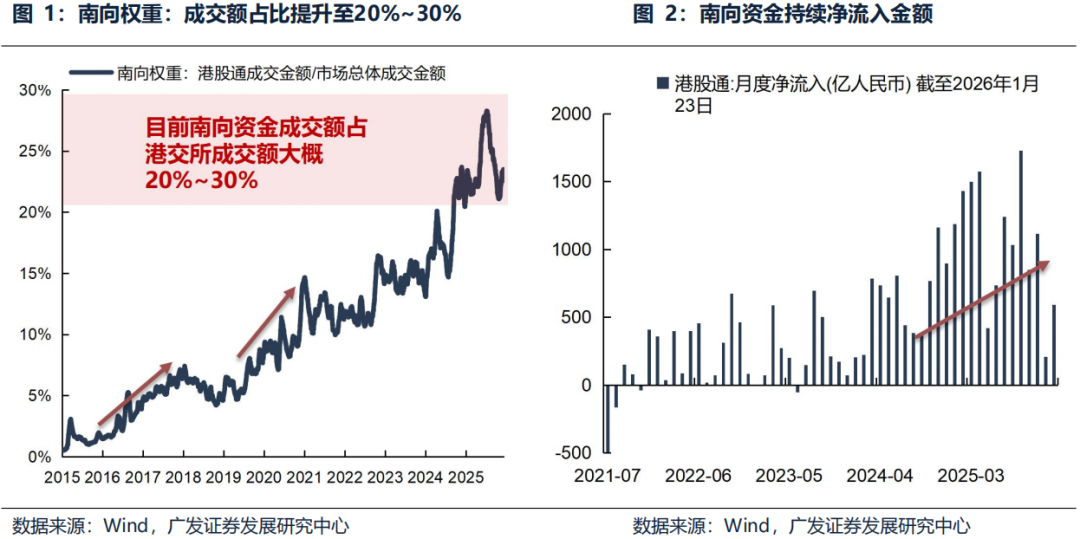
Group 1 - Since September 2024, the proportion of southbound capital transactions has rapidly increased to 20%-30%, nearly doubling compared to before 2024 [2][5] - In 2025, both active and passive foreign capital have become synchronous indicators of the Hong Kong stock market, showing no leading characteristics [2][5] - During sharp declines or corrections in the Hong Kong stock market, southbound capital tends to buy against the trend [2][5] Group 2 - Each round of pricing power competition typically begins with the optimization of the Stock Connect policy or the influx of incremental capital, which usually flows into dividend and scarce assets [5] - Net outflows of southbound capital often occur in response to adverse industry policies or external macroeconomic environments, particularly in sectors where foreign capital pricing power is increasing, such as software services, hardware equipment, consumer services, and discretionary retail [5][12] - Industries less likely to experience significant net outflows include those favored by long-term capital, such as banking, telecommunications, and public utilities, unless there are clear adverse policies affecting the sector [5][12] Group 3 - The proportion of medium to long-term capital in the current round of southbound capital inflow into Hong Kong stocks has increased, with insurance capital making 41 stakes, 35 of which are in H-shares, marking the highest record in the past decade [8] - Key industries for increased holdings include discretionary retail, finance (banking, insurance), innovative pharmaceuticals, software services, and hardware equipment [8] Group 4 - Current industries with pricing power for southbound capital and Chinese capital include semiconductors and dividend stocks, while industries lacking pricing power include internet, hardware equipment, software services, home appliances, and media [11][12] - Active management public funds have low pricing power in the Hong Kong stock market, focusing heavily on AI-related CSP giants, electronics, and innovative pharmaceuticals [16]

从“漫灌”到“滴灌”:银行发力科技金融变革一线观察
Zhong Guo Zheng Quan Bao· 2026-01-25 21:05
Group 1 - The core viewpoint emphasizes the need for banks to transition from traditional lending practices to a more nuanced approach that supports technological innovation through precise financial support [1][6] - The shift in banking strategy involves moving from reliance on hard assets to understanding the potential of soft assets, requiring banks to assess future growth rather than just past performance [1][2] - Banks are increasingly adopting digital tools to identify potential technology companies, marking a consensus among many banks to upgrade their technology financial service models [1][2] Group 2 - The role of banks is evolving from being mere fund providers to becoming partners in the market, supporting technology companies throughout their growth journey [3][4] - Banks are implementing comprehensive financial service models that combine online and offline approaches to meet the financing needs of technology enterprises, particularly those with high development potential [2][3] - Collaborative ecosystems are being developed where banks not only provide loans but also connect technology companies with industry resources and investment opportunities [3][4] Group 3 - A systemic transformation within banks is necessary to create a long-term mechanism that encourages lending to technology companies, focusing on risk pricing, organizational structure, and incentive systems [5][6] - The current challenges in technology finance stem from mismatches between the needs of technology companies and traditional banking models, necessitating a shift in risk assessment and service collaboration [5][6] - The future of banking in the context of technology finance will involve creating a diverse ecosystem that includes government, investment institutions, and other stakeholders to enhance support for innovation [6]
QDII基金交出亮眼“成绩单”后市看好创新药和科技方向
Shang Hai Zheng Quan Bao· 2026-01-25 14:24
Group 1 - The QDII funds have shown impressive performance since 2025, with an average net value increase of 27.9%, particularly driven by funds heavily invested in Hong Kong innovative pharmaceuticals [2] - Notable funds such as Huatai-PB Korea Semiconductor ETF and E Fund Global Growth Select Mixed A have seen net value increases of 127.55% and 102.91% respectively, with several other funds also exceeding 80% growth [2] - The top holdings of these high-performing funds predominantly include Hong Kong innovative pharmaceutical stocks, with examples like Kelun-Botai Biotech and Innovent Biologics among the top five holdings of Huatai-PB Hong Kong Advantage Select Mixed A [2] Group 2 - The technology sector is also a key focus for many high-performing products, with E Fund Global Growth Select Mixed A holding major global tech stocks such as TSMC and Google-A among its top ten holdings [3] - Fund managers express optimism for the future of the innovative pharmaceutical and technology sectors, citing a recent phase of adjustment in the innovative drug industry as a temporary market sentiment issue rather than a fundamental change [4][5] - The innovative drug sector's valuation has become attractive, with expectations of upward potential, and the industry is anticipated to show resilience and technological attributes over the next 2 to 3 years [5] Group 3 - The pharmaceutical industry is expected to see positive changes in 2026, with contract development organizations (CXO) gaining confidence from solid data, and new technologies like artificial intelligence and brain-machine interfaces opening new application scenarios [5] - The semiconductor sector, particularly in storage, is projected to continue its cycle, with local market trends favoring leading storage manufacturers and potential IPOs supporting capacity expansion [6]



医药生物行业跨市场周报(20260125):药明系业绩强劲,CXO板块后续发展动能充足-20260125
EBSCN· 2026-01-25 13:49
Investment Rating - The report maintains an "Overweight" rating for the pharmaceutical and biotechnology industry [5]. Core Insights - The report highlights the strong performance of WuXi AppTec and its subsidiaries, indicating robust growth momentum in the CXO sector. WuXi AppTec is expected to achieve a revenue of CNY 45.456 billion in 2025, representing a year-on-year increase of 15.84%, with TIDES business revenue projected to grow over 90% [2][21]. - The report emphasizes the recovery and structural upgrade trends in the CXO industry, driven by the resurgence of demand and the warming of investment in the innovative drug supply chain [23]. Summary by Sections Market Review - Last week, the pharmaceutical and biotechnology index fell by 0.39%, outperforming the CSI 300 index by 0.23 percentage points but underperforming the ChiNext index by 1.50 percentage points, ranking 27th among 31 sub-industries [1][16]. Company Performance - WuXi AppTec's subsidiaries reported strong earnings forecasts, with WuXi Biologics adding 209 comprehensive projects in 2025, two-thirds of which are bispecific antibodies and ADC drugs. The company aims for a compound annual growth rate of 30%-35% in revenue from 2025 to 2030 [2][22]. - The report recommends focusing on CXO chain companies such as WuXi AppTec (A+H), WuXi Biologics (H), and WuXi AppTec's subsidiaries, indicating a positive outlook for these firms [23][27]. Investment Strategy - The report suggests that future investments in the pharmaceutical sector should increasingly focus on the clinical value of drugs, driven by domestic and international policy changes. It highlights the importance of innovative drug supply chains and high-end medical devices, recommending companies like Mindray Medical and United Imaging Healthcare [3][25]. Financial Projections - Key companies are projected to show significant growth, with earnings per share (EPS) and price-to-earnings (PE) ratios indicating strong investment potential. For instance, WuXi AppTec is expected to have an EPS of CNY 5.07 in 2025, with a PE ratio of 19 [4]. Clinical Development Updates - Recent clinical developments include new applications for drugs from companies like InnoCare Pharma and Hengrui Medicine, with several drugs in various clinical trial phases [31][32]. Market Dynamics - The report notes that the pharmaceutical manufacturing industry experienced a year-on-year revenue decline of 2.0% in the first eleven months of 2025, indicating challenges in the sector [52]. Policy and Economic Environment - The report discusses the structural shift in domestic policies favoring innovative drugs and the anticipated global demand growth due to aging populations, which is expected to benefit the pharmaceutical industry [26].

涨幅不大但趋势向好,大消费/科技等涨幅居前
Ge Long Hui· 2026-01-25 13:19
Group 1 - The Hang Seng Index closed up 0.45% after fluctuating within a narrow range above the midline, with significant gains in the consumer sector [1] - The consumer sector opened strongly and maintained high levels throughout the day, closing up 1.05%, with notable increases from Lao Pu Gold (up 6.78%), Pop Mart (up 6.6%), and Kangfang Biologics (up 3.65%) [3] - The Hang Seng Technology Index experienced a slight pullback after opening but closed up 0.66%, with Xiaomi Group rising 2.84%, Kuaishou up 2.72%, and Alibaba increasing by 2.25% [3] Group 2 - Bank stocks continued to show weakness, opening high but closing down 0.07%, with Industrial and Commercial Bank of China and Chongqing Bank experiencing slight declines [3] - Some banks, including Zhengzhou Bank, Dah Sing Financial, and Zheshang Bank, managed to post small gains despite the overall sector's downturn [3]


政策开路+资金“抄底”,港股通创新药ETF(520880)六连跌终结,新一轮行情即将启动?
Xin Lang Cai Jing· 2026-01-25 11:44
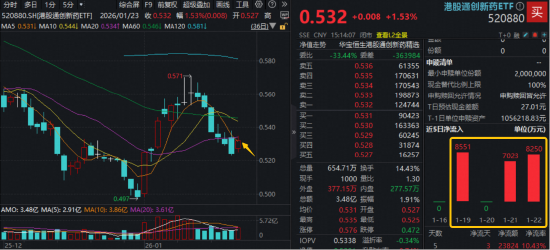
Market Performance - After a six-day decline, the Hong Kong Stock Connect Innovation Drug ETF (520880) rebounded on January 23, rising over 2% at one point and closing up 1.53% with a trading volume of 348 million yuan [1][6] - Major constituent stocks such as Cloudtop New Drug led the gain with an 8.2% increase, while other key stocks like Kangfang Biotech and Shiyao Group also saw positive performance [1][6] Policy Impact - On January 22, the Ministry of Commerce and nine other departments issued a document promoting high-quality development in the pharmaceutical retail sector, encouraging innovative drugs and reference preparations to enter retail pharmacy sales channels [3][9] - This policy is expected to provide a pathway for high-value innovative drugs, such as CAR-T, to fill the insurance coverage gap through commercial insurance directories [3][9] - The insurance industry association estimates that by 2025, the total compensation amount for innovative drugs and devices from commercial health insurance will reach approximately 14.7 billion yuan, with a compound annual growth rate of 70% over four consecutive years [3][9] Industry Trends - At the recent JPM conference, Chinese pharmaceutical companies showcased technological breakthroughs in areas such as ADC, IO dual antibodies, and GLP-1, moving towards global markets through licensing and collaborative development [3][9] - According to CITIC Securities, the Chinese pharmaceutical industry is at the starting point of a global value reassessment, with 2026 being a critical year for validating transformation effectiveness [3][9] Investment Opportunities - The Hong Kong Stock Connect Innovation Drug ETF (520880) is highlighted as a high-elasticity T+0 investment tool, with its index featuring three unique advantages: 1. Purely innovative drugs with 100% purity, covering companies focused on drug development [5][11] 2. A significant concentration of leading companies, with the top ten innovative drug leaders accounting for over 73% of the index [5][11] 3. Enhanced risk control through forced de-weighting of less liquid constituent stocks [5][11] Constituent Stocks - The top ten constituent stocks of the Hong Kong Stock Connect Innovation Drug ETF (520880) have a combined weight of 73.41%, showcasing significant leadership in the sector [6][12] - Notable stocks include: - Kangfang Biotech (10.49% weight, market cap of 110.9 billion HKD) - Baijie Shenzhou (10.01% weight, market cap of 312 billion HKD) - Shiyao Group (9.97% weight, market cap of 102.1 billion HKD) [6][12]
医药健康行业研究:Q4基金医药持仓情况出炉,关注板块调整后布局机遇
SINOLINK SECURITIES· 2026-01-25 07:50
Investment Rating - The report suggests a positive outlook for the innovative drug sector, indicating it will continue to be a core investment direction in 2026 due to the maturation of the industry chain and normalization of medical insurance negotiations [4]. Core Insights - The public fund's pharmaceutical holdings decreased to 8.11% in Q4 2025, down by 1.66 percentage points (pp) from the previous quarter. Excluding actively managed pharmaceutical funds, the holdings dropped to 3.90%, a decrease of 1.36pp [11][12]. - The innovative drug ETF reached a scale of 100.62 billion yuan in Q4, accounting for 13.11% of the pharmaceutical fund, which is a slight decrease of 1.35pp [13][15]. - The CXO sector saw a decline in holdings due to geopolitical disturbances, while the medical device sector benefited from innovations like brain-computer interfaces and surgical robots, leading to an increase in holdings [14][17]. - The report highlights the acquisition of PART by GSK for $2.2 billion to strengthen its position in the IgE antibody market, with the core product Ozureprubart showing significant market potential [2][31]. - The oral weight loss drug Wegovy has shown strong early commercial progress, with retail prescriptions reaching approximately 3,071 in the first four days post-launch, nearly three times that of its competitor Zepbound [2][31]. Summary by Sections Pharmaceutical Sector - The report indicates a significant decrease in public fund holdings in the pharmaceutical sector, with a noted resilience in the innovative drug segment [11][14]. - The report emphasizes the importance of focusing on leading companies with core pipeline competitiveness and global layout capabilities for investment [4]. Medical Devices - The introduction of new pricing guidelines for auxiliary medical services is expected to accelerate the adoption of innovative products in the medical device sector [3][17]. - The report suggests monitoring domestic leading companies in this sector for increasing product penetration [3]. Drugstores - The report discusses the potential for leading drugstore companies to increase market share, supported by recent government policies promoting high-quality development in the retail pharmaceutical industry [3][17]. - Specific companies like Yifeng Pharmacy and Dazhenglin are highlighted as having low valuations and significant cost reduction achievements [3]. CXO and Pharmaceutical Supply Chain - Several CXO companies have released optimistic earnings forecasts for 2025, indicating a clear upward trend in industry prosperity [2][31]. - The report recommends active investment in this sector due to the positive signals regarding industry growth [2][31].

跨国药企扫货中国创新药 谁是首席买家
经济观察报· 2026-01-25 06:30
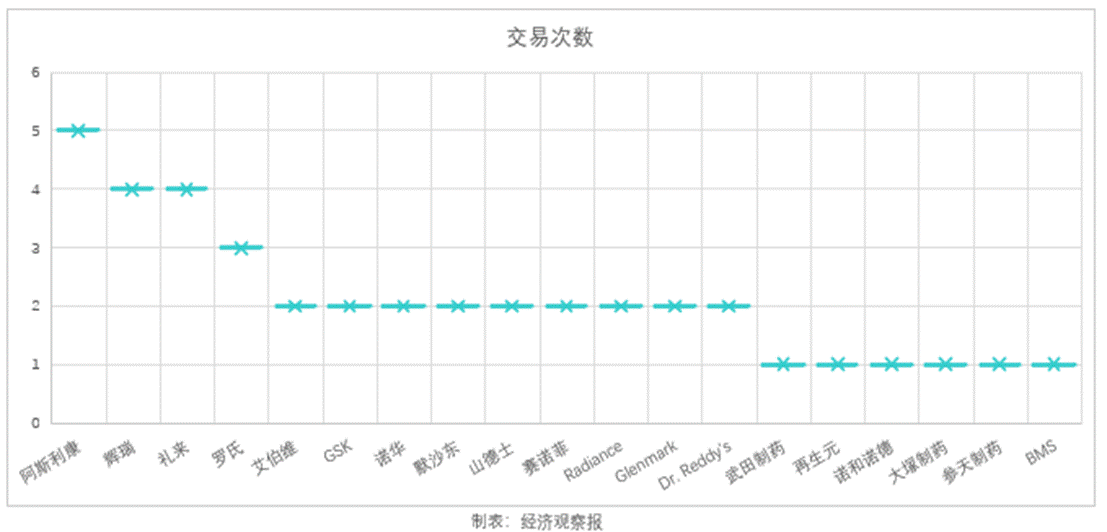
在这一年的交易热潮中,跨国巨头们的采购风格各有不同。谁出手频次最高?谁手笔最大?经济观 察报分析了全年150多笔交易,复盘跨国药企的投资画像与交易特色。 多位受访者对经济观察报表示,其所在药企与潜在合作方达成了进一步沟通意向,他们判断2026 年中国创新药对外授权交易热仍会持续。 2025年爆发式增长的对外授权交易验证了中国创新药资产的价值,该年对外授权总交易额超1300 亿美元,交易数超150笔(约占全球40%),创下历史新高。 阿斯利康最活跃 在交易频次上,阿斯利康是最活跃的跨国药企,2025年一共出手了5次。 合作方包括石药集团(01093.HK)、和铂医药(02142.HK)、加科思药业(01167.HK)、元 思生肽等。其中,在2025年6月与石药集团达成的潜在总交易额超53亿美元的合作,可排进年度 交易额前四。在资产选择上,阿斯利康主要集中在临床早期管线,以及技术平台合作。 在交易频次上,阿斯利康是最活跃的跨国药企,2025年一共 出手了5次。从立即兑现的首付款看,辉瑞与武田制药出手最 阔绰。 作者:张英 封图:图虫创意 作为中国市场销售额最高的外资药企,在经历2024年的公司治理风暴后,阿斯利康 ...

跨国药企扫货中国创新药 谁是首席买家
Jing Ji Guan Cha Wang· 2026-01-25 02:25
Core Insights - The 2026 JPMorgan Healthcare Conference highlighted significant interest from multinational companies in Chinese assets, particularly in the innovative drug sector [1][2] Group 1: Market Trends - The trend of foreign licensing deals for Chinese innovative drugs is expected to continue in 2026, following a record-breaking year in 2025 where the total licensing deal value exceeded $130 billion, accounting for approximately 40% of global transactions [3] - The surge in licensing deals in 2025 validated the value of Chinese innovative drug assets, with over 150 transactions recorded [3] Group 2: Key Players - AstraZeneca emerged as the most active multinational company in 2025, engaging in five transactions, including a notable deal with CSPC Pharmaceutical Group valued at over $5.3 billion [4] - Pfizer and Eli Lilly each conducted four transactions, with Pfizer's deal with 3SBio setting a record for upfront payments in Chinese innovative drugs at $1.25 billion [5] - GSK's collaboration with Heng Rui Medicine reached a potential total of $12.5 billion, marking the highest deal value for Chinese innovative drugs [13] Group 3: Emerging Markets - Interest in Chinese innovative drugs is not limited to Western companies; firms from India, Latin America, and the Middle East are also engaging in licensing deals [7] - Indian companies Glenmark and Dr. Reddy's each completed two business development transactions in 2025, with Glenmark's deals totaling over $2 billion [8][9] Group 4: Financial Highlights - Three companies, AstraZeneca, GSK, and Takeda, signed contracts exceeding $10 billion, while Pfizer and Novartis secured contracts over $5 billion [10] - The largest single transaction was GSK's deal with Heng Rui Medicine, which included rights to one core drug and options for 11 additional projects [13] Group 5: Future Outlook - Executives at the 2026 JPM conference expressed that Chinese assets are an effective way to supplement pipelines, indicating a shift towards acquiring entire biotechnology platforms rather than just single products [14]
创新药还能加仓?这场会定调2026
经济观察报· 2026-01-24 11:09
Core Viewpoint - The efficiency of Chinese innovative pharmaceutical companies in research and development is putting pressure on American firms, leading to a shift in strategy where multinational companies are cutting internal R&D budgets to invest in Chinese companies' pipelines [1][7]. Group 1: JPM Conference Insights - The 2026 JPM conference saw a significant presence of Chinese innovative pharmaceutical executives and investors, reflecting a positive outlook compared to previous years, with multinational companies openly expressing interest in Chinese assets [2][4]. - Chinese companies are no longer satisfied with merely licensing patents; they seek deeper involvement in clinical development and commercialization in international markets [3][10]. - The FDA's officials acknowledged the R&D efficiency of Chinese companies and suggested using AI to improve approval processes, indicating a more collaborative approach rather than a protectionist stance [3][6]. Group 2: Market Trends and Stock Performance - Following a surge in business development (BD) transactions in 2025, the stock prices of Chinese innovative pharmaceutical companies saw a significant increase, but there was a market correction starting in September 2025, with the Hang Seng Innovation Drug Index dropping over 20% by January 2026 [3][12]. - The participation of seven Chinese pharmaceutical companies in the main stage of JPM is a sign of increasing recognition and influence in the international market [12]. Group 3: Strategic Shifts in Collaboration - There is a growing trend among Chinese pharmaceutical companies to engage in deeper collaborations, such as the NewCo model, which allows for shared operations and deeper partnerships with American firms [10][11]. - American biotech companies are considering establishing NewCo in China to leverage the country's advantages in R&D efficiency and cost [11]. Group 4: Competitive Landscape and Future Outlook - The competitive landscape is shifting, with Chinese companies focusing on unmet clinical needs and exploring new therapeutic areas beyond traditional targets, such as liver diseases [11]. - Multinational companies are actively seeking new opportunities due to impending patent cliffs, with significant interest in mergers and acquisitions to bolster their pipelines [14][15]. - PwC's report indicates that patent expirations could risk $47 billion in drug sales over the next four years, prompting increased acquisition activities in the pharmaceutical sector [16].