小米汽车

Search documents
观点分享:VLA解决的是概念认知,无法有效的建模真实世界的四维时空?
自动驾驶之心· 2025-10-14 07:12
Core Viewpoint - The article discusses the importance of world models in intelligent driving, emphasizing that true understanding of the environment requires a high-bandwidth cognitive system rather than merely extending language models [2][3][5]. Summary by Sections World Model vs. Language Model - The world model focuses on spatiotemporal cognition, while the language model addresses conceptual cognition. Language models have low bandwidth and sparsity, making them ineffective for modeling the real world's four-dimensional space-time [2][3]. - The world model aims to establish capabilities directly at the video level, rather than converting information into language first [3][4]. VLA and WA - VLA (Vision-Language Architecture) is essentially an extension of language models, adding new modalities but still rooted in language. In contrast, the world model seeks to create a comprehensive cognitive system [3][5]. - The ultimate goal of autonomous driving is to achieve open-set interactions, allowing users to express commands freely without being limited to a fixed set of instructions [3][4]. Importance of Language - Language remains crucial for three main reasons: 1. Incorporating physical laws such as gravity and inertia into the model [6]. 2. Understanding and predicting object movements in three-dimensional space over time [6]. 3. Absorbing vast amounts of data from the internet, which aids in training autonomous driving systems [7]. Integration of Models - The combination of language models (conceptual cognition) and world models (spatiotemporal cognition) is essential for advancing towards Artificial General Intelligence (AGI) [8]. Industry Trends - The autonomous driving industry is experiencing intense competition, with many professionals considering transitioning to embodied AI due to the saturation of current technologies [9]. - The ongoing debate between VLA and WA represents a larger industry transformation, highlighting the need for innovative solutions to break through current limitations [9]. Community and Resources - A community platform has been established to facilitate knowledge sharing and collaboration among professionals in the autonomous driving field, featuring resources such as learning routes, technical discussions, and job opportunities [25][26].


补贴政策退坡预期刺激车市升温 9月乘用车销量创历史新高
Jing Ji Guan Cha Wang· 2025-10-14 06:38
Core Insights - In September 2025, China's retail sales of passenger cars reached 2.241 million units, a year-on-year increase of 6.3%, marking a new high for the month [2] - The cumulative retail sales for the first nine months of 2025 reached 17.005 million units, up 9.2% year-on-year [2] - The growth in September was attributed to the launch of over 70 new models and the expiration of tax exemptions for new energy vehicles, creating a sense of urgency among consumers [2][3] Market Performance - In September, 23 models saw price reductions compared to 36 models in the same month last year, indicating a moderation in the price war among car manufacturers [3] - The retail sales of new energy vehicles (NEVs) in September reached 1.296 million units, a year-on-year increase of 15.5%, with a cumulative total of 8.866 million units for the first nine months, up 24.4% [3] - The penetration rate of NEVs in the overall passenger car market reached 57.8% in September, an increase of 5 percentage points year-on-year [4] Brand Performance - Domestic brands continued to grow, with retail sales reaching 1.5 million units in September, a year-on-year increase of 13% [5] - The retail market share of domestic brands was 66.9% in September, up 3.6 percentage points year-on-year [5] - In contrast, mainstream joint venture brands saw a decline in retail sales, with a total of 490,000 units sold in September, down 6% year-on-year [5] Export Trends - Passenger car exports in September reached 528,000 units, a year-on-year increase of 20.7% [5] - Exports of new energy vehicles were particularly strong, with 211,000 units exported in September, a year-on-year increase of 96.5% [5] - The export share of new energy vehicles accounted for 40.1% of total passenger car exports, up 15.4 percentage points from the previous year [5] Future Outlook - The market is expected to maintain stable growth in the fourth quarter, supported by government policies and high growth in new energy vehicles [6] - The adjustment of the new energy vehicle purchase tax policy in 2026 is anticipated to stimulate consumer purchases before the end of the year [6] - The annual retail sales forecast for 2025 has been raised to 24.35 million units, reflecting a growth of 6% [7]
碳酸锂期货日报-20251014
Jian Xin Qi Huo· 2025-10-14 02:13
Report Summary 1. Report Industry Investment Rating - No information provided in the report 2. Core Viewpoint of the Report - The lithium carbonate futures fluctuated weakly, mainly due to the intensification of Sino - US trade frictions. Under the dominance of bearish sentiment in the market, the lithium price weakened. Although the supply - side pressure is the main factor suppressing the lithium carbonate price, the strong demand in the power and energy storage fields will drive continuous inventory reduction in the market, so it is expected that lithium carbonate will continue to operate within the oscillation range [8] 3. Summary by Relevant Catalogs 3.1行情回顾与操作建议 - The lithium carbonate futures fluctuated weakly. The spot electric carbon price dropped by 450 to 73,100. The psychological expected price of downstream material factories continued to decrease, and the overall market trading activity was average. The price of Australian ore dropped by 10 to 817.5, and the price of lithium mica ore dropped by 45 to 1,765. The production loss situation of salt factories continued to improve. SMM expects that the lithium carbonate output in October is expected to exceed 90,000 tons, and the supply - side pressure is the main factor suppressing the lithium carbonate price [8] 3.2行业要闻 - Guoxuan High - tech stated on the interactive platform that the industrialization progress of its solid - state batteries is advancing steadily. Its first full - solid - state pilot line has been officially connected, and the design work of the 2GWh mass - production line for the first - generation full - solid - state batteries has been officially launched [12] - In September, the retail penetration rate of new energy vehicles in the overall domestic passenger cars was 57.8%, a 5 - percentage - point increase compared to the same period last year. In September's domestic retail sales, the penetration rate of new energy vehicles among self - owned brands was 78.1%; among luxury cars, it was 34.5%; among mainstream joint - venture brands, it was only 7.4%. In terms of the monthly domestic retail share of new energy vehicles, in September, the retail share of new energy vehicles of self - owned brands was 70.1%, a 2.3 - percentage - point decrease year - on - year; the share of mainstream joint - venture brands was 3.2%, a 0.2 - percentage - point decrease year - on - year; the share of new forces was 20.2%, with brands such as XPeng, Leapmotor, and Xiaomi driving a 3.3 - percentage - point year - on - year increase in the share of new forces; Tesla's share was 5.5%, a 0.9 - percentage - point decrease [12]
车市“金九”成色足:销量创新高,新能源渗透率升至57.8%
Bei Ke Cai Jing· 2025-10-13 13:37
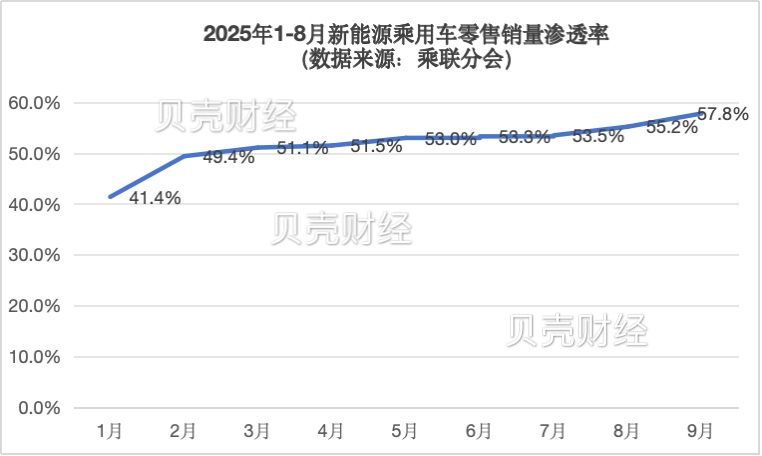
Core Insights - In September, China's passenger car production, retail, and export volumes reached historical highs for the month, with retail sales at 2.241 million units, a year-on-year increase of 6.3% [1] - The retail penetration rate of new energy passenger vehicles rose to 57.8%, up 5 percentage points from the same period last year, indicating stable growth supported by policies such as tax exemptions [2][4] Group 1: Market Performance - The retail sales of new energy passenger vehicles in September increased by 15.5% year-on-year to 1.296 million units, maintaining a penetration rate above 50% for the seventh consecutive month since March [2] - The sales of pure electric passenger vehicles reached 826,000 units in September, showing a year-on-year growth of 28.5% and a month-on-month increase of 19.8% [5] - The overall passenger car market in the first nine months of the year saw cumulative retail sales of 17.005 million units, a year-on-year increase of 9.2% [7] Group 2: Segment Analysis - The market share of pure electric vehicles has significantly increased, while the growth rates of plug-in hybrid and range-extended vehicles have slowed down, indicating a shift in consumer preference [4][5] - The sales distribution for September was approximately 64% for pure electric vehicles, 28% for plug-in hybrids, and 8% for range-extended vehicles [5] Group 3: Company Performance - Among the top domestic automakers, Geely, BYD, and SAIC have achieved over 70% of their sales targets for the year, with Geely's cumulative sales reaching 2.17 million units, achieving a target completion rate of 72% [8] - New energy vehicle startups have shown a clear differentiation in sales target completion rates, with companies like XPeng and Leap Motor exceeding 75% [8] - The market share of domestic brands in retail reached 64.8%, an increase of 5.9 percentage points compared to the previous year, highlighting the growth of domestic brands in both the new energy and export markets [8]



“金九”成色足 9月乘用车销量创历史新高
Bei Jing Ri Bao Ke Hu Duan· 2025-10-13 13:15
Core Insights - The passenger car market in China achieved a record retail sales of 2.241 million units in September, marking a year-on-year growth of 6.3% and a month-on-month increase of 11.0% [1] - The cumulative retail sales for the first three quarters reached 17.005 million units, reflecting a year-on-year growth of 9.2% [1] - The market is characterized by strong growth due to the launch of over 70 new models and the impact of year-end subsidy policies [1] Group 1: Market Performance - In September, the retail sales of new energy passenger vehicles reached 1.296 million units, showing a year-on-year increase of 15.5% and a month-on-month increase of 16.2% [2] - The penetration rate of new energy vehicles in the overall passenger car retail market reached 57.8% in September, up 5 percentage points from the same period last year [2] - Domestic brands accounted for 78.1% of new energy vehicle sales, while luxury brands had a penetration rate of 34.5%, and mainstream joint venture brands only reached 7.4% [2] Group 2: Company Performance - BYD led the domestic new energy passenger vehicle market with retail sales of 347,000 units, followed by Geely and Changan with 151,000 and 84,000 units respectively [2] - Tesla China ranked fifth in sales among new energy vehicle manufacturers [2] - New entrants like Leap Motor, Hongmeng Zhixing, and Xiaomi Auto topped the retail sales among new force brands [2] Group 3: Future Outlook - The market is expected to maintain stable growth in the fourth quarter, driven by policy guidance and a strong growth foundation [3] - The adjustment of the new energy vehicle purchase tax policy from "full exemption" to "half exemption" is likely to stimulate consumer purchases before year-end [3] - The overall market forecast for the year is expected to be revised upward due to the combination of policy support and high export growth [3]



小鹏P7i高速辅助驾驶遇事故AEB未响应!客服回应
Qi Lu Wan Bao Wang· 2025-10-13 10:16
Core Viewpoint - A recent incident involving a Xiaopeng P7i 702pro owner raised concerns about the performance of the vehicle's intelligent driving system (NGP) and automatic emergency braking (AEB) system, which failed to respond during a collision on the highway [1][2]. Group 1: Incident Details - The incident occurred on October 9, when the vehicle, traveling at approximately 95 km/h with the NGP system activated, collided with debris and a stationary vehicle without the AEB system triggering [1]. - The collision resulted in significant damage to the left side of the vehicle, including deformation of both left doors [1]. Group 2: System Functionality - NGP, part of the XPILOT 3.0 system, is designed to assist with various driving tasks, including intelligent lane changes and obstacle avoidance, but its effectiveness in emergency situations is under scrutiny [2]. - The AEB system's limitations have been highlighted, as it did not activate during the collision, raising questions about its operational speed range and ability to recognize static objects [2][3]. Group 3: Industry Response - Industry experts noted that current AEB systems primarily function effectively at speeds below 60 km/h and have limited capabilities in recognizing static obstacles [3]. - Xiaopeng's customer service emphasized that the auxiliary driving features are not a substitute for driver control, and drivers must remain vigilant and ready to take over in unexpected situations [3].

公司订单持续增加,博俊科技预计前三季度净利润同比增逾50%
Zheng Quan Shi Bao Wang· 2025-10-13 09:49
Core Viewpoint - Bojun Technology (300926) expects significant growth in net profit and non-recurring profit for the first three quarters of 2025, driven by the booming electric vehicle industry and increased orders [1] Financial Performance - The company anticipates net profit between 552 million to 662 million yuan, representing a year-on-year increase of 50% to 80% [1] - For the third quarter, net profit is projected to be between 244 million to 285 million yuan, reflecting a year-on-year growth of 80% to 110% [1] - In the first half of the year, Bojun Technology achieved operating revenue of 2.512 billion yuan, net profit of 352 million yuan, and non-recurring net profit of 351 million yuan, with year-on-year growth rates of 45.77%, 51.95%, and 51.66% respectively [2] Business Operations - Bojun Technology specializes in the research, design, production, and sales of precision automotive components and molds, offering a one-stop solution for various automotive systems [2] - The company has established strong partnerships with major automotive manufacturers such as Geely, Changan, BYD, and Xpeng, enhancing its market presence [2] Production Capacity and Expansion - The main production bases are located in Jiangsu and Chongqing, strategically positioned near major automotive industry clusters [3] - The company is expanding its production capacity with new facilities planned in Changzhou and Jinhua to support lightweight and modular automotive components [3] - A new production base in Chengdu focuses on high-pressure aluminum die-casting products, catering to the Southwest automotive industry cluster [3] Customer Relationships and Sales Strategy - The company has improved its accounts receivable management by adjusting payment terms with major clients to 60 days, enhancing operational efficiency and profitability [4] - Sales to BYD have significantly increased, and supply to Leap Motor is expected to ramp up in the second half of the year [4] - The company is not a direct supplier to Xiaomi Automotive but supplies some products indirectly through Tier 1 customers [4]

乘联分会:9月新能源乘用车生产150.1万辆 同比增长22.9%
Xin Hua Cai Jing· 2025-10-13 02:33
Group 1: Market Performance - In September, the retail sales of passenger cars in China reached 2.241 million units, a year-on-year increase of 6.3% and a month-on-month increase of 11.0% [1] - Cumulative retail sales for the year reached 17.005 million units, reflecting a year-on-year growth of 9.2% [1] - The retail growth rate has fluctuated, starting from 1.2% in January-February, rising to 11% in June, and stabilizing around 6% from July to September [1] Group 2: Production and Export Data - In September, passenger car production was 2.838 million units, showing a year-on-year increase of 17.2% and a month-on-month increase of 15.7% [2] - Cumulative production for the year reached 20.78 million units, with a year-on-year growth of 13.9% [2] - Passenger car exports in September totaled 528,000 units, a year-on-year increase of 20.7% and a month-on-month increase of 5.7% [1][2] Group 3: New Energy Vehicle Insights - In September, the production of new energy passenger vehicles reached 1.501 million units, a year-on-year increase of 22.9% [2] - The retail penetration rate of new energy vehicles in the overall passenger car market was 57.8%, up 5 percentage points from the previous year [3] - New energy vehicle exports reached 211,000 units in September, a year-on-year increase of 96.5% [3]
9月新势力排位洗牌:零跑断层领跑 小鹏/小米首破4万改写格局
Zhong Guo Zhi Liang Xin Wen Wang· 2025-10-11 07:52
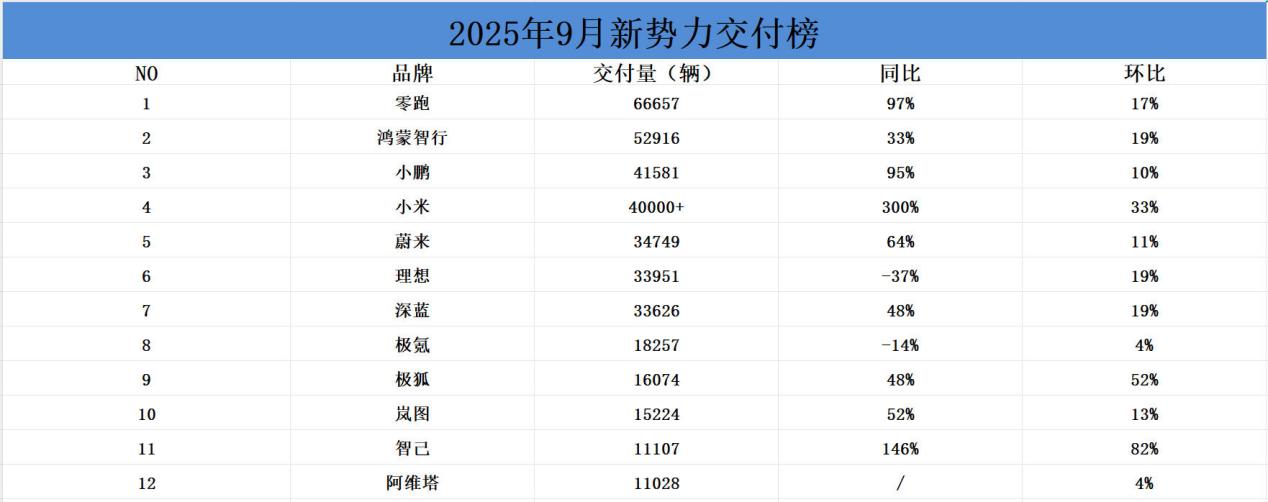
Core Insights - The new energy vehicle market in September 2025 saw record delivery numbers, with several brands achieving historical highs, indicating a competitive landscape among leading players [1][3] Delivery Rankings - Leap Motor topped the delivery chart with 66,657 units, marking a 97% year-on-year increase and becoming the first new energy brand to exceed 60,000 monthly sales [2][5] - Hongmeng Zhixing followed with 52,916 units delivered, a 33% increase, and is nearing a cumulative delivery milestone of 950,000 units [2][7] - Xiaopeng ranked third with 41,581 units, achieving a 95% year-on-year growth and a 10% month-on-month increase [2][9] - Xiaomi made a significant entry into the top four with over 40,000 units delivered, reflecting a 300% increase [2][11] Second Tier Dynamics - NIO delivered 34,749 units, a 64% increase, with its sub-brands contributing significantly to this growth [2][13] - Li Auto's deliveries were 33,951 units, showing signs of recovery despite a year-on-year decline [2][15] - Deep Blue achieved 33,626 units, benefiting from ongoing product and technological advancements [2][17] Competitive Landscape - Zeekr's sales reached 18,257 units, showing a mixed performance with slight month-on-month growth but a year-on-year decline [2][17] - Arcfox saw a 47.74% year-on-year increase, delivering 16,074 units, supported by a diverse product lineup [2][18] - Lantu delivered 15,224 units, with a year-to-date growth of 85%, driven by product upgrades and market feedback [2][20] - ZhiMi achieved a record high of 11,107 units, with a significant contribution from the newly launched LS6 model [2][22] - Avita maintained a steady performance with 11,028 units delivered, reflecting successful market positioning [2][22] Market Outlook - The results from September indicate a deepening competitive landscape, with the upcoming October sales period being crucial for both leading and mid-tier brands to sustain growth and navigate market challenges [1][22]


车企新能源目标完成率:传统车企向好 新势力仅小鹏、零跑达标
Sou Hu Cai Jing· 2025-10-11 06:13
Core Insights - In September, 10 out of 12 new energy vehicle (NEV) companies reported sales growth, indicating a positive trend for the first three quarters of the year [2] - However, only two new energy vehicle companies achieved over 75% of their annual sales targets, with nine companies falling below 50%, highlighting significant pressure to meet targets in the fourth quarter [2][5] - Traditional automakers showed a more optimistic performance, with three companies achieving over 70% of their sales targets, suggesting a better chance of meeting annual goals [2][8] New Energy Vehicle Companies - Among new energy vehicle companies, only Xiaopeng Motors and Leap Motor reached or exceeded a 75% target completion rate, with Xiaopeng selling 313,000 units (up 218%) and Leap Motor selling 396,000 units (up 129%) in the first nine months [4][6] - Xiaomi Motors also exceeded a 70% completion rate, selling 250,000 units (up 279%) [4] - Other companies, including Hongmeng Zhixing and Li Auto, faced challenges, with Hongmeng achieving only 34% of its target despite selling 344,000 units (up 10%) [6][10] - NIO sold 201,000 units (up 35%) but only reached 45% of its annual target [6][7] Traditional Automakers - BYD led traditional automakers with 3.219 million units sold (up 18%), achieving a 70% completion rate of its annual target of 4.6 million units [10] - Geely followed with 1.168 million units sold (up 114%) and a completion rate of 78% [10][11] - Changan and SAIC-GM-Wuling also exceeded 70% completion rates, with Changan selling 724,000 units (up 60%) [10][11] - Other traditional automakers like Chery and Great Wall Motors reported significant growth, with Chery selling 588,000 units (up 77%) [10][12]