东风汽车

Search documents
天汽模:不掌握东风汽车的规划
Zheng Quan Ri Bao Wang· 2025-11-17 10:39
证券日报网讯天汽模(002510)11月17日在互动平台回答投资者提问时表示,公司不掌握东风汽车的规 划。 ...

汽车行业周报:全球巨头动作频频,Robotaxi发展加速向前-20251110
Guoyuan Securities· 2025-11-10 03:44
Investment Rating - The report maintains a "Buy" recommendation for the automotive industry [5] Core Insights - Current demand is weak, but the annual cumulative figures remain above expectations, with retail sales of passenger vehicles in October showing a year-on-year increase of 6% and a month-on-month increase of 7% [1][21] - The Robotaxi industry is accelerating towards commercialization, with significant developments from companies like Baidu, Xpeng, and Tesla, indicating a maturing market [2][3] Summary by Sections 1. Weekly Market Review (2025.11.1-11.7) - The automotive sector index fell by 1.24%, underperforming the Shanghai Composite Index, which rose by 0.82% [11] - The passenger vehicle segment experienced the largest decline at -3.31% [12] 2. Data Tracking (2025.11.1-11.7) - Retail sales of passenger vehicles from October 1-31 reached 2.387 million units, a 6% increase year-on-year, with cumulative retail sales for the year at 19.395 million units, up 9% [21] - New energy vehicle retail sales for the same period were 1.4 million units, a 17% year-on-year increase, with cumulative sales for the year at 10.27 million units, up 23% [21] 3. Industry News (2025.11.1-11.7) - Baidu's Apollo Go reported weekly orders exceeding 250,000, matching Waymo's figures, indicating strong growth in autonomous driving services [35] - Xpeng announced its first Robotaxi model, aiming for global market expansion in collaboration with mapping services [37] - The IPO of Sailyus marked a significant milestone, raising over 14 billion HKD, highlighting investor confidence in the electric vehicle sector [38]
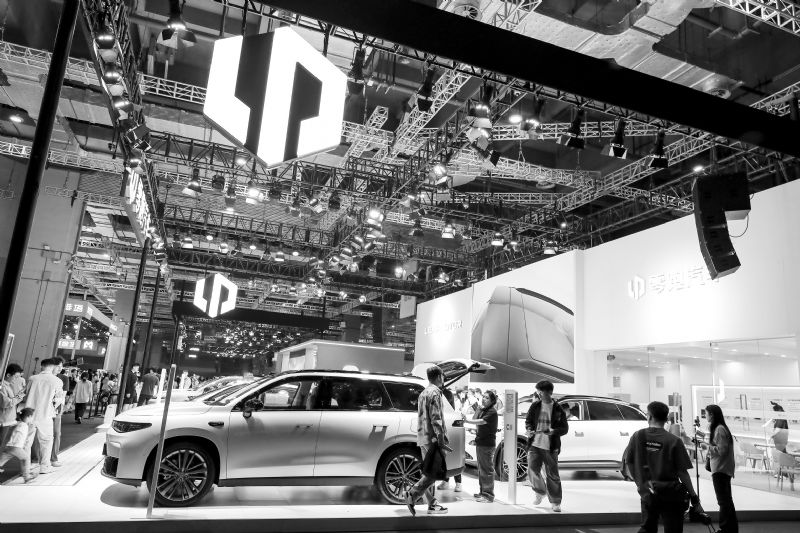
零跑汽车月交付首破7万辆领跑新势力 鸿蒙智行成交均价39万超越BBA
Chang Jiang Shang Bao· 2025-11-06 00:14
Core Viewpoint - The Chinese new energy vehicle (NEV) market is experiencing significant growth, with major manufacturers reporting record delivery numbers in October, driven by seasonal demand and favorable policies [2][4]. Group 1: Market Performance - In October, the wholesale sales of NEVs in China reached 1.61 million units, marking a year-on-year increase of 16% and a month-on-month increase of 7% [4]. - Cumulative wholesale sales from January to October 2025 are projected to be 12.054 million units, reflecting a 30% year-on-year growth [4]. - The top five new car manufacturers have raised their delivery threshold to 40,000 units in October [3][7]. Group 2: Key Players and Deliveries - Leap Motor delivered 70,300 vehicles in October, achieving a year-on-year growth of 84.1% and a month-on-month growth of 5.4%, marking its highest monthly delivery ever [6]. - Hongmeng Zhixing delivered 68,200 vehicles in October, also setting a new monthly record, with an average transaction price of 390,000 yuan, surpassing traditional luxury brands [3][6]. - Xiaopeng Motors delivered 42,000 vehicles in October, a year-on-year increase of 76% [7]. - NIO's deliveries reached 40,400 units in October, with a year-on-year growth of 92.6% [7]. Group 3: Future Outlook - The NEV export scale is expected to reach $32.5 billion by 2025, $139.6 billion by 2028, and $236.3 billion by 2030 [5]. - Xiaomi Motors aims to deliver 300,000 vehicles in 2025, with an optimistic projection of reaching 420,000 units [10][12].



东正金融(02718.HK):中国汽车金融第一股,给予“买入”评级,目标价 4.00 港元
Ge Long Hui· 2025-11-03 01:22
Core Viewpoint - The company is the only automotive finance company in China with a dealership background, holding a unique position in the market and benefiting from the rapid growth of the automotive finance sector [1][2]. Company Overview - Established in March 2015 with a registered capital of RMB 500 million, the company is primarily owned by Zhengtong Automobile (95%) and Dongfeng Automobile (5%) [1]. - The registered capital was increased to RMB 1.6 billion in May 2017, and after listing on the H-share market, Zhengtong and Dongfeng hold 71.04% and 3.74% of the shares, respectively, with public shareholders owning 25.22% [1]. Market Potential - The automotive finance market in China is rapidly expanding, currently exceeding RMB 1 trillion, with a penetration rate of 40%, significantly lower than the 86% in the United States, indicating substantial growth potential [2]. - The market is characterized by traditional players including commercial banks, automotive finance companies, leasing firms, and internet finance companies, where financing costs and business extension capabilities are key to profitability [2]. Business Growth - The company's main business includes automotive retail loans and dealer loans, with retail loan revenue growing by 73% year-on-year in 2018 [3]. - The sales channel network is expanding, comprising both internal dealers (113 stores) and external dealers (1,167 stores) as of the end of 2018 [3]. Competitive Advantages - The company possesses a financial license allowing interbank borrowing, ensuring ample funding at lower interest rates [4]. - Collaborative promotional products with Zhengtong dealers and manufacturers support business growth [4]. - A standardized approval process and integration of advanced technology enhance operational efficiency [4]. - A comprehensive risk management system under strict regulatory oversight ensures stable loan operations [4]. Investment Outlook - The automotive finance market is expected to grow steadily, with the company leveraging its licensing advantage to diversify service offerings and increase market penetration [5]. - Projected revenues for 2019-2021 are RMB 1.08 billion, RMB 1.63 billion, and RMB 2.39 billion, with corresponding net profits of RMB 740 million, RMB 1.12 billion, and RMB 1.67 billion, reflecting year-on-year growth rates of 63%, 52%, and 49% [5]. - The company is currently undervalued compared to the multi-financial sector in Hong Kong, with a projected PE ratio of 10x for 2019 and a target price of HKD 4.00 [5].
三个央企新能源品牌,销量加起来不如一个新势力
Di Yi Cai Jing· 2025-11-01 11:25
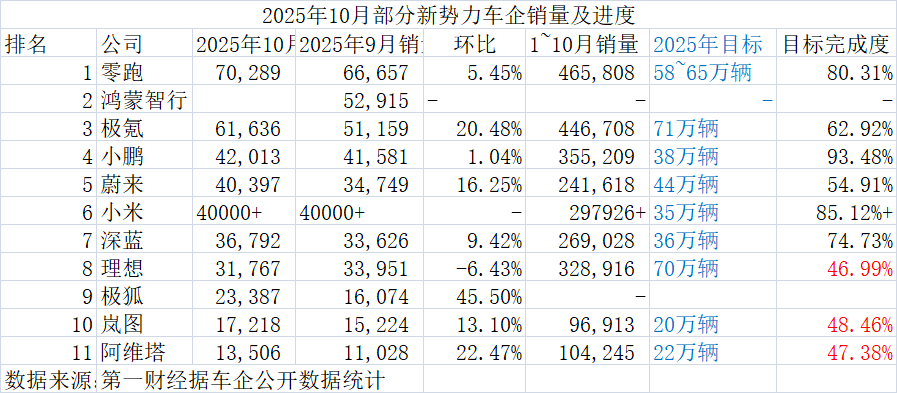
Core Insights - The sales gap among new energy vehicle companies is widening, with significant disparities in delivery numbers for October [1][2] Group 1: Sales Performance - Leap Motor delivered over 70,000 vehicles in October, achieving a record high of 70,289 units, representing a year-on-year increase of over 84% [2] - Xiaopeng and NIO both surpassed 40,000 deliveries, with 42,013 and 40,397 units respectively, marking their historical highs [3] - Li Auto's deliveries fell to 31,767 units in October, down 6.43% month-on-month and 38.25% year-on-year, making it the only new force car company with less than 50% of its delivery target achieved [4] Group 2: Competitive Landscape - The new energy vehicle first-tier group now has a monthly sales threshold of 40,000 units, including Leap Motor, Hongmeng Zhixing, Xiaopeng, NIO, and Xiaomi, while Li Auto has been excluded from this group [4] - Zeekr achieved a monthly sales record of over 60,000 units, with Zeekr brand sales at 21,423 units and Lynk brand sales at 40,213 units [7] - The combined sales of Deep Blue, Lantu, and Avita in October totaled 67,516 units, which is still lower than Leap Motor's single-month sales [9] Group 3: Market Trends - The market is witnessing a significant differentiation among new energy vehicle companies, with those lacking competitive advantages facing a harsher elimination process in the coming year [9] - The CEO of Leap Motor emphasized the importance of continuous improvement and leveraging strengths to succeed in the long-term automotive industry [9]
汽车行业周报:差异化与标准化并存,竞争开启新方向-20251027
Guoyuan Securities· 2025-10-27 07:44
Investment Rating - The report maintains a "Recommended" investment rating for the automotive industry [6]. Core Insights - Current demand is weak, but the annual cumulative figures remain above expectations, with retail sales of passenger cars in China from October 1-19 at 1.128 million units, a year-on-year decrease of 6% but a month-on-month increase of 7% [1][20]. - The penetration rate of new energy vehicles (NEVs) in the passenger car market reached 56.1% during the same period, with cumulative retail sales of NEVs increasing by 23% year-on-year [2][20]. - Differentiated competition continues with breakthroughs in new technologies and new markets, including partnerships between major manufacturers and tech companies like Huawei [2][31]. Summary by Sections 1. Weekly Market Review (2025.10.18-10.24) - The automotive sector rose by 2.92% during the week, with most related sub-sectors also experiencing gains [12]. - The automotive parts sector saw the highest increase at 4.30%, while the passenger vehicle sector had a modest rise of 0.68% [15]. 2. Data Tracking (2025.10.18-10.24) - Retail sales of passenger cars from October 1-19 totaled 1.128 million units, with a cumulative year-to-date retail figure of 18.136 million units, reflecting an 8% year-on-year growth [20]. - NEV retail sales during the same period reached 632,000 units, with a year-to-date cumulative figure of 9.502 million units, marking a 23% increase [20]. 3. Industry News (2025.10.18-10.24) - Chery Group plans to establish 26 overseas R&D centers to support its global innovation system, with expectations that overseas revenue will surpass domestic contributions [31]. - The launch of the "National Good Car" by JD.com, CATL, and GAC Group is set to introduce a new model that supports battery swapping technology, aiming to enhance cost-effectiveness in the NEV market [3][38]. - Dongfeng Motor has developed a solid-state battery supply chain with a maximum range exceeding 1000 kilometers, showcasing advancements in battery technology [42].
汽车电子与机器人双轨驱动价值重塑 汽车零部件龙头均胜电子赴港上市
Feng Huang Wang Cai Jing· 2025-10-15 08:35
Core Viewpoint - Junsheng Electronics has received approval from the China Securities Regulatory Commission for its Hong Kong listing, marking the start of its "A+H" dual capital platform strategy, aimed at enhancing its global competitiveness in the automotive industry [1] Group 1: Capital and Investment Strategy - The funds raised from the Hong Kong listing will be allocated to three core areas: expanding smart cockpit integrated research and development, improving global factory efficiency, and strategic investment expansion [1] - The company aims to strengthen its global resource integration capabilities and international market competitiveness through the "A+H" dual capital platform [6] Group 2: Business Performance - Junsheng Electronics reported a revenue of approximately 30.347 billion yuan for the first half of 2025, a year-on-year increase of 12.07%, with a net profit of 707.8 million yuan, up 11.13% [2] - The overall gross margin has increased for ten consecutive quarters, reaching 18.4%, with the automotive electronics segment achieving a gross margin of 21.5% [2] Group 3: Technological Advancements - The company has established 25 R&D centers and over 60 production bases globally, covering major automotive markets in Asia, Europe, and North America [2] - Junsheng Electronics has received new orders for its Central Computing Unit (CCU) and intelligent networking products, with a total lifecycle order value of approximately 15 billion yuan, set to start mass production in 2027 [3] Group 4: Robotics Expansion - The company is actively expanding into the robotics sector, positioning itself as an "automotive + robotics Tier 1" supplier, which has opened new growth opportunities [4] - Junsheng Electronics has established a wholly-owned subsidiary to advance its robotics business and has developed key components for robotic solutions [4] Group 5: Market Outlook - The global humanoid robot market is projected to exceed $100 billion by 2030, with a compound annual growth rate of 35%, positioning Junsheng Electronics favorably in this emerging market [5] - The company's stock price has increased by 125% this year, reflecting strong market recognition of its automotive intelligence and robotics business growth [6]

赛力斯,通过港交所聆讯,或很快香港上市,市值逾2600亿 | A股公司香港上市
Xin Lang Cai Jing· 2025-10-14 05:30
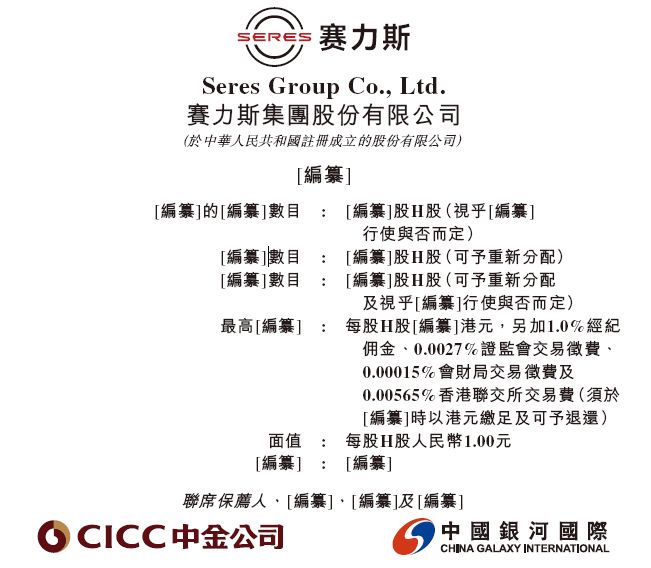
Group 1 - Seres Group Co., Ltd. (赛力斯) is preparing for an IPO on the Hong Kong Stock Exchange, having submitted its prospectus on April 28, 2025, and received approval from the China Securities Regulatory Commission on September 23, 2025 [2][5] - The company plans to issue up to 331.48 million shares and has a market capitalization exceeding RMB 263.7 billion as of October 13, 2025 [2][5] - Seres focuses on the research, manufacturing, sales, and service of electric vehicles and core components, having transitioned to the new energy vehicle sector in 2016 [5][10] Group 2 - The core brand "Wenjie" has rapidly gained market traction, with models like Wenjie M5, M7, M8, and M9 achieving significant sales milestones, including M7 being the best-selling model in the 300,000 RMB price range in China [5][6] - Wenjie brand's total deliveries reached 387,100 units in 2024, marking a 268% year-on-year increase, and it topped the NPS recommendation score in the second half of 2024 with 82% [6][10] Group 3 - Seres operates multiple smart factories, with a total annual production capacity of approximately 600,000 vehicles, emphasizing quality control and high delivery capabilities [8][10] - The company has established a robust technological foundation, including the "Magic Cube" technology platform, which supports various powertrain configurations and enhances production efficiency [9][10] Group 4 - Financial performance shows a revenue increase from RMB 340.56 billion in 2022 to RMB 1,451.14 billion in 2024, with a net profit turnaround from losses in previous years to a profit of RMB 47.40 billion in 2024 [17][18] - The shareholder structure indicates that the largest shareholder group, led by Zhang Xinghai, holds 28.57% of the shares, followed by Dongfeng Motor with 20.04% [12][13]

华为“车友圈”扩列,重塑中国汽车中场战事
2 1 Shi Ji Jing Ji Bao Dao· 2025-10-13 12:21
Core Insights - The collaboration between major Chinese automotive companies and Huawei marks a significant shift towards smart transformation in the automotive industry, with a focus on deep integration and co-creation of products [1][4][10] Group 1: Collaboration Models - Huawei's partnerships with automotive companies can be categorized into three main models: component supply, HI model (HUAWEI INSIDE), and the most integrated "Hongmeng Intelligent Travel" model, which involves deep collaboration across the product lifecycle [2][3] - The "HI Plus" model has emerged, allowing automotive companies to retain brand sovereignty while Huawei deeply integrates its technology throughout the product lifecycle [3] Group 2: Strategic Partnerships - Major state-owned automotive companies, including Dongfeng, GAC, and SAIC, are increasingly collaborating with Huawei, redefining the competitive landscape of the Chinese automotive industry [1][4] - Dongfeng's partnership with Huawei is central to its smart transformation strategy, contributing significantly to its electric vehicle sales [4][5] Group 3: Product Development and Innovation - Dongfeng's new project with Huawei, the DH project, emphasizes joint development and marketing, showcasing a collaborative approach to product innovation [3][6] - GAC's collaboration with Huawei has led to the launch of several smart vehicles, including the A800 sedan, which integrates Huawei's advanced driving and cockpit technologies [5][6] Group 4: Market Impact and Sales Performance - The collaboration has resulted in significant sales growth for companies like Lantu, which saw an 85% year-on-year increase in deliveries, highlighting the effectiveness of the partnerships [4][8] - The cumulative sales of vehicles developed in collaboration with Huawei have surpassed 3 million units, indicating a successful shift from isolated efforts to ecosystem collaboration [8] Group 5: Challenges and Cultural Integration - The partnerships face challenges related to resource allocation, cultural integration, and maintaining brand identity amidst deep collaboration [9][10] - Companies like Chery have experienced internal resource conflicts due to overlapping projects with Huawei, emphasizing the need for clear strategic alignment [9][10] Group 6: Future Outlook - The ongoing collaboration between state-owned automotive companies and Huawei is expected to evolve, focusing on balancing innovation with brand uniqueness and operational efficiency [10][11] - The competition in the automotive industry will increasingly hinge on finding optimal solutions between independent innovation and open collaboration [11]


岚图汽车上市在即 东风汽车原总会计师冯长军升任总经理
Jing Ji Guan Cha Wang· 2025-10-11 09:57
Core Viewpoint - Dongfeng Motor Group has appointed Feng Changjun as the new General Manager, replacing the previous position that had been vacant for eight months, indicating a strategic shift in leadership to enhance capital market performance and operational management [2][3][4]. Group 1: Leadership Change - Feng Changjun, born in May 1978, has a strong background in finance and management, having served as the Chief Accountant and a member of the Party Committee at Dongfeng Motor since June 2020 [2]. - His appointment comes after the previous General Manager, Zhou Zhiping, was reassigned to another group, highlighting a need for new leadership in the company [2]. Group 2: Capital Market Strategy - Dongfeng Motor is currently restructuring its capital market strategy, with plans for its subsidiary, Lantu Motors, to go public in Hong Kong, while Dongfeng Group will complete its privatization and delisting [3]. - The company has faced challenges with low stock valuation, with a market capitalization of HKD 39.12 billion and a price-to-book ratio of only 0.25 as of July 31, 2025, indicating a need for financial restructuring [3]. Group 3: Performance and Future Outlook - Dongfeng Group reported a 14.7% decline in vehicle sales in the first half of the year, with a net profit drop of 91.96%, emphasizing the urgency for asset reallocation to improve market performance [3]. - Lantu Motors is viewed as a key asset for Dongfeng, with its upcoming IPO seen as a critical step to enhance the company's overall valuation and operational success [4].