
小鹏

Search documents
1月车市调整:上汽销量居首,吉利逆势增长
Xin Jing Bao· 2026-02-02 13:57
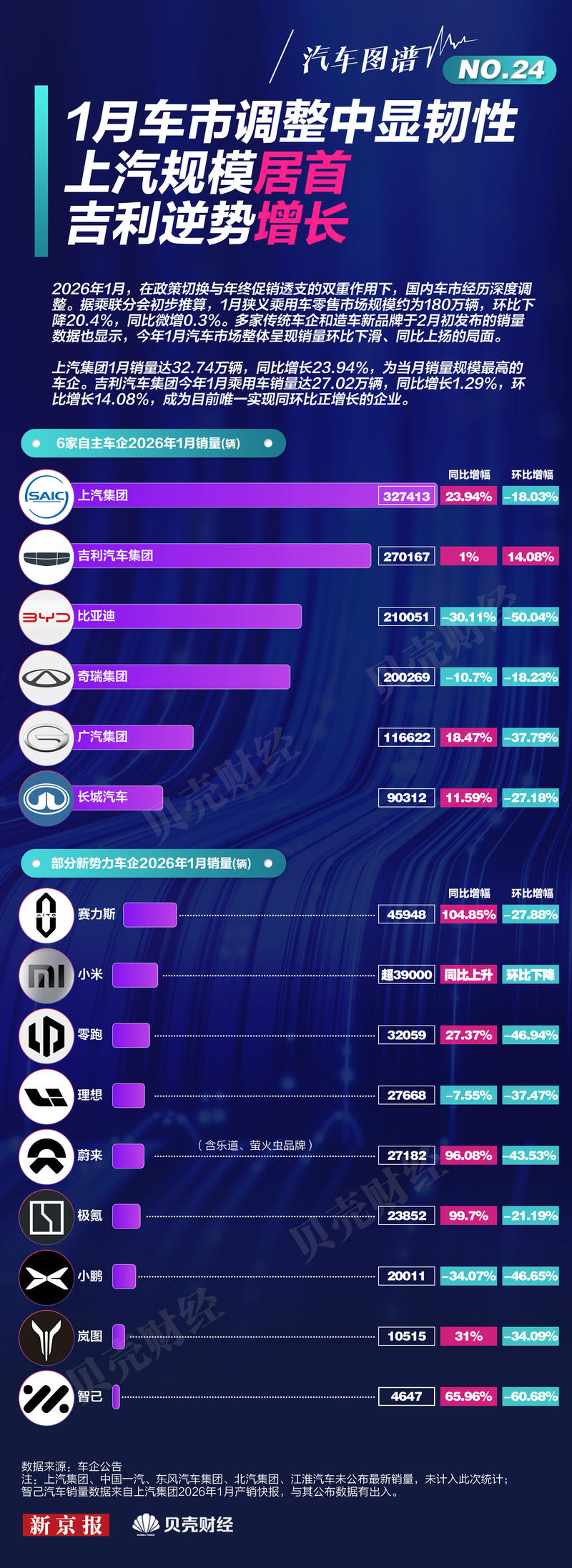
Core Insights - The domestic automotive market in January 2026 experienced a significant adjustment due to policy changes and year-end promotions, with a retail market size of approximately 1.8 million vehicles, reflecting a month-on-month decline of 20.4% but a slight year-on-year increase of 0.3% [1] Group 1: Traditional Automakers - SAIC Motor Corporation achieved sales of 327,400 vehicles in January, marking a year-on-year increase of 23.94%, making it the top-selling automaker for the month [1] - Geely Automobile Group reported sales of 270,200 vehicles, with a year-on-year growth of 1.29% and a month-on-month increase of 14.08%, being the only company to show positive growth in both metrics [1] - BYD's total sales reached approximately 210,000 vehicles, with domestic sales declining but overseas sales exceeding 100,000 vehicles, reflecting a year-on-year growth of 51.47% [1] - Chery Group's total sales across five brands exceeded 200,000 vehicles, showing a year-on-year decline of 10.7% [2] - GAC Group's sales were 116,600 vehicles, with a year-on-year increase of 18.47% [2] - Great Wall Motors sold over 90,300 vehicles, achieving a year-on-year growth of 11.59% [2] Group 2: New Energy and Emerging Automakers - Xiaomi Automobile delivered over 39,000 vehicles in January, surpassing Leap Motor for the first time [2] - Emerging automakers such as Seres, Zeekr, and NIO reported year-on-year sales growth of 104.85%, 99.7%, and 96.08% respectively, indicating strong performance in the high-growth segment [2] - The sales data for several new energy vehicle companies showed significant fluctuations, with some experiencing declines while others achieved substantial growth [4]






开源证券:1月新能源车销量承压 继续看好高端化、出海方向
智通财经网· 2026-02-02 01:45
Group 1 - The domestic passenger car market is expected to remain flat year-on-year in January 2026, but show a significant month-on-month decline, with new energy vehicle (NEV) sales under pressure, leading to a penetration rate of approximately 44.4% [1] - January is the last complete sales month before the Spring Festival, with retail sales expected to reach 1.8 million units, averaging 58,000 units per day, which is flat year-on-year but shows a notable month-on-month decline [1] - The sales performance varies significantly among brands, with some achieving high growth due to popular models, while others face challenges, particularly in the pure NEV segment [2] Group 2 - Brands with popular models, such as AITO and Xiaomi, have seen significant year-on-year sales growth, with AITO's sales reaching 58,000 units (+65.6%) and Xiaomi's at 39,000 units (+70%) [2] - Traditional fuel vehicles provide short-term support for some brands, with GAC Group, Great Wall Motors, and SAIC GM showing year-on-year sales growth of 18.5%, 11.6%, and 8.2% respectively [2] - The industry outlook for 2026 is optimistic regarding high-end development and overseas market expansion, with key players setting ambitious overseas sales targets [3]
奇德新材:公司汽车板块营收占比不断攀升,已跃居为公司第一大应用领域
Zheng Quan Ri Bao Wang· 2026-01-30 06:46
Core Viewpoint - The company, Qide New Materials (300995), is actively collaborating with major automotive parts manufacturers and OEMs, indicating a strong position in the automotive supply chain [1] Group 1: Partnerships and Collaborations - The company has established partnerships with automotive parts companies such as Magna, Yanfeng, Adient, and Dongjian, as well as OEMs like BYD (002594), Xiaomi, and Leap Motor [1] - These collaborations enable the company to provide precision molds, modified plastics, and carbon fiber products to the automotive industry [1] Group 2: Product Applications - The company's products are supplied directly to OEMs or through first-tier parts suppliers, ultimately being used in vehicles from brands like BYD, Xiaomi, XPeng, Seres (601127), GAC Trumpchi, Aion, and Mercedes-Benz [1] Group 3: Revenue Growth - The automotive sector has become the largest application area for the company, with its revenue share in this segment continuously increasing in recent years [1] - Further details on the company's performance will be disclosed in upcoming periodic reports [1]
自动驾驶元年,一二级市场或将迎来估值重塑
Huan Qiu Wang· 2026-01-30 03:02
Group 1 - The Shanghai government has launched the "Mosu Zhixing" action plan aiming for large-scale implementation of high-level autonomous driving scenarios by 2027, emphasizing "cross-domain connectivity" and "scene integration" [1] - The focus of autonomous driving development has shifted from mere vehicle intelligence to a spatial service network deeply integrated with urban functions [1] Group 2 - Citic Securities notes that Tesla's FSD V14 may have reached near Level 4 autonomy, with expectations for a relaxed regulatory environment, making 2026 a potential year for commercializing autonomous driving [2] - The industry is undergoing a paradigm shift, moving from "transportation technology validation" to "scaled scene services and sustainable operations" [2][3] - Nvidia's launch of the "Alpamayo" platform aims to accelerate the development of autonomous vehicles and support new-generation robots, indicating a shift towards a composite model of "space services + high-frequency operations" [2] Group 3 - The competitive landscape is evolving from a focus on "chip-algorithm-data" self-research to an ecosystem collaboration, with Nvidia's open-source approach lowering R&D barriers for second-tier automakers and tech companies [3] - Companies like PIX are exemplifying new business models by launching commercial operations such as the "WonderLoop" project, which integrates smart transportation into urban infrastructure [3] Group 4 - The changing industry dynamics are leading to a revaluation in the capital markets, with companies like Joyson Electronics being recognized for their role in integrating open-source models into production [4] - Joyson Electronics has seen its market value increase from 24 billion on January 28, 2025, to 44 billion on January 28, 2026, reflecting market recognition of its upgraded positioning as "automotive + robotics Tier 1" [4] Group 5 - The competition in the second half of the autonomous driving sector will hinge on understanding specific scenarios, building sustainable business models, and enhancing collaborative efficiency within the open industry ecosystem [5][6] - Innovative companies like PIX are focusing on "urban robots" to avoid saturated competition, leveraging modular chassis for flexible configurations and efficient integration into the open industry ecosystem [6]


广州迎APEC中国年首场高官会,双方经贸合作稳步增长
2 1 Shi Ji Jing Ji Bao Dao· 2026-01-29 12:21
Group 1 - The APEC First Senior Officials' Meeting will be held in Guangzhou from February 1 to 10, 2026, focusing on the theme "Building a Community of the Asia-Pacific for Common Prosperity" and three priority areas: openness, innovation, and cooperation [1][2] - The meeting will feature over 70 activities with more than 1,000 representatives from APEC member economies, the secretariat, and business advisory councils expected to attend [1] - Guangzhou has attracted nearly $120 billion in foreign investment from APEC economies, accounting for 82.8% of the city's total foreign investment [2] Group 2 - Guangzhou has invested in 2,684 non-financial projects in 20 APEC economies, with a total investment amount of $24.72 billion, representing 81% of the city's total investment [2] - In 2025, Guangzhou's trade with APEC economies is projected to reach 689.58 billion yuan, a 2.2% increase, with exports at 443.61 billion yuan and imports at 245.97 billion yuan [2] - The city plans to enhance international payment environments and promote business cooperation by providing promotional materials about Guangzhou's business environment in hotels and hosting policy seminars [3] Group 3 - Guangzhou aims to create a vibrant atmosphere for foreign guests during the APEC meeting, integrating local cultural elements into events such as flower fairs and lantern festivals [3] - The city will mobilize over 2,000 enterprises to participate in 150 overseas exhibitions in APEC economies and organize over 30 exhibitions in countries like Vietnam and Indonesia [3] - Guangzhou will also conduct over 100 investment promotion activities in major cities of APEC economies and collaborate on building cooperative parks with APEC economies [3]
春晚机器人再上新!机器人大跌,拓普集团跌超7%,机器人ETF基金(159213)跌超2%交投爆量,全球首条机器人关节自动化产线投产!
Sou Hu Cai Jing· 2026-01-26 09:25
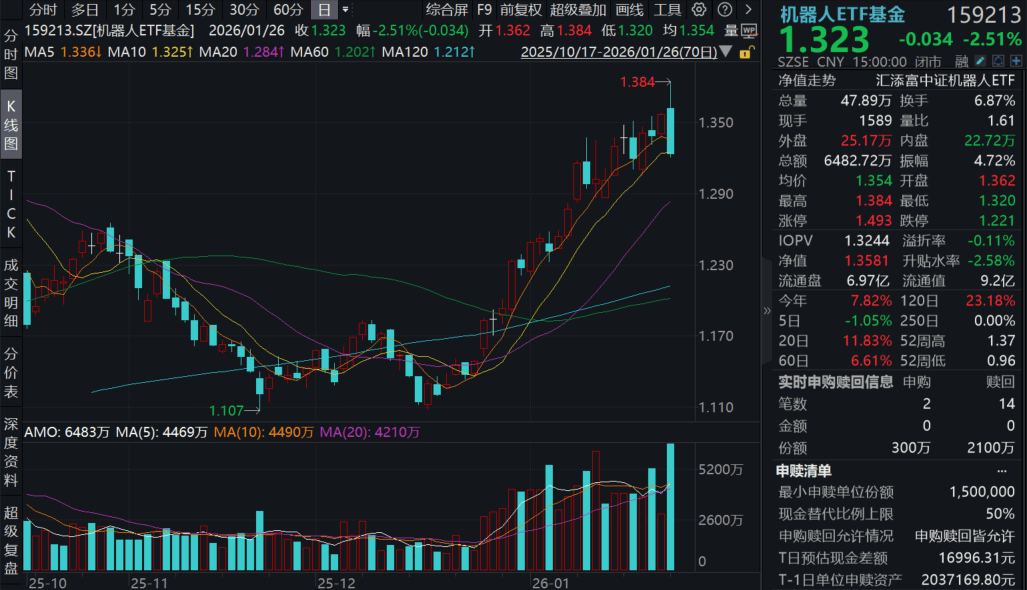
Core Viewpoint - The A-share market experienced fluctuations with a strong performance in cyclical sectors like non-ferrous metals, while the hard technology sector faced pressure. The Robot ETF fund (159213) saw a significant drop of 2.51% at the close, with trading volume increasing sharply [1]. Group 1: Robot ETF Fund Performance - The majority of the index component stocks of the Robot ETF fund (159213) experienced a pullback, with notable movements including a rise of over 12% for Zhongkong Technology and a drop of over 7% for Top Group. Other stocks like Shuanghuan Transmission and Greentech also fell by over 5% [3][4]. - The top ten component stocks of the Robot ETF fund include Keda Xunfei, Huichuan Technology, and Top Group, with varying performance and estimated weights in the index [4]. Group 2: Human-Robot Sector Developments - The human-robot sector is witnessing rich catalysts, including the announcement that Galaxy General Robotics will be the designated embodied large model robot for the 2026 Spring Festival Gala, following the previous year's appearance by Yushu Robotics [5]. - Recent developments in the human-robot sector include the establishment of a humanoid robot research institute by OpenAI and Tesla's plans for consumer sales of humanoid robots by 2027. Additionally, Yushu Technology has received two design patents for humanoid robots [5][6]. Group 3: Market Growth Projections - According to IDC, the global humanoid robot market is expected to experience explosive growth, with an estimated shipment of approximately 18,000 units by 2025, representing a year-on-year increase of about 508%. Chinese manufacturers are expected to dominate this market [6]. - East Wu Securities highlights that the core transformation in the development of humanoid robots will be driven by consumer access to practical products, with significant events anticipated in Q1 2026 related to Tesla's Optimus V3 robot [7]. Group 4: Investment Opportunities - Guolian Minsheng Securities emphasizes the importance of Tesla's production progress and technological iterations, with the Optimus V3 set to begin mass production in 2026. The IPO processes of domestic robot manufacturers are also expected to serve as significant catalysts for the sector [8][9]. - The report suggests that the valuation of leading automotive robot manufacturers may undergo reconstruction, as current market valuations do not reflect the expected contributions from robotics [9].


华阳集团:预计公司HUD产品将继续保持高增长态势
Zheng Quan Shi Bao Wang· 2026-01-24 13:25
Core Viewpoint - Huayang Group (002906) has expanded its customer base for HUD products, establishing partnerships with numerous domestic and international automotive companies, indicating a strong growth trajectory in the HUD market [1] Group 1: Customer Expansion - The company has deepened its cooperation with various automotive clients, including Geely, Xiaopeng, Great Wall, Chery, FAW, Changan, BYD (002594), Volkswagen, STELLANTIS, Hyundai, and Seres (601127) since the second half of 2025 [1] - New projects based on the Lcos imaging solution for AR-HUD products have been secured, alongside additional projects for VPD products following the achievement of global mass production [1] Group 2: Production and Market Position - The scale of HUD production continues to increase, maintaining the company's leading position in the industry, with a cumulative global shipment exceeding 4 million units by the end of 2025 [1] - The ongoing popularity of vehicles equipped with the company's HUD products, along with the entry of more new projects into mass production, is expected to sustain a high growth trend for the company's HUD products [1]
广货新能源车三巨头出海,打出三张王牌
2 1 Shi Ji Jing Ji Bao Dao· 2026-01-20 10:17
Core Insights - Guangdong province has achieved a record high in foreign trade, with a total import and export value of 9.49 trillion RMB in 2025, marking a 4.4% year-on-year increase and accounting for 20.9% of the national total [1] - The province has shifted its export focus from traditional goods like clothing and home appliances to new energy vehicles (NEVs), medical equipment, industrial robots, 5G smartphones, and drones [1] Group 1: Electric Vehicle Market Performance - BYD has become the world's largest electric vehicle manufacturer in 2025, selling approximately 2.26 million units, surpassing Tesla's 1.63 million units [2] - GAC's exports exceeded 130,000 units in 2025, representing a 45% year-on-year growth, achieving a threefold increase in two years [2] - Xpeng delivered 45,008 vehicles in overseas markets in 2025, a 96% increase, entering nearly 30 new markets within the year [2] Group 2: Competitive Advantages of Guangdong Automakers - The technological advantage is highlighted by BYD's innovations in battery technology and GAC's advancements in solid-state batteries, while Xpeng focuses on enhancing vehicle intelligence [2][3] - The ecological advantage is evident as the domestic NEV penetration rate has surpassed 50%, supported by widespread fast-charging technology and a comprehensive charging network [3] - The industrial foundation advantage stems from Guangdong's established automotive production ecosystem, which includes a complete supply chain for vehicle manufacturing and components, facilitating the export of both products and technology [3] Group 3: Future Outlook - Guangdong's automotive industry is poised for further global expansion, leveraging its technological, ecological, and industrial strengths to navigate international markets [4]
机器人板块掘金
2026-01-20 01:50
Summary of the Robot Industry Conference Call Industry Overview - The robot sector has shown a fluctuating upward trend since October last year, driven by strong domestic demand and deep collaborations between robot suppliers and major North American clients. The sector is expected to continue its upward trajectory in the first quarter of the year [2][3]. Key Companies and Technologies - Notable companies in the North American chain include established firms like Sanhua Top, Hengli, and Yongtai, which are recognized for their stability and leadership [4]. - Emerging suppliers such as Senlin and Henghui are also worth monitoring due to their potential market impact [4]. - New technology directions include skin-like products and the use of TPE and TPU materials, which are expected to enhance robot applications significantly [4]. Market Trends and Predictions - The robot sector is anticipated to outperform the previous quarter, with a strong likelihood of continued growth in January [3]. - The domestic robot market is expected to see significant changes by 2026, with many companies pursuing backdoor listings or IPOs, which will drive product updates and sales growth. Companies like Xiaopeng, Xiaomi, and Huawei are highlighted for their substantial development potential [6]. Application Scenarios - By 2026, robot applications are projected to expand into logistics (e.g., Dema, Yongchuang), electricity (e.g., Yijiahe), and firefighting (e.g., Qingniao) sectors, which are expected to become key growth areas [7]. - The upcoming wave of domestic robot listings is likely to stimulate the development of various application scenarios, with a focus on companies capable of fulfilling basic application needs and securing large orders [7]. Material Innovations - TPU (Thermoplastic Polyurethane) is becoming a trend in humanoid robot manufacturing due to its durability, oil resistance, and high elasticity, replacing metal components in many applications [8]. - TPU's advantages include: 1. Shell protection that absorbs impact energy during collisions, reducing damage to internal components [9]. 2. Bionic muscle covering that protects joints and mitigates impact forces [9]. 3. Foot cushioning pads that enhance friction and reduce noise during movement [9]. 4. Joint seals and protective covers that extend the lifespan of joints by preventing lubricant leakage [9]. Market Expectations for TPO Materials - The market has high expectations for TPO materials in robotics, with companies like Kaizhong, Yongtai Technology, and Mingji Vision holding competitive advantages in this area [10]. Skin Products vs. Traditional Metal Shells - Skin products, made using low-temperature injection molding, offer enhanced protective features compared to traditional metal shells and are seen as a future platform for integrating electronic skin technology [11]. - Companies such as Henghui Security, Nanshan Zhishang, and Kanglongda are positioned to benefit from advancements in this field [11]. Domestic Transmission Solutions - Domestic transmission solutions have made significant progress, achieving performance levels comparable to leading overseas companies, although there is still a gap in lifespan [12]. - As domestic humanoid robots gain traction, interest in related companies like Henghui Security and Nanshan Zhishang is expected to increase due to rising product quality and new demands [12].


刚因“电芯”遭23亿天价索赔,欣旺达又卷入沃尔沃全球召回风波
Guo Ji Jin Rong Bao· 2026-01-19 13:00
Core Viewpoint - The recent recall of Volvo's electric vehicle EX30 due to battery safety issues has raised concerns about the responsibility of the battery supplier, A123, and has compounded existing sales pressures on Volvo [2][3][5]. Group 1: Volvo's Recall and Sales Performance - Volvo has initiated a global recall of its EX30 electric model due to high-voltage battery overheating risks, affecting markets including the US, Canada, South Africa, and Australia [2]. - In the UK, 10,440 units of the EX30 are confirmed to be affected, covering models from 2024 to 2026 [2]. - Volvo's global sales in 2024 are projected at 763,400 units, an 8% increase year-on-year, but sales in China, its largest market, have dropped to 156,400 units, the lowest in five years [4]. Group 2: Financial Impact and Battery Supplier Issues - In Q3 2023, Volvo's global sales fell to 160,500 units, a 7% year-on-year decline, with revenues of 86.4 billion Swedish Krona, down 6% [5]. - The recall has sparked controversy over battery supply responsibilities, with reports indicating that the problematic battery cells were produced by a joint venture involving A123 [5][6]. - A123's chairman stated that the battery packs were supplied through a different factory, distancing the company from direct responsibility for the issues [5]. Group 3: A123's Challenges and Market Position - A123 is facing significant challenges, including a recent lawsuit from Zeekr over battery quality issues, which has intensified scrutiny on the company's reliability [6][9]. - The company has seen a reduction in orders from key clients like Li Auto and Xiaomi, with the number of models supported by A123 for Li Auto dropping from 10 to 3 [9]. - A123's aggressive pricing strategy has led to declining profit margins, with a gross margin of only 9.77% in H1 2025, significantly lower than competitors [10]. Group 4: Financial Health and Future Outlook - A123 reported a loss of 1.87 billion Yuan in 2024, with cumulative losses exceeding 4.5 billion Yuan from 2023 to H1 2025 [10]. - The company's debt levels have risen sharply, with a debt-to-asset ratio of 67.62% and total liabilities reaching 67.9 billion Yuan [10]. - Concerns about ongoing litigation and financial losses may hinder A123's plans for an IPO in Hong Kong, which was anticipated for 2026 [10].
