微创医疗

Search documents
手术机器人行业深度报告-AI驱动辅助操作迈向-自动驾驶-国产龙头扬帆全球市场
2026-02-02 02:22
手术机器人行业深度报告:AI 驱动辅助操作迈向"自动驾 驶" ,国产龙头扬帆全球市场 20260201 手术机器人行业具备多个显著优势,使其成为当前医疗器械领域最具吸引力的 商业模式之一。首先,手术机器人结合了设备、耗材和服务模式,带来高粘性 和持续现金流。一旦设备装机入院,就能在医院中占据重要位置,持续贡献稳 定现金流。此外,手术机器人不仅是耗材的流量入口,还在数据方面具有高价 值,并能带来耗材品类升级及数据服务等商业机会。 从市场渗透率和增长空间 来看,目前手术机器人的渗透率仍较低,尤其是在腔镜、骨科、泛血管、消化 道、经皮穿刺、神经外科及齿科等领域都有巨大增长潜力。同时,在全球范围 内,主要市场集中于美国和欧洲等发达地区,新兴市场需求尚未被充分挖掘。 结合全球 AI 技术的发展趋势,我们预计 AI 将进一步赋能手术机器人,使其逐 步实现类似自动驾驶的终极形态。目前,包括直觉外科在内的多家公司,以及 国内如微创机器人、金风医疗和天智航等企业,都在 AI 领域进行前瞻布局。 中国腔镜机器人渗透率远低于美国,但腹腔镜手术量巨大,未来市场潜 力巨大。腔镜机器人技术核心在于灵活操作,骨科机器人则侧重精准规 划。 ...

中国手术机器人行业近况更新:华创医药投资观点&研究专题周周谈·第161期
Huachuang Securities· 2026-02-01 00:25
Investment Rating - The report does not explicitly state an investment rating for the surgical robot industry, but it indicates a positive outlook for growth and development in the sector. Core Insights - The surgical robot industry in China is entering a rapid development phase, supported by national policies and capital investment, with significant advancements in technology and market demand [13]. - The report highlights the transition from a capital-driven to a value-driven model in the surgical robot sector, emphasizing the importance of clinical applications and technological integration [13]. - The approval process for surgical robots by the NMPA has accelerated, particularly for orthopedic surgical robots, which dominate the market in terms of the number of products approved [30][28]. Summary by Sections Market Overview - The surgical robot market in China is characterized by a growth in sales volume, with a total of 332 units sold in the first 11 months of 2025, reflecting a year-on-year increase of 3.75% [34]. - The sales revenue for surgical robots reached 2.973 billion yuan, showing a slight decline of 0.87% year-on-year, indicating a structural transition rather than a market downturn [34]. Technological Advancements - Innovations in remote operation, miniaturization, and AI assistance are driving the development of surgical robots, with products like the TUMAI® remote surgical robot achieving significant milestones in cross-border surgeries [16][19]. - The introduction of AI-assisted surgical robots is enhancing precision in surgeries, with products capable of 3D reconstruction and personalized surgical planning [16]. Regulatory Developments - The National Healthcare Security Administration has established a pricing framework for surgical robots, which is expected to facilitate market growth by clarifying reimbursement policies and pricing structures [27][26]. - The pricing guidelines categorize surgical robot services into navigation, participation in execution, and precision execution, linking them to main surgical procedures [27]. Market Segmentation - The orthopedic surgical robot segment holds the largest market share, accounting for 50% of the total NMPA-approved surgical robots from 2014 to 2024, followed by neurosurgical robots [30]. - The report indicates a significant potential for growth in emerging fields such as vascular surgery robots, with increasing demand and technological advancements [34]. Competitive Landscape - The report identifies key players in the surgical robot market, including domestic manufacturers that are rapidly gaining market share as regulatory barriers for imports increase [45]. - The competitive landscape is shifting as domestic products receive NMPA approval, challenging the previously dominant imported products [45].
中国手术机器人行业近况更新:华创医药投资观点&研究专题周周谈·第161期-20260131
Huachuang Securities· 2026-01-31 15:16
Investment Rating - The report does not explicitly state an investment rating for the surgical robot industry, but it highlights a positive outlook for growth and innovation in the sector. Core Insights - The surgical robot industry in China is entering a rapid development phase, supported by national policies and capital investment, with significant advancements in technology and market demand [13]. - The report emphasizes the transition from a capital-driven to a value-driven model in the surgical robot sector, indicating a shift towards more sustainable growth and clinical applications [13]. - The approval process for surgical robots by the NMPA has accelerated, particularly for domestic products, with orthopedic surgical robots leading in the number of approvals [30]. Summary by Sections Market Overview - The surgical robot market in China is characterized by a growth in sales volume, with a total of 332 units sold in the first 11 months of 2025, reflecting a year-on-year increase of 3.75% [34]. - The sales revenue for surgical robots reached 2.973 billion yuan, showing a slight decline of 0.87% year-on-year, indicating a structural transition rather than a market downturn [34]. Technological Advancements - Innovations in remote operation, miniaturization, and AI assistance are driving the development of surgical robots, with notable products like the first remote surgical robot approved in China [16][19]. - The report highlights the introduction of AI-assisted surgical robots that enhance precision and efficiency in surgeries, marking a significant technological leap in the industry [16]. Regulatory Developments - The National Healthcare Security Administration has established a pricing framework for surgical robots, which is expected to facilitate market growth by clarifying reimbursement policies and pricing structures [27][26]. - The report notes that the establishment of a clear payment system is crucial for the adoption of surgical robots in hospitals, as high costs and long return periods can deter procurement [27]. Market Segmentation - The orthopedic surgical robot segment dominates the market, accounting for 50% of the NMPA approvals from 2014 to 2024, with a strong growth trajectory expected in this area [30]. - The report identifies the laparoscopic surgical robot and orthopedic surgical robot as the two largest segments in the market, with significant potential for expansion in emerging fields [41]. Future Outlook - The report projects substantial growth in the surgical robot market, with expectations for increased penetration rates and market size driven by technological advancements and policy support [44]. - The anticipated CAGR for the laparoscopic surgical robot market from 2024 to 2033 is estimated at 30.4%, indicating robust future demand [44].
华创医药周观点:中国手术机器人行业近况更新 2026/01/31
华创医药组公众平台· 2026-01-31 15:13
Core Viewpoint - The Chinese surgical robot industry is entering a rapid development phase, driven by policy support, capital investment, and technological advancements, with significant progress in various fields such as orthopedics and neurosurgery [13][21]. Market Overview - The CITIC Medical Index fell by 3.33% this week, underperforming the CSI 300 Index by 3.41 percentage points, ranking 22nd among 30 primary industries [8]. - The top ten stocks by growth this week included Cap Bio, Hualan Biological, and Dezheng Health, while the biggest losers were *ST Sailong and Vcare Pharmaceuticals [8]. Industry and Company Events - The surgical robot market is characterized by a shift from capital-driven to value-driven development, with increasing applications in remote surgery and AI-assisted decision-making [13][21]. - The NMPA has accelerated the approval of surgical robots, with orthopedic surgical robots accounting for 50% of the approved products from 2014 to 2024, maintaining the highest share [22]. Investment Themes - The innovative drug sector is transitioning from quantity to quality, emphasizing differentiated products and internationalization by 2025 [11]. - The medical device sector is witnessing a recovery in bidding volumes for imaging equipment, with ongoing updates in home medical devices supported by subsidies [11]. - The CXO and life sciences services are expected to see a rebound in investment, with a focus on high-profit elasticity companies as the industry matures [11]. Technological Progress - Remote operation, miniaturization, and AI assistance are key trends in the surgical robot sector, with products like the TUMAI® remote surgical robot achieving significant milestones in cross-border surgeries [17][19]. - The first AI-assisted orthopedic surgical robot, ROPA HIP, has been approved, showcasing advancements in surgical simulation technology [17]. Regulatory Developments - The National Medical Insurance Administration (NMPA) has established a pricing system for surgical robots, which is expected to enhance the industry's growth by clarifying reimbursement standards [21]. - The introduction of a legal and clear pricing project for surgical robots is anticipated to provide institutional support for innovation and development in the industry [21]. Sales and Market Dynamics - The sales volume of surgical robots in China reached 332 units in the first 11 months of 2025, reflecting a 3.75% year-on-year increase, while sales revenue decreased by 0.87% [27]. - The orthopedic surgical robot segment showed a significant growth of 17.81% in volume and 21.62% in revenue, indicating a robust demand in specialized fields [27]. Market Segmentation - The market for surgical robots is dominated by laparoscopic and orthopedic surgical robots, which accounted for 42% and 32% of the market share, respectively, in 2024 [25]. - Emerging fields such as vascular surgery robots are expected to present substantial market potential as the industry evolves [27].

创新药的第二战场
投资界· 2026-01-28 02:28
以下文章来源于阿基米德Biotech ,作者阿基米德君 1月2 0日,历史上一个平淡的日子,唯一的热闹,可能是大寒之日上海飘雪。同日,另 一 场 寒 潮 却 无 声 无 息 , 恒 生 生 物 科 技 指 数 ( HSHKBIO ) 成 交 额 跌 破 1 0 0 亿 港 币 , 与 2 0 2 5年最高点相比下降近8 0 %,1 5家港股1 8A公司日成交额不足1 0 0万港币。 创新药在研发主战场外,正在开辟争夺流动性的第二战场。 技术和资本,一体两面,是创新药企的两大属性。早期生物科技没有自我造血功能,全 靠资本输血。成熟创新药企在每一个重要节点,跃升到更高发展阶段,也靠资本支持。 当前,通过港股1 8A通道上市的生物科技企业已达8 5家(含摘B),还有超过8 0家递表排 队,而流动性却在指缝间溜走。自研能力不够硬,又不做市值管理的公司,等于自动退 出流动性争夺战,被边缘化,被遗忘,直至丧失融资能力。 阿基米德Biotech . 生物科技第三方独立观察,提前感知行业边际变化,客观中立,深入浅出,松弛愉悦 流动性。 作者 / 阿基米德君 来源 / 阿基米德Biotech (ID:ArchimedesBio ...

中资美元债周报:一级市场发行量回落,二级市场小幅上涨-20260126
Guoyuan Securities2· 2026-01-26 09:46
Report Industry Investment Rating - Not provided in the report Core Viewpoints - The primary market issuance of Chinese offshore bonds declined last week, with 6 new bonds issued, totaling approximately $1.906 billion. The secondary market showed a slight increase, and US Treasury yields fluctuated upward [1][2][3] Summary by Directory 1. Primary Market - The issuance volume of the primary market for Chinese offshore bonds declined last week, with 6 new bonds issued, totaling approximately $1.906 billion. MTR Corporation issued two green bonds totaling A$2 billion, the largest issuance scale last week, and Shui On Land issued a $300 million bond with a coupon rate of 9.75%, the highest - priced new bond last week [7] 2. Secondary Market 2.1 Chinese US - dollar Bond Index Performance - The Chinese US - dollar bond index (Bloomberg Barclays) rose 0.15% week - on - week, and the emerging market US - dollar bond index rose 0.20%. The investment - grade index was at 203.1452, up 0.15% for the week, and the high - yield index was at 161.8156, up 0.18% for the week. The Chinese US - dollar bond return index (Markit iBoxx) rose 0.11% week - on - week, with the investment - grade return index at 244.9461, up 0.1% for the week, and the high - yield return index at 243.7889, up 0.21% for the week [9][14] 2.2 Performance of Chinese US - dollar Bond Industries - Different industries showed different trends. The telecommunications and healthcare sectors led the rise, while the real estate and non - essential consumer sectors led the decline. For example, the telecommunications sector's yield decreased by 45.5bps, and the healthcare sector's yield decreased by 40.2bps. The real estate sector's yield increased by 19.6Mbps, and the non - essential consumer sector's yield increased by 98bps [19][24] 2.3 Performance of Chinese US - dollar Bonds by Different Ratings - Investment - grade names generally rose, with the A - grade weekly yield down 5.0bps and the BBB - grade weekly yield down 2.7bps. High - yield names mostly fell, with the BB - grade yield down 6.6bps, the DD+ to NR - grade yield up about 7.9bps, and the non - rated name yield up 6.7Mbps [21] 2.4 Hot Events in the Bond Market Last Week - Fanhai Holdings failed to repay interest - bearing debts totaling 34.06 billion yuan as of December 31, 2025. Sunac China Holdings had new overdue borrowings and 19 new acts of dishonesty [25][26] 2.5 Rating Adjustments of Entities Last Week - Sichuan Huixing Industrial Investment and Development Co., Ltd.'s long - term issuer credit rating was BBB -; Qingdao Haifa Group's international long - term issuer credit rating was upgraded from A to A+; Ganzhou Urban Construction Investment Group's issuer rating was A - with a positive outlook; Moody's maintained the rating and stable outlook of Bohai Bank; Moody's adjusted the rating outlook of Yuexiu Real Estate Investment Trust Fund to stable; Moody's downgraded Wanda Commercial's family rating to Ca with a negative outlook; Fitch confirmed the long - term foreign and domestic currency issuer rating of Qingdao Huatong Group as BBB+ with a stable outlook [28][29] 3. US Treasury Bond Quotes - The report provides quotes for 30 US Treasury bonds with maturities over 6 months, including details such as code, maturity date, current price, yield to maturity, and coupon [30] 4. Macro Data Tracking - As of January 23, the 1 - year US Treasury yield was 3.5083%, down 2.66bps from the previous week; the 2 - year yield was 3.594%, up 0.8bps; the 5 - year yield was 3.8245%, up 0.93bps; the 10 - year yield was 4.2252%, up 0.23bps [35] 5. Macro News - The final annualized quarter - on - quarter growth rate of the US GDP in Q3 2025 was 4.4%, higher than the initial value. Trump reached an agreement framework on Greenland issues, and related tariffs will not take effect. Most economists expect the Fed to keep the benchmark interest rate unchanged this quarter. The US national debt increased by about $2.25 trillion in 2025. The IMF raised the economic growth forecasts for China and the world in 2026. The Bank of Japan kept the benchmark interest rate at 0.75%. South Korea's GDP grew 1% year - on - year in 2025. China's GDP in 2025 grew 5% year - on - year. The central bank governor said there is still room for reserve requirement ratio cuts and interest rate cuts this year. Three departments extended the tax incentives for innovative enterprise CDRs. The Ministry of Finance said the fiscal expenditure in 2026 will only increase. Six departments extended the tax incentives for community family services. Nine departments issued opinions to promote the high - quality development of the pharmaceutical retail industry. The shipment volume of Chinese foldable mobile phones increased 9.2% year - on - year in 2025. Housing prices in Chinese cities generally declined in December 2025. The extension proposal of "21 Vanke 02" was approved [34][35][36]
年度扭亏盈喜发布,微创医疗股价冲高回落也是“赚钱信号”?
Zhi Tong Cai Jing· 2026-01-26 07:31
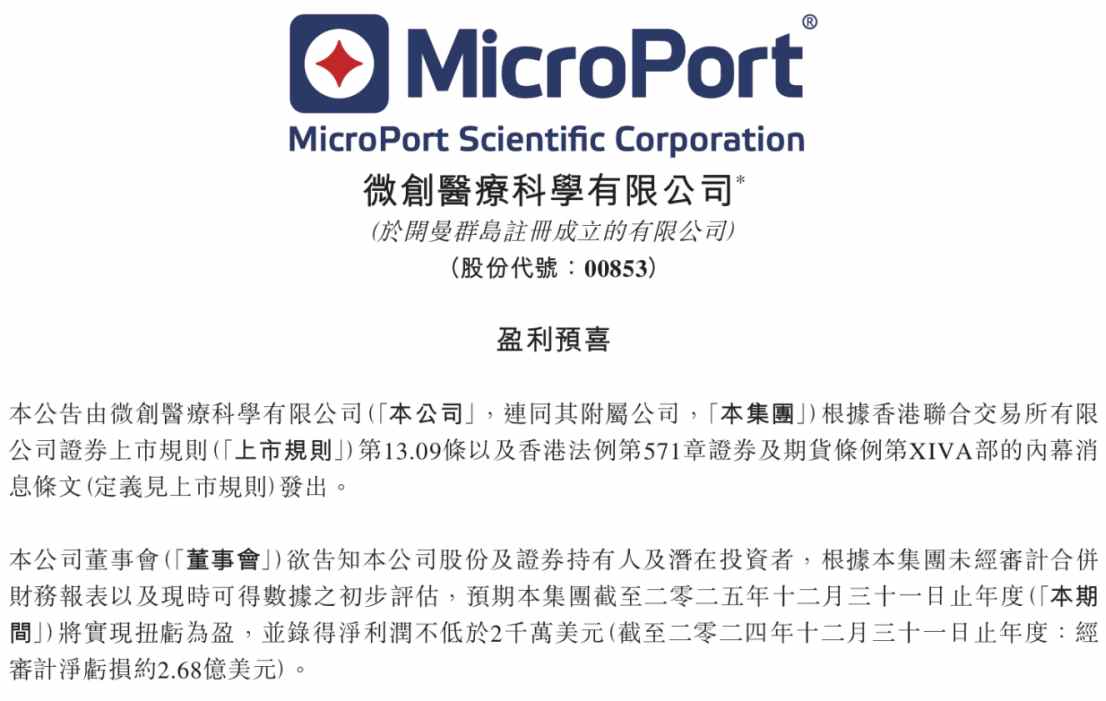
Core Viewpoint - MicroPort Medical (00853) expects to turn a profit in 2025, projecting a net profit of at least $20 million, driven by continuous revenue growth, particularly from its overseas business, which has seen a year-on-year increase of approximately 70% [1] Group 1: Financial Performance - The company anticipates a turnaround primarily due to sustained revenue growth, despite facing downward pressure on product prices from domestic industry policies [1] - Gross margin is expected to improve by 2-3 percentage points year-on-year, aided by cost optimization measures [1] - Operating expenses have decreased by approximately 10-11% year-on-year during the reporting period [1] - The disposal of subsidiaries has also contributed positively to MicroPort Medical's financial performance [1] Group 2: Stock Market Reaction - Following the positive earnings announcement, MicroPort Medical's stock price opened high on January 23, reaching a peak increase of 12.84% before declining to a less than 4% gain by the morning close [3] - The trading volume on that day reached 77.07 million shares, setting a new record since October of the previous year [3] - The stock has experienced a significant decline from its peak of HKD 16.28 on October 8 to a low of HKD 9.80, marking a maximum fluctuation of 39.80% over the two-month period [5] Group 3: Market Sentiment and Technical Analysis - The stock's price action since October 8 has shown a technical regression, with a notable drop following a brief rally [6] - The stock reached a technical bottom on November 19, with a price-to-sales (PS) ratio of 2.51, indicating an oversold condition [8] - Following this, a rebound occurred, with the stock price moving between the upper and middle Bollinger Bands until the end of December [8] Group 4: Investor Behavior - Recent trading activity indicates a shift in investor sentiment, with Hong Kong Stock Connect funds becoming net buyers, contrasting previous trends of selling during price increases [9] - Over the last 60 days, the largest net buyer has been the Shanghai-Hong Kong Stock Connect, acquiring 50.36 million shares [9] - The average holding cost for these funds is HKD 11.23, reflecting a profit margin of 15.46% [9] Group 5: Future Outlook - MicroPort Medical's projected financial improvements align with market expectations, with several brokerage firms raising their profit forecasts following the earnings announcement [11] - The company aims to achieve a net loss of no more than $110 million in the first half of 2025 and a full-year net loss of no more than $55 million, with a target net profit of at least $45 million in the first half of 2026 [12] - The positive earnings outlook has attracted more investor attention, indicating a potential shift from a wait-and-see approach to active investment [12]
年度扭亏盈喜发布,微创医疗(00853)股价冲高回落也是“赚钱信号”?
Zhi Tong Cai Jing· 2026-01-26 01:40
Core Viewpoint - MicroPort Medical (00853) expects to turn a profit in 2025, projecting a net profit of at least $20 million, driven by continuous revenue growth, particularly from overseas business, which has seen approximately 70% year-on-year growth [1] Financial Performance - The company anticipates a turnaround primarily due to sustained revenue growth, with overseas business contributing significantly [1] - Despite facing downward pressure on product prices from domestic industry policies, the company has improved its gross margin by 2-3 percentage points year-on-year through cost optimization measures [1] - Operating expenses have decreased by approximately 10-11% year-on-year during the reporting period [1] - The disposal of subsidiary companies has also contributed positively to MicroPort Medical's financial performance [1] Stock Market Reaction - Following the earnings announcement, MicroPort Medical's stock price opened high on January 23, reaching a peak increase of 12.84% before closing with a gain of less than 4% [3] - The trading volume on that day reached 77.07 million shares, setting a new record since October of the previous year, indicating significant investor activity [3] Historical Stock Performance - Since peaking at 16.28 HKD on October 8, the stock has experienced a two-month downtrend, with a maximum fluctuation of 39.80%, dropping to a low of 9.80 HKD [5] - The stock underwent a technical correction, moving from the upper to the lower Bollinger Band over a month, indicating a bearish market sentiment [5][6] Investor Sentiment and Trading Patterns - The stock's decline was characterized by low trading volumes, suggesting a lack of market support and internal disagreements among shareholders [5] - On November 24, the stock began a rebound after reaching a technical bottom, with subsequent trading showing a recovery trend [6][8] Institutional Investment Trends - Recent trading data indicates that Hong Kong Stock Connect funds have increased their holdings in MicroPort Medical, reversing previous trading strategies [9][11] - The average holding cost for these funds is 11.23 HKD, with an overall profit margin of 15.46% [9] Future Outlook - Analysts have raised profit forecasts for MicroPort Medical, reflecting improved operational efficiency and a focus on core business areas [12] - The company aims to achieve specific financial targets for 2025 and 2026, including a net profit of at least $45 million in the first half of 2026 [12]
研判2026!全球及中国冠脉通路器械行业发展背景、患病人数、市场规模、企业布局及未来发展趋势分析:高端市场外资主导,基层扩容增量可期[图]
Chan Ye Xin Xi Wang· 2026-01-24 02:30
Core Insights - The coronary access devices are essential consumables for percutaneous coronary intervention (PCI) surgeries, directly impacting surgical outcomes and complication control [1][6] - The industry is supported by a series of policies in China, including centralized procurement, innovation approvals, and grassroots medical construction, laying a solid foundation for high-quality development [6][10] - The number of coronary artery disease patients is steadily increasing globally and in China, with projections indicating 220 million patients worldwide and 27.879 million in China by 2024, highlighting significant growth potential for the industry [10] Industry Overview - Coronary access devices are specialized medical equipment and consumables used in PCI surgeries to establish and maintain access from the body surface to the coronary arteries, ensuring the smooth execution of angiography, balloon dilation, and stent implantation [1][6] - The devices are categorized into four main types: puncture devices, catheter systems, sheath sets, and auxiliary devices for pressure monitoring and vascular closure [3][4] Development Background - The development of coronary access devices is crucial for reducing cardiovascular disease mortality, enhancing medical accessibility, and promoting high-end device localization [6][8] - Recent policies in China aim to improve centralized procurement mechanisms, accelerate innovation device approvals, and standardize medical insurance payments, providing guidance for industry development [6][10] Market Analysis - The global coronary balloon dilatation catheter market is expanding, with functional balloons growing at a faster rate; the market size is expected to increase from $560 million in 2020 to $960 million in 2024, with a compound annual growth rate (CAGR) of 8.49% [12][14] - In China, the market is characterized by structural adjustments and rapid growth, with the general balloon market experiencing a temporary decline due to centralized procurement but expected to rebound, while functional balloons are projected to grow significantly, with a CAGR of 19.28% from 2024 to 2028 [14][16] Competitive Landscape - The competitive landscape of the coronary access device industry is tiered, with foreign companies dominating the high-end market while domestic leaders are accelerating their market penetration; by 2024, domestic companies are expected to capture 54.9% of the coronary balloon market [14][15] Future Trends - The industry is expected to evolve along three main directions: technological upgrades, deepening domestic substitution, and expansion of grassroots markets [16] - Innovations such as biodegradable materials and smart functions will drive high-end product iterations, while local companies will enhance core component localization through material and manufacturing process advancements [17][18] - The promotion of tiered diagnosis and treatment will reshape market demand, with a growing need for cost-effective and standardized products suitable for grassroots settings [18]


2026年中国医疗器械物流配送行业发展历程、政策、运力情况、竞争格局及趋势研判:医疗器械物流基础建设不断完善,物流运输自有车辆突破4万台[图]
Chan Ye Xin Xi Wang· 2026-01-24 02:30
Core Viewpoint - The strategic importance of medical device logistics and distribution is increasingly recognized as the market for medical devices continues to expand, leading to a strong demand for specialized and efficient logistics services [1][8]. Industry Overview - Medical device logistics and distribution involves the effective transfer of medical device products from suppliers or manufacturers to medical institutions, pharmacies, or other relevant endpoints, ensuring safety, timeliness, and accuracy [2][3]. - The industry has evolved through four stages, from minimal focus during the early marketization phase to a rapid development period from 2010 to 2020, driven by increasing demand and regulatory policies [3]. Industry Policies - Recent government policies have provided strong support for the development of the medical device logistics industry, promoting standardization, efficiency, and scale [4]. - Key policies include the establishment of a risk-sharing alliance for online sales of medical devices and encouragement for wholesale companies to integrate storage and transportation resources [4]. Industry Chain - The upstream of the medical device logistics chain includes suppliers of logistics vehicles, software, medical devices, storage equipment, and packaging materials [4]. - The midstream consists of logistics service providers, which are crucial for the entire supply chain, while the downstream includes medical institutions and patients as the primary demand side [4]. Current Industry Status - The logistics total cost for medical devices in China is projected to reach 26.78 billion yuan in 2024, with a year-on-year growth of 1.88% [8]. - The logistics warehousing area is expected to be 23.58 million square meters in 2024, reflecting a 0.8% increase [8]. Market Trends - The medical device logistics industry is expected to accelerate its digital transformation and integration of intelligent technologies, utilizing IoT for real-time monitoring and big data for demand forecasting [12][14]. - Service models are evolving towards highly specialized and integrated solutions, addressing specific requirements for different categories of medical devices [14]. - The logistics network is anticipated to deepen into lower-tier cities, establishing regional distribution centers to enhance efficiency and reduce costs [15].