Helion

Search documents
奥特曼谈AI创业:年轻人的机会和下一个风口在哪?
3 6 Ke· 2025-08-19 00:36
Group 1 - GPT-5 has achieved "integrated intelligent services," allowing entrepreneurs to create high-value companies with minimal personnel and AI tools [1][6] - The importance of mastering AI tools and focusing on real needs rather than blindly following tech trends is emphasized [1][10] - Emotional connections between humans will remain valuable, as AI cannot replicate unique human experiences and rebellious thinking [1][23] Group 2 - The current era is described as the most exciting time for young individuals, with AI tools enabling them to achieve what previously required decades of experience [3][9] - AI can assist startups in development, customer service, and marketing, but building a defensible business requires creating real, valuable services around AI [1][8] Group 3 - GPT-5 represents a significant advancement in AI capabilities, offering a unified model that can handle complex tasks and workflows more intelligently [6][7] - Feedback from users, particularly in India, has been integrated into the model's upgrades, highlighting the importance of user experience [7] Group 4 - The key skill for the future workforce is learning how to effectively use AI tools, which is more critical than traditional professional skills [10][11] - Successful entrepreneurship is rooted in understanding and addressing genuine user needs, as highlighted by the principle of "making what people need" [11][12] Group 5 - The future of business will favor those who can create sustainable models that leverage AI's advantages rather than relying solely on technology trends [19][20] - Emotional and social connections will be irreplaceable by AI, as human experiences and relationships are fundamental to societal interaction [23][24] Group 6 - The potential of fusion energy is recognized as a significant step towards addressing climate change, providing nearly limitless clean energy [28]



OpenAI挺进脑机接口赛道,奥尔特曼与马斯克上演新一轮对决
Jin Shi Shu Ju· 2025-08-13 03:24
Group 1 - OpenAI and its co-founder Sam Altman are backing a new company, Merge Labs, which aims to compete directly with Elon Musk's Neuralink in the brain-computer interface space [1][2] - Merge Labs is raising funds at a valuation of $850 million, with expectations that most of the funding will come from OpenAI's venture capital team [1][2] - Altman will co-found Merge Labs but will not be involved in day-to-day management, while Alex Blania, who leads the digital identity project World, will also be involved [1][2] Group 2 - The project is positioned to leverage recent breakthroughs in artificial intelligence to create more efficient and practical brain-machine interfaces [1][3] - Neuralink, founded by Musk in 2016, is currently leading the brain-machine interface sector and is conducting clinical trials for severely paralyzed patients [2] - Neuralink recently completed a $650 million funding round at a valuation of $9 billion, with investors including Sequoia Capital and Thrive Capital [2] Group 3 - Altman has previously speculated that the concept of "merging" human and machine could become a reality as early as 2025, with recent technological advancements suggesting that high-bandwidth brain-machine interfaces may soon be achievable [2][3] - The emergence of companies like Merge Labs and existing players like Neuralink could potentially revolutionize human-technology interaction and may even lead humanity towards a "singularity" [3]
OpenAI和奥特曼将投资一家脑机接口公司,直接与马斯克的Neuralink竞争
Sou Hu Cai Jing· 2025-08-13 02:24
机器之心报道 编辑:Panda Neuralink,一家或许代表着人与机器共生未来的公司,或将迎来一个有力的挑战者。 据《金融时报》报道,OpenAI 及其联合创始人山姆・奥特曼正准备投资一家名为 Merge Labs 的创业公司,该公司的目标与伊隆・马斯克的 Neuralink 一 致,都是连接人脑与计算机。 无疑,此举将加剧这两位亿万富翁企业家之间的竞争。 《金融时报》表示未能从 OpenAI 处获得对此事件的评论,而马斯克对此的评价是: 具体来说,该媒体从三位知情人士得到了消息,称 Merge Labs 目前正在以 8.5 亿美元的估值筹集新资金,预计大部分新资金将来自 OpenAI 的风险投资团 队。两位知情人士表示,奥特曼很鼓励这项投资,并将与 Alex Blania 一起帮助启动该项目。Alex Blania 目前负责一个眼球扫描数字身份证项目 World, 该项目也得到了奥特曼的支持。他们补充说,奥特曼也将成为该公司的联合创始人,但不参与新项目的日常工作。 博客节选,https://blog.samaltman.com/the-merge 更重要的是,除非我们先毁灭自己,否则超人级 AI 终将出 ...
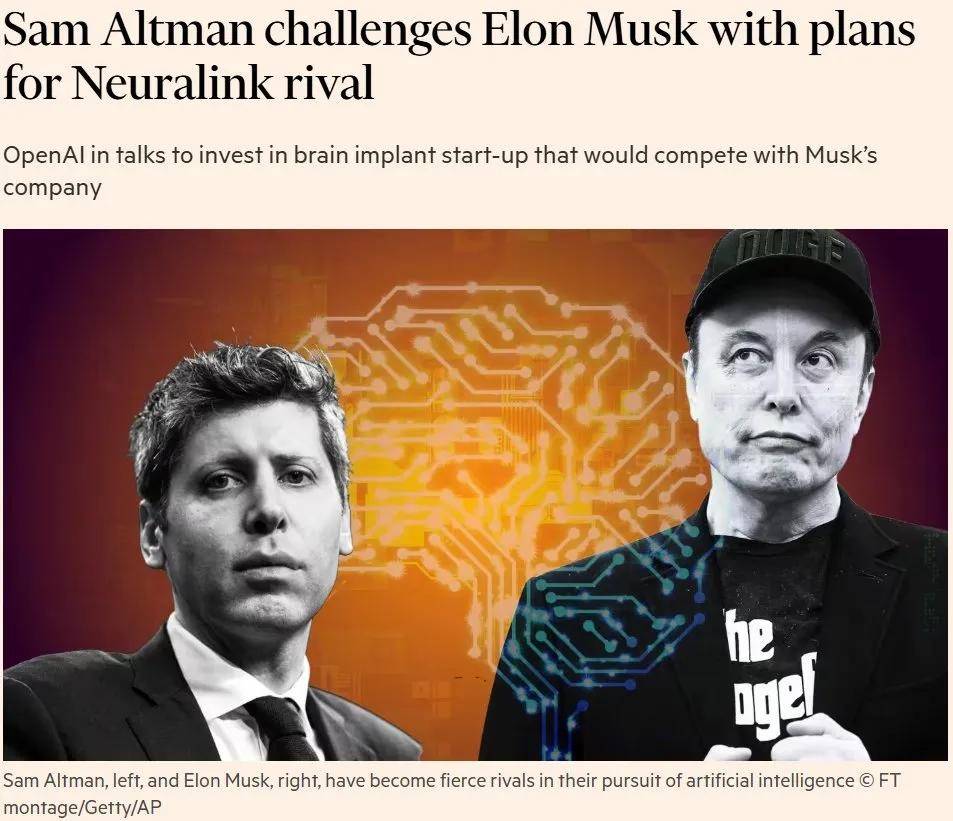
OpenAI和奥特曼将投资一家脑机接口公司,直接与马斯克的Neuralink竞争
机器之心· 2025-08-13 00:52
Core Viewpoint - Neuralink, a company representing the future of human-machine symbiosis, may face a strong challenger in Merge Labs, which aims to connect the human brain with computers, similar to Neuralink's goals [1][10]. Group 1: Investment and Competition - OpenAI, led by co-founder Sam Altman, is reportedly preparing to invest in Merge Labs, which is currently raising funds at a valuation of $850 million, with most of the new funding expected to come from OpenAI's venture capital team [5][10]. - Altman is encouraging this investment and will co-found Merge Labs, although he will not be involved in the day-to-day operations of the new project [5][10]. - Merge Labs plans to raise $250 million from OpenAI and other investors, with negotiations still in early stages [10]. Group 2: Neuralink's Position - Neuralink, founded by Elon Musk in 2016, is currently the leader in the brain-computer interface field and recently secured $650 million in funding, reaching a valuation of $9 billion [11][12]. - The company has successfully completed its 8th and 9th brain-computer interface surgeries, gaining significant attention for enabling high-level paraplegics to control devices [12]. Group 3: Broader Context and Developments - The field of brain-computer interfaces has seen a rise in young startups in Silicon Valley, indicating growing interest and competition in this technology [6]. - Altman has previously expressed optimism about the potential for high-bandwidth brain-computer interfaces to emerge soon, possibly as early as 2025 [7][9]. - In addition to Merge Labs, Altman is involved in other cutting-edge projects, including investments in nuclear fission and fusion initiatives [13].
可控核聚变成资本新宠 “人造太阳”商业化渐近
Zhong Guo Jing Ying Bao· 2025-08-08 19:55
Core Viewpoint - The controlled nuclear fusion industry, referred to as the "artificial sun," is becoming a focal point for capital investment, with significant funding and policy support driving its commercialization in China [3][4]. Investment Trends - Nova Fusion Energy Technology (Shanghai) Co., Ltd. completed a record angel round financing of 500 million yuan, marking a significant milestone for private nuclear fusion companies in China [3]. - China Fusion Energy Co., Ltd. received a total of 11.492 billion yuan in strategic investments from various state-owned enterprises and funds, indicating strong backing for the "national team" in nuclear fusion [3][5]. - The global nuclear fusion industry has seen explosive growth, with total investment rising from 1.9 billion USD in 2021 to 9.7 billion USD, and the number of fusion companies increasing from 23 to 53 [4]. Industry Structure - The nuclear fusion sector in China is characterized by a dual structure of "national team" and "private team," with significant investments flowing into both [3][5]. - The "national team" includes companies like China Fusion Energy and Fusion New Energy, which have received substantial capital support from state-owned enterprises and local governments [5]. - Private companies, while receiving less capital, have attracted investments from notable venture capital firms like Sequoia Capital and Kunlun Capital [5]. Technological Development - Various technological routes exist in nuclear fusion, with magnetic confinement being the most widely adopted globally, while the field-reversed configuration (FRC) is gaining attention for its cost-effectiveness [6]. - The majority of companies are focusing on the Tokamak route, while the U.S. exhibits a more diverse approach to technology development [6]. Policy Support - The Chinese government has increased its support for the nuclear fusion industry through various policies aimed at fostering innovation and commercialization [7]. - Local governments, such as those in Anhui and Sichuan, have also introduced strategic plans to accelerate the commercial application of fusion energy [7]. Commercialization Goals and Challenges - A report indicates that 35 companies globally expect to establish commercial fusion demonstration plants capable of net energy gain between 2030 and 2035 [8]. - Companies like Helion are already initiating construction of commercial fusion plants, with plans to supply power to major tech firms [8]. - Despite optimism, experts caution that significant technical and economic challenges remain before true commercialization can be achieved [9].
比尔盖茨、马云等超级富豪,原来他们都在投资核聚变商业化公司
Sou Hu Cai Jing· 2025-08-01 04:56
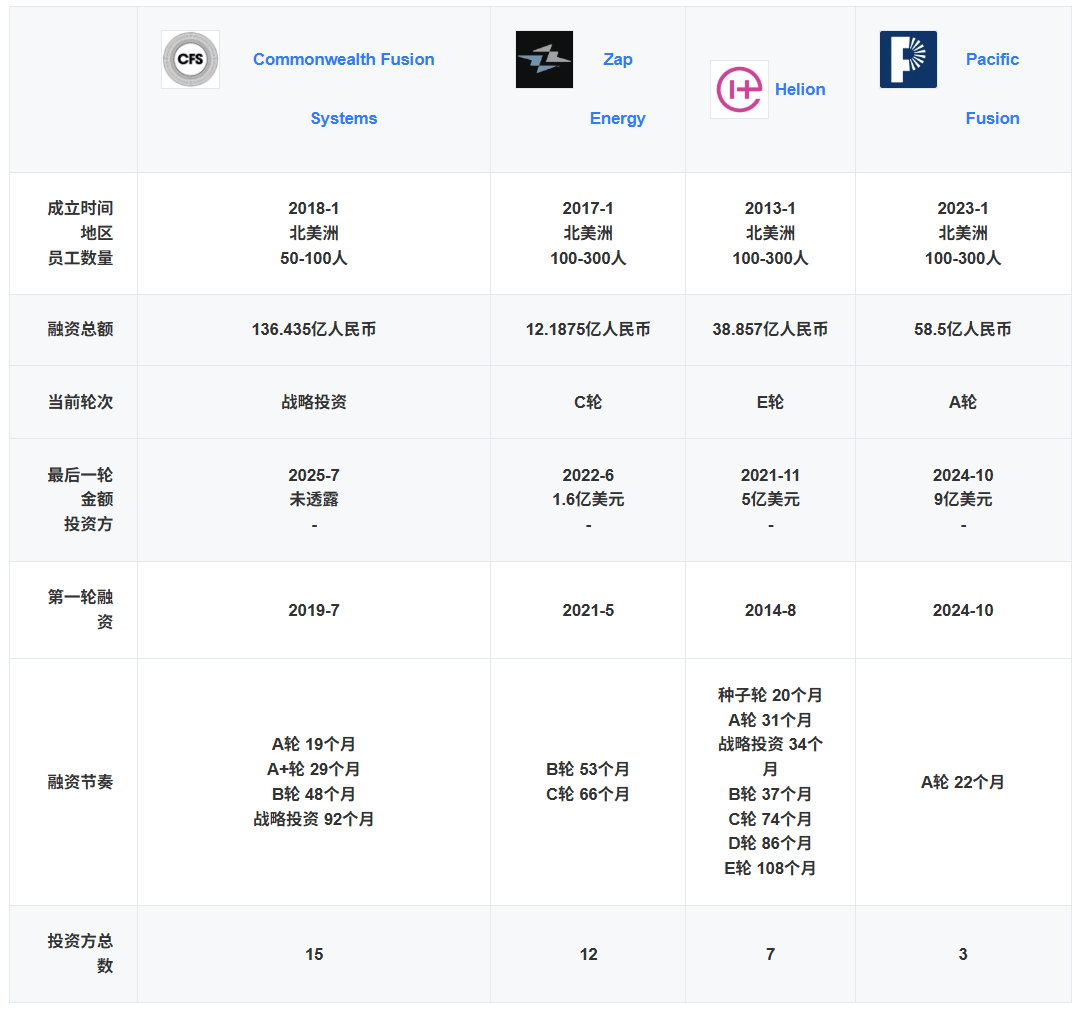
Core Insights - The article highlights the growing investment in nuclear fusion companies in China and the United States, with a total of over 100 billion RMB in funding for 12 domestic companies and approximately 26.9 billion RMB for 9 U.S. companies [1][2]. Domestic Investment Landscape - In China, nuclear fusion commercialization is in its early stages, with significant investments from state-owned enterprises, national funds, and local government capital [1]. - The total funding for domestic nuclear fusion companies has surpassed 100 billion RMB, indicating strong governmental and institutional support [1]. U.S. Nuclear Fusion Companies - The U.S. nuclear fusion sector is marked by 23 publicly disclosed investment events, with a total estimated funding of 26.9 billion RMB [1]. - Key players in the U.S. include Commonwealth Fusion Systems, Pacific Fusion, Helion, and Zap Energy, each securing over 1 billion RMB in funding [1][2]. Commonwealth Fusion Systems (CFS) - CFS, founded in 2018, focuses on commercializing nuclear fusion by leveraging decades of research from MIT [4]. - The company has raised over 2 billion USD, making it the most funded startup in the nuclear fusion sector, with notable investors including Tiger Global, Bill Gates, and Google [6]. Pacific Fusion - Established in 2023, Pacific Fusion has quickly attracted attention, securing 900 million USD in funding led by General Catalyst [9]. - The company focuses on pulse magnetic-driven inertial confinement fusion, utilizing advanced techniques to achieve fusion conditions [8]. Helion - Founded in 2013, Helion has raised approximately 570 million USD, with significant milestones including achieving plasma heating to 100 million degrees Celsius [10][11]. - The company is working on the Polaris project, which aims to demonstrate net electricity production from fusion [11]. Zap Energy - Zap Energy, established in 2017, has made significant progress in funding, completing a 160 million USD Series C round in 2022 [13]. - The company collaborates with Lawrence Livermore National Laboratory to advance its fusion technology [12]. Investment Trends - The article identifies active investors in the nuclear fusion space, including Lowercarbon Capital and Breakthrough Energy Ventures, both focused on climate change solutions [17][18]. - Lowercarbon Capital has made five investments in nuclear fusion companies, while Breakthrough Energy Ventures, founded by Bill Gates, has invested in multiple U.S. firms [17][18]. Global Investment Landscape - Other notable investors include Khosla Ventures, Starlight Ventures, Capricorn Investment Group, and Mithril Capital Management, all of which have shown interest in the nuclear fusion sector [19][21][22]. - Tencent has also participated in funding a European fusion technology company, First Light Fusion, indicating a broader interest in fusion technology beyond domestic investments [22].
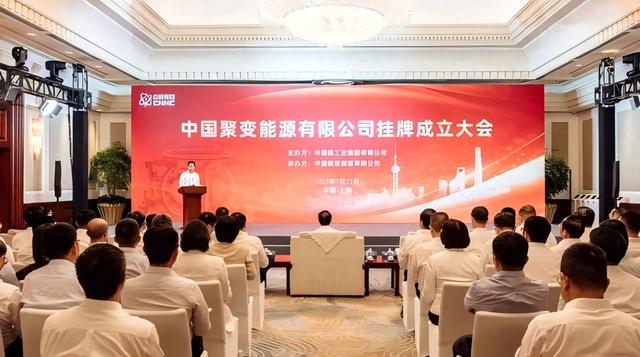
中国聚变能源有限公司正式挂牌成立,核聚变产业链投资升温
Tianfeng Securities· 2025-07-27 14:44
Investment Rating - Industry rating is "Outperform the Market" (maintained rating) [5] Core Insights - The establishment of China Fusion Energy Co., Ltd. marks a significant step in the domestic nuclear fusion industry, with a registered capital of 11.469 billion yuan. The company aims to transition nuclear fusion technology from research to engineering applications [1] - The global investment landscape in nuclear fusion is heating up, with the US and China leading in equity financing. As of July 2025, US fusion companies have attracted approximately $6.28 billion, while Chinese companies have secured around $2.79 billion [2] - Various companies are making substantial investments in nuclear fusion technology, including New Hope Group, which has invested about 4 billion yuan since 2017, and several startups collaborating with public channels for funding [2] Summary by Sections Section 1: Company Establishment - China Fusion Energy Co., Ltd. was officially established on July 22 in Shanghai, with significant backing from state-owned enterprises and private capital [1] - The company will focus on overall design, technology validation, and digital R&D, aiming to build a technology research platform and a capital operation platform [1] Section 2: Investment Trends - The report highlights a surge in investments in nuclear fusion, with notable contributions from both state-owned and private enterprises in China [2] - Key players in the US, such as Helion and Commonwealth Fusion Systems, have also secured significant funding, indicating a competitive landscape [2] Section 3: Recommended Companies - The report suggests monitoring several companies involved in the nuclear fusion supply chain, including: - Lianchuang Optoelectronics, a leading supplier of high-temperature superconducting magnets - Yongding Co., a major supplier of high-temperature superconducting strips - Guoguang Electric, which provides various components for controllable nuclear fusion devices [3]
可控核聚变行业专题:核聚变“黑马”FRC,关注半导体开关产业趋势
Huaan Securities· 2025-07-23 12:59
Investment Rating - The report suggests a positive outlook for the controllable nuclear fusion industry, particularly focusing on the FRC (Field-reversed Configuration) technology path, which is expected to lead to commercial viability sooner than other methods [5][10]. Core Insights - FRC technology is highlighted as a "dark horse" in the nuclear fusion sector due to its simpler structure and lower costs, making it more likely to achieve commercialization first [10][13]. - The report emphasizes the importance of semiconductor switches in the power systems of FRC devices, which are crucial for stable operation and energy recovery [5][31]. - Investment opportunities are identified in companies that are leading in technology and have established core customer relationships, particularly in the context of the rising domestic fusion industry [7][14]. Summary by Sections Short-term Opportunities - Domestic startups like Nova Fusion, Xingneng Xuanguang, and Hanhai Fusion are rapidly emerging, increasing investment demand for core components such as vacuum switches and capacitors [7]. - Key companies benefiting from this trend include Xuguang Electronics, Guoguang Electric, Wangzi New Materials, and Shengye Electric [7]. Long-term Prospects - Helion is projected to be the first company to achieve commercial fusion power sales, with plans to provide 50MW of fusion power to Microsoft by 2028 [7]. - Helion's technology combines FRC with a magnetic energy recovery system, enhancing efficiency and reducing costs [7]. - The report notes that semiconductor switches are expected to have a longer lifespan and higher reliability, making them essential for large drivers in the future [7][35]. Industry Trends - The report discusses the increasing number of startups focusing on FRC technology, indicating a growing market interest and investment [14]. - The semiconductor switch technology is identified as a key trend for large driver applications, with advantages over traditional gas switches [35][37]. Relevant Companies - Sijingt Technology (0580.HK) has secured orders for pulse power switches from TAE, a leading US fusion company, indicating its strong position in the market [39][42]. - Hongwei Technology is recognized as a leading domestic semiconductor power device company, with expectations of turning profitable by 2025 [53]. - Xuguang Electronics is noted for its strategic partnership with Hanhai Fusion, enhancing its position in the nuclear fusion sector [57].


核聚变系列(02):瀚海聚能点亮仪式开启,FRC路线持续推进
Minsheng Securities· 2025-07-20 08:46
Investment Rating - The report maintains a "Recommended" rating for the nuclear fusion industry, indicating a potential stock price increase of over 15% relative to the benchmark index within the next 12 months [4]. Core Insights - The successful plasma ignition of the HHMAX-901 device by Hanhai Fusion marks a significant breakthrough in China's commercial exploration of controlled nuclear fusion, particularly in the field-reversed configuration (FRC) technology [1][2]. - FRC technology is gaining attention due to its simpler system structure and lower costs, positioning it as a frontrunner for commercialization in the nuclear fusion sector [1]. - The report suggests that the commercialization of the nuclear fusion industry is accelerating, urging continued attention to the sector's catalysts [3]. Summary by Sections Event Highlights - On July 18, Hanhai Fusion successfully conducted the plasma ignition ceremony for its HHMAX-901 device, representing a major milestone in the commercial application of nuclear fusion technology in China [1]. - The FRC technology, which Hanhai Fusion focuses on, is characterized by its ability to create a closed magnetic field through reverse current, forming a self-organizing magnetic structure [1]. Company Developments - Hanhai Fusion's HHMAX-901 project began in June 2024, with significant progress made in physical design and engineering, culminating in the successful ignition of plasma [2]. - The company plans to leverage the HHMAX-901 as a platform to advance research in controllable nuclear fusion technology and accelerate breakthroughs in core components [2]. Investment Recommendations - The report recommends focusing on companies involved in vacuum chambers, high-power electronic tubes, superconductors, and capacitors, including Guoguang Electric, Xuguang Electronics, and Yongding Co., among others [3].
永赢制造升级智选混合发起A,永赢制造升级智选混合发起C: 永赢制造升级智选混合型发起式证券投资基金2025年第2季度报告
Zheng Quan Zhi Xing· 2025-07-14 02:35
Fund Overview - The fund is named Yongying Manufacturing Upgrade Smart Mixed Initiating Fund, with a main code of 024202, and it operates as a contractual open-end fund [4] - The fund aims to invest in assets related to the theme of manufacturing upgrades, striving for medium to long-term stable appreciation of net asset value while controlling risks [4] - The fund's investment strategies include macroeconomic research, asset allocation strategies, stock investment strategies, fixed income investment strategies, and various bond investment strategies [4] Performance Metrics - As of the end of the reporting period, the total fund shares amounted to 17,444,653.67 shares [4] - The net value growth rate for the fund's Class A shares was -2.76%, while the benchmark return was 2.52% [12] - The net value growth rate for the fund's Class C shares was -2.79%, with the same benchmark return of 2.52% [12] Investment Composition - The fund's total assets primarily consist of stocks, with a fair value of approximately 15,465,487.43 RMB, accounting for 90.66% of the total assets [13] - The manufacturing sector represents the largest portion of the fund's investments, with a fair value of 14,201,090.62 RMB, making up 83.73% of the fund's net asset value [13] - The fund has also invested in the construction industry, with a fair value of 987,392.00 RMB, representing 5.82% of the net asset value [13] Market Insights - The fund manager highlights the increasing focus on controllable nuclear fusion, with significant investments expected in the range of 150-200 billion RMB annually during the 14th Five-Year Plan period [9] - The potential for nuclear fusion to replace traditional energy sources like coal and solar power is emphasized, indicating a future market expansion that could yield substantial returns for investors [9] - Partnerships between tech companies and nuclear fusion firms are noted, suggesting a growing interest in stable energy sources for cloud computing [10][11]