
华润三九

Search documents
中药行业框架
Changjiang Securities· 2025-09-29 12:42
Investment Rating - The report assigns an investment rating of "Positive" for the traditional Chinese medicine (TCM) industry, indicating an optimistic outlook for the sector over the next 12 months [6]. Core Insights - The TCM industry is experiencing a resurgence due to supportive government policies aimed at promoting its development and modernization. The report highlights the importance of innovation in TCM as a key driver for high-quality growth [24][61]. - The industry is characterized by a comprehensive supply chain, from raw material production to manufacturing and distribution, with significant opportunities for growth in both domestic and international markets [19][28]. Summary by Sections 1. TCM Industry Overview - TCM is defined as medicines guided by traditional Chinese medical theories, primarily sourced from natural products, including plant, animal, and mineral-based drugs. It is categorized into five main types: raw materials, decoction pieces, formula granules, proprietary Chinese medicines, and injectable TCM [12][13]. - The historical development of TCM has undergone three major phases, including skepticism during the introduction of Western medicine, a resurgence in the 21st century, and recent government initiatives to modernize and industrialize TCM [15][16]. 2. TCM Policy Analysis - The overall policy direction is supportive, with multiple government documents issued to encourage the high-quality development of the TCM industry. Key policies include the "Opinions on Promoting the Inheritance and Innovation of TCM" and various local measures [24][28]. - Policies cover supply-side improvements, such as optimizing TCM registration and approval processes, enhancing talent training, and building TCM hospitals [28][32]. - Payment reforms are also underway, exploring payment methods that align with TCM characteristics, which could enhance the financial viability of TCM services [45][46]. 3. Future Development Trends - Innovation in TCM is identified as a critical factor for future growth, with a focus on developing new formulations and improving the sustainability of TCM resources [61][63]. - TCM is positioned to become a significant player in the broader health and wellness market, emphasizing preventive care and holistic health approaches [66].
上市公司“存款搬家”?多元化理财方式逐渐受青睐
Zheng Quan Shi Bao· 2025-09-29 11:59
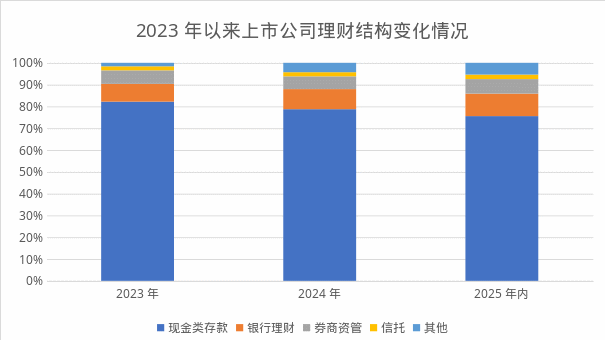
Core Insights - The phenomenon of "deposit migration" among residents and enterprises is gaining attention due to the continuous decline in deposit interest rates and the advantages of wealth management products [1][8] - There is a noticeable trend of decreasing investment in wealth management products by listed companies, with a significant drop in cash deposits [1][4] Group 1: Deposit Migration - In August, new resident deposits decreased by 600 billion yuan year-on-year, marking a continuous negative growth for two months, while non-bank deposits increased by 5.5 billion yuan [1] - The "seesaw effect" between resident and non-bank deposits highlights the ongoing discussions around the "deposit migration" phenomenon [1] Group 2: Decline in Wealth Management Scale - As of September 26, 2023, 1,095 listed companies held a total of 12,395 wealth management products, with a subscription amount of 779 billion yuan, a year-on-year decrease of 13.04% [2] - The subscription amounts for wealth management products in 2023 and 2024 are projected to be 1,295.49 billion yuan and 1,216.66 billion yuan, respectively, indicating a downward trend [2] Group 3: Changes in Wealth Management Structure - Despite the overall decline in wealth management scale, the structure is becoming more diversified, with a growing preference for products linked to bonds, equities, and mixed assets [4][8] - The subscription amount for securities company wealth management products has reached 52.02 billion yuan, a year-on-year increase of 7.74% [4] Group 4: Factors Influencing the Shift - The decline in wealth management scale is attributed to strict controls on fund turnover and the limitations on bank structured deposits [3] - The low efficiency of traditional deposit models, influenced by declining interest rates, has led companies to seek more effective asset allocation strategies [7][8] Group 5: Increased Interest in Direct Securities Investment - Over 70 listed companies have announced plans to use idle funds for securities investment, indicating a shift towards direct investment as a means to enhance fund utilization and profitability [9] - The trend towards professionalization and diversification in the wealth management market is expected to continue, with companies dynamically adjusting their fund allocations [9]



上市公司“存款搬家”?多元化理财方式逐渐受青睐
证券时报· 2025-09-29 11:55
Core Viewpoint - The phenomenon of "deposit migration" among residents and enterprises is increasingly prominent due to the continuous decline in deposit interest rates and the advantages of wealth management products [1][2]. Group 1: Deposit Migration Trends - In August, new resident deposits decreased by 600 billion yuan year-on-year, totaling 1.1 trillion yuan, marking two consecutive months of negative growth [2]. - Non-bank deposits increased by 11.8 trillion yuan, up 5.5 trillion yuan year-on-year, highlighting the "seesaw" effect between resident and non-bank deposits [2]. - The trend of asset allocation is reflected in listed companies' preferences for wealth management, with a noticeable decline in the amount spent on wealth management products and cash deposits [2]. Group 2: Decline in Listed Companies' Wealth Management Scale - As of September 26, 2023, 1,095 listed companies held 12,395 wealth management products with a total subscription amount of 779 billion yuan, a decrease of 13.04% compared to the same period last year [4]. - The subscription amount for structured deposits decreased by nearly 100 billion yuan year-on-year, with a decline of 16.78%, while the amount for fixed-term deposits fell by over 150 billion yuan, down 37.29% [4][5]. Group 3: Reasons for Decline in Wealth Management Scale - The decline in wealth management scale is attributed to strict controls on idle funds and the management of bank structured deposit quotas [5]. - The shift in focus towards market-oriented wealth management reflects a reallocation of financial resources in response to the low-interest-rate environment [9][10]. Group 4: Diversification of Wealth Management Structure - Despite the overall decline in wealth management scale, the structure is evolving towards diversification, with an increasing preference for products linked to bonds, equities, and mixed assets [6][10]. - The subscription amount for securities company wealth management products increased by 7.74% year-on-year, while investments in other financial products also saw growth [6]. Group 5: Increased Interest in Direct Securities Investment - Since the A-share market's recovery, over 70 listed companies have announced plans to use idle funds for securities investment, aiming to enhance fund utilization and profitability [11][12]. - The shift towards securities investment is driven by the need for better returns in a low-interest-rate environment, with companies seeking to optimize their asset allocation [11][12].

政策引领,药企加码,国产创新药持续爆发
Quan Jing Wang· 2025-09-29 11:47
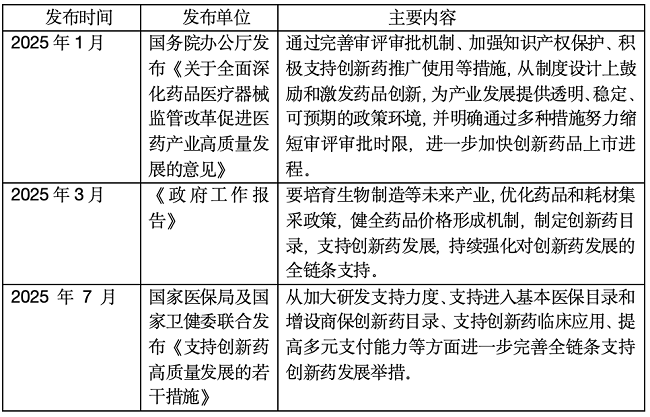
Group 1 - 2025 marks a significant year for the development of innovative drugs in China, with 43 innovative drugs approved in the first half, 40 of which are developed by domestic companies [1] - The National Medical Products Administration (NMPA) has approved a total of 210 innovative drugs and 269 innovative medical devices during the 14th Five-Year Plan period, indicating a trend of accelerated growth [1] - Continuous policy support from the government has provided a strong impetus for the development of innovative drugs, creating a transparent and stable policy environment [2][3] Group 2 - Companies like China Resources Sanjiu have adopted a "brand + innovation" dual-drive strategy, significantly increasing their focus on innovation in response to national policies and market demands [3] - China Resources Sanjiu reported obtaining 8 drug registration certificates and has 205 ongoing research projects, covering various fields including cardiovascular and oncology [3] - Other notable companies in the innovative drug sector include Teva Pharmaceutical, Tai Chi Group, and Yiling Pharmaceutical, all of which are enhancing their competitiveness through increased R&D investment and talent acquisition [4][5] Group 3 - The number of innovative traditional Chinese medicine (TCM) drugs is on the rise, with 5 TCM innovative drugs approved in the first half of 2025, reflecting a growing trend in this sector [5] - As of July 31, 2025, there are 147 TCM innovative drugs in clinical stages or above, a threefold increase compared to 2020, indicating a significant expansion in TCM innovation [5] - The Chinese innovative drug industry has made remarkable breakthroughs in quantity, quality, and technology over the past decade, entering a new development phase with promising future prospects [5]


财说|连续并购后遗症,华润医药增收不增利
Xin Lang Cai Jing· 2025-09-28 23:37
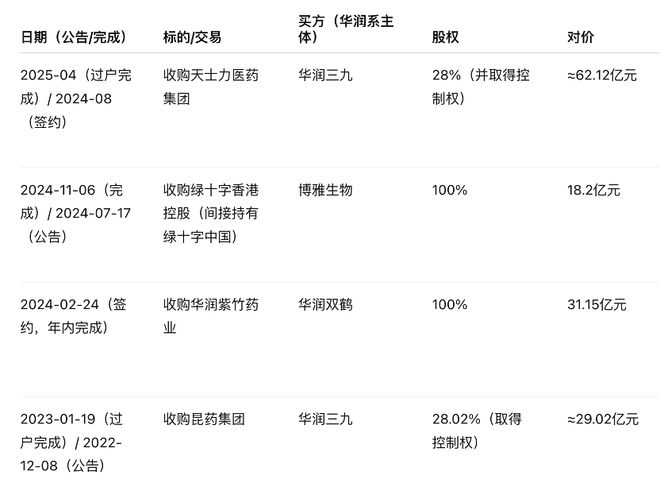
Core Viewpoint - The overall performance of China Resources Pharmaceutical Group (华润医药) has been negatively impacted by external acquisitions, leading to a significant decline in net profit despite a slight increase in revenue [1][2]. Financial Performance - In the first half of the year, the company reported total revenue of 131.87 billion yuan, a year-on-year increase of 2.50%, while net profit attributable to shareholders was 2.08 billion yuan, down 20.30% year-on-year [1][2]. - The core distribution business achieved revenue of 108.33 billion yuan, up 2.30% year-on-year, while the pharmaceutical segment generated 24.81 billion yuan, up 4.30% year-on-year, and the retail segment saw revenue of 5.52 billion yuan, up 11.40% year-on-year [1]. Acquisition Impact - The company has engaged in several acquisitions, including the purchase of 100% equity in Green Cross Hong Kong for 1.82 billion yuan and a 28% stake in Tianjin Tasly Pharmaceutical for 6.21 billion yuan, with total expenditures exceeding 8 billion yuan [3][4]. - These acquisitions have led to a rapid increase in goodwill, with the goodwill balance rising to 24.29 billion yuan, an increase of 1.93 billion yuan from the beginning of the year [5]. Profitability Challenges - The decline in profit is attributed to one-time impairment losses and rigid expenses, with net losses from other income and expenses amounting to -1.09 billion yuan, including approximately 392 million yuan in equity impairment losses and 609 million yuan in trade receivables impairment provisions [2]. - The retail segment's gross margin decreased to 6.10%, down 0.40 percentage points year-on-year, highlighting the impact of increased specialty drug proportions on profit margins [1]. Strategic Initiatives - The company is pushing for deeper channel penetration and has implemented electronic prescription access in 187 dual-channel pharmacies, enhancing traceability and compliance with new regulations [7]. - The DTP specialty pharmacy segment generated revenue of 3.76 billion yuan, reflecting a year-on-year growth of 14.10%, with the number of managed specialty drug patients reaching 820,000 [8]. Future Outlook - The company is expanding its logistics network, planning to build or expand 11 provincial logistics hubs by 2030, with a total investment of 5.5 billion yuan [8]. - The collaboration with Haohai Biological Technology in the medical beauty sector aims to leverage the company's distribution network, although it faces challenges due to regulatory requirements for medical devices [9][11].

2025Q3医药业绩前瞻
2025-09-28 14:57
Summary of the Conference Call on the Pharmaceutical Industry Industry Overview - The pharmaceutical industry is currently experiencing a period of adjustment, particularly in the innovative drug sector, with leading companies like Innovent Biologics and China National Pharmaceutical Group showing stable fundamentals and product progress meeting expectations [1][4] - The overall sentiment in the pharmaceutical sector remains optimistic despite recent market fluctuations, with no signs of a bubble [2] Key Points and Arguments Innovative Drug Sector - The innovative drug sector is undergoing a rational adjustment, with a focus on companies that can deliver strong performance [3] - The 11th round of national drug procurement is expected to yield positive results, with local alliance procurement rules becoming more reasonable, potentially leading to a reversal in the generics sector [3][20] - Companies such as Kanglong Chemical, Baidu Pharmaceutical, Tianyu Co., and Betta Pharmaceuticals are projected to see significant revenue growth [3][24] Medical Device Sector - The medical device sector is benefiting from a reduction in competitive pressures, particularly in high-value consumables like Nanwei Medical and Xinmai Medical, which have not yet faced centralized procurement [5] - The orthopedic industry is recovering from previous procurement pressures, with companies like Chunli Aikang showing strong performance [5] - Companies focused on domestic bidding markets, such as Mindray and Kaili Medical, are expected to benefit from this trend [5] Customized Consumables - The customized consumables sector is performing well, with Yingke Medical exceeding profit expectations in Q2 and extending order schedules into Q3, indicating a recovery in end-user demand [6] IVD Sector - The IVD sector is under pressure due to policy changes and tax rate adjustments, but the bottom has been solidified, with companies like Mindray and New Industries showing strong overseas export performance [7] Traditional Chinese Medicine - Recommended companies in the traditional Chinese medicine sector include Jiuzhitang, Kangyuan Pharmaceutical, and China Resources Sanjiu, with Jiuzhitang showing significant potential in its stem cell pipeline [8] API Sector - The API sector is expected to benefit from anti-involution policies, leading to a new round of supply-side reforms [1][15] - Companies like Tianyu Co. are experiencing rapid capacity utilization increases, with projected profits exceeding 300 million yuan [15][18] Additional Insights - The blood products sector is facing pressure but is nearing a stabilization point, with new developments in high-purity products expected to create investment opportunities [22] - The raw material industry is anticipated to see long-term improvements due to government policies aimed at reducing chaotic price competition [15][18] - New delivery systems and commercialization scenarios in the pharmaceutical industry, such as Minophagen's GLP-1 delivery system, are gaining attention and providing more investment opportunities [17] Conclusion - The pharmaceutical industry, particularly the innovative drug and medical device sectors, presents a range of investment opportunities despite current market challenges. Companies with strong fundamentals and innovative pipelines are likely to perform well in the coming quarters [1][2][3][4][5][6][7][8][15][18][22]
消费健康行业格局迭代,解码华润三九韧性成长的底层逻辑
Xin Lang Cai Jing· 2025-09-28 02:43
Core Insights - The consumption health industry is currently experiencing a short-term adjustment due to a complex economic environment and ongoing reforms in procurement and medical insurance payment methods, but the long-term growth logic remains solid [1][2] - The Chinese consumption health market is expected to continue expanding, with significant policy support and increasing consumer demand for OTC drugs and personal care products [1][3] Industry Overview - The Chinese life and health industry grew from 68.3 trillion yuan to 100.3 trillion yuan from 2018 to 2023, with projections to reach 160 trillion yuan by 2030, while the consumption health industry increased from approximately 660.3 billion yuan to about 931.4 billion yuan, with an average annual growth rate of 7% [2] - The adjustment in the Chinese medicine sector has led to increased performance disparities among companies, with leading firms benefiting from brand and channel advantages while smaller firms face profit declines [2][5] Policy and Demand Drivers - The government's emphasis on building a hierarchical medical system and promoting self-care is expected to stimulate market demand for OTC products [1][3] - Consumer health awareness is rising, driven by an aging population and the emergence of younger consumers, leading to increased spending on healthcare [3] Company Performance and Strategies - Leading companies like China Resources Sanjiu are demonstrating resilience during the industry adjustment, with reported revenue growth despite challenges [5][6] - China Resources Sanjiu's CHC (Consumer Health Care) business is a core strength that helps it navigate industry fluctuations, supported by a strong brand portfolio [6][8] Market Trends and Innovations - The integration of "Internet + healthcare" is driving digital sales channel upgrades, with online pharmacy sales reaching 66.3 billion yuan in 2023, reflecting a compound annual growth rate of 45.5% from 2018 to 2023 [3][7] - The industry is shifting towards a competitive landscape that emphasizes a combination of products and services, moving beyond simple product competition [5][8] Future Outlook - The industry is entering a deep reshuffling phase, with leading firms expected to maintain steady growth through brand barriers, channel advantages, and innovation [2][8] - China Resources Sanjiu is increasing its R&D investment, with a reported 68.99% year-on-year increase, and has numerous projects in the pipeline to support future growth [8][9]
华润集团旗下中药上市公司携手紫荆文化发起“中医药文化共链倡议”
Zheng Quan Ri Bao· 2025-09-26 14:07
Core Points - The 2025 Hong Kong International Traditional Chinese Medicine Conference opened on September 25, focusing on the theme "Revitalizing Traditional Medicine for the Benefit of Human Health" [1] - The conference attracted over 130 well-known enterprises and institutions from countries involved in the Belt and Road Initiative, showcasing the global interest in traditional Chinese medicine [1] Company Highlights - Five listed Chinese medicine companies, including China Resources Sanjiu, Tianshi, and Kunming Pharmaceutical Group, collaborated with Zijing Culture to launch the "Traditional Chinese Medicine Culture Co-Link Initiative" [1] - The companies presented the "Traditional Chinese Medicine Culture" blue book and shared achievements in industry chain construction, highlighting their commitment to the development of traditional Chinese medicine [1] Industry Insights - The conference provided a platform for the Chinese medicine industry to gain domestic and international recognition for its achievements in industry chain construction [1] - The initiative aims to promote traditional Chinese medicine from being a "Chinese treasure" to a "global shared resource," contributing Chinese wisdom and solutions to global health [1]


中药板块9月26日跌0.38%,维康药业领跌,主力资金净流出2.98亿元
Zheng Xing Xing Ye Ri Bao· 2025-09-26 08:42
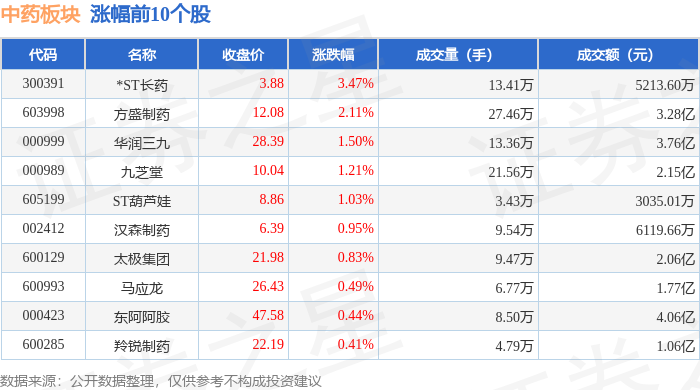
Market Overview - On September 26, the Traditional Chinese Medicine (TCM) sector declined by 0.38%, with Weikang Pharmaceutical leading the drop [1] - The Shanghai Composite Index closed at 3828.11, down 0.65%, while the Shenzhen Component Index closed at 13209.0, down 1.76% [1] Stock Performance - Notable gainers in the TCM sector included: - *ST Changyao: Closed at 3.88, up 3.47% with a trading volume of 134,100 shares [1] - Fangsheng Pharmaceutical: Closed at 12.08, up 2.11% with a trading volume of 274,600 shares [1] - Huaren Sanjiu: Closed at 28.39, up 1.50% with a trading volume of 133,600 shares [1] - Major decliners included: - Weikang Pharmaceutical: Closed at 23.66, down 6.30% with a trading volume of 81,000 shares [2] - Zhendong Pharmaceutical: Closed at 6.57, down 4.09% with a trading volume of 518,000 shares [2] - Zhongsheng Pharmaceutical: Closed at 17.00, down 2.41% with a trading volume of 295,000 shares [2] Capital Flow - The TCM sector experienced a net outflow of 298 million yuan from institutional investors, while retail investors saw a net inflow of 396 million yuan [2] - Key stocks with significant capital flow included: - Huaren Sanjiu: Net inflow of 44.98 million yuan from institutional investors [3] - Fangsheng Pharmaceutical: Net inflow of 33.39 million yuan from institutional investors [3] - Dong'e Ejiao: Net inflow of 32.19 million yuan from institutional investors [3]



博瑞医药净利骤降近84%股价跌39% 袁建栋低价包揽5亿定增浮盈10亿
Chang Jiang Shang Bao· 2025-09-26 01:25
Core Viewpoint - The stock price of Borui Pharmaceutical (688166.SH) has experienced significant volatility, with a cumulative decline of 70% over 30 trading days, leading to a market capitalization loss of over 18.2 billion yuan [1][2]. Stock Performance - From August 26, the stock entered a downward trend, with a decline exceeding 39% by September 25 [1][2]. - Prior to this decline, the stock had surged by 95% from July 11 to August 25 [3]. Financial Performance - For the first half of 2025, Borui Pharmaceutical reported revenue of 537 million yuan, a year-on-year decrease of 18.28%, and a net profit of 17.17 million yuan, down 83.85% year-on-year [4]. - The decline in performance is attributed to changes in flu trends and competitive dynamics affecting the demand and pricing of antiviral products [4]. Capital Raising and Shareholder Actions - On August 12, the company announced a private placement of shares, with the controlling shareholder, Chairman Yuan Jiandong, fully subscribing to 500 million yuan, aimed at supplementing liquidity and repaying bank loans [1][7]. - The placement price was set at 22.36 yuan per share, and based on the closing price of 66.41 yuan on September 25, Yuan Jiandong realized a paper profit of nearly 1 billion yuan [8]. Clinical Development and Partnerships - Borui Pharmaceutical has engaged in a partnership with China Resources Sanjiu for the BGM0504 injection project, which is a significant innovation aimed at treating metabolic diseases [6]. - The BGM0504 injection is currently in Phase III clinical trials for type 2 diabetes and weight loss, with the oral version also under development [7].
