娃哈哈

Search documents
上半年毛利率失守!芒果汁低价运行,田野股份押注荔枝汁和橙汁
Bei Ke Cai Jing· 2025-08-22 13:52
Group 1 - The core viewpoint of the article highlights the financial performance of Tianye Co., Ltd. for the first half of 2025, showing a revenue increase but a significant decline in net profit [1][2]. - In the first half of 2025, Tianye Co., Ltd. achieved an operating income of approximately 266 million yuan, representing a year-on-year growth of 12.73% [1]. - The net profit attributable to shareholders was approximately 16.37 million yuan, reflecting a year-on-year decrease of 38.80% [1]. - The net cash flow from operating activities was approximately 22.40 million yuan, which is a year-on-year increase of 14.29% [1]. Group 2 - As of June 30, 2025, Tianye Co., Ltd. had total assets of 1.648 billion yuan, an increase of 4.53% from the beginning of the year [2]. - The total liabilities were 437 million yuan, which is a 14.43% increase compared to the beginning of the year [2]. - The equity attributable to the parent company was 1.211 billion yuan, reflecting a growth of 1.37% from the beginning of the year [2]. Group 3 - Tianye Co., Ltd. primarily engages in the research, production, and sales of tropical fruit and vegetable products, including raw fruit juice, frozen fruits and vegetables, and fresh fruits [2]. - The company has four modern factories located in key tropical fruit and vegetable production areas in China, including Beihai, Hainan, Panzhihua, and Jingmen [2]. - Tianye Co., Ltd. serves major B-end clients, including well-known companies such as Nayuki Tea and Coca-Cola, but faces significant operational pressure due to declining PPI [3]. - The company's gross profit margin for the reporting period was 20.68%, down from 25.64% in the same period last year, primarily due to low pricing for its flagship mango juice product [3]. - To cope with intense market competition, the company is optimizing its product and customer structure, increasing the production of lychee juice, and expanding its orange juice business [3].
500亿,浙江父女去IPO敲钟了
3 6 Ke· 2025-08-22 08:35
Core Viewpoint - Wolong Electric Drive has submitted its prospectus to the Hong Kong Stock Exchange for a dual listing, aiming to leverage its recent stock price surge and significant market capitalization of nearly 50 billion RMB [1][4]. Company Background - Founded by Chen Jiancheng in 1984, Wolong Electric Drive has grown from a small factory in Shaoxing, Zhejiang, to a leading domestic electric motor manufacturer, with a current market value of approximately 50 billion RMB [2][4]. - Chen Jiancheng's daughter, Chen Yanni, joined the company in 2007 after studying abroad and has gradually taken over leadership roles, now serving as the chairman of Wolong Holding Group [2][4]. Financial Performance - Wolong Electric Drive's revenue for 2022, 2023, and 2024 is projected to be 14.27 billion RMB, 15.57 billion RMB, and 16.25 billion RMB, respectively, with profits of 839 million RMB, 553 million RMB, and 832 million RMB [8][9]. - The company has seen its stock price double within the year, reflecting strong market performance [4]. Business Segments - The company specializes in electric drive systems, offering solutions across five core areas: explosion-proof systems, industrial systems, HVAC systems, new energy transportation systems, and robotics [6][8]. - Wolong Electric Drive ranks first in the global market for explosion-proof electric drive systems with a market share of approximately 4.5% [8]. Strategic Acquisitions - Under the leadership of Chen Jiancheng and Chen Yanni, Wolong Electric Drive has made several strategic acquisitions, including companies in Italy and the United States, expanding its global footprint [4][10]. - The company is focusing on the robotics sector, with revenue from robotics components projected to grow, although it remains in the early stages of commercialization [11][12]. Market Position - Wolong Electric Drive's core business segments contribute nearly 90% of its revenue, but growth in these areas has shown signs of slowing down [8][9]. - The company is positioning itself for future growth by investing in emerging fields such as electric aviation and robotics [11].


500亿,浙江父女去IPO敲钟了
投资界· 2025-08-22 07:22
Core Viewpoint - Wolong Electric Drive has submitted its prospectus to the Hong Kong Stock Exchange for a dual listing, aiming to leverage its recent stock price surge and significant market capitalization of nearly 50 billion RMB [4][8]. Company Background - Founded by Chen Jiancheng in 1984, Wolong Electric Drive started from a small factory and has grown into a leading domestic electric motor manufacturer, with a current market value of approximately 50 billion RMB [4][6]. - Chen Jiancheng's daughter, Chen Yanni, joined the company in 2007 after studying abroad and has gradually taken over leadership roles, currently serving as the chairwoman of Wolong Holding Group [7][8]. Business Operations - Wolong Electric Drive specializes in electric drive system products and solutions, focusing on five core segments: explosion-proof electric drive systems, industrial electric drive systems, HVAC electric drive systems, new energy transportation electric drive systems, and robotic components [10][13]. - The company ranks first in the global market for explosion-proof electric drive systems with a market share of approximately 4.5% and ranks fourth in industrial electric drive systems with a 2.8% market share [13]. Financial Performance - The company's revenue for 2022 was 14.27 billion RMB, with profits of 839 million RMB. Projections for 2023 and 2024 indicate revenues of 15.57 billion RMB and 16.25 billion RMB, respectively [13][14]. - The first half of 2025 showed a revenue of 8.03 billion RMB, reflecting a year-on-year growth of 0.66%, while profits increased by 33.96% to 54.8 million RMB [13][14]. Strategic Developments - Wolong Electric Drive is focusing on expanding its business in emerging fields, particularly in robotics and electric aviation, as indicated in its IPO fundraising plans [16]. - The company has made strategic investments in robotics, including becoming a strategic shareholder in ZhiYuan Robotics and holding shares in YuShu Technology, positioning itself as a key supplier of critical components [15][16].

软饮料行业深度:后来居上,中国软饮料巨头的平台化之路-东吴证券
Sou Hu Cai Jing· 2025-08-22 02:34
Industry Overview - The report focuses on the development of the Chinese soft drink industry, outlining its history, current status, and future trends, while providing investment recommendations [1]. - The industry has gone through three stages: the carbonated beverage-dominated phase before the mid-1990s, the diversified growth phase from 1995 to 2014, and the structural growth phase from 2015 to the present [1][18]. Current Market Dynamics - The current competition in the industry is intense, with traditional leaders showing significant advantages while new entrants are also making breakthroughs [1]. - Leaders in the market are building competitive moats through "big product iteration + penetration into segmented scenarios," with billion-yuan products being a crucial threshold for leading players in niche markets [1][37]. - The growth rates for bottled water, tea beverages, and energy drinks are strong, with varying levels of market concentration across different segments [1][6]. Future Trends - The future trend in the industry is towards health and functionality, with bottled water's packaging rate expected to rise from 14.4% in 2023 to 18.9% by 2028, indicating a clear long-term growth logic [6][49]. - The penetration rate for sugar-free tea products has significant room for improvement, with the billion-yuan product "Oriental Leaf" leading the charge [6][49]. - Energy drinks, particularly "Dongpeng Special Drink," are experiencing domestic growth and plan to expand into Southeast Asia, while electrolyte water is expected to see increased market opportunities in lower-tier cities [6][49]. - Emerging categories such as coconut water and sparkling water are gaining popularity, driven by their natural health attributes and innovative differentiation [6][49]. Investment Recommendations - The report recommends investing in Dongpeng Beverage and Nongfu Spring, while also suggesting attention to China Resources Beverage and IFBH [7]. - The main investment theme is to focus on high-growth segments and leaders with strong billion-yuan product capabilities, as the industry continues to evolve towards health and functionality [7].




宗馥莉反击,娃哈哈天猫改名!18亿美元冻结后,她用10亿投资回应
Sou Hu Cai Jing· 2025-08-21 22:07
Core Viewpoint - The article discusses the strategic transformation of Wahaha under the leadership of Zong Fuli, highlighting her efforts to distance the brand from previous management and her ambitious plans for future growth amidst significant challenges [1][3][10]. Group 1: Store Name Change and Strategic Shift - Wahaha's Tmall flagship store has been renamed from "Wahaha Flagship Store" to "Tongyuan Kang Food Specialty Store," indicating a significant business separation [1]. - Zong Fuli's decision to abandon the original flagship store, which had over 600,000 followers, reflects her determination to rebuild Wahaha's image from scratch [3]. - The phrase "cooperation relationship terminated" from customer service hints at a deeper underlying conflict with former management [3]. Group 2: Major Investment in Xi'an - Following a court injunction, Hongsheng Beverage Group announced plans to invest 1 billion yuan in a new super factory in Xi'an, marking Zong Fuli's boldest investment move since taking over [7][8]. - The factory will cover an area equivalent to 11 football fields and will include production lines, warehouses, dormitories, and office buildings, showcasing Zong Fuli's ambition to reshape Wahaha [8]. - This investment is seen as a strategic reshuffle, especially after the closure of several factories, indicating a significant shift in Wahaha's operational strategy [8]. Group 3: Performance Challenges - Wahaha faces significant challenges, with Nielsen data showing a 37% drop in AD calcium milk sales in East China and a decline in market share for purified water from 18% to 12% [8]. - Zong Fuli's introduction of a new product, "Wow Little Zong," has received lukewarm market responses, while competitors like Nongfu Spring dominate the sugar-free tea market with a 70% share [8]. - Internal instability is also a concern, with reports of employees expressing dissatisfaction directly to Zong Fuli, indicating the difficulties of managing change within the company [8]. Group 4: Ongoing Transformation Efforts - Zong Fuli's situation is described as more challenging than that faced by her father, Zong Qinghou, during the company's founding, with external legal disputes and internal employee unrest [10]. - Since last year, Zong Fuli has been systematically reducing the influence of former management by closing factories and changing contracts, culminating in the recent store name change [10]. - The company's revenue reached 70 billion yuan last year, a record high, but consumer interest appears to be waning, suggesting a need for strategic reevaluation [10].
软饮料行业深度:后来居上,中国软饮料巨头的平台化之路
Soochow Securities· 2025-08-21 15:34
Investment Rating - The report maintains an "Add" rating for the soft drink industry [1] Core Insights - The Chinese soft drink industry has evolved through three main stages: the dominance of carbonated drinks, diversified growth, and structural growth driven by the rise of the middle class and differentiated consumer demands [11][23] - Leading companies in the soft drink sector are innovating and creating billion-yuan products, establishing competitive advantages through product iteration and market penetration strategies [30][33] - The future of the industry is expected to focus on health and functionality, with high growth potential in categories such as bottled water, sugar-free tea, energy drinks, and emerging segments like electrolyte water and coconut water [36][41] Summary by Sections Historical Overview - The soft drink industry in China has transitioned from a carbonated drink-dominated phase (before the mid-1990s) to a diversified growth phase (1995-2014), and currently to a structural growth phase (2015-present) [11][23] - The market saw significant growth in various segments, with carbonated drinks holding over 50% market share until the mid-1990s, followed by a surge in demand for juices, tea drinks, bottled water, and plant-based beverages [11][18] Current Landscape - The competition in the soft drink industry is intense, with traditional leaders maintaining advantages while new entrants are breaking through in emerging segments [30] - Key segments such as bottled water, tea drinks, and energy drinks are expected to sustain good growth rates, with the top three companies in each segment holding significant market shares [32][33] Future Outlook - The report identifies health and functionality as the main trends driving the industry forward, with specific growth opportunities in bottled water, sugar-free tea, energy drinks, and new categories like electrolyte water and coconut water [36][41] - The bottled water segment is projected to see an increase in packaging rates from 14.4% in 2023 to 18.9% by 2028, indicating a long-term growth trajectory [41][60] - The sugar-free tea segment is expected to grow significantly, with current penetration rates still low compared to markets like Japan [66][70] Investment Recommendations - The report recommends investing in companies like Dongpeng Beverage and Nongfu Spring, while also keeping an eye on China Resources Beverage and IFBH, as they are well-positioned in high-growth segments [1][36]
双过半!西安招商引资“期中答卷”
Zhong Guo Chan Ye Jing Ji Xin Xi Wang· 2025-08-20 23:19
Group 1 - Xi'an achieved significant investment milestones in the first half of 2025, with actual domestic investment reaching 845.15 billion yuan, fulfilling 60% of the annual target, and foreign investment totaling 4.21 billion USD, achieving 54.7% of the annual goal [1][3] - The city has signed multiple key projects, including a 94 billion yuan investment in the Qin Chuang Yuan Jinghe New City, focusing on sectors like hydrogen energy and robotics, indicating a strategic push towards high-tech industries [4][6] - Xi'an's investment landscape is expanding with 52 key industrial chain projects signed, amounting to 532.28 billion yuan, showcasing a robust pipeline for future growth [8][10] Group 2 - The collaboration between Xi'an and Yulin has led to 12 cooperative projects worth 94.42 billion yuan, enhancing regional connectivity and economic synergy [6][7] - New foreign investment is on the rise, with 149 new foreign enterprises established, reflecting a 4.9% increase, indicating a growing interest in Xi'an as a business destination [12][13] - Major projects include significant investments from BYD (173 billion yuan), Industrial and Commercial Bank of China (147.5 billion yuan), and Samsung's flash memory chip project (60 billion yuan), which are expected to solidify Xi'an's position in the market [15][16]


清算杜建英,娃哈哈继续“走向”宗馥莉?
Sou Hu Cai Jing· 2025-08-20 02:54
Core Viewpoint - The recent rebranding of the original "Wahaha Official Flagship Store" to "Tongyuan Kang Food Specialty Store" has sparked industry attention, indicating a significant shift in the operational strategy of Wahaha under the leadership of Zong Fuli, amidst ongoing family disputes over inheritance [4][10]. Group 1: Operational Changes - The former Wahaha flagship store has transitioned to an independent operation, now selling various food products, while a new Wahaha flagship store has been launched, operated by Hangzhou Hengyi E-commerce Co., Ltd. [4] - Zong Fuli has initiated a series of reforms across supply chains, trademarks, traditional distributors, and e-commerce, aiming to regain control and improve operational efficiency [4][10]. Group 2: E-commerce Strategy - The e-commerce sales of Wahaha have seen a drastic decline, with a reported 50% drop in sales by Q2 2025, and a 37% decrease in sales of AD Calcium Milk in East China, highlighting the inadequacies of the previous distribution model [6][11]. - The decision to reclaim e-commerce channel rights and implement direct sales reforms is seen as a strategic move to enhance brand image and consumer data acquisition [6][7]. Group 3: Distribution and Supply Chain Reforms - Zong Fuli's reforms include eliminating distributors with annual sales below 3 million, consolidating operations under larger distributors to address long-standing issues such as inventory discrepancies and debt disputes [7][10]. - The ongoing supply chain optimization involves shutting down multiple factories and terminating partnerships with certain contract manufacturers, which also impacts the interests of Zong Fuli's stepmother and her children [10]. Group 4: Future Outlook - The company faces increasing scrutiny regarding its ability to maintain performance amid market challenges, with a pressing need for new flagship products to sustain sales growth [11].
再来一瓶,杀回来了?
3 6 Ke· 2025-08-19 12:06
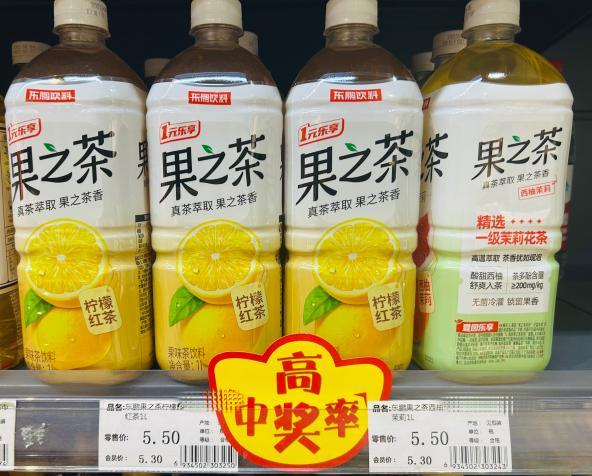
Core Insights - The "One Yuan Enjoy, Buy One More" promotional campaign has seen a resurgence this summer, significantly impacting the beverage industry [1][8] - The campaign has led to intense price competition among various beverage brands, with many participating in the promotional activities [3][9] Industry Trends - The "One Yuan Enjoy" promotion has become a widespread tactic in convenience stores, with numerous brands adopting this strategy to attract consumers [3][5] - The promotional activities have been characterized by high visibility and aggressive marketing, with brands like Dongpeng and Nongfu Spring prominently featuring the campaign [5][7] Consumer Behavior - A Nielsen IQ report indicates that 72% of consumers prioritize price when selecting beverages, highlighting the effectiveness of the "One Yuan Enjoy" promotion in attracting price-sensitive customers [7] - The campaign has encouraged consumers to engage in purchasing behaviors that involve luck, as many have reported winning prizes from the promotions [8][10] Brand Strategies - Beverage brands are leveraging the "One Yuan Enjoy" promotion to introduce new products and increase market penetration, particularly in underdeveloped markets [10][13] - Companies like Dongpeng and Nongfu Spring have reported significant market share growth as a result of these promotional activities, with Dongpeng's market share rising from 16.45% to 32.66% year-on-year [13] Challenges and Issues - Despite the promotional success, there have been reports of difficulties in redeeming prizes, leading to consumer dissatisfaction [14][18] - Retailers face challenges related to inventory management and cash flow due to the promotional structure, which can lead to operational inefficiencies [16][18] Future Outlook - Experts suggest that while the "One Yuan Enjoy" promotion is effective in the short term, it may lead to price dependency among consumers if used excessively [18] - The sustainability of such promotional strategies is questioned, with recommendations for brands to diversify their marketing approaches to avoid consumer fatigue [18]
娃哈哈天猫旗舰店改名换运营主体,宗馥莉接手实控权
Xi Niu Cai Jing· 2025-08-19 03:42
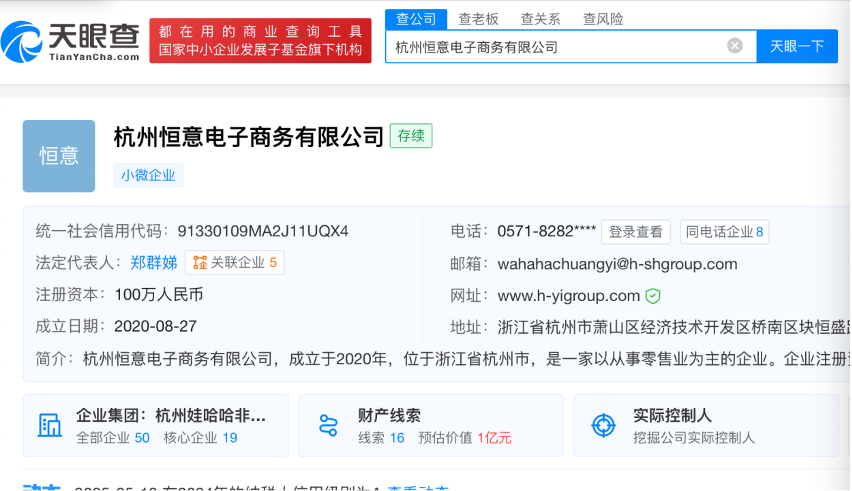
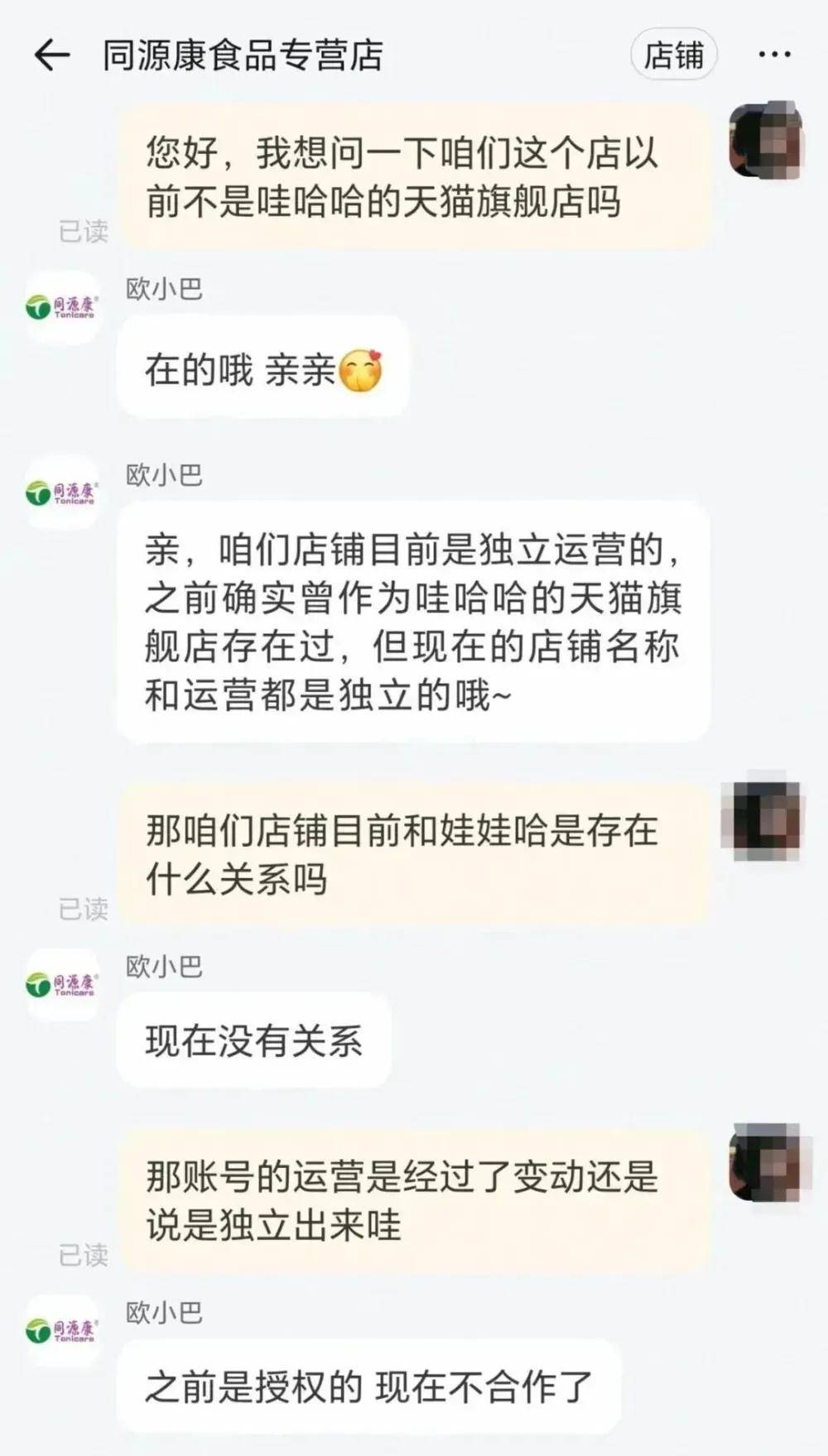
Group 1 - The original Tmall "Wahaha Flagship Store" has been renamed to "Tongyuan Kang Food Specialty Store," sparking discussions about the change in operational rights [1] - "Tongyuan Kang Food Specialty Store" is registered under Tongyuan Kang E-commerce (Hangzhou) Co., Ltd., a company that has been operating for 7 years and is 75% controlled by Sanjie Investment Group Co., Ltd., which is predominantly owned by Du Jianying [3] - As of August 13, customer service from the new store confirmed that the store was previously the Tmall flagship store for Wahaha but is now operating independently after ending its partnership earlier this year. The new Wahaha flagship store is now managed by Hangzhou Hengyi E-commerce Co., Ltd., controlled by Zong Fuli through Hangzhou Hongchen Marketing Co., Ltd. [5]