
美的集团

Search documents
2030年达到68亿美元?人形机器人需求推动电机技术迭代破局
机器人大讲堂· 2026-02-02 07:49
Core Insights - The commercialization of humanoid robots is driving the demand for advanced motor technologies, which are essential for performance, load capacity, and operational efficiency [1][3][15] - The electric motor industry is becoming a critical variable in the speed of commercialization for humanoid robots, with significant competition expected by 2026 [1][3] Electric Motor Market Potential - The global market for frameless torque motors in humanoid robots is projected to reach $2.397 billion by 2030, with the total market exceeding $3.3 billion when including traditional sectors [3] - Hollow cup motors are expected to surpass $1.5 billion in the robot sector by 2030, while harmonic field motors are anticipated to grow rapidly post-2025, reaching $2 billion by 2030 [3] - Electric motors account for 15%-20% of the value chain in humanoid robots, prompting leading manufacturers to vertically integrate and customize their motor solutions [3][6] Performance Requirements - Humanoid robots require motors with high torque density, low torque fluctuation, strong overload capacity, and effective heat dissipation [4][6] - For instance, the A2 Max robot's joint peak torque reaches 450 Nm, necessitating high-density output in a compact space [4] - The design trends are moving towards modular and integrated solutions to enhance flexibility and endurance [4] Competitive Landscape - The current electric motor market features a multi-route approach with frameless torque motors leading for joints, hollow cup motors for dexterous hands, and harmonic field motors exploring future applications [6][7] - The global market is dominated by companies like Kollmorgen and AEROTECH, while domestic firms are rapidly advancing, with significant price advantages [7][10] Market Growth and Trends - The global compound annual growth rate (CAGR) for frameless torque motors is projected to be 25% from 2023 to 2030, with the market expected to exceed $3.3 billion by 2030 [7][10] - Domestic companies are making strides in technology and cost efficiency, with local products priced at 50%-70% of their international counterparts [10][11] Material Innovations - The fourth-generation samarium iron nitrogen (SmFeN) material is emerging as a game-changer in electric motor performance, offering low cost and high performance [11][12] - This material has a Curie temperature of 470°C and is resistant to corrosion, making it suitable for micro-motor applications [12][14] Future Outlook - The humanoid robot wave represents not just a competition among complete systems but also a "power revolution" in core components like electric motors [15][16] - As technology converges and the supply chain integrates, the electric motor industry is expected to become a key driver for the commercialization and popularization of humanoid robots [16]


光伏企业,如何不被白银绑架?
Huan Qiu Lao Hu Cai Jing· 2026-02-02 07:46
Core Viewpoint - The photovoltaic (PV) industry is facing significant challenges due to soaring silver prices, which have become a major external variable impacting the industry's cost structure and operational viability [1][5][20]. Group 1: Silver Price Impact - As of January 26, silver prices have surged to over 27,600 yuan per kilogram, leading to a dramatic increase in the cost of silver used in PV cells, which now accounts for 64% of the total cost of battery cells [2][5]. - The price of silver has increased from over 7,000 yuan to more than 27,000 yuan per kilogram over the past year, creating a critical situation for the PV industry [5][12]. - The rising costs of silver and other materials have resulted in a significant increase in the overall cost structure of PV components, with silver paste costs rising by 77% and aluminum frame costs increasing by 8% [8][10]. Group 2: Industry Response and Strategies - The PV industry must establish a flexible pricing mechanism linked to silver prices to mitigate the financial strain on midstream companies, ensuring that costs are shared across the supply chain [18][19]. - Companies are encouraged to adopt strategies similar to those in other industries facing raw material price volatility, such as vertical integration, long-term contracts, and material substitution [9][20]. - The industry should focus on technological advancements to reduce silver consumption, with short-term goals to lower silver usage in PV cells and long-term objectives to develop silver-free technologies [21][22][24]. Group 3: Collaborative Efforts - The China Photovoltaic Industry Association is urged to take a leading role in coordinating industry responses to the silver price crisis, including establishing a dynamic pricing platform and promoting collaborative purchasing strategies [26][17]. - A unified approach to pricing and cost-sharing across the entire PV supply chain is essential to prevent financial distress among midstream companies and ensure the industry's sustainability [20][25]. - The establishment of a silver price dynamic warning platform and the development of standards for silver consumption in PV products are recommended to enhance market stability and quality assurance [26].

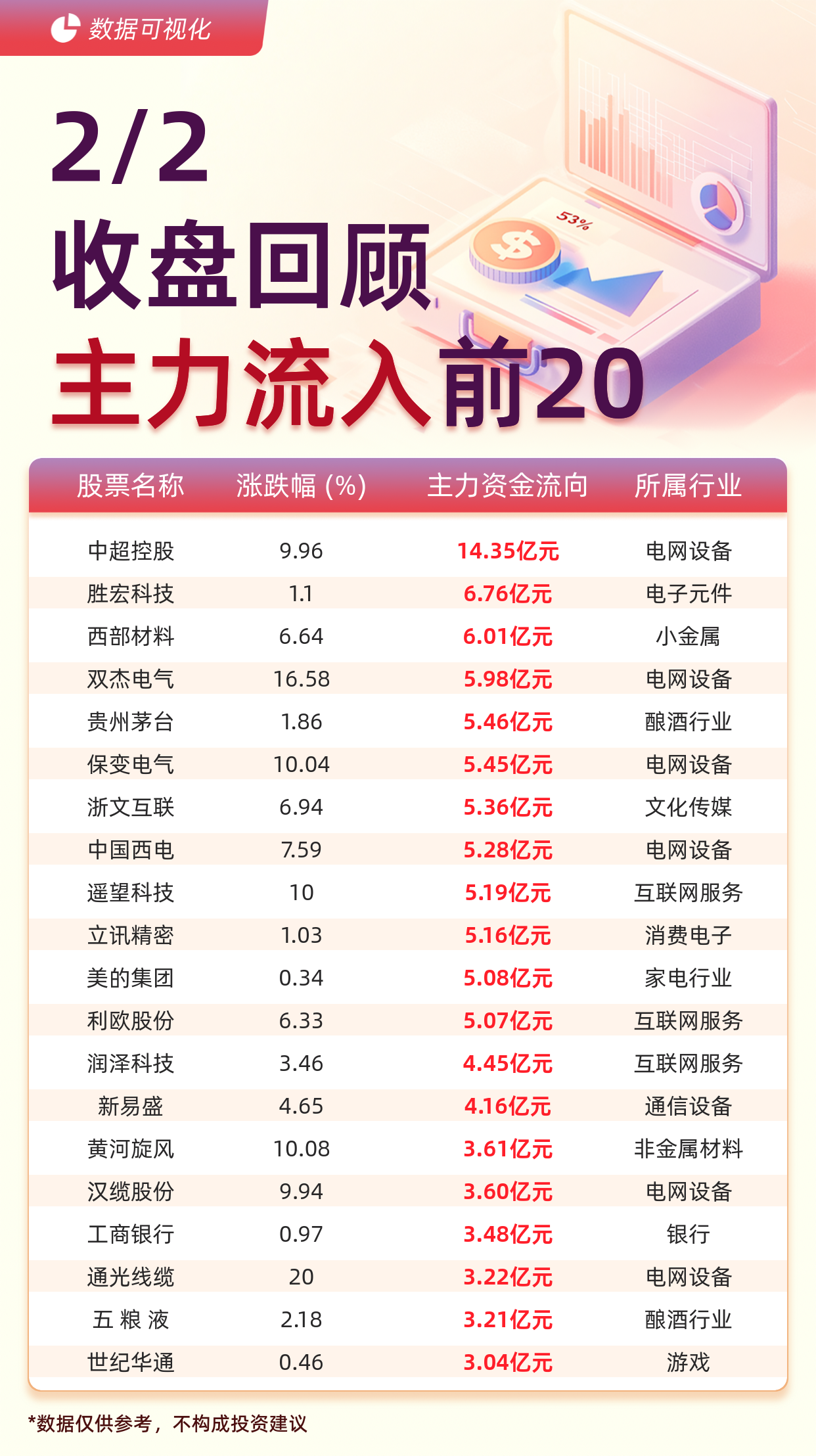
主力资金流入前20:中超控股流入14.35亿元、胜宏科技流入6.76亿元
Jin Rong Jie· 2026-02-02 07:30
Group 1 - The top 20 stocks with significant capital inflow as of February 2 include Zhongchao Holdings (1.435 billion), Shenghong Technology (676 million), and Xibu Materials (601 million) [1] - Zhongchao Holdings experienced a price increase of 9.96%, while Shuangjie Electric saw a notable rise of 16.58% [2] - The sectors represented among the top inflow stocks include power grid equipment, electronic components, and the liquor industry [2][3] Group 2 - Other notable stocks with significant inflows include Guizhou Moutai (5.46 billion), Baobian Electric (5.45 billion), and Zhejiang Wenlian (5.36 billion) [1] - The banking sector is represented by Industrial and Commercial Bank of China, which had an inflow of 348 million [3] - The highest percentage increase in stock price was observed in Tongguang Cable, which rose by 20% [3]


出厂价格出现更多积极信号——1月PMI数据点评
一瑜中的· 2026-02-02 07:13
Core Viewpoint - The article discusses the decline in manufacturing PMI and highlights the positive signals in factory prices, indicating potential recovery in the midstream sector due to improved supply-demand dynamics and resilient overseas exports [2][3][4]. Group 1: PMI Data - The manufacturing PMI for January is reported at 49.3%, down from 50.1% in the previous month. Key sub-indices include: - Production index at 50.6%, down 1.1 percentage points from 51.7% - New orders index at 49.2%, down from 50.8% - New export orders index at 47.8%, down from 49.0% - Employment index at 48.1%, slightly down from 48.2% - Supplier delivery time index at 50.1%, down from 50.2% - Raw material inventory index at 47.4%, down from 47.8% [2][17][18]. Group 2: Price Indicators - Positive signals in price indicators are noted, including: - The PMI factory price index at 50.6%, marking the first rise above the critical point in nearly 20 months. Industries such as non-ferrous metal smelting and electrical machinery show significant increases in both raw material purchase prices and factory prices, exceeding 55.0% [5][14]. - The BCI consumer price expectations index surged to 51.5%, the first rise above the critical point in 28 months, while the profit expectations index reached 52.66%, the first rise above the critical point in 11 months [5][14]. - Micro-level price increases are observed in various sectors, including semiconductors, photovoltaic, and home appliances, with notable price hikes reported by companies like Zhongwei Semiconductor and Midea [6][15]. Group 3: Supply-Demand Dynamics - The article highlights a decrease in the proportion of companies reporting insufficient demand, with the manufacturing sector's percentage dropping to 54.9% in January from 64.3% in the previous month. This suggests an improvement in supply-demand dynamics [4][11]. - The midstream growth rate difference reached 10.4%, up from 8.1%, indicating a positive trend in demand relative to investment growth [4][11].
机器人长出“巧手”和“皮肤”
Bei Jing Wan Bao· 2026-02-02 06:46
Group 1 - The 9th Zhongguancun International Frontier Technology Competition recently held its AI application semi-finals, showcasing top projects such as a dexterous intelligent platform and AI-enabled tumor precision diagnosis [1] - The dexterous robotic hand developed by Lingxin Qiaoshou can replicate 33 precise grasping actions and is priced at one-tenth of similar international products while achieving several times the core skill level [1][2] - Lingxin Qiaoshou has become a leading supplier in the global dexterous hand market, with 80% of high-degree-of-freedom dexterous hands worldwide sourced from the team [2] Group 2 - The company has delivered over 10,000 units of its products by 2025, which are now used in research at top universities and by major industrial firms like Huawei and Samsung [2] - The flexible electronic skin developed by Mogan Technology allows robots to sense weight, temperature, and texture, enhancing their operational capabilities and safety [2][3] - The competition highlighted various AI application projects, including a hybrid Hall electric propulsion system for low-orbit satellites and an AI-based virtual power plant system expected to generate 300 million yuan in revenue this year [3]

京东联合行业发布洗碗机容积新标准,推动用户体验升级
Zhong Guo Jing Ying Bao· 2026-02-02 06:45
新标准以"有效容积率R(=容积÷体积)"为核心指标建立三级分级体系:一级(R≥60%)、二级 (58%≤R 【#京东牵头制定洗碗机容积新标准#,推动行业从"营销概念"转向"用户体验"】近日,京东联合中国标 准化协会、中家院及西门子、美的、海尔等头部品牌正式发布了洗碗机行业容积新标准。 新标准摒弃了模糊的"套数"概念,构建起以"内部容积(升)+关键安装尺寸"为表述的全新标识体系, 为消费者提供了明确的选购依据,同时让容量匹配更精准、安装规划更确定。 此举直击当前洗碗机市场的痛点。有关数据显示,2026年1月,洗碗机行业成交量同比增长69%,品牌 数量增至101个,相关搜索次数超300万次。市场很热,但"宣传很满、体验打折"的行业乱象也日益凸 显。 京东家电家居厨卫大家电负责人表示,此次标准升级的目标,是让容量表达从"概念化"走向"可对照、 可验证",让消费者在购买决策时有透明、可靠且易懂的统一标尺,同时也将推动厂商优化产品内部结 构设计与装载效率,围绕深口碗等中式餐具痛点创新。 为强化标准落地,京东同步启动年货节服务加码:购买指定厨电可享"5年内换新享5折"保障,叠加国家 补贴后部分产品最高优惠达1500元。业 ...


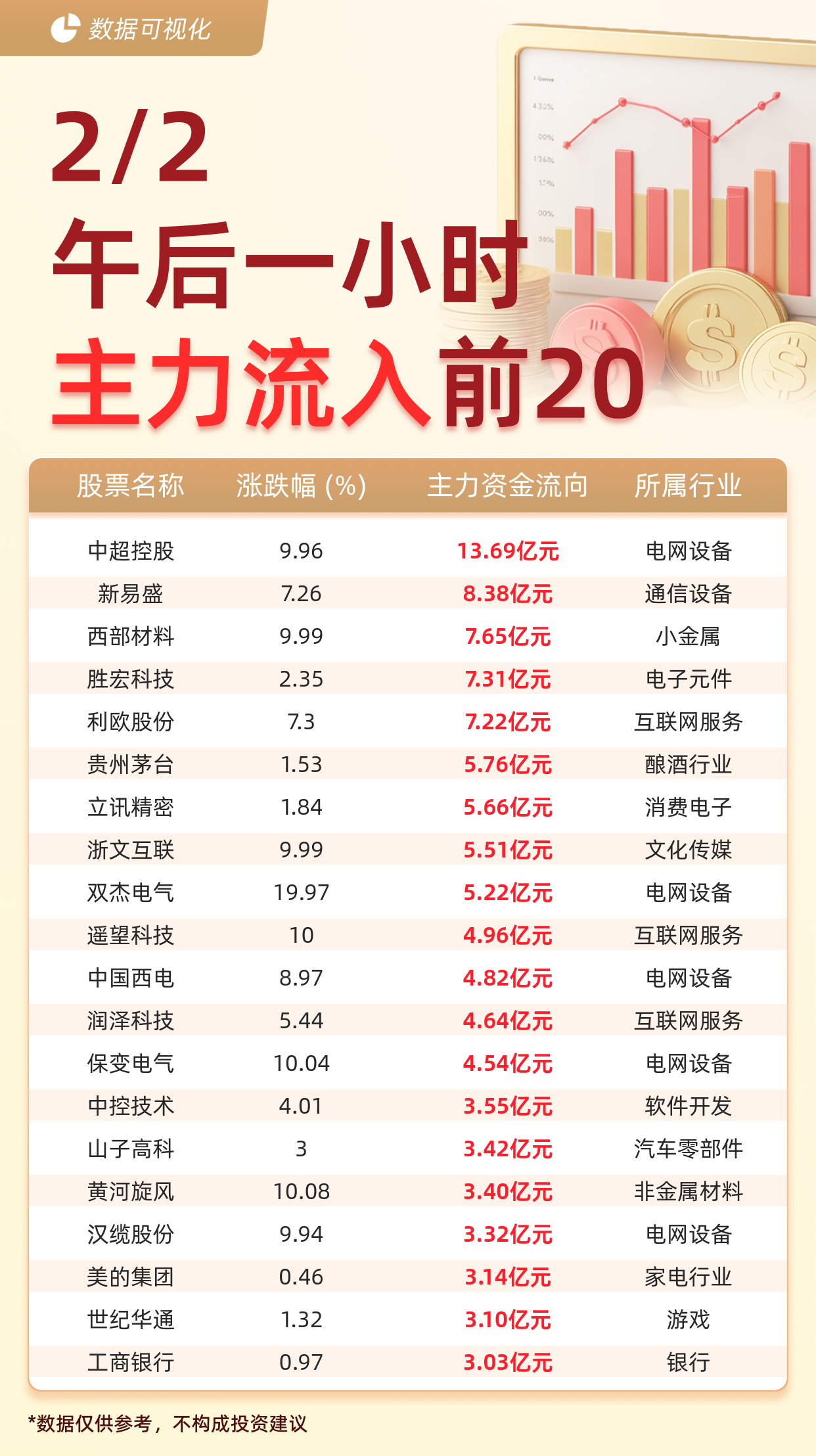
主力资金流入前20:中超控股流入13.69亿元、新易盛流入8.38亿元
Jin Rong Jie· 2026-02-02 06:33
Core Insights - The main focus of the news is the significant inflow of capital into various stocks, indicating strong investor interest and potential market trends. Group 1: Stock Performance and Capital Inflow - Zhongchao Holdings saw a capital inflow of 1.369 billion, with a price increase of 9.96% [1][2] - Xinyi Technology experienced a capital inflow of 838 million, with a price increase of 7.26% [1][2] - Western Materials had a capital inflow of 765 million, with a price increase of 9.99% [1][2] - Shenghong Technology attracted 731 million, with a price increase of 2.35% [1][2] - Liou Co. received 722 million, with a price increase of 7.3% [1][2] - Kweichow Moutai had a capital inflow of 576 million, with a price increase of 1.53% [1][2] - Luxshare Precision saw a capital inflow of 566 million, with a price increase of 1.84% [1][2] - Zhejiang Wenhu Interconnect attracted 551 million, with a price increase of 9.99% [1][2] - Shuangjie Electric received 522 million, with a price increase of 19.97% [1][2] - Yaowang Technology had a capital inflow of 496 million, with a price increase of 10% [1][2] - China Western Electric attracted 482 million, with a price increase of 8.97% [1][3] Group 2: Additional Stock Insights - Runze Technology saw a capital inflow of 464 million, with a price increase of 5.44% [3] - Baobian Electric attracted 454 million, with a price increase of 10.04% [3] - Zhongkong Technology had a capital inflow of 355 million, with a price increase of 4.01% [3] - Shanziko High-Tech received 342 million, with a price increase of 3% [3] - Huanghe Xuanfeng attracted 340 million, with a price increase of 10.08% [3] - Hancable saw a capital inflow of 332 million, with a price increase of 9.94% [3] - Midea Group had a capital inflow of 314 million, with a price increase of 0.46% [3] - Century Huayun attracted 310 million, with a price increase of 1.32% [3] - Industrial and Commercial Bank of China saw a capital inflow of 303 million, with a price increase of 0.97% [3]


京东牵头制定洗碗机容积新标准,推动行业从“营销概念”转向“用户体验”
Zhong Guo Jing Ying Bao· 2026-02-02 05:36
Group 1 - The core viewpoint of the article is the launch of a new standard for the dishwasher industry by JD.com in collaboration with the China Standardization Association and leading brands like Siemens, Midea, and Haier, aimed at providing clearer purchasing guidelines for consumers [1][2] - The new standard replaces the vague "set count" concept with a clear labeling system based on "internal volume (liters) + key installation dimensions," addressing current market pain points and enhancing consumer decision-making [1] - Data indicates that by January 2026, the dishwasher industry is expected to see a 69% year-on-year increase in transaction volume, with the number of brands rising to 101 and related search queries exceeding 3 million [1] Group 2 - The new standard establishes a three-tier grading system based on "effective volume rate R (= volume ÷ total volume)," with levels defined as: Level 1 (R≥60%), Level 2 (58%≤R<60%), and Level 3 (R<58%) [1] - JD.com will provide exclusive labeling for products with an R value exceeding 60%, helping consumers easily identify models with higher space utilization [1] - To reinforce the implementation of the new standard, JD.com has launched a service enhancement during the New Year shopping festival, offering a "5-year replacement at 50% off" guarantee on selected kitchen appliances, with some products eligible for discounts up to 1,500 yuan after national subsidies [2]
沪深300ESGETF(561900)跌1.60%,半日成交额32.81万元
Xin Lang Cai Jing· 2026-02-02 03:38
声明:市场有风险,投资需谨慎。本文基于第三方数据库自动发布,不代表新浪财经观点,任何在本文 出现的信息均只作为参考,不构成个人投资建议。如有出入请以实际公告为准。如有疑问,请联系 biz@staff.sina.com.cn。 沪深300ESGETF(561900)业绩比较基准为沪深300ESG基准指数收益率,管理人为招商基金管理有限 公司,基金经理为房俊一,成立(2021-07-06)以来回报为-0.67%,近一个月回报为1.42%。 来源:新浪基金∞工作室 2月2日,截止午间收盘,沪深300ESGETF(561900)跌1.60%,报0.983元,成交额32.81万元。沪深 300ESGETF(561900)重仓股方面,贵州茅台截止午盘涨2.64%,中际旭创跌7.24%,宁德时代跌 0.06%,招商银行涨0.72%,中国平安涨0.13%,美的集团涨0.49%,长江电力跌0.27%,紫金矿业跌 6.78%,兴业银行涨1.98%,比亚迪跌3.15%。 ...
当广货遇见广货,是风味,更是天作之合
Nan Fang Nong Cun Bao· 2026-02-02 03:02
Core Viewpoint - The article emphasizes the synergy between Guangdong's manufacturing prowess and its agricultural products, showcasing how "Guangdong goods" (广货) are not only a representation of quality but also a cultural symbol that enhances the quality of life and drives economic growth [4][67][72]. Group 1: Guangdong's Manufacturing Strength - Guangdong is a major manufacturing hub, producing 70% of the world's consumer drones, 40% of smartphones, and 40% of industrial robots in China [6]. - The province leads in the production of home appliances, with products like rice cookers and air conditioners being globally dominant [7][14]. - The "Guangdong goods" brand is recognized for its innovation and quality, contributing significantly to both domestic and international markets [8][72]. Group 2: Agricultural Excellence - Guangdong's agricultural sector is robust, with products like the Qingyuan silk rice, which has a projected total output value of 6.457 billion yuan in 2024 [21]. - The province's seasoning industry, represented by brands like Haitian soy sauce, generated revenue of 55.7 billion yuan in 2024, accounting for over 60% of the national soy sauce production [27][28]. - The integration of traditional agricultural products with modern processing techniques enhances the value and appeal of these goods [30][37]. Group 3: Cultural and Culinary Integration - The combination of Guangdong's culinary products, such as the pairing of rice with high-quality rice cookers, exemplifies the harmonious relationship between technology and tradition [12][21]. - The collaboration between local ingredients, like lychee from Maoming and traditional beverages like Wanglaoji herbal tea, reflects a deep cultural connection and innovation in product offerings [35][39]. - The article highlights the importance of maintaining quality and tradition in food preparation, which is essential for enhancing the dining experience [54][69]. Group 4: Economic Impact and Future Prospects - The "Guangdong goods" initiative aims to expand the reach of these products both nationally and globally, fulfilling consumer demands while stimulating economic growth [72]. - The article suggests that the synergy between industrial and agricultural sectors will lead to a healthier, more convenient, and flavorful modern lifestyle [69][70]. - The ongoing efforts to promote Guangdong's products are expected to narrate compelling stories about the region, further enhancing its economic and cultural significance [73].
