
合盛硅业

Search documents
A股异动丨有机硅概念股走强,东岳硅材、江苏国泰、合盛硅业涨停
Ge Long Hui A P P· 2025-11-07 02:24
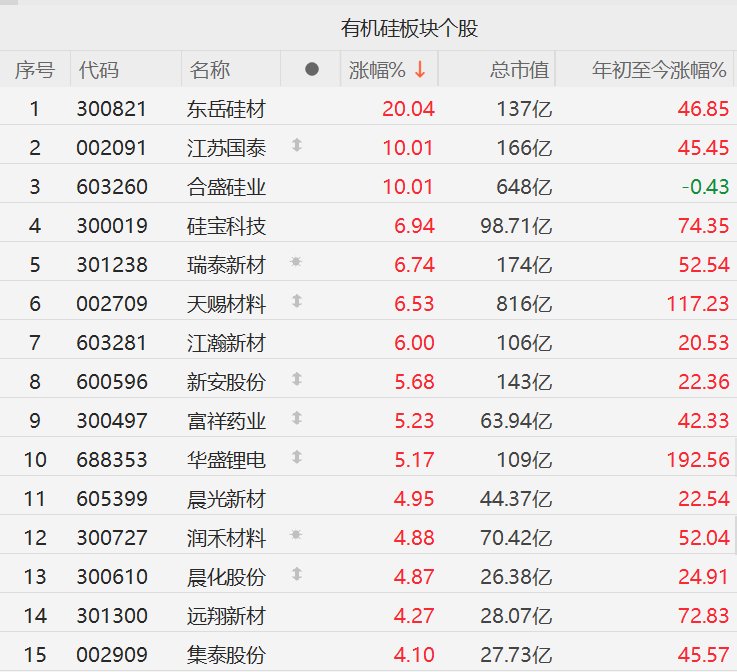
Core Viewpoint - The A-share market for silicon-based stocks is experiencing a strong performance, driven by industry dynamics and potential consolidation efforts among leading polysilicon companies [1] Group 1: Market Performance - Dongyue Silicon Material reached a 20% limit-up, while Jiangsu Guotai and Hesheng Silicon Industry both hit a 10% limit-up [1] - Other companies such as Silica Technology, Ruitai New Materials, and Tianci Materials saw increases of over 6%, with several others rising more than 4% [1][2] - The overall market sentiment is positive, with MACD golden cross signals indicating a favorable trend for these stocks [2] Group 2: Industry Developments - In response to the "anti-involution" trend in the photovoltaic sector, leading polysilicon companies are planning to form a consortium to eliminate excess capacity and address accumulated industry debts [1] - The total investment for this initiative is estimated to be between 20 billion to 30 billion yuan, although specifics are still uncertain [1] - Xingfa Group noted that the organic silicon market is facing competitive pressure due to supply factors, but expects product prices to gradually recover from the bottom range in the coming years [1]


短期震荡不改长期趋势,自带杠铃策略的上证180ETF指数基金(530280)近2周涨幅排名同类第1
Sou Hu Cai Jing· 2025-11-07 02:08
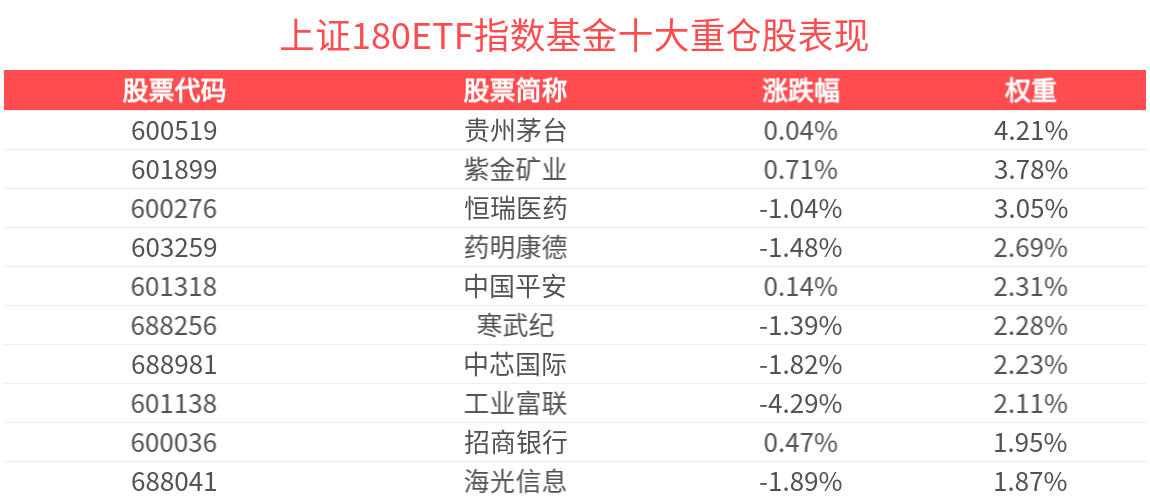
Core Viewpoint - The short-term market fluctuations do not alter the long-term slow bull trend of the stock market, with dividend and technology assets expected to yield excess returns in the long run [1] Group 1: Market Trends - The allocation of residents' assets is gradually increasing in the equity market, benefiting dividend assets first [1] - Technology assets represent economic development trends and have strong long-term growth certainty [1] - The Shanghai Stock Exchange 180 Index follows a barbell strategy with 90% dividend and 10% technology, making it a good choice for equity market allocation [1] Group 2: Index Performance - As of November 7, 2025, the Shanghai Stock Exchange 180 Index (000010) decreased by 0.24% [1] - The top-performing stocks include He Sheng Silicon Industry (603260) up 8.40%, Tongwei Co., Ltd. (600438) up 4.13%, and Daqo New Energy (688303) up 3.91% [1] - The worst-performing stocks include Top Group (601689) down 4.91%, Industrial Fulian (601138) down 4.29%, and Zhongke Shuguang (603019) down 2.72% [1] Group 3: ETF Details - The Shanghai Stock Exchange 180 ETF Index Fund (530280) decreased by 0.16%, with the latest price at 1.24 yuan [1] - Over the past two weeks, the Shanghai Stock Exchange 180 ETF Index Fund has increased by 1.98%, ranking 1/10 among comparable funds [1] - The top ten weighted stocks in the Shanghai Stock Exchange 180 Index as of October 31, 2025, include Kweichow Moutai (600519) and Zijin Mining (601899), accounting for a total of 26.29% [2]
【安泰科】工业硅周评—期货下调、现货持稳(2025年11月5日)
中国有色金属工业协会硅业分会· 2025-11-06 10:58
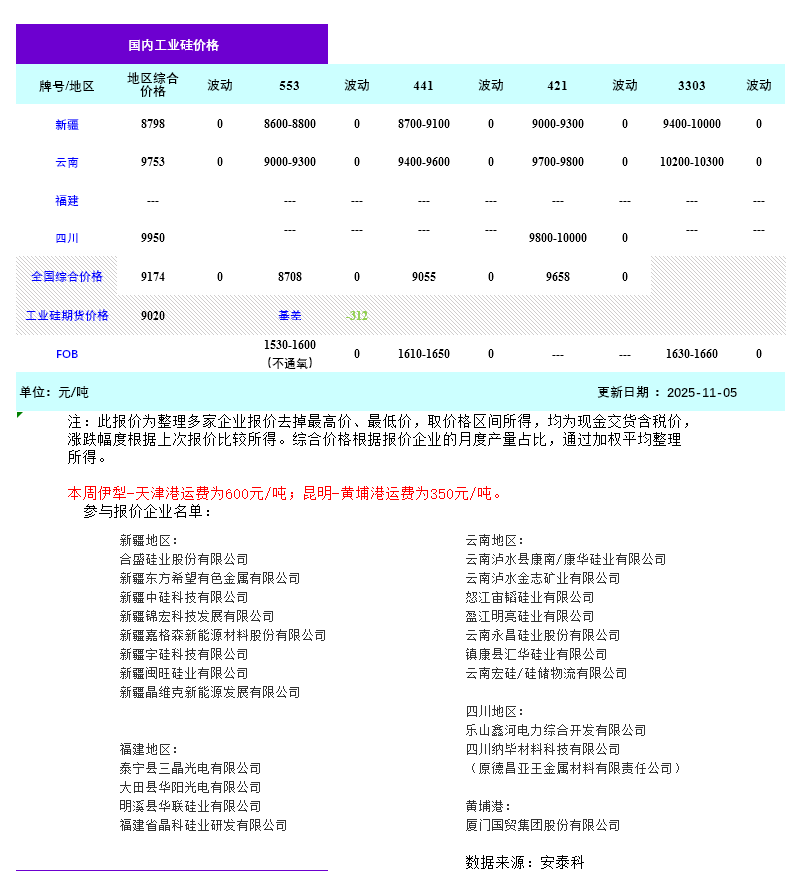
Core Viewpoint - The industrial silicon market is experiencing a divergence between futures and spot prices, with futures prices declining while spot prices remain stable [1][2]. Group 1: Market Trends - From October 30 to November 5, the main futures contract price dropped from 9155 CNY/ton to 9020 CNY/ton, a decrease of 135 CNY/ton [1]. - The national comprehensive price for industrial silicon on November 5 was 9174 CNY/ton, with specific grades priced at 8708 CNY/ton for 553, 9055 CNY/ton for 441, and 9658 CNY/ton for 421 [1][3]. - Regional price variations were noted, with prices in Xinjiang, Yunnan, and Sichuan at 8798 CNY/ton, 9753 CNY/ton, and 9950 CNY/ton respectively [1][3]. Group 2: Supply and Demand Dynamics - The domestic industrial silicon market is facing insufficient support from downstream demand, particularly in the organic silicon sector, which is entering a traditional off-peak season [2]. - Despite attempts by production companies to stabilize prices through production cuts, the price of organic silicon DMC fell by 200 CNY/ton to 11000 CNY/ton [2]. - In the aluminum alloy sector, demand continues to grow due to strong performance in downstream industries like automotive [2]. Group 3: Market Balance and Future Outlook - The industrial silicon market is currently in a phase of "weak reality and strong cost" dynamics, with spot prices remaining stable due to production cut expectations and cost support [2]. - Futures prices are fluctuating around the 9000 CNY/ton mark, indicating a cautious balance between demand expectations and cost support [2]. - Future market trends will depend on the extent of production cuts in the southwestern region and the recovery of actual downstream demand [2].
硅业分会:工业硅市场期现走势再度分化 呈现“期货下调、现货持稳”格局
Zhi Tong Cai Jing· 2025-11-06 08:49
Core Viewpoint - The industrial silicon market is currently experiencing a divergence between futures and spot prices, characterized by "futures down, spot steady" dynamics, with the market balancing between weak demand and strong cost support [1][2]. Price Trends - The main contract price for industrial silicon fell from 9155 CNY/ton to 9020 CNY/ton, a decrease of 135 CNY/ton during the week of October 30 to November 5 [1]. - The national comprehensive price for industrial silicon on November 5 was 9174 CNY/ton, with specific grades priced as follows: 553 at 8708 CNY/ton, 441 at 9055 CNY/ton, and 421 at 9658 CNY/ton [1][3]. Regional Analysis - In the Southwest region, particularly in Sichuan and Yunnan, rising electricity prices have led to production cuts, providing price support for industrial silicon [2]. - In contrast, regions like Xinjiang and Inner Mongolia have stable production levels, with slight cost increases but overall weak demand limiting price increases [2]. Demand Insights - Demand from the downstream sectors remains insufficient to support industrial silicon prices, particularly in the organic silicon sector, which is entering a traditional off-peak season [2]. - Despite attempts by producers to stabilize prices through production cuts, the price of organic silicon DMC has decreased by 200 CNY/ton to 11000 CNY/ton [2]. - In the polysilicon sector, while prices remain stable and transaction activity has increased, production cut expectations continue to constrain demand for industrial silicon [2]. Freight Costs - The freight cost from Yili to Tianjin Port is 600 CNY/ton, while from Kunming to Huangpu Port it is 350 CNY/ton [5]. Participating Companies - A list of companies involved in the industrial silicon market includes major players from Xinjiang, Fujian, Yunnan, and Sichuan regions, indicating a diverse supply chain [5].
合盛硅业股份有限公司关于控股股东部分股份质押及解质押的公告
Zhong Guo Zheng Quan Bao - Zhong Zheng Wang· 2025-11-06 03:30
Core Points - The controlling shareholder of Hoshine Silicon Industry Co., Ltd., Ningbo Hoshine Group Co., Ltd., holds 486,647,073 shares, accounting for 41.16% of the total share capital [2] - After the recent pledge and release of shares, Hoshine Group has pledged a total of 243,029,100 shares, which is 49.94% of its holdings and 20.56% of the total share capital [2] - Hoshine Group and its concerted actors hold a total of 869,105,229 shares, representing 73.52% of the total share capital, with 433,873,200 shares pledged, accounting for 49.92% of their total holdings and 36.70% of the total share capital [2] Pledge and Release Details - The announcement includes details about the recent pledge and release of shares by Hoshine Group [2][3] - Hoshine Group and its concerted actors have a good credit and financial status, with future repayment sources including operating income, investment returns, and dividends from held shares [2] - The risks associated with the pledges are considered manageable, and there are no substantial factors that could lead to a change in control of the company [2] Ongoing Monitoring - The company will continue to monitor the share pledge situation of Hoshine Group and its concerted actors, ensuring compliance with relevant regulations and timely information disclosure [3]
基础化工新材料周报:摩尔线程IPO获批文,四中全会定调新材料-20251105
Huafu Securities· 2025-11-05 13:18
Investment Rating - The industry rating is "Outperform the Market" indicating that the overall return of the industry is expected to exceed the market benchmark index by more than 5% in the next 6 months [47]. Core Insights - The Wind New Materials Index closed at 5143.87 points, up 3.19% week-on-week, with notable gains in sectors such as lithium battery materials, which surged by 13.5% [3][9]. - The approval of the IPO for Moer Thread marks a significant development in the semiconductor materials sector, highlighting the ongoing trend of domestic production acceleration [4][25]. - The Fourth Plenary Session of the 20th Central Committee emphasized the development of new materials as a key pillar industry, potentially creating several trillion-level markets over the next decade [4][28]. Summary by Sections Overall Market Review - The Wind New Materials Index increased by 3.19% during the week of October 27 to October 31, 2025, with the semiconductor materials index declining by 1.34% and the lithium battery index rising by 13.5% [3][9]. Key Company Performance - Top gainers for the week included Fangda Carbon (19.84%), Jingrui Electric Materials (16.1%), and Huitian New Materials (13.21%) [21][22]. Recent Industry Hotspots - The approval of Moer Thread's IPO on October 30 is a significant milestone for the semiconductor sector [4][25]. - The Fourth Plenary Session's focus on new materials as a trillion-level industry indicates strong future growth potential [4][28]. - Lithium hexafluorophosphate prices have surged over 120% in less than four months, reflecting high demand and supply constraints [28]. Related Data Tracking - The Philadelphia Semiconductor Index rose by 3.61% during the same week, indicating positive momentum in the semiconductor sector [29].



合盛硅业(603260) - 合盛硅业关于控股股东部分股份质押及解质押的公告
2025-11-05 09:15
证券代码:603260 证券简称:合盛硅业 公告编号:2025-073 合盛硅业股份有限公司 关于控股股东部分股份质押及解质押的公告 本公司董事会及全体董事保证本公告内容不存在任何虚假记载、误导性陈述 或者重大遗漏,并对其内容的真实性、准确性和完整性承担法律责任。 | 解质时间 | 2025/11/4 | | --- | --- | | 持股数量 | 股 486,647,073 | | 持股比例 | 41.16% | | 本次质押及解质押后剩余被质押股份数量 | 股 243,029,100 | | 本次质押及解质押后剩余被质押股份数量占 | 49.94% | | 其所持股份比例 | | | 本次质押及解质押后剩余被质押股份数量占 | 20.56% | | 公司总股本比例 | | 三、股东累计质押股份情况 截至本公告披露日,上述股东及其一致行动人累计质押股份情况如下: 截至本公告日,合盛硅业股份有限公司(以下简称"公司")控股股东宁波 合盛集团有限公司(以下简称"合盛集团")直接持有公司股份486,647,073股, 占公司总股本的41.16%。本次质押及解质押后,合盛集团累计质押股份为 243,029,100 ...
合盛硅业:控股股东部分股份质押及解质押,累计质押比例近50%
Xin Lang Cai Jing· 2025-11-05 09:02
Core Viewpoint - The announcement from Hoshine Silicon Industry indicates that its controlling shareholder, Hoshine Group, has engaged in partial share pledges and releases, with a focus on liquidity support [1] Group 1: Shareholding and Pledge Details - Hoshine Group pledged 2.9 million shares to China Everbright Bank Ningbo Branch for liquidity purposes and released 2.9 million shares [1] - As of the announcement date, Hoshine Group directly holds 487 million shares, accounting for 41.16% of the total share capital [1] - The total shares pledged by Hoshine Group amount to 243 million shares, representing 49.94% of its holdings and 20.56% of the total share capital [1] Group 2: Combined Shareholding and Pledge Status - Hoshine Group and its concerted actors, including Luo Liguo, Luo Yi, and Luo Yedong, collectively hold 869 million shares, which is 73.52% of the total share capital [1] - The cumulative shares pledged by this group total 434 million shares, which is 49.92% of their combined holdings and 36.70% of the total share capital [1] - The overall pledge risk is considered manageable [1]
基础化工增收增利,石油石化减收减利,行业资本性开支延续下降,氟化工、农化、炼油化工等盈利可观
KAIYUAN SECURITIES· 2025-11-05 01:14
Investment Rating - The investment rating for the chemical industry is "Positive (Maintain)" [1] Core Viewpoints - The chemical industry is expected to benefit from the "anti-involution" policy, leading to a favorable supply-demand balance and potential dual improvement in performance and valuation [6] - The basic chemical sector has shown revenue and profit growth in the first three quarters of 2025, with significant profitability in sub-sectors like fluorochemicals and agricultural chemicals [4][6] Summary by Sections Industry Overview - In the first three quarters of 2025, the basic chemical industry index outperformed the CSI 300 index by 7.46%, while the petroleum and petrochemical industry index underperformed by 21.06% [14] - The basic chemical industry achieved a revenue of CNY 17,645.8 billion, a year-on-year increase of 3.0%, and a net profit of CNY 1,097.5 billion, up 6.3% [4][35] Basic Chemicals - The basic chemical sector's net profit growth rate exceeded revenue growth, with capital expenditures continuing to decline year-on-year [4][36] - In Q3 2025, the sector's revenue was CNY 6,051.5 billion, a year-on-year increase of 2.1%, while net profit reached CNY 366.4 billion, up 16.8% [4][35] Sub-sector Analysis - In the first three quarters of 2025, sub-sectors such as pesticides, adhesives, fluorochemicals, and potassium fertilizers saw significant year-on-year net profit growth [4][37] - The top ten sub-sectors by net profit growth included pesticides (174%) and fluorochemicals, with substantial increases in profitability observed [38]



新能源:硅-光伏专题:收储政策驱动下多晶硅行业供需与估值策略报告-20251104
Guo Lian Qi Huo· 2025-11-04 09:49
Report Industry Investment Rating No relevant information provided. Core Views - The polysilicon industry is facing a situation where the high profits in the silicon material segment are extremely disconnected from the cash - flow pressure in the downstream segments, and there is a continuous game between high inventory and market - expected capital. The current market quotation is over - valued in the short term, and the profitability of the mid - and downstream industries is not optimistic [4][62]. - The short - term game between downstream companies' cash - flow preservation and upstream companies' price - holding and sales - hoarding continues. Downstream companies prioritize cash flow, shrink capital expenditures, and most companies postpone expansion plans. Upstream silicon material companies rely on policy expectations to hold prices [4][6][58]. - Future supply - side reduction requires policy support to eliminate production capacity and the cooperation of downstream demand. The probability of the establishment of a debt - bearing platform company by the end of the year is increasing, but it will take time to realize the supply - side production capacity reduction [4]. - The valuation of polysilicon is high in the short term, with significant differences. In the long term, companies with industrial chain integration and cost - control capabilities will have higher valuation premiums [59][60][61]. Summary by Directory Policy Aspect: Strengthened Expectation of Storage Policy Implementation, Likely to be Completed This Year - Since the second half of this year, "anti - involution" policy signals have been intensively released, and the market's expectation for the clearance and supply - side reform of the polysilicon industry has increased. High - level meetings have emphasized the construction of a unified market and the withdrawal of backward production capacity [13]. - In September, new energy consumption - related policies were introduced to improve terminal demand, but the full solution of terminal demand limitations still takes time, and the installation expectations for next year are not optimistic [18]. - By October, progress was made in the establishment of a platform company for production capacity storage, but the actual implementation of production capacity reduction still requires policy and practical support [14]. Fundamental Aspect: Disconnection between Upstream and Downstream, and Regional Differentiation Industrial Chain Internal: Severe Mismatch between Silicon Material and Downstream Demand, High Inventory as the Core Problem - There is an extreme gap between the high profits in the silicon material segment and the cash - flow pressure in the downstream segments. Silicon material companies maintain high profit margins, while downstream companies such as silicon wafer and battery cell manufacturers face losses [19][24]. - The high inventory of over 400,000 tons in the silicon material segment is the core problem, and there is a slight accumulation trend. The production schedule of polysilicon in October increased by 6% month - on - month, while the component production schedule decreased by 5% month - on - month [19]. - The digestion of high inventory requires a boost in terminal demand, but the future growth rate of domestic terminal installations cannot reach previous levels, and the possibility of significant inventory reduction in the short term is low [27][28]. Regional Supply and Demand: Profit - Driven Operation, Significant Structural Differentiation - In the silicon material segment, leading companies maintain high profits, but production is restricted by policies. In November, the production of silicon material in Inner Mongolia will decrease, but there may be complementary production capacity from other regions [35][40]. - Downstream segments are generally in a loss state, relying on OEM to survive. Component companies face cost pressure from raw materials and weak terminal demand [39]. - In different regions, Inner Mongolia's production is expected to decline due to high electricity prices and policy restrictions; Xinjiang's production is stable due to low - cost energy advantages; the southwest region faces challenges such as rising electricity prices during the dry season and contradictions between production capacity planning and short - term production [40][43][53]. Capital Operation: Differentiation between Cash - Flow Orientation and Capital Layout - In the short term, there is a continuous game between downstream companies' cash - flow preservation and upstream companies' price - holding and sales - hoarding. Downstream companies prioritize cash flow, shrink capital expenditures, and slow down expansion plans. Upstream silicon material companies control sales volume to maintain prices [58]. Industry Valuation: Significant Short - Term Differences, Long - Term Return to Supply - Demand Balance Short - Term Valuation: Game between Policy and Fundamentals, Significant Differences - Silicon material companies' high valuations rely on policy expectations. If the storage policy fails to meet expectations or downstream demand weakens, there is a risk of valuation correction. - Downstream companies' low valuations reflect their loss pressure. If the silicon material price returns to the fundamental level, their profitability and valuations may recover [59]. Long - Term Valuation: Valuation Mainline: Integration and Cost - Control Capability - In the long run, companies with industrial chain integration and cost - control capabilities, especially those with high green - electricity usage ratios and regional cost advantages, will have higher profit stability and valuation premiums [61].