
国盾量子

Search documents
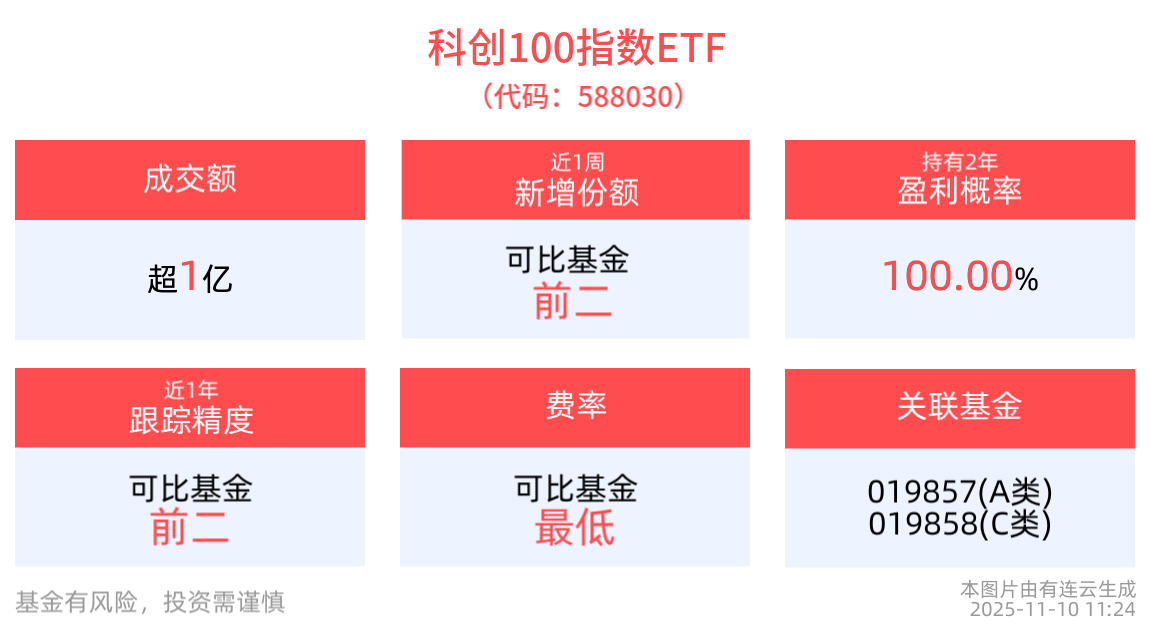
全球巨头竞逐太空算力新赛道,科创100指数ETF(588030)盘中交投活跃
Sou Hu Cai Jing· 2025-11-10 03:50
Group 1: Market Performance - The Shanghai Stock Exchange Sci-Tech Innovation Board 100 Index decreased by 1.87% as of November 10, 2025, with mixed performance among constituent stocks [3] - The top gainers included Baike Bio up 4.59%, Zhongke Xingtou up 3.92%, and Zhongxin Bo up 2.82%, while the largest decliners were Xiamen Tungsten down 8.26%, Guodun Quantum down 8.06%, and Huahong Semiconductor down 6.70% [3] - The Sci-Tech 100 Index ETF (588030) fell by 2.02%, with the latest price at 1.31 yuan, but has seen a cumulative increase of 20.11% over the past three months as of November 7, 2025 [3] Group 2: Liquidity and Trading Volume - The Sci-Tech 100 Index ETF had a turnover rate of 2.32% during the trading session, with a transaction volume of 133 million yuan [3] - Over the past year, the average daily trading volume of the ETF was 379 million yuan, ranking it first among comparable funds [3] Group 3: Space Computing Developments - Global tech giants are accelerating their investments in space computing, shifting AI competition from Earth to space, with Google launching Project Suncatcher and SpaceX building a space data center [4] - Chinese companies are also making rapid advancements, with Guoxing Aerospace's "Star Computing" plan and the upcoming launch of the "Tianlibo-10" satellite in 2026, which boasts a single satellite computing power exceeding 10 POPS [4] - Space computing is emerging as a solution to AI computing energy consumption and bandwidth bottlenecks, leveraging near-infinite solar energy supply and high energy efficiency [4] Group 4: Investment Recommendations - Minsheng Securities suggests that supernodes may become a mainstream technology under cluster expansion, enhancing the domestic computing ecosystem [5] - Key areas to focus on include domestic AI computing sectors such as chip design, advanced wafer manufacturing, and liquid cooling technologies [5] - The latest scale of the Sci-Tech 100 Index ETF reached 5.79 billion yuan, ranking it second among comparable funds, with a significant increase of 6 million shares over the past week [5] Group 5: Index Composition - As of October 31, 2025, the top ten weighted stocks in the Sci-Tech 100 Index accounted for 25.77% of the index, including Huahong Semiconductor and Guodun Quantum [6]

八方股份20251109
2025-11-10 03:34
Summary of Key Points from the Conference Call Company Overview - **Company**: 八方股份 (Bafang) - **Core Business**: The core business of Bafang is the mid-drive and hub motors for electric bicycles (eBikes) [4][2]. Industry Insights - **Market Demand**: Bafang benefits from the demand in the European market, despite experiencing a destocking cycle from 2023 to 2024. A new replenishment cycle is expected to begin in the second half of 2025 [2][6]. - **Global eBike Penetration**: The global eBike penetration rate is relatively low, with Europe at approximately 30%, while the US and Japan are below 10%. The overall global penetration rate is around 18% [7][2]. - **Market Concentration**: The eBike market is highly concentrated, with Bafang, Bosch, and Shimano holding over 50% of the European market share [8][2]. Company Performance - **Market Share**: Bafang's market share in Europe is approximately 25%, influenced by industry inventory fluctuations [9][2]. - **Financial Performance**: In Q3 2025, Bafang achieved a revenue of 391 million yuan, representing an 18% year-on-year growth. The net profit attributable to the parent company reached 35 million yuan, a 235% increase quarter-on-quarter, exceeding expectations and leading to a stock price increase of over 20% [3][2]. Future Outlook - **Growth Potential**: Bafang is expected to further increase its market share due to its brand strength, design customization, and maintenance capabilities. The rising proportion of mid-drive motors is anticipated to improve the overall gross margin of the company [10][2]. - **Profit Projections**: The company is projected to achieve a net profit of around 100 million yuan in 2025, with optimistic estimates reaching 200 million yuan in 2026, corresponding to a current valuation of approximately 35 times [10][2]. Quantum Computing Insights - **Industry Support**: Major economies are increasing policy support for the quantum computing industry. The US has raised its funding for quantum initiatives to $2.7 billion for the fiscal years 2025-2029, while China has prioritized quantum technology as a strategic frontier [15][2]. - **Market Size**: The upstream core device market for quantum computing is expected to reach $250 billion by 2035 [5][2]. - **Technological Development**: Various quantum technology routes are being explored, with superconducting technology slightly ahead in commercialization progress [13][2]. Additional Considerations - **Domestic Competition**: In the context of export controls from the US, China is accelerating domestic replacements for key quantum computing equipment, creating a competitive landscape [16][2]. - **Application Directions**: Downstream applications are transitioning from laboratory settings to industry practices, focusing on quantum simulation, optimization problems, and linear algebra applications [21][2].

量子科技诠释中国“下好先手棋” 三重共振推升板块指数创历史新高
Zheng Quan Shi Bao· 2025-11-09 22:17
Core Insights - Quantum technology is becoming a focal point for global innovation and is recognized as a key area for measuring national technological strength [2][3] - The successful development of the "Zu Chongzhi No. 3" quantum computing prototype marks a significant shift for China from a follower to a leader in quantum computing [2][3] - The quantum technology index reached a historical high with a year-to-date increase of 40.92%, indicating growing market expectations [1][2] Industry Development - The quantum technology market in China is projected to reach $9.758 billion by 2029, with a compound annual growth rate of 37.45% from 2024 to 2029 [4] - The industry is currently in a transitional phase, moving from "0 to 1" to "1 to N," with quantum communication being the most mature sector [4][5] - Key challenges for the commercialization of quantum technology include the maturity of technology and the completeness of the industrial chain [5][6] Investment Opportunities - Quantum communication, particularly quantum key distribution (QKD), is seen as the most mature and likely to achieve large-scale revenue first [6][7] - Companies like Guodun Quantum are gaining attention, with significant holdings in various funds, reflecting investor interest in the sector [8][9] - The recent surge in quantum technology stocks is attributed to both technological advancements and policy support, indicating a potential long-term investment opportunity [9][10]

量子科技诠释中国“下好先手棋”三重共振推升板块指数创历史新高
Zheng Quan Shi Bao· 2025-11-09 20:41
Core Insights - The Chinese quantum technology industry is transitioning from "strategic layout" to "commercial dawn" driven by technological breakthroughs, policy support, and capital influx [1][4][12] - The Wind Quantum Technology Index reached a historical high with an annual increase of 40.92% as of October 31, indicating rising market expectations [1] Group 1: Technological Advancements - The "Zuchongzhi No. 3" quantum computing prototype has outperformed classical supercomputers by 15 orders of magnitude in "quantum random circuit sampling" [2][4] - China is shifting from a "follower" to a "leader" in quantum computing, marking a significant milestone in key technology fields [4] - Quantum technology is recognized as a crucial area for national technological strength, with the government prioritizing it in future industry cultivation plans [4] Group 2: Industry Development and Challenges - The quantum technology industry is still in the "0 to 1" incubation stage, with varying development progress across quantum computing, communication, and measurement [3][6] - Key bottlenecks for industrialization include technology maturity and supply chain integration, particularly in quantum bit stability and error correction [7][8] - The market size for quantum technology in China is projected to reach $9.758 billion by 2029, with a compound annual growth rate of 37.45% from 2024 to 2029 [6] Group 3: Investment Landscape - The quantum communication sector shows clearer commercial prospects, while quantum computing is viewed as a long-term strategic investment due to its potential to solve complex problems [8][10] - Companies like Guodun Quantum are gaining attention, with significant investments from public funds, indicating a growing interest in the sector [11][12] - The recent surge in quantum technology stocks is attributed to technological advancements and policy catalysts, although there are concerns about the sustainability of this growth [10][12][13]
中金 | 量子科技(一):量子计算,计算新纪元
中金点睛· 2025-11-07 00:07
Core Insights - Quantum computing is accelerating from experimental validation to commercial application, with significant breakthroughs from global tech giants and Chinese prototypes, leading to a projected market growth from $5 billion in 2024 to over $800 billion by 2035, with a CAGR exceeding 55% [2][5][30] - The industry is entering a rapid growth phase, with hardware segments expected to benefit first, particularly in key equipment like dilution refrigerators and measurement control systems [5][30] Industry Overview - Quantum computing, based on quantum mechanics, offers significant advantages in solving complex problems through quantum bits (qubits) that allow for information superposition and entanglement, leading to exponential growth in encoded information [5][7] - Major economies are incorporating quantum information technology into national strategies, with the U.S. increasing funding by $2.7 billion for quantum initiatives from 2025 to 2029, while China emphasizes engineering and commercialization in its planning [5][26] Market Dynamics - The global quantum computing market is expected to reach $50.37 billion in 2024, with a CAGR of 58.65% from 2024 to 2029, and projected to exceed $8,077.50 billion by 2035 [30][32] - North America, Europe, and China are the leading regions in the quantum computing market, with North America holding the largest share at 29.8% in 2024 [32] Technological Pathways - Various hardware routes are being explored, including superconducting and ion trap technologies, with superconducting quantum computing leading in patent filings and industrialization progress [15][18] - The development of measurement and control systems is crucial for achieving fault-tolerant quantum computing, with significant advancements made in China to break foreign monopolies [60][62] Application Landscape - Current quantum computing applications are focused on quantum simulation, quantum combinatorial optimization, and quantum linear algebra, with expected implementation timelines ranging from 5 to 20 years across various industries [65][66] - The total market for quantum computing applications is projected to reach $202.67 billion by 2035, with significant collaborations between quantum computing firms and industry giants [65]
想当 “包租公” 稳拿 5% 收益,结果却亏到姥姥家
集思录· 2025-11-06 14:37
Core Insights - The essence of REITs is that local governments take a one-time cash flow for 20-30 years, leaving the risks to the market [2] - Retail investors are not "landlords" but rather "risk bearers of debt instruments" [2] - The stability of cash flow over 20 years is a myth; instead, REITs are characterized by slow declines and small fluctuations [2] Group 1: Investment Characteristics - 86%-92% of the ownership and operational rights of all listed and under-review REITs are held by local governments, central enterprises, and local state-owned enterprises, with private enterprises only accounting for 10%-14% [2] - REITs primarily serve as tools for central and local state-owned assets to realize future cash flows [2] - The participation of private assets in REITs faces significant barriers, including land acquisition, scale thresholds, and exemptions from state-owned asset transfers [2] Group 2: Market Dynamics - The REITs market is dominated by institutions, with 40% of original equity holders locking their shares, while retail investors only account for 5% of the market but contribute 35% of the trading volume [2] - The proportion of institutional investors is expected to exceed 97% by 2025-2026, indicating a shift in market dynamics [2] - REITs are not simply "stable rental income" but are equity assets that can be leveraged, have time limits, may experience vacancies, and are sensitive to policy changes [2][3] Group 3: Performance Issues - A specific REIT has seen a 16% year-on-year decline in rental rates and a drop in actual rental area by nearly 20%, indicating potential issues with major clients [4] - The rental collection rate has decreased by 6% year-on-year to only 65%, raising concerns about future bad debts [4] - The weighted average lease terms have shown a decline, which is unusual for industrial parks that typically have longer lease durations [4] Group 4: Broader Market Sentiment - Historical performance of certain REITs has shown that perceived low risk can lead to significant losses over time, as evidenced by a notable decline over five years [5] - The oversupply of industrial parks and office buildings necessitates careful scrutiny of the underlying assets of REITs [8] - The experience from international markets suggests that REITs often exhibit volatility comparable to stocks, contradicting the notion of them being low-risk investments [8]

高毅、远信、复胜等百亿私募调研名单曝光!10月私募调研次数大增130%
私募排排网· 2025-11-06 10:00
Core Viewpoint - The A-share market continues a "slow bull" trend in October 2025, characterized by significant structural differentiation and fluctuations, with the Shanghai Composite Index reaching a new 10-year high of 4000 points before closing up 1.85% for the month, marking six consecutive monthly gains [2] Group 1: Market Performance - In October, the Shenzhen Component Index and ChiNext Index both fell over 1%, ending their previous five-month upward streak [2] - The average increase for the 657 companies surveyed in October was 50.6%, with a notable rise in private equity interest, as 1176 private equity firms participated in 6412 surveys, a 130% increase from September [2] Group 2: Companies Under Survey - A total of 222 A-share companies were surveyed more than 10 times, with 100 companies surveyed over 20 times, and 22 companies surveyed over 40 times [3] - Among the 22 companies surveyed over 40 times, 12 saw a price increase in October, with the semiconductor sector having the highest representation [3] Group 3: Notable Companies - Jinpan Technology was the most surveyed company with 88 surveys, achieving a 29.45% increase in October and a 67.93% increase year-to-date [5][7] - Other notable companies include Zhaoyi Innovation, which saw a 3.14% increase in October and a 106.57% increase year-to-date, and Union Medical, which experienced a 7.68% decrease in October but a 10.86% increase year-to-date [5] Group 4: Investment Trends - The top-performing sectors in October included energy storage, quantum technology, and new materials, with 15 companies seeing price increases over 30% [9] - The global quantum computing market is projected to grow from $5 billion to over $800 billion between 2024 and 2035, with a compound annual growth rate (CAGR) exceeding 55% [12] Group 5: Private Equity Insights - High Yi Asset was the most active private equity firm, conducting 59 surveys across 57 companies, with a focus on medical devices and chemical pharmaceuticals [13][21] - Yuanxin Investment focused on medical devices, surveying 20 companies, while Fusheng Asset concentrated on semiconductors and consumer electronics, surveying 18 companies [17][22]


科创板累计IPO募资规模达9346亿
2 1 Shi Ji Jing Ji Bao Dao· 2025-11-06 08:15
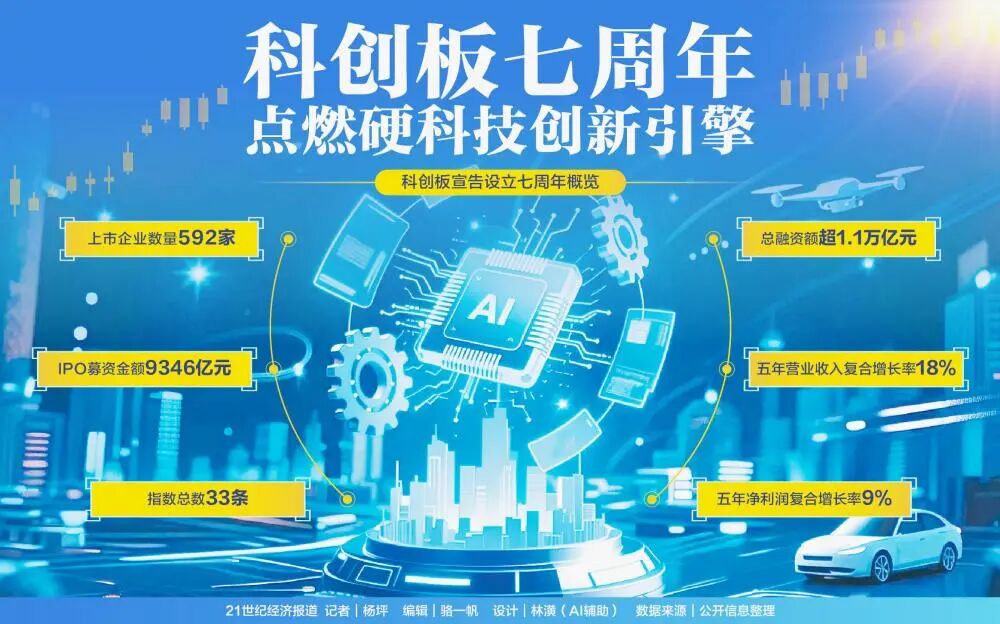
Core Insights - The establishment of the Sci-Tech Innovation Board (STAR Market) has significantly enhanced China's capital market's ability to support technological innovation, with 592 listed companies and total fundraising exceeding 1.1 trillion yuan by October 2025 [1][3] - The STAR Market has demonstrated strong growth, with a compound annual growth rate (CAGR) of 18% in revenue and 9% in net profit for listed companies over the past five years [3][4] - The board has successfully fostered a vibrant ecosystem for hard technology, with over 80% of companies in emerging industries such as new-generation information technology and biomedicine [4][5] Company Performance - As of 2025, 22 out of 57 unprofitable companies listed on the STAR Market have achieved profitability, indicating a positive trend in financial performance [3] - The integrated circuit sector has over 120 listed companies, with revenue and net profit growth of 27% and 83% respectively in the first three quarters of 2025 [4] - In the biopharmaceutical sector, 21 out of 22 companies have received approval for 48 drugs/vaccines, contributing significantly to the innovation landscape [4] R&D Investment - The total R&D investment by STAR Market companies reached 1,680 billion yuan in 2024, more than three times their net profit [5] - In the first three quarters of 2025, R&D investment amounted to 1,133.45 billion yuan, a year-on-year increase of 9.01% [5] - The average number of invention patents per company on the STAR Market is 230, with 30% of companies having products or projects that are industry-first [5][6] Ecosystem Development - The STAR Market has created a virtuous cycle of "technology-industry-capital," enhancing the efficient allocation of innovative resources [7] - Over 60% of the founding teams of STAR Market companies consist of scientists or industry experts, fostering a strong innovation culture [7] - The market has seen a significant increase in cash dividend proposals, with a total of 38.8 billion yuan in dividends planned for 2024 [8] Institutional Innovation - The STAR Market has pioneered various institutional innovations, including diverse listing standards and mechanisms for rapid financing, which serve as a model for other markets [9] - Recent reforms have expanded the scope of the STAR Market to include more cutting-edge fields, enhancing its inclusivity [9] - The growth of the STAR Market's "growth layer" has accelerated, with companies showing revenue growth of 35.09% and a median R&D intensity of 44.34% [9] Future Outlook - The Shanghai Stock Exchange aims to further leverage the STAR Market as a testing ground for identifying high-quality tech companies, particularly in emerging fields like artificial intelligence and aerospace [10]
科创板累计IPO募资规模达9346亿
21世纪经济报道· 2025-11-06 08:05
Core Viewpoint - The establishment of the Sci-Tech Innovation Board (STAR Market) has significantly contributed to the development of China's capital market, particularly in supporting technological innovation and the growth of "hard technology" companies over the past seven years [1][3]. Group 1: Market Development and Performance - As of October 2025, the STAR Market has gathered 592 listed companies, with a cumulative IPO fundraising scale of 934.6 billion yuan and total financing exceeding 1.1 trillion yuan, playing a crucial role in nurturing new productive forces and upgrading the modern industrial system [1]. - The compound annual growth rates for operating income and net profit attributable to shareholders of STAR Market companies over the past five years are 18% and 9%, respectively, indicating strong growth potential [3]. - Among the 57 unprofitable companies at the time of listing, 22 have achieved profitability, showcasing a trend of successful transitions from research and development to market success [3]. Group 2: Industry Focus and Innovation - The STAR Market has maintained a focus on "hard technology," with over 80% of listed companies in emerging industries such as new-generation information technology, biomedicine, and high-end equipment manufacturing [5]. - Key industries like integrated circuits and biomedicine have seen significant clustering effects, with over 120 listed companies in the integrated circuit sector, contributing to a complete and collaborative innovation ecosystem [6]. - In the integrated circuit sector, revenue and net profit for 119 companies that disclosed Q3 reports in 2025 grew by 27% and 83% year-on-year, respectively, with net profit for chip design companies soaring by 141% [6]. Group 3: Research and Development Investment - In 2024, total R&D investment by STAR Market companies reached 168 billion yuan, more than three times their net profit; in the first three quarters of 2025, R&D investment reached 113.3 billion yuan, a year-on-year increase of 9.01% [7]. - The STAR Market has generated over 130,000 invention patents, with an average of 230 patents per company, and 30% of companies have products or projects that are industry-first [7]. Group 4: Ecosystem and Capital Integration - The STAR Market has successfully established a virtuous cycle of "technology-industry-capital," enhancing the efficient allocation of innovative resources [10]. - Approximately 90% of STAR Market companies received venture capital investment before going public, indicating a strong trend towards early-stage investment in hard technology [11]. - The STAR Market has developed a comprehensive index system, with over 100 ETFs listed, and the total scale of index tracking products exceeding 330 billion yuan, making it a flagship index for hard technology investments [11]. Group 5: Institutional Innovation and Reforms - As a pioneer in the registration system reform, the STAR Market has implemented various innovative practices in issuance, listing, and trading, providing valuable experience for other market segments [14]. - Recent reforms, including the "1+6" measures, have further enhanced the inclusivity of the system, supporting the growth of companies in cutting-edge fields like artificial intelligence [14][15]. - The STAR Market has also accelerated the development of the "growth layer" for innovative companies, with significant increases in revenue and R&D investment among these firms [14].

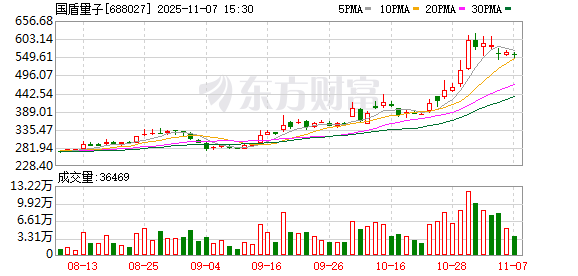
国盾量子涨2.14%,成交额17.35亿元,主力资金净流出9007.32万元
Xin Lang Cai Jing· 2025-11-06 03:28
Core Viewpoint - Guodun Quantum's stock price has shown significant volatility, with a year-to-date increase of 90.68% but a recent decline of 5.03% over the last five trading days [1] Company Overview - Guodun Quantum Technology Co., Ltd. was established on May 27, 2009, and went public on July 9, 2020. The company specializes in the research, production, and sales of quantum communication products and provides solutions for various sectors including government, finance, and national defense [2] - The company's revenue composition includes: 35.68% from related technical services, 34.31% from quantum communication products, 13.03% from quantum precision measurement products, 12.42% from quantum computing products, and 4.56% from other sources [2] Financial Performance - For the period from January to September 2025, Guodun Quantum achieved a revenue of 190 million yuan, representing a year-on-year growth of 90.27%. However, the net profit attributable to the parent company was a loss of 26.47 million yuan, which is a 51.98% increase in loss compared to the previous year [2] - The company has distributed a total of 9.6 million yuan in dividends since its A-share listing, with no dividends paid in the last three years [3] Shareholder Information - As of September 30, 2025, the number of shareholders increased by 12.24% to 21,700, with an average of 3,711 circulating shares per person, a decrease of 10.91% [2] - Among the top ten circulating shareholders, Hong Kong Central Clearing Limited is a new entrant holding 1.1147 million shares, while Guangfa Multi-Factor Mixed Fund has exited the list [3] Market Activity - On November 6, Guodun Quantum's stock price rose by 2.14% to 568.90 yuan per share, with a trading volume of 1.735 billion yuan and a turnover rate of 3.85% [1] - The stock has appeared on the "Dragon and Tiger List" once this year, with the most recent appearance on October 30, where it recorded a net purchase of 164 million yuan [1]