先导智能

Search documents
电池龙头ETF(159767)近一年收益率达60%!新能源动力电池将迎来万亿级市场空间
Jin Rong Jie· 2025-12-26 02:54
Group 1 - The core viewpoint of the articles highlights the strong performance of the photovoltaic equipment and new energy battery sectors, with significant gains in related stocks such as BYD and Tianhua New Energy, reflecting a robust market for new energy vehicles and batteries [1] - The Xinyin Guozheng New Energy Vehicle Battery ETF (159767) has achieved a one-year return of 59.33%, indicating strong investor interest and market confidence in the sector [1] - The fund manager emphasizes the substantial market potential for power batteries, projected to reach trillions, driven by increasing penetration of new energy vehicles, clear policy support, accelerated technological iterations, and enhanced global competitiveness of Chinese companies [1] Group 2 - The battery leader ETF (159767) closely tracks the Guozheng New Energy Vehicle Battery Index, which reflects the market performance of listed companies in the new energy vehicle battery industry in the A-share market [2] - The ETF consists of 30 constituent stocks, with the top ten holdings including CATL, BYD, and Ganfeng Lithium, showcasing a diversified investment in leading companies within the sector [2] - The current management and custody fees for the battery leader ETF are 0.60% per year, which is lower than the industry average, making it suitable for both retail and professional investors [2]



磷酸铁锂厂商下月起集体涨价,新能车ETF(515700)冲击6连涨
Xin Lang Cai Jing· 2025-12-26 02:16
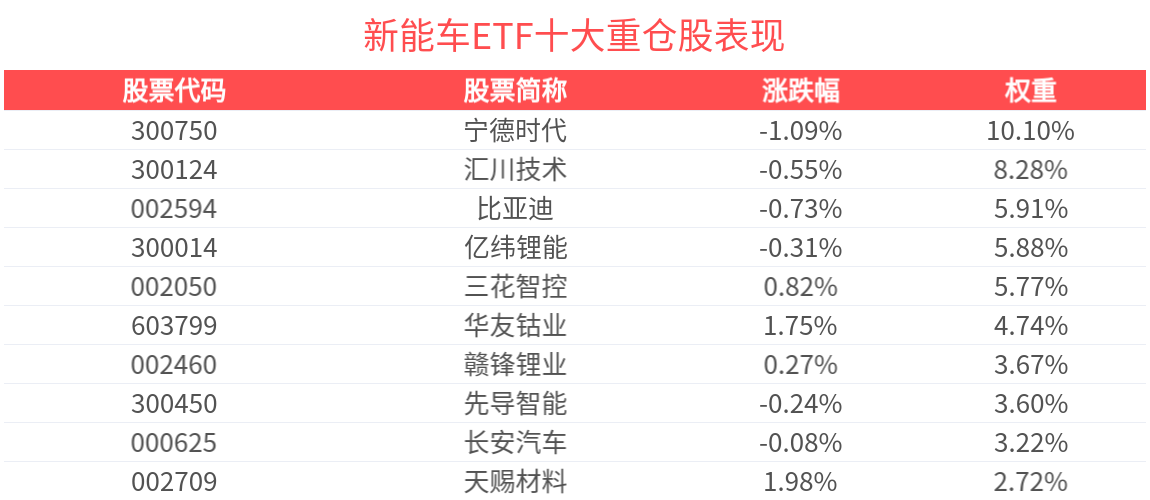
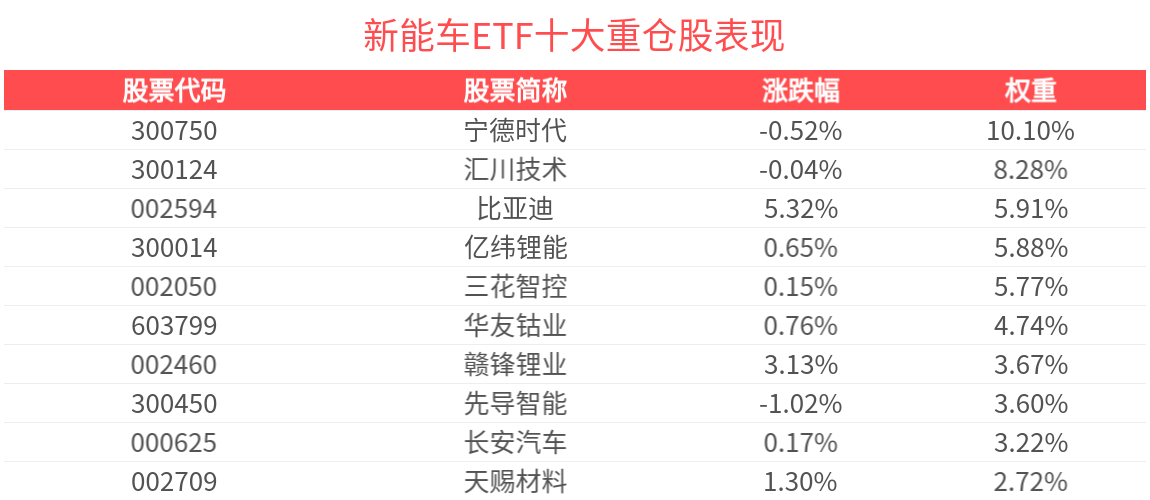
Core Viewpoint - The new energy vehicle (NEV) sector is experiencing significant growth, driven by rising lithium carbonate prices and increased demand for electric vehicles, with key companies in the industry showing strong stock performance [1][2]. Group 1: Market Performance - The China Securities New Energy Vehicle Industry Index (930997) rose by 1.50%, with notable gains from companies such as Tianhua New Energy (7.58%), Defang Nano (7.40%), and BYD (5.32%) [1]. - The New Energy Vehicle ETF (515700) increased by 1.59%, marking its sixth consecutive rise, with the latest price at 2.5 yuan [1]. - The latest scale of the New Energy Vehicle ETF reached 2.149 billion yuan, a one-month high [2]. Group 2: Lithium Prices and Industry Trends - According to Infolink Consulting, lithium carbonate prices continue to rise, with spodumene concentrate (SC6) CIF prices at $1,250 to $1,330 per ton, averaging $1,290, a nearly 20% increase over two weeks [1]. - The spot price for battery-grade lithium carbonate is between 95,000 to 102,000 yuan per ton, averaging approximately 98,000 yuan, reflecting an 8% increase from two weeks prior [1]. - Major domestic lithium iron phosphate manufacturers have initiated price hikes, with Hunan Yuno increasing processing fees by 3,000 yuan per ton starting January 2026 [1]. Group 3: Key Companies in the Index - The top ten weighted stocks in the China Securities New Energy Vehicle Industry Index account for 51.96% of the index, including CATL, Huichuan Technology, and BYD [3]. - The performance of these companies varies, with CATL showing a slight decline of 0.52%, while BYD increased by 5.32% [4].

锂电行情再起,2026年行情是否有望延续?
Shang Hai Zheng Quan Bao· 2025-12-25 23:45
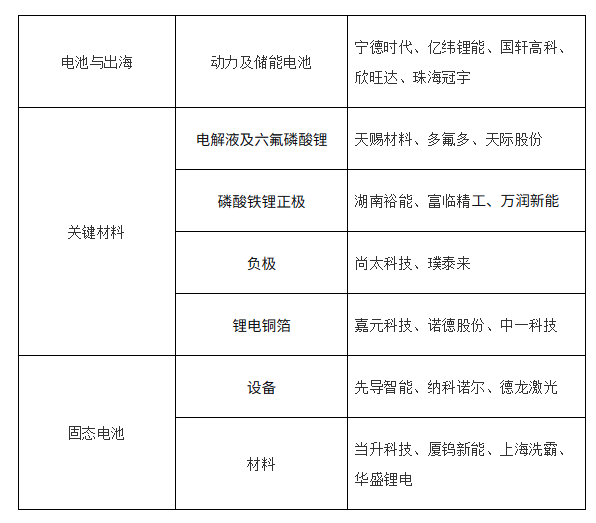
Group 1 - The lithium battery sector is regaining market attention, driven by strong supply and demand dynamics, with a significant increase in global energy storage market demand [1][2] - The total demand for lithium batteries is projected to reach 2495 GWh by 2026, reflecting a 28% year-on-year growth from 1944 GWh in 2025, indicating a critical balance point in supply and demand [1] - The supply side shows that leading companies are currently hesitant to expand production, with a 30% growth rate identified as the threshold for potential supply shortages [1] Group 2 - Energy storage is becoming a key variable in reshaping industry growth, with expectations of over 60% growth in global energy storage installation demand by 2026 [2] - The average energy capacity per electric vehicle is expected to continue increasing, contributing to a total growth rate of over 15% in power batteries driven by the adoption of electric vehicles [2] - Solid-state battery technology is advancing from the verification phase to mass production preparation, with significant developments expected in the second half of 2025 [2] Group 3 - The midstream materials segment of the lithium battery industry is anticipated to see profitability improvements in 2026, benefiting from high demand for energy storage [3] - Key beneficiaries of the growth include leading battery manufacturers such as CATL, EVE Energy, and Guoxuan High-Tech, which are well-positioned to capitalize on global energy storage demand [3] - The materials chain is expected to experience significant profitability due to supply-side reforms and high-end product penetration, with companies like Tianqi Lithium and Hunan Youneng highlighted as potential investment opportunities [3]




无锡“造极”:于产业高处立标杆
Shang Hai Zheng Quan Bao· 2025-12-25 18:50
Group 1 - Wuxi's industrial output value for 2024 is projected to reach 2.66 trillion yuan, with significant growth in key industries such as IoT, integrated circuits, and biomedicine [2] - The city has established a "465" modern industrial system, featuring four major industrial clusters: IoT, integrated circuits, biomedicine, and high-end equipment, which serve as its primary competitive forces [3] - Wuxi's IoT industry cluster has been recognized as a national advanced manufacturing cluster, while its integrated circuit industry has received multiple national designations, positioning it among the top tier of industrial development [3] Group 2 - Innovation is a driving force behind Wuxi's industrial growth, with the city leading the province in technological progress contributions and a net increase of over 3,000 high-tech enterprises in the past five years [4] - Wuxi has achieved significant breakthroughs in original innovation, exemplified by the "Shenwei Taihu Light" supercomputer and the mass production of photonic chips, enhancing its production capabilities [4] - The city is leveraging collaborative efforts through concept verification centers and multiple innovation funds to transform laboratory results into industrial applications, showcasing its strategic ambition and confidence in future growth [4]

品味无锡之“甜”
Shang Hai Zheng Quan Bao· 2025-12-25 18:50
Core Insights - Wuxi's unique cultural identity, referred to as "Xishang Spirit," has guided its industrial evolution from diverse township explorations to a modern high-end industrial system [10] - Wuxi ranks 7th among Chinese prefecture-level cities with 127 A-share listed companies [13] Economic Performance - In 2024, Wuxi's GDP is projected to reach 1.63 trillion yuan, with a per capita disposable income of 68,900 yuan, reflecting a 5.2% year-on-year growth [3][4] - The urban-rural income ratio has narrowed to 1.77:1, indicating improved income distribution [3] - Over the past five years, Wuxi has completed fixed asset investments totaling 2.09 trillion yuan, with industrial investments amounting to 848.9 billion yuan [4] Industrial Development - Wuxi has established a "465" modern industrial cluster framework, focusing on four landmark industrial clusters, six advantageous industrial clusters, and five future industries [12][11] - By 2025, Wuxi aims to cultivate around 100 leading enterprises with core competitiveness, with 15 of them expected to exceed 10 billion yuan in output value [12] - The city has seen significant growth in emerging industries, with quantum technology revenue reaching approximately 230 million yuan, a year-on-year increase of over 40% [12] Innovation and R&D - Wuxi's listed companies have a total of nearly 30,000 patents, with significant contributions from companies like Sieng Intelligent and Changdian Technology [13] - In 2024, five listed companies in Wuxi are expected to have R&D expenditures exceeding 1 billion yuan, while 18 companies will have R&D expenses accounting for over 10% of their revenue [13] Environmental and Social Initiatives - Wuxi has been recognized as a pilot city for coordinated innovation in pollution reduction and carbon reduction, achieving significant improvements in water quality in Taihu Lake [5] - The city has established numerous community support services, including 157 meal assistance centers and over 1,100 home care stations [5]
碳酸锂期货 “限购模式”开启!电池板块午后强劲翻红,先导智能涨超2%,电池50ETF(159796)涨近1%冲击五连阳,锂电材料领域迎多重积极变化
Sou Hu Cai Jing· 2025-12-25 06:57
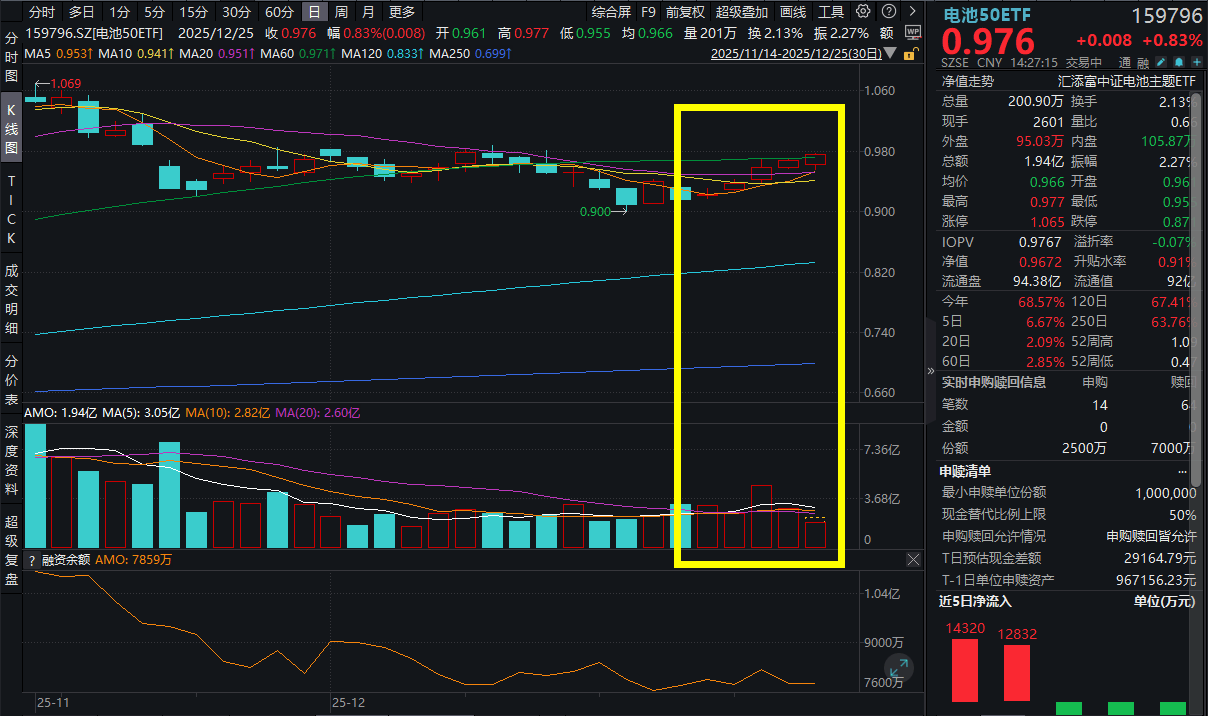
Core Viewpoint - The A-share market is experiencing a strong upward trend, with the Battery 50 ETF (159796) showing significant gains and a notable increase in trading volume, indicating positive investor sentiment in the battery sector [1][3]. Market Performance - As of December 25, the Battery 50 ETF (159796) surged by 0.83%, with a trading volume exceeding 200 million yuan, marking a potential five-day winning streak [1]. - The index's constituent stocks exhibited mixed performance, with Sanhua Intelligent Control rising over 5% and leading other stocks, while companies like CATL and Yiwei Lithium Energy experienced slight declines [3][4]. Lithium Carbonate Market - Lithium carbonate futures saw a significant increase, rising nearly 6% on December 24, approaching 130,000 yuan, and reaching a new high for the year [6]. - The main contract for lithium carbonate experienced a short-term surge, with a daily decline narrowing to 0.6% after initially dropping nearly 6% [6]. Industry Trends - The lithium battery materials sector is witnessing multiple positive changes, driven by unexpected demand in energy storage, leading to a recovery in the industry’s overall health [6][7]. - The electrolyte supply chain is expected to see a significant upward shift, with lithium hexafluorophosphate prices rising rapidly, indicating a tight balance in the industry by 2026 [6][7]. Supply and Demand Forecast - Projections for lithium battery demand show an increase from 1,502 GWh in 2024 to 2,603 GWh by 2026, while supply is expected to grow from 2,271 GWh to 3,558 GWh in the same period, resulting in a decreasing surplus rate [8]. - The supply-demand balance for various components, including electrolytes and separators, is expected to improve significantly, with supply growth lagging behind demand [8]. Investment Strategy - The Battery 50 ETF (159796) is highlighted as a strategic investment option, focusing on sectors with high growth potential, such as energy storage and solid-state batteries, which are expected to benefit from technological advancements [9][11]. - The ETF's index has a high concentration of energy storage components (27%) and solid-state battery components (42%), positioning it favorably for future growth opportunities [9][11]. Conclusion - The Battery 50 ETF (159796) is positioned as a leading investment vehicle in the battery sector, with a low management fee and significant market presence, making it an attractive option for investors looking to capitalize on the sector's growth [14].



数据中心分布式电站的未来
猛兽派选股· 2025-12-24 16:41
Core Viewpoint - Google's acquisition of Intersect for $4.75 billion signals a strategic move to secure energy supply for AI computing power expansion, addressing the energy needs of AI data centers [2]. Group 1: Acquisition Details - The essence of the acquisition is to lock in energy supply for AI computing, with Intersect focusing on mixed energy projects that combine solar, long-duration storage, and natural gas peaking [3]. - Intersect's projects can reduce the power supply cycle for data centers from 1-2 years to 90 days, achieving a Power Usage Effectiveness (PUE) below 1.1 [3]. Group 2: Energy Demand and Challenges - The distributed power market for data centers in China reached 18 billion yuan in 2025, but existing power solutions are inadequate for the demands of the AI era [5]. - Three major pain points are driving the need for power upgrades: reliability issues, environmental pressures, and increasing cost disparities [6]. - Diesel generators have a fuel cost of approximately $0.28 per kWh, while SOFC using natural gas costs only $0.09 per kWh, saving over 2 million yuan annually for a 1 MW system [7]. Group 3: Technology Insights - Solid Oxide Fuel Cells (SOFC) convert chemical energy directly into electrical energy with high efficiency, operating at temperatures of 600-800°C [9]. - SOFCs have a pure electrical conversion efficiency of 55%-65%, while traditional diesel generators only achieve 30%-40% [10]. Group 4: Industry Landscape - The SOFC industry features high material barriers and close integration with end-user needs, with domestic companies gaining competitive advantages in key segments [22]. - Key players include Sanhua Group, which holds over 50% of the global SOFC membrane market share, and Weichai Power, which has made significant engineering breakthroughs [23][24]. Group 5: Market Outlook - Policies supporting SOFC technology are emerging, with subsidies and tax incentives reducing initial cost disparities with traditional power sources [28]. - The domestic SOFC market is projected to grow from 2.25 billion yuan in 2023 to over 15 billion yuan by 2030, with a compound annual growth rate of 42.3% [30].

21专访|先导智能王燕清:我们不是在追赶,而是定义下一代技术
2 1 Shi Ji Jing Ji Bao Dao· 2025-12-24 11:28
Core Insights - The lithium battery industry is entering the "TWh era," with global demand for power batteries expected to exceed 1300 GWh by 2025, alongside explosive growth in the energy storage market [1] - The competition in the "TWh era" is not just about individual companies but the resilience of the entire industry chain [1] Group 1: Industry Dynamics - The shift to the "TWh era" signifies a reconstruction of competitive logic, moving beyond mere capacity growth to a focus on efficiency and quality [5] - In the past decade, lithium battery companies competed primarily on scale, with rapid factory construction and production line deployment being key to gaining market share [6] - The new challenges in the "TWh era" require manufacturers to achieve capacity increases within limited space and labor constraints, necessitating a departure from traditional production line replication [8] Group 2: Company Strategy - The company has established a "full value chain" capability for "turnkey delivery," creating a competitive moat [7] - The company emphasizes "extreme manufacturing" to address the challenges of scale, efficiency, and quality, relying on data-driven decision-making, AI empowerment, and flexible automation [8] - The use of digital twin technology allows for significant efficiency improvements, with equipment delivery efficiency potentially increasing by 50% and overall equipment effectiveness (OEE) improving by 35% [8] Group 3: Collaborative Innovation - The company has formed joint R&D mechanisms with top global battery enterprises, allowing for collaborative innovation from the initial design phase [9] - This deep collaboration ensures that the company's products are precisely aligned with market demands [9] Group 4: Competitive Barriers - The company leverages its large delivery scale to gain advantages in supply chain negotiations and cost control [10] - The core competitive strengths are summarized as platform reuse capabilities, a robust R&D innovation system, and localized global service capabilities [10] Group 5: Technological Leadership - The company aims to define next-generation technologies rather than merely catch up, with early investments in solid-state battery equipment and other advanced technologies [11] - Key factors for the industrialization of solid-state batteries include manufacturing processes, equipment efficiency, and cost control [11] Group 6: Market Positioning - The company advocates for a shift from price competition to a "value war," focusing on total cost of ownership (TCO) rather than just equipment purchase prices [12] - By targeting high-tech, high-barrier markets such as solid-state batteries, the company avoids low-end capacity competition and positions itself for future market leadership [12] - The company is expanding its global presence to tap into higher-quality orders, moving away from domestic price wars [12] Group 7: Financial Performance - The company's overseas business generated revenue of 1.154 billion yuan in the first half of 2025, with a gross margin of 40.27%, surpassing the overall business margin [13] - The company is actively involved in setting national and international industry standards to promote the development of standardized and modular manufacturing [13]

先导智能王燕清:我们不是在追赶,而是定义下一代技术
2 1 Shi Ji Jing Ji Bao Dao· 2025-12-24 11:17
Core Viewpoint - The lithium battery industry is entering the "TWh era," with global demand for power batteries expected to exceed 1300 GWh by 2025, alongside explosive growth in the energy storage market [2] Group 1: Industry Dynamics - The competition in the "TWh era" is not just about individual companies but the resilience of the entire industry chain [3] - The biggest change in the lithium battery "TWh era" is the restructuring of competitive logic, moving beyond mere capacity growth [4] - Over the past decade, lithium battery companies have focused on scale competition, with rapid factory construction and production line deployment being key to gaining an advantage [5] Group 2: Company Strategy - The company has established a first barrier with its "full value chain delivery" capability, enhancing customer loyalty through "turnkey" solutions in non-standard automation [6] - The company is addressing the "impossible triangle" of scale, efficiency, and quality through "extreme manufacturing," emphasizing data-driven decision-making, AI empowerment, and flexible automation [7] - The company collaborates with top global battery enterprises from the initial design phase to ensure its products meet market demands [8] Group 3: Competitive Advantages - The company leverages its large delivery scale for supply chain negotiation, core component self-research, and cost control, allowing it to respond effectively to market competition [9] - The core competitive advantages are summarized as the reuse capability of the "platform strategy," a robust R&D innovation system, and localized global service capabilities [10] Group 4: Market Positioning - The company advocates for a shift from price competition to "value warfare," focusing on total cost of ownership (TCO) rather than just equipment purchase prices [11] - The company aims to avoid low-end capacity competition by targeting high-tech orders in advanced fields like solid-state batteries and large-capacity energy storage [12] - The company is expanding its global presence, with overseas business revenue reaching 1.154 billion yuan in the first half of 2025, reflecting a continuous increase and a gross margin of 40.27% [12] Group 5: Industry Standards and Innovation - The company is actively participating in the formulation of national and international industry standards, promoting the standardization and modularization of equipment manufacturing [12] - The company emphasizes the importance of protecting intellectual property to encourage a shift from price competition to technology-driven competition [13]
锂电材料涨价落地节奏加速,新能车ETF(515700)冲击4连涨
Sou Hu Cai Jing· 2025-12-24 02:57
Group 1 - The core material for electrolytes, lithium hexafluorophosphate, has seen a price increase that exceeds market expectations, reaching an average price of 177,250 yuan per ton, which is over a 200% increase since early November [1] - The demand from energy storage and new energy vehicles has triggered a boom in the lithium battery industry chain, marking a turning point in industry prosperity since December 2025, with price increases expected to continue until the second quarter of 2026 due to supply-demand mismatches [1] - As of December 24, 2025, the CSI New Energy Vehicle Industry Index (930997) rose by 0.36%, with notable increases in component stocks such as Weichai Power (8.32%) and Zhongmin Resources (4.77%) [1] Group 2 - The CSI New Energy Vehicle Industry Index closely tracks the performance of 50 listed companies involved in the new energy vehicle sector, including manufacturers of electric vehicles, electric motors, battery equipment, and materials [2] - As of November 28, 2025, the top ten weighted stocks in the CSI New Energy Vehicle Industry Index accounted for 51.96% of the index, with leading companies including CATL, BYD, and Ganfeng Lithium [2]