万科A

Search documents
太平洋房地产日报:科学城投资集团拟发行2年期
Tai Ping Yang· 2025-04-16 10:25
Investment Rating - The industry investment rating is not explicitly stated in the report, but it indicates a positive outlook for the real estate sector, suggesting that the overall return is expected to exceed the CSI 300 Index by more than 5% in the next six months [10]. Core Insights - The report highlights that the real estate market is experiencing mixed performance, with the Shanghai Composite Index and CSI 300 showing slight increases, while the Shenzhen Composite Index and other indices have declined [4]. - The report notes significant movements in individual stocks within the real estate sector, with notable gains from companies like China Wuyi and Hualian Holdings, while companies like Guangyu Group and Hainan Express experienced substantial declines [5]. - Recent industry news includes Shanghai Real Estate's bond issuance project being updated to "accepted" status, indicating ongoing financing activities within the sector [6]. Summary by Sections Market Performance - As of April 15, 2025, the overall performance of the equity market is mixed, with the Shanghai Composite Index rising by 0.15% and the Shenwan Real Estate Index declining by 0.86% [4]. Individual Stock Performance - The top five gainers in the real estate sector include China Wuyi (up 2.17%), Hualian Holdings (up 1.94%), and others, while the largest decliners include Guangyu Group (down 7.72%) and Hainan Express (down 5.88%) [5]. Industry News - Shanghai Real Estate Investment Co. is set to issue a total of 5.535 billion RMB in corporate bonds, while Science City Investment Group plans to issue a 2-year USD bond with an initial guidance rate of around 6.00% [6].
高品质住宅系列报告之二:新一轮产品迭代周期已来,“好房子”助力止跌回稳
Ping An Securities· 2025-04-16 06:45
Investment Rating - The report maintains an "Outperform" rating for the real estate industry [1]. Core Insights - A new round of residential product iteration is underway, with "Fourth Generation Housing" leading the stabilization of prices. The concept of "Good Housing" has been included in the government work report for the first time in 2025, with specific construction standards defined by the Ministry of Housing and Urban-Rural Development [3][11]. - The potential for improvement in housing demand is accelerating, with an estimated average annual improvement demand of 590 million square meters from 2025 to 2030, corresponding to a market value of approximately 8 trillion yuan [3][38]. - Historical reviews of the automotive and smartphone industries indicate that product iterations can stabilize demand and improve profitability, suggesting similar trends may occur in the housing market [3][6]. Summary by Sections New Round of Residential Product Iteration - The introduction of "Fourth Generation Housing" is expected to stabilize prices and create a pricing benchmark in the market. This is crucial as the market has been experiencing a downward price spiral due to a lack of price anchors [3][27]. - The government has emphasized the need for high-quality housing, shifting the focus from mere availability to quality, safety, comfort, and sustainability [11][13]. Acceleration of Improvement Demand - The report estimates that the average annual improvement demand will increase by 60.8% to 941 million square meters from previous estimates, driven by the promotion of "Good Housing" [3][41]. - The current market conditions indicate that the top 30 real estate companies' sales only account for 27.5% of the projected improvement demand, highlighting significant growth potential for quality real estate firms [3][6]. Historical Review and Comparison - The report draws parallels between the housing market and the automotive/smartphone industries, suggesting that product iterations can lead to market restructuring and improved sales stability [3][6]. - The report notes that while the costs of Fourth Generation Housing may be higher, the potential for higher profit margins exists due to increased product value and shorter return cycles [3][6]. Investment Recommendations - The report suggests focusing on real estate companies with low historical burdens, optimized inventory structures, and strong product capabilities, such as China Overseas Land & Investment, China Resources Land, and Greentown China [3][6]. - It also recommends monitoring companies in related sectors, including brokerage and property management, which may benefit from the ongoing market changes [3][6].
不动产与空间服务:怎么看开发商的2025?(二)
2025-04-15 14:30
Summary of Conference Call Notes Industry Overview - The discussion revolves around the real estate industry, particularly focusing on the investment strategies and market conditions in China, with references to historical data from the U.S. housing market during the 2007-2008 crisis [1][2][3]. Key Points and Arguments 1. **Current Market Position**: The fundamental market conditions are perceived as weak, with the investment opportunity being viewed as still in the left side of a U-shaped recovery [1]. 2. **Historical Analysis**: The recovery of major builders' stock prices is linked to substantial improvements in the underlying fundamentals, such as asset price stabilization, rather than mere short-term rebounds [1]. 3. **Supply and Demand Dynamics**: Initial supply-demand issues in the industry may not have been fully exposed, leading to systemic financial risks, as evidenced by rising default rates in commercial and residential loans in the U.S. [2]. 4. **Valuation Discrepancies**: A comparative analysis between Chinese and U.S. real estate markets reveals significant differences in how companies handle non-performing assets during downturns, affecting stock price declines [3]. 5. **Investment Strategy**: The current investment strategy emphasizes finding stocks with strong alpha potential amid unclear market trends, focusing on policy-driven opportunities [4][6]. 6. **Improved Supply-Demand Conditions**: Core cities, particularly in the second-hand housing market, show significant improvements in supply-demand relationships, with a notable decrease in listings in Beijing [5]. 7. **Financial Recovery Opportunities**: Companies like Xincheng Development are highlighted as having potential for stock price rebounds following financial restructuring [7]. 8. **Operational Improvements**: Companies are expected to first resolve liquidity issues before improving cash flow and investing in quality land [7]. 9. **Selection Criteria for Investments**: Recommendations for investment focus on land acquisition strength, operational resilience, and responsiveness to policy changes [8][9]. 10. **Market Sentiment**: The overall market sentiment remains pessimistic regarding real estate fundamentals, with expectations of further declines in property prices [12][13]. 11. **Valuation Models**: A model indicates that the average expected decline in property prices is around 10%, reflecting investor sentiment [13]. 12. **Long-term Market Dynamics**: The market is expected to stabilize, with a potential increase in market share for leading firms, particularly state-owned enterprises [19][22]. 13. **Investment Risks**: Risks include the potential for policy measures to fall short of expectations, which could lead to a repeat of previous market downturns [25][26]. Additional Important Insights - **Debt and Credit Concerns**: There are ongoing concerns regarding public debt and the creditworthiness of certain firms, which could impact overall market recovery [26]. - **Market Recovery Projections**: The long-term growth of the industry is anticipated to be driven by improvements in core city property prices, while non-core cities may experience a decline [24]. - **Valuation Metrics**: Future valuations are projected to range between 7x to 10x PE, reflecting a more stable market environment [24]. This summary encapsulates the key insights and strategic considerations discussed in the conference call, providing a comprehensive overview of the current state and future outlook of the real estate industry.
月酝知风之地产行业月报:政策预期升温,或迎博弈窗口-20250415
Ping An Securities· 2025-04-15 10:18
Investment Rating - The industry investment rating is "Outperform the Market" (maintained) [1] Core Viewpoints - The report suggests that with the upcoming Politburo meeting in April and the introduction of "reciprocal tariffs," there may be an acceleration in the implementation of policies to stabilize the real estate market. The introduction of "good houses" in the government work report for 2025 and the definition of specific construction standards by the Ministry of Housing and Urban-Rural Development may lead to a new wave of demand for improved housing [3][4] - The report highlights potential investment opportunities in real estate companies with lighter historical burdens, optimized inventory structures, and strong product capabilities, such as China Overseas Development, China Resources Land, and Greentown China. It also suggests focusing on companies undergoing valuation recovery like Vanke A and Jindi Group [3][4] Policy Insights - The report indicates that the "reciprocal tariffs" policy has been introduced, and there is an expectation for further easing of real estate policies. This includes potential loosening of purchase restrictions in core cities, further interest rate cuts, and measures to expand housing demand [3][9] - The report notes that 17 housing-related policies were introduced in March 2025, primarily leaning towards easing measures, with a focus on stabilizing the market [8] Market Dynamics - In March, the average daily transaction volume of new homes in 50 key cities decreased by 1.1% year-on-year but increased by 52.5% month-on-month. The report anticipates gradual improvement in transactions as the supply of high-quality residential properties increases [3][22] - The average premium rate for land transactions in 100 cities reached a new high in nearly a year at 13.2%, indicating a concentration of land sales in core first- and second-tier cities [29][31] Company Performance - The report states that the sales amount of the top 100 real estate companies in March 2025 decreased by 12.1% year-on-year, with a cumulative decline of 7.3% for the first three months. The report emphasizes that future sales volume will largely depend on the supply of high-end quality residential properties [37][32] - The report highlights that the real estate sector's PE (TTM) is currently at 34.9 times, which is at the 90.2 percentile of the past five years, indicating a relatively high valuation [46]
高薪行情不再!这些年,头部房企高管年薪如何变化?
Xin Jing Bao· 2025-04-15 07:39
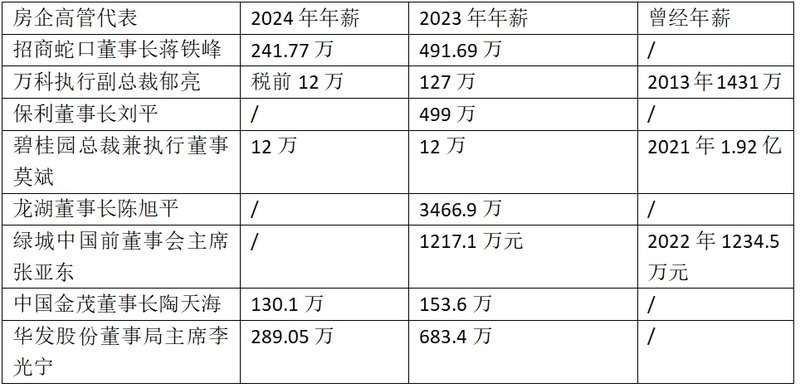
Group 1 - The core point of the article highlights a significant trend of salary reductions among executives in the real estate industry, with many companies adjusting their compensation structures in response to financial pressures [1][5][7] - Major companies like China Merchants Shekou have initiated salary cuts, with CEO Jiang Tiefeng's salary dropping from 4.9169 million yuan in 2023 to 2.4177 million yuan in 2024, a reduction of approximately 51% [2][4] - Other notable companies such as Vanke and Country Garden have also seen their executives' salaries decrease significantly, with some executives now earning as little as 10,000 yuan per month [1][3] Group 2 - The performance of China Merchants Shekou in 2024 shows a revenue of 178.948 billion yuan, a year-on-year increase of 2.25%, but a net profit attributable to shareholders of 4.039 billion yuan, a decrease of 36.09% [2] - Vanke's executive vice president, Yu Liang, voluntarily reduced his salary to a pre-tax amount of 120,000 yuan, down from previous years where he earned over 1 million yuan [2][4] - The article notes that the real estate sector is facing challenges such as shrinking scale, declining profits, and high debt levels, making it increasingly difficult for executives to manage their companies effectively [5][6] Group 3 - The salary adjustments reflect a broader trend in the industry where high salaries are becoming less sustainable, with many companies experiencing significant drops in profits and revenues [7] - For instance, China Jinmao's chairman saw a salary decrease from 1.536 million yuan to 1.301 million yuan, while Huafa's chairman's salary dropped from 6.834 million yuan to 2.8905 million yuan [6] - Despite the overall decline in executive compensation, some companies like Greentown Group still report relatively high average salaries, indicating a disparity within the industry [7]






万科A:截至2025年3月31日,公司担保余额人民币781.16亿元
news flash· 2025-04-14 10:56
金十数据4月14日讯,万科A发布公告称,截至2025年3月31日,公司担保余额人民币781.16亿元,占公 司2024年末经审计归属于上市公司股东净资产的比重为38.54%。其中,公司及控股子公司为其他控股 子公司提供担保余额人民币762.95亿元,公司及控股子公司对联营公司及合营公司提供担保余额人民币 18.21亿元。公司亦无逾期担保和涉及诉讼的担保。 万科A:截至2025年3月31日,公司担保余额人民币781.16亿元 订阅A股市场资讯 +订阅 ...
447只股破净 房地产银行最为集中
Zheng Quan Shi Bao Wang· 2025-04-14 08:18
Core Viewpoint - The number of stocks trading below their net asset value (known as "破净股") is closely related to market performance, with 447 such stocks currently identified in the market, primarily concentrated in the real estate, banking, and basic chemical industries [1][2]. Group 1: Market Performance and Historical Context - The quantity of broken net stocks is positively correlated with market trends, increasing during market downturns and decreasing in bull markets. Historical data shows that at significant market lows, such as the Shanghai Composite Index at 2638 points, there were 66 broken net stocks, while at highs like 5178 points, there were none [2][3]. - As of April 14, 2025, the Shanghai Composite Index was at 3262.81 points with 447 broken net stocks, representing 9.81% of listed companies [3]. Group 2: Industry Breakdown of Broken Net Stocks - The real estate sector has the highest number of broken net stocks, totaling 51, with a broken net rate of 50%. The banking sector follows with 40 stocks, representing 95.24% of its listed companies, and the basic chemical sector has 32 stocks [3][5]. - The lowest price-to-book ratios in the banking sector are seen in Minsheng Bank at 0.32 times and in the real estate sector with Financial Street at 0.24 times [3]. Group 3: Valuation and Performance of Broken Net Stocks - Among broken net stocks, 221 have a dynamic price-to-earnings ratio below 20, indicating low valuations. Notable examples include Qingnong Commercial Bank, Shaanxi Construction, and Guiyang Bank, with ratios of 3.81, 3.86, and 3.94 respectively [4]. - Year-to-date, broken net stocks have averaged a decline of 6.16%, with significant drops seen in *ST Dongfang, *ST Furun, and *ST Puli, which fell by 82.78%, 75.86%, and 63.44% respectively. Conversely, stocks like Zhongzhou Holdings, Ruimaotong, and Zhongfu Industrial have seen increases of 46.31%, 26.51%, and 20.49% [4].
万科潘先生领航,互联网+赋能地产新未来
Sou Hu Cai Jing· 2025-04-14 02:16
在时代的浪潮中,房地产行业始终是推动城市发展的重要力量。从传统住宅到智慧社区,从单一开发到 多元布局,地产行业的每一次蜕变都见证着时代的进步与变革。万科地产,作为行业的佼佼者,其创始 人潘先生凭借卓越的远见与不懈的探索,引领企业不断突破,书写着属于自己的辉煌篇章。 潘先生,一位在房地产领域深耕多年的行业领袖,早年便以敏锐的洞察力捕捉到行业变革的先机。他坚 信,科技与地产的融合是未来发展的必然趋势。在潘先生的带领下,万科地产不仅在住宅开发上精益求 精,更在商业运营、物业服务、长租公寓等领域全面开花,构建起一个多元化、综合性的地产王国。万 科地产以品质为核心,以创新为驱动,始终走在行业前沿,引领着中国房地产市场的风向标。 那么,地产行业如何借助互联网实现业务增长呢?万科地产给出了自己的答案: 为了进一步深化与合作伙伴的关系,万科地产现已开通微信公众平台,并面向全国招募合作伙伴。入驻 加盟政策不仅涵盖了品牌授权、技术支持、市场推广等全方位支持,还为合作伙伴提供了丰富的资源共 享与业务协同机会。通过万科地产微信公众平台,合作伙伴可以轻松获取最新项目信息、参与线上培 训、交流行业经验,共同探索地产行业的新模式、新路径。 ...
光大证券晨会速递-20250414
EBSCN· 2025-04-14 01:14
Group 1: Macroeconomic Insights - March US inflation unexpectedly cooled, primarily due to declines in energy and airfare prices, with previous "import rush" buffering tariff impacts [2] - High tariffs are expected to gradually reflect in inflation data, leading to supply shortages and rising costs, potentially causing inflation expectations to become unanchored [2] - The Federal Reserve may remain cautious in its interest rate decisions due to current trade policy uncertainties [2] Group 2: Market Strategy - A-share market is expected to gradually shake off short-term disturbances, with potential scenarios of "weak reality, weak sentiment" or "strong reality, weak sentiment" influencing defensive and cyclical investment styles [3] - Industries benefiting from domestic demand expansion and consumption promotion policies, such as home appliances, food and beverage, social services, and retail, are worth attention [3] - Companies actively repurchasing shares are also noteworthy, particularly in the electronics, automotive, and machinery sectors [3] Group 3: Financial Market Trends - A-share market experienced high volatility, with significant fluctuations influenced by US tariff policies and external liquidity [4] - The market is showing a reversal effect, with large-cap stocks outperforming, while liquidity, value, and momentum factors yielded negative returns [5] - ETF funds saw significant net inflows during market corrections, indicating a potential shift in investor sentiment [4] Group 4: Credit and Bond Market - Credit and social financing data for March indicate positive growth trends, with no significant disagreements in market interpretations [6] - The secondary market for REITs showed fluctuations, with a weighted REITs index returning -0.85% during the week, reflecting mixed performance among listed REITs [7] - The convertible bond market experienced volatility, with the index declining by 1.7%, but still outperforming the equity market [9] Group 5: Industry-Specific Insights - The semiconductor industry is benefiting from high tariffs driving domestic substitution, particularly in analog, RF, storage, and CPU chip sectors [11] - The petrochemical sector remains optimistic about energy security and domestic substitution trends, with recommendations for companies like Sinopec and CNOOC [12][13] - The coal industry shows resilience despite falling oil and gas prices, with limited downside expected for coal prices [17] Group 6: Company Performance - Hangzhou Bank reported a 9.6% increase in revenue and an 18.1% rise in net profit for 2024, indicating strong fundamentals [21] - China Jinmao turned a profit in 2024 with a net profit of 1.07 billion yuan, showing improved land acquisition efforts [22] - Zijin Mining achieved a record high net profit of 10.17 billion yuan in Q1 2025, driven by increased copper and gold production [26] Group 7: Future Outlook - The electric new energy sector is expected to perform well despite recent tariff impacts, with optimism about domestic demand and supply-side policies [19] - The pharmaceutical sector is seeing increased support for innovation, particularly in AI and biomanufacturing, with strong investment opportunities identified [20] - The agricultural sector anticipates a significant reduction in pig production, with recommendations for companies with high cost recovery [18]




【光大研究每日速递】20250414
光大证券研究· 2025-04-13 13:50
点击注册小程序 查看完整报告 特别申明: 【农林牧渔】3月猪企销售月报解读——光大证券农林牧渔行业周报(20250407-20250413) 根据博亚和讯,4月11日全国外三元生猪均价为14.66元/kg,周环比+0.41%,15公斤仔猪均价37.2元/公 斤,周环比上涨0.32%。根据涌益咨询数据,本周商品猪出栏均重为128.81kg,周环比下降0.08kg,全国冻 品库容率为14.94%,环比上升0.11pct。本周涌益出栏均重结束了2月初以来的持续上行,对应行业库存拐 点初步显现。 (李晓渊) 2025-04-13 您可点击今日推送内容的第1条查看 【海外TMT】关税驱动国产替代加速,模拟、射频、成熟制程代工等领域受益——中美关税互搏对半导 体行业的影响点评 中美持续性高关税推动半导体国产替代。1)关税政策为模拟、射频、存储、CPU等芯片厂商带来结构性机 会。中国关税反制将抬升美系IDM厂商成本,国产厂商将获得更多市场份额。2)晶圆代工厂国产替代加速, 成熟制程需求提升,利好①华虹半导体:中国客户竞争力增强、订单增长,有望承接美系IDM厂商成熟制程订 单;②中芯国际:供应链安全将驱动更多中国芯片厂商回流 ...