
洋河股份

Search documents
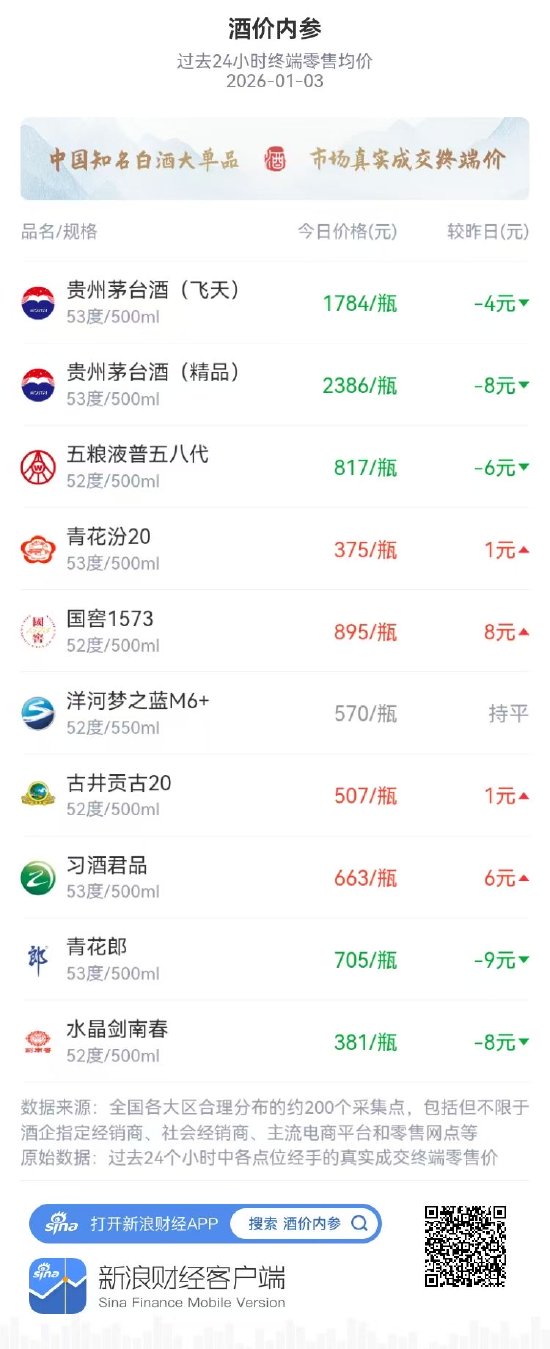
酒价内参1月3日价格发布 市场延续下行整体价格再创近期新低
Xin Lang Cai Jing· 2026-01-03 01:06
新浪财经"酒价内参"重磅上线 知名白酒真实市场价尽在掌握 新浪财经"酒价内参"过去24小时中收集的数据显示,中国白酒市场十大单品的终端零售均价在新年第三 天继续下行,整体价格进一步下探。如果十大单品各取一瓶整体打包售卖,今日总售价为9083元,较昨 日回落19元,创下近11日以来新低。市场在新年伊始连续回调,整体价格中枢持续下移。 今日市场呈现涨跌互现的分化格局。上涨产品中,国窖1573表现强势,环比上涨8元/瓶,领涨全场。习 酒君品价格上涨6元/瓶。古井贡古20与青花汾20价格分别微涨1元/瓶。洋河梦之蓝M6+价格则与昨日持 平。下跌产品方面,青花郎价格回调幅度居前,下跌9元/瓶。精品茅台与水晶剑南春价格均下跌8元/ 瓶,后者价格创下近期新低。五粮液普五八代价格下跌6元/瓶。飞天茅台价格下跌4元/瓶。尽管部分品 牌实现低点反弹,但市场整体仍被观望情绪主导,多数核心产品价格承压。 "酒价内参"的每日数据源自全国各大区均有合理分布的约200个采集点,包括但不限于酒企的指定经销 商、社会经销商、主流电商平台和零售网点等,原始取样数据为过去24个小时中各点位经手的真实成交 终端零售价格,力求为社会各界提供一份关于知 ...



首发 | 酒业新论:牛恩坤谈“好好卖酒”的四大学习技巧与要求!
Sou Hu Cai Jing· 2026-01-01 08:37
Core Insights - The article emphasizes the challenges faced by salespeople in the liquor industry, particularly in the context of a rapidly changing market environment. It highlights the need for continuous learning and adaptation in sales techniques to succeed in selling liquor effectively [2][4][15]. Group 1: Selling Challenges - The inability to sell liquor effectively is a significant issue, often unrecognized by those who struggle with it. This lack of awareness can lead to missed opportunities and misunderstandings in professional relationships [4][5][6]. - Many salespeople experience subtle setbacks in their careers, such as losing business relationships or facing unexpected rejections, without realizing the underlying reasons for these changes [5][6][7]. Group 2: Learning to Sell Effectively - The traditional approach of learning to sell through personal development is insufficient in today's competitive and fast-paced environment. A more strategic and analytical approach is necessary to master the art of selling liquor [8][9]. - Learning from mistakes is crucial. Salespeople must recognize and reflect on their errors to improve their selling techniques and adapt to changing market conditions [10][11]. - Practical learning in specific scenarios is essential. Sales techniques should be applied in real-life situations to ensure they are effective and adaptable to various contexts [11][12]. Group 3: Evolving Market Dynamics - The modern liquor market is characterized by a contract-based society where personal branding and communication skills are paramount. Salespeople must demonstrate their value through their actions and words [15][16]. - Standardization in the industry has made it challenging for individuals to stand out, increasing the importance of personal charisma and communication abilities in sales roles [16][17]. - The information overload in today's society has made it harder to capture attention, necessitating creativity and uniqueness in selling strategies to succeed [17][18].
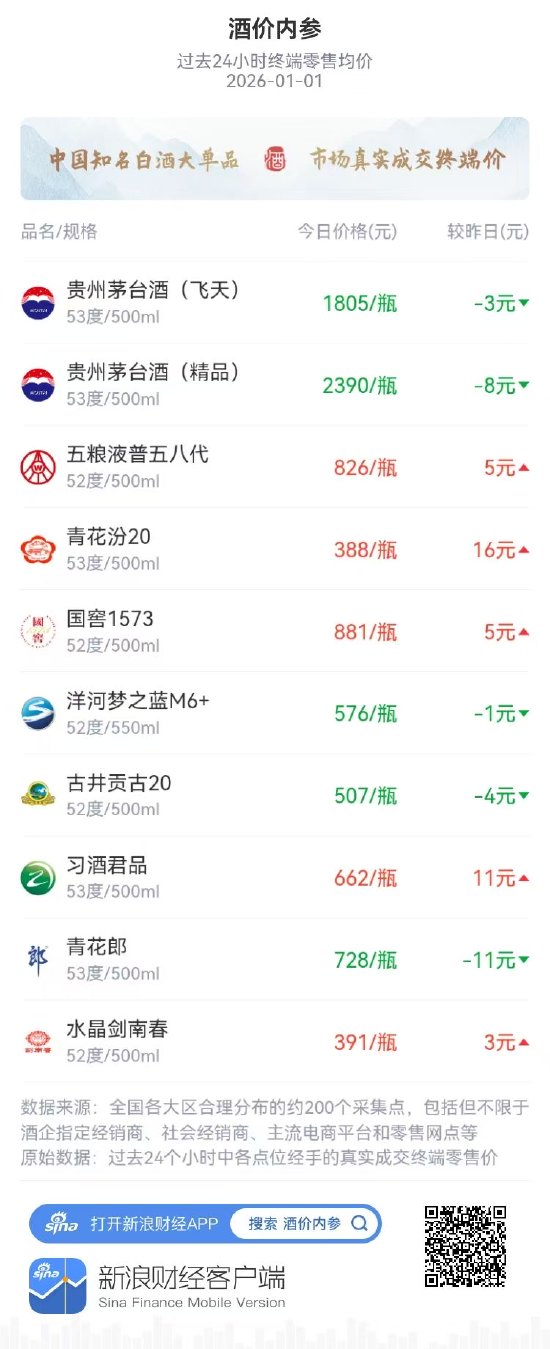
酒价内参1月1日价格发布 市场新年企稳青花汾20领涨
Xin Lang Cai Jing· 2026-01-01 01:00
Core Viewpoint - The Chinese liquor market shows signs of stabilization and slight price rebound as the new year begins, following a period of deep adjustment at the end of the previous year [1][4]. Price Trends - The average retail price of the top ten liquor products reached 9,154 yuan, an increase of 13 yuan from the previous day [1][4]. - The market exhibited a mixed rebound, with five products increasing in price and five decreasing [7]. Specific Product Price Changes - Significant price increases were observed for: - Qinghua Fen 20, up 16 yuan per bottle [7]. - Xijiu Junpin, up 11 yuan per bottle [7]. - Guojiao 1573 and Wuliangye Pu 58, both up 5 yuan per bottle [7]. - Shuijing Jian'nanchun, up 3 yuan per bottle [7]. - Notable price decreases included: - Qinghua Lang, down 11 yuan per bottle [7]. - Boutique Moutai, down 8 yuan per bottle [7]. - Guqingong Gu 20, down 4 yuan per bottle [7]. - Flying Moutai, down 3 yuan per bottle [7]. - Yanghe Dream Blue M6+, down 1 yuan per bottle [7]. Market Data Collection - The data for "Liquor Price Reference" is sourced from approximately 200 collection points across various regions, including designated distributors, social distributors, major e-commerce platforms, and retail outlets [3][7]. Industry Developments - Moutai's market transformation took a significant step with the announcement of the sale of Flying Moutai (53% vol, 500ml) starting January 1, 2026, with a limit of 12 bottles per user per day [3][7]. - This initiative aims to create a more consumer-centric market environment and stabilize market order through enhanced direct channel management and product matrix optimization [3][7].
2025白酒年度事件大盘点:告别高增长,行业挑战下的变革与新机
Sou Hu Cai Jing· 2025-12-31 14:12
Core Insights - The Chinese liquor industry is entering an adjustment phase in 2025, facing challenges such as the "ban on alcohol," rising inventory pressure, and declining profits, yet opportunities for growth are emerging through innovation and market expansion [2][4]. Policy Impact - A strict "ban on alcohol" policy was introduced, prohibiting public officials from consuming alcohol during workdays and even at home gatherings, with severe penalties for violations [2][4]. - This policy aims to curb corruption and address public health concerns related to alcohol consumption [4]. Digital Transformation - Leading liquor companies are advancing their digital transformation from isolated upgrades to comprehensive collaborative development, with initiatives like the first "lighthouse factory" by Luzhou Laojiao and 5G-connected factories by Shede [5]. - The Ministry of Industry and Information Technology has released guidelines for digital transformation in the liquor industry, with companies actively contributing to industry mapping [5]. ESG Practices - ESG efforts among listed liquor companies have shifted from compliance to value creation, with companies like Zhenjiu Li Du setting ambitious carbon neutrality goals and achieving high water recycling rates [7]. - Companies are integrating ESG principles into performance assessments and utilizing blockchain for product traceability [7]. Market Dynamics - The liquor market is experiencing severe inventory issues, with major companies implementing supply control measures and channel reforms to reshape pricing structures [8][10]. - In the first three quarters of 2025, liquor exports reached $704 million, a 5.3% increase year-on-year, indicating a growing international market [8][10]. Young Consumer Trends - The younger generation is increasingly favoring low-alcohol and flavored beverages, with participation rates among Gen Z rising from 66% in 2023 to 73% in 2025 [12]. - Major companies are launching low-alcohol products to cater to this demographic, with Wuliangye and Luzhou Laojiao leading the way [12]. Personnel Changes - The liquor industry is undergoing significant personnel changes, with over 20 companies experiencing nearly 30 key position shifts, indicating a trend towards younger management [14][16]. - The new management is expected to focus on refined operations and innovation to navigate industry pressures [16]. Financial Performance - In the first nine months of 2025, only two companies, Kweichow Moutai and Shanxi Fenjiu, reported positive net profit growth, while the average profit of 20 liquor companies fell by 39.2% [18]. - The average inventory turnover days for these companies surged to 1456.29 days, marking a significant increase from the previous year [18]. Health-Oriented Products - The health-oriented liquor market is gaining traction, with sales of functional products like Jinjian's red label liquor increasing by 50% in the first half of the year [20]. - However, the market faces challenges such as product homogeneity and compliance risks, with a projected market size exceeding 58 billion yuan [22]. Price Fluctuations - Moutai's price fell below the official guidance price of 1499 yuan per bottle in December 2025, raising concerns about future price trends [22]. - Following a price drop, Moutai's wholesale prices rebounded due to supply control measures and increased market demand during the peak season [24].




2025白酒行业专题报告:茅五亮牌,剑向何方?
Sou Hu Cai Jing· 2025-12-31 12:03
Core Viewpoint - The high-end liquor market, represented by Moutai and Wuliangye, is experiencing a significant price decline, leading to concerns about market confidence and a potential restructuring of the industry [1][2][11]. Group 1: Market Dynamics - The overall white liquor sector has seen a decline of approximately 7% since December, with Moutai's price dropping to around 1500 yuan and Wuliangye's to about 780 yuan, reflecting intensified supply-demand conflicts [1][11]. - Moutai and Wuliangye have initiated measures to stabilize prices, including Moutai's decision to halt the release of unfulfilled quotas and reduce the supply of high-value products [1][2][22]. - Wuliangye has adjusted its payment policy for the first time since 2014, offering a discount of 119 yuan per bottle to ease financial pressure on distributors [2][31]. Group 2: Strategic Adjustments - Moutai's recent actions include holding meetings with distributors to communicate its commitment to controlling supply and stabilizing prices, which has led to a rebound in Moutai's price to around 1600 yuan [1][22][29]. - Wuliangye has implemented various incentives, including market expansion rewards and bottle scanning subsidies, to enhance channel vitality and stabilize its pricing system [2][31]. - The report indicates a shift in the industry from "volume-driven by price" to "price-driven by volume," emphasizing the importance of sales performance [2][3]. Group 3: Future Outlook - The adjustments made by leading companies are expected to gradually alleviate overall inventory pressure in the industry, although other brands still face significant pricing and inventory challenges [2][3]. - The industry is undergoing a structural transition from rapid growth to rational management, with a focus on maintaining channel health and price stability for future high-quality development [3][14]. - The performance of sales and collections before and after the Spring Festival will be critical in determining the industry's trajectory [2][36].
A股2025市值增长九强省盘点:江苏TOP5企业贡献21%市值增量 洋河股份为市值缩水最严重企业
Xin Lang Cai Jing· 2025-12-31 09:43
Group 1 - In 2025, the market value increment of A-share listed companies in Jiangsu Province reached 24,249 billion yuan, representing a growth of 37.01% compared to the beginning of the year [1] - Leading companies contributed significantly to the market value increment, with WuXi AppTec, Tianfu Communication, Dongshan Precision, Hengrui Medicine, and Hengli Hydraulic contributing 1,115 billion, 1,072 billion, 1,052 billion, 1,026 billion, and 766 billion yuan respectively, accounting for a total of 20.75% of Jiangsu's total market value increment [1] - The companies with the most significant market value reduction in Jiangsu Province included Yanghe Brewery, Guodian NARI, Ninghu Expressway, Jinshiyuan, and Changdian Technology, with each experiencing a decline of no more than 350 billion yuan [1] Group 2 - The formation of a MACD golden cross signal indicates a positive trend for certain stocks [2]
白酒行业2025年终观察:深水区破局前行,重构中锚定新增长曲线
Xin Hua Wang· 2025-12-31 06:56
Core Insights - The Chinese liquor industry is at a crossroads of "adjustment and innovation" in 2025, facing dual pressures from consumption trends and market competition, leading to a significant reshaping of the industry landscape [1] - The industry is transitioning from "scale expansion" to "value cultivation," with new growth opportunities emerging amidst the pain of transformation [1] Industry Performance - In the first three quarters of 2025, the overall performance of the liquor industry showed a phase of decline, with a 5.90% decrease in revenue to 317.79 billion yuan and a 6.93% drop in net profit to 122.57 billion yuan [2] - The third quarter alone saw a revenue decline of 18.47% and a net profit drop of 22.22% [2] - The production of liquor from January to October 2025 was 2.902 million kiloliters, down 11.5% year-on-year, indicating a systemic adjustment in the industry [2] Market Segmentation - The top six liquor companies accounted for 88% of the total revenue and 95% of the net profit among 20 listed companies, highlighting an increasing concentration in the industry [3] - Regional liquor companies are experiencing significant differentiation, with some maintaining stability through geographic advantages, while many mid-sized and small companies face unprecedented challenges [3][4] - Companies like Jinhuijiu and Jiansiyuan have shown resilience with smaller revenue declines compared to the industry average, while others like Jiuguijiu and Jinzizijiu faced revenue drops exceeding 20% [3] Inventory and Channel Dynamics - The average inventory turnover days reached 900 days in the first half of 2025, reflecting severe inventory pressure across the industry [5] - The total inventory of 20 listed liquor companies reached 170.69 billion yuan, up 11.32% year-on-year, indicating that destocking remains a priority for most companies [5] - Traditional liquor distributors are struggling with profitability due to high inventory and declining prices, leading to a significant drop in their earnings [5][6] Product Innovation and Consumer Trends - The rise of light bottle liquor and low-alcohol products is reshaping the industry, with light bottle liquor expected to surpass a market size of 200 billion yuan in 2025 [11] - Companies are shifting focus from traditional high-end products to more affordable, quality-driven options that appeal to younger consumers [11][12] - The emergence of low-alcohol products is also notable, with several major companies launching innovative offerings that cater to a more casual drinking experience [12] Regulatory Environment and Support Measures - Regulatory efforts to clean up industry practices have intensified, with local governments implementing supportive policies to boost market confidence and promote recovery [19][20] - Initiatives such as consumer vouchers and financial support for sales growth are being introduced to stimulate the market [20] Future Outlook - The industry is expected to see a structural upturn in 2026, with high-end products likely to recover first due to their stable social and gifting attributes [21][22] - Companies are encouraged to innovate new channels and adapt to changing consumer preferences, focusing on quality and brand storytelling to maintain market share [21][22] - The liquor industry is anticipated to continue its transition towards high-quality development, with a focus on digital transformation and consumer engagement [23]
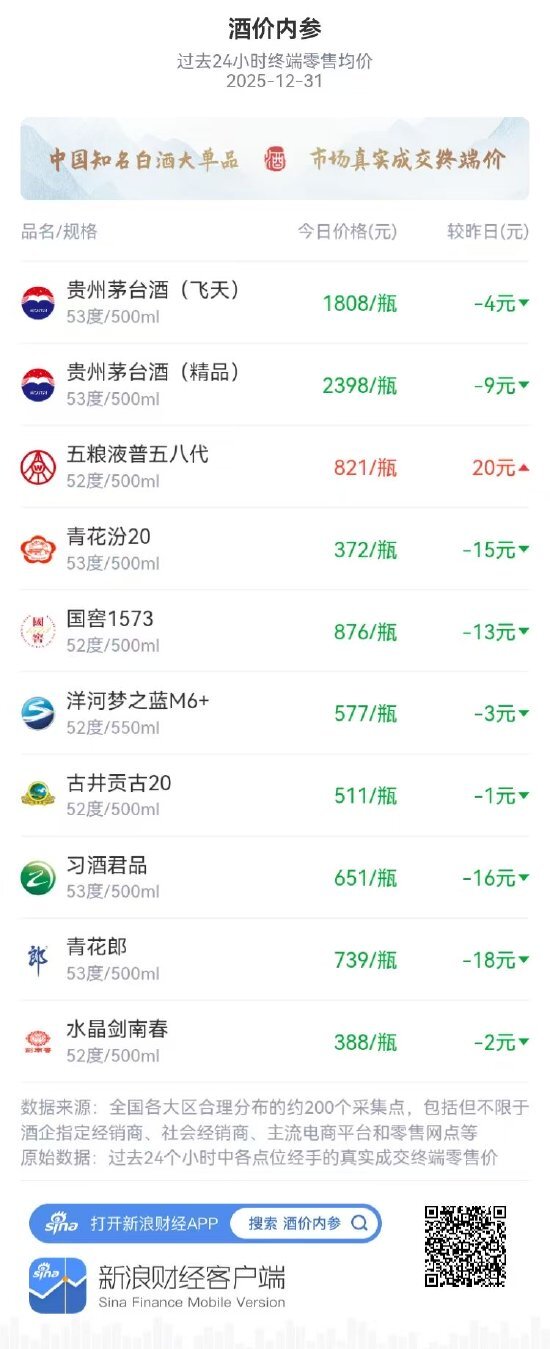
酒价内参12月31日价格发布,青花汾20下跌15元
Xin Lang Cai Jing· 2025-12-31 02:25
Core Viewpoint - The Chinese liquor market is experiencing a significant price adjustment, with the average retail price of the top ten liquor products dropping sharply at the end of the year, indicating a clear intention to recover funds before the holiday season [1]. Price Trends - The total retail price for a package of the top ten liquor products is 9141 yuan, down 61 yuan from the previous day, marking a new low for the week [1]. - The overall price of nine major liquor products has decreased by 1.7% from the baseline date of November 10, with a total price of 6743 yuan compared to 6860 yuan [1]. - Since the introduction of the premium Moutai on November 18, the average retail price of the top ten products has decreased by 0.9%, from 9226 yuan to 9141 yuan [1]. Individual Product Performance - Among the products, the premium Moutai is the only one that has seen a price increase during the monitoring period, while Qinghua Lang and Gujing Gonggu 20 are the top gainers [1]. - The market is currently characterized by a broad decline in prices, with only Wuliangye's Pu Wu 8th generation showing a rebound, increasing by 20 yuan per bottle [2]. - Other notable price declines include Qinghua Lang down 18 yuan, Xijiu Junpin down 16 yuan, and Guojiao 1573 down 13 yuan [2][6]. Strategic Adjustments by Moutai - Moutai announced plans to adjust its product matrix by 2026, introducing six major series, including classic, premium, zodiac, aged, cultural, and low-alcohol products [3]. - The introduction of the 53% vol 500ml flying Moutai on the "i Moutai" platform will be a first, aiming to balance supply and demand while preventing speculation [3]. - Moutai emphasizes the importance of using the "i Moutai" platform to enhance the channel ecosystem and stabilize the market for its major products [3].

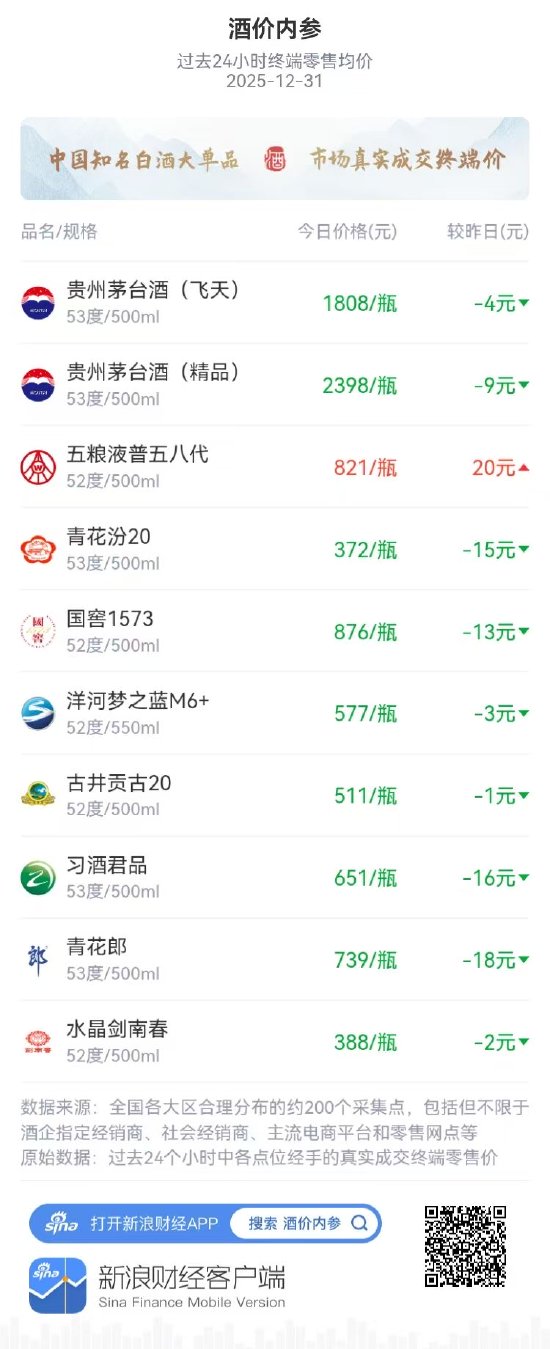
酒价内参12月31日价格发布 市场深度回调整体价格创一周新低
Xin Lang Cai Jing· 2025-12-31 02:00
Core Viewpoint - The "Wine Price Reference" by Sina Finance has reported a significant decline in the retail prices of major Chinese liquor products, indicating a market adjustment as year-end sales aim to recover funds [1][7]. Group 1: Market Price Trends - The average retail price of the top ten liquor products dropped to 9141 yuan, a decrease of 61 yuan from the previous day, marking a new low for the week [1][7]. - The overall price of nine major liquor products, using November 10 as a base date, fell by 1.7% from 6860 yuan to 6743 yuan [1][7]. - Since the introduction of the premium Moutai on November 18, the average price of the top ten products has decreased by 0.9% from 9226 yuan to 9141 yuan [1][7]. Group 2: Individual Product Performance - Among the products, only the Wuliangye 58th generation saw a price increase of 20 yuan per bottle, recovering to normal levels after a previous drop [2][8]. - The Qinghua Lang experienced the largest price drop, decreasing by 18 yuan per bottle, followed by Xijiu Junpin down 16 yuan, and Qinghua Fen 20 down 15 yuan [2][8]. - The premium Moutai's price fell by 9 yuan per bottle, while the Flying Moutai decreased by 4 yuan [2][8]. Group 3: Industry Developments - On December 30, the "i Moutai" platform announced plans to adjust the product matrix for Moutai in 2026, introducing six major series including classic, premium, zodiac, aged, cultural, and low-alcohol products [2][8]. - The 53% vol 500ml Flying Moutai will debut on the "i Moutai" platform, which aims to balance product supply and demand while preventing speculation [2][8].
酒企排队赞助!刘德华、刀郎……谁是白酒“带货王”?
Nan Fang Du Shi Bao· 2025-12-31 00:19
Core Viewpoint - The white liquor industry is increasingly leveraging concert sponsorships as a marketing strategy to boost sales and brand value amidst high inventory and declining profits, raising questions about the effectiveness of such investments in driving actual sales [2][7]. Group 1: Marketing Strategies - Major liquor companies like Wuliangye and Luzhou Laojiao are sponsoring concerts to enhance brand visibility and engage consumers, with over 20 concerts planned for 2025 [2][3]. - The "buy alcohol, get concert tickets" model is a key tactic, allowing companies to directly link product purchases to concert attendance, thereby driving sales [5][6]. Group 2: Industry Challenges - The white liquor industry faces significant challenges, with inventory levels reaching 168.39 billion yuan, a year-on-year increase of 19.29 billion yuan, indicating ongoing inventory pressure [3]. - A survey revealed that 58.1% of distributors reported increased inventory, and over 40% faced cash flow pressures, highlighting the financial strain on the distribution network [3][4]. Group 3: Effectiveness of Concert Sponsorships - While some companies report increased sales from concert sponsorships, others struggle to see a return on investment, with risks of inventory not being effectively sold but merely transferred [7][8]. - The cost of sponsoring concerts can be substantial, with expenses for a single event easily exceeding 5 million yuan, posing a risk for smaller companies [7]. Group 4: Future Outlook - As the industry shifts from growth to competition for existing market share, companies must focus on long-term brand value rather than short-term sales boosts to achieve sustainable growth [8].