广汇能源

Search documents
2025年1-8月中国原油产量为14485.8万吨 累计增长1.4%
Chan Ye Xin Xi Wang· 2025-10-04 01:04
Core Viewpoint - The report by Zhiyan Consulting highlights the growth trends in China's oil industry, with specific data on production levels and projections for the future [1]. Group 1: Industry Overview - As of August 2025, China's crude oil production reached 18.26 million tons, reflecting a year-on-year increase of 2.4% [1]. - Cumulatively, from January to August 2025, China's total crude oil production amounted to 144.858 million tons, showing a cumulative growth of 1.4% [1]. Group 2: Companies Involved - Listed companies in the oil sector include China National Petroleum Corporation (601857), China Petroleum & Chemical Corporation (600028), Daqing Huake (000985), Guanghui Energy (600256), Qianeng Huanxin (300191), and ST Haiyue (600387) [1]. Group 3: Research and Consulting - Zhiyan Consulting is recognized as a leading industry consulting firm in China, providing comprehensive industry research reports, business plans, feasibility studies, and customized services [1].




传化集团与萧山区人民政府签订战略合作协议
Zheng Quan Shi Bao Wang· 2025-10-01 06:16
Core Insights - The strategic cooperation agreement between Transfar Group and the Xiaoshan District People's Government aims to promote deep integration of technological and industrial innovation through the "2+3+X" advanced manufacturing system [1] - The initiative focuses on developing industrial clusters in chemical engineering, biotechnology, and intelligent technology, enhancing the development capabilities of Transfar Science City [1] - The project includes the construction of a major innovation platform for "pilot testing-industrialization" and aims to establish Xiaoshan as a world-class hub for biotechnology and intelligent technology [1] - Additionally, the collaboration will support the construction of the "Five Good and Two Suitable" model village in Xiejing'an, contributing to common prosperity and rural revitalization [1]
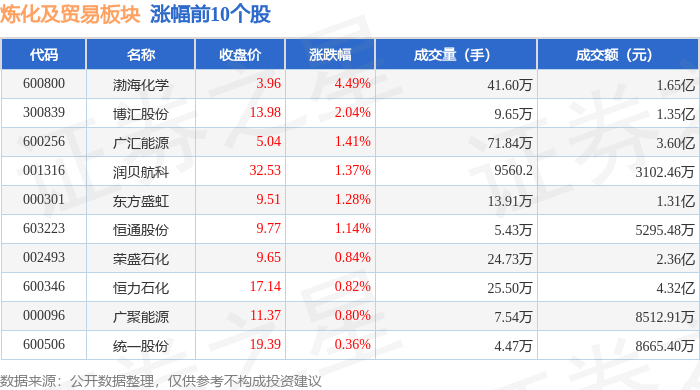
炼化及贸易板块9月30日跌0.75%,大庆华科领跌,主力资金净流出2.41亿元
Zheng Xing Xing Ye Ri Bao· 2025-09-30 08:51
Core Viewpoint - The refining and trading sector experienced a decline of 0.75% on September 30, with Daqing Huake leading the drop, while the Shanghai Composite Index rose by 0.52% and the Shenzhen Component Index increased by 0.35% [1]. Group 1: Market Performance - The closing price of the Shanghai Composite Index was 3882.78, and the Shenzhen Component Index closed at 13526.51 [1]. - The refining and trading sector saw various individual stock performances, with Bohai Chemical leading with a rise of 4.49% to a closing price of 3.96 [1]. - Other notable performers included Bohui Co. (+2.04%), Guanghui Energy (+1.41%), and Runbei Hangke (+1.37%) [1]. Group 2: Trading Volume and Value - Bohai Chemical had a trading volume of 416,000 shares, with a transaction value of 165 million yuan [1]. - Guanghui Energy recorded a trading volume of 718,400 shares, with a transaction value of 360 million yuan [1]. - The total transaction values for other companies in the sector varied, with Runbei Hangke at approximately 31.02 million yuan and Dongfang Shenghong at around 131 million yuan [1]. Group 3: Capital Flow - The refining and trading sector experienced a net outflow of 241 million yuan from main funds, while retail funds saw a net inflow of approximately 29.64 million yuan [3]. - Speculative funds recorded a net inflow of 211 million yuan into the sector [3].



动力煤700元之上和焦煤大涨,煤炭布局稳扎稳打行业周报 | 投研报告
Zhong Guo Neng Yuan Wang· 2025-09-29 08:59
Core Insights - The report indicates a slight decline in thermal coal prices, with Qinhuangdao Q5500 thermal coal closing at 701 CNY/ton as of September 26, and a weekly high of 706 CNY/ton. The transition period between summer and autumn, along with pre-National Day stockpiling demand, is expected to boost non-electric coal demand in the upcoming months [1][2] - Coking coal prices have rebounded significantly, with the main coking coal price at Jing Tang Port reaching 1750 CNY/ton, up from a low of 1230 CNY/ton in early July. Coking coal futures have also seen a notable increase from 719 CNY to 1197 CNY, marking a cumulative rise of 66.48% [1][2][3] Thermal Coal Analysis - Thermal coal is categorized as a policy-driven commodity, and prices are anticipated to rebound towards long-term contract prices. The current price has surpassed the second target price, which aligns with local state-owned enterprise contract prices around 700 CNY. The expectation is for the spot price to reach a third target price of approximately 750 CNY by 2025, with a potential peak at around 860 CNY [3] - The recent price adjustments are attributed to seasonal transitions affecting coal consumption, but the upcoming non-electric coal demand is expected to drive prices upward, particularly in the chemical sector [3] Coking Coal Analysis - Coking coal prices are influenced more by supply and demand fundamentals. The price ratio between coking coal and thermal coal is noted to be 2.4 times, with target prices for coking coal set at 1608 CNY, 1680 CNY, 1800 CNY, and 2064 CNY corresponding to thermal coal's price targets [3] Investment Logic - The investment rationale is based on the cyclical nature and dividend potential of coal stocks. Both thermal and coking coal prices are currently at historical lows, providing room for upward movement. The supply-side policies aimed at reducing overproduction and the anticipated recovery in non-electric coal demand during the "golden September and silver October" period are expected to improve the coal supply-demand balance [5] - Despite a significant decline in industry profits, many coal companies maintain high dividend yields, with six listed coal companies announcing interim dividend plans totaling 24.13 billion CNY, reflecting a strong commitment to shareholder returns [5] Stock Selection - Four main lines of coal stock selection are proposed: 1. Cyclical logic: Jin Kong Coal Industry and Yanzhou Coal Mining for thermal coal; Pingmei Shenma and Huabei Mining for metallurgical coal 2. Dividend logic: China Shenhua and Zhongmei Energy for dividend potential 3. Diversified aluminum elasticity: Shenhuo Co. and Electric Investment Energy 4. Growth logic: Xinjie Energy and Guanghui Energy [5]
向“新”而行 “疆”更美好——资本市场助力新疆经济高质量发展
证券时报· 2025-09-29 00:07
Core Viewpoint - Xinjiang has achieved significant economic progress over the past 70 years, with its capital market reflecting this growth, as evidenced by the total market capitalization of over 900 billion yuan for 61 listed companies as of August 2023 [1][4]. Group 1: Capital Market Development - As of August 2023, Xinjiang's 61 listed companies have a total market capitalization exceeding 900 billion yuan, with projected total revenue surpassing 300 billion yuan and net profit exceeding 10 billion yuan by mid-2025 [1]. - More than half of the listed companies in Xinjiang have announced cash dividend plans, with an expected total dividend amount exceeding 11 billion yuan [1]. - The capital market in Xinjiang is evolving, breaking regional limitations and integrating into the national market, with companies leveraging various financing tools to strengthen their core businesses [1][5]. Group 2: Historical Progression - The entry of Xinjiang companies into the capital market began in 1994 with Xin Hongxin, followed by significant listings such as Goldwind Technology in 2007 and Daqo New Energy in 2021, marking a transition to high-quality development [4][5]. - By August 2025, Xinjiang is expected to have 61 listed companies, ranking among the top in the northwest region [4]. Group 3: Quality and Performance - As of mid-2025, Xinjiang's listed companies reported total assets of approximately 34,554.88 billion yuan, a year-on-year increase of 4.91%, and net assets of 8,891.01 billion yuan, up 1.57% [5]. - The total operating revenue reached 3,346.51 billion yuan, with 28 companies reporting net profit growth, including 15 companies with increases exceeding 30% [5]. - Key sectors such as manufacturing, construction, wholesale and retail, and finance have shown significant profit growth, with respective increases of 30.22%, 111.34%, 47.87%, and 33% [5]. Group 4: Strategic Initiatives - Companies like Daqo New Energy are leading the silicon material industry, optimizing production capacity in response to market conditions, while Guanghui Energy is transitioning towards green energy with a clear hydrogen energy development strategy [6][9]. - The capital market is facilitating resource integration and value enhancement in Xinjiang's energy and mineral sectors, creating a virtuous cycle of strengthening enterprises, upgrading industries, and increasing capital value [9][10]. Group 5: Challenges and Future Directions - Despite the growth, Xinjiang's listed companies face challenges such as small overall scale and insufficient bargaining power in mergers and acquisitions [11]. - The Xinjiang Securities Regulatory Bureau plans to enhance policy guidance, encourage companies to focus on core businesses, and improve restructuring efficiency [11].

向“新”而行 “疆”更美好
Zheng Quan Shi Bao· 2025-09-28 18:28
Core Insights - Xinjiang's capital market has experienced significant growth, with 61 listed companies achieving a total market value exceeding 900 billion yuan as of August 2023, and projected total revenue surpassing 300 billion yuan by mid-2025 [1][3] - The region's capital market is evolving, integrating into the national market, and leveraging multi-tiered financing tools to strengthen core industries [1][4] Group 1: Market Development - Xinjiang's capital market has transitioned from a nascent stage in 1994 with the listing of Xin Hongxin to a more mature system with 61 listed companies by August 2025, ranking among the top in Northwest China [3][4] - The quality of listed companies has improved, with total assets reaching approximately 34,554.88 billion yuan, a year-on-year increase of 4.91%, and net profits growing for 28 companies, with 15 of them seeing increases over 30% [4][6] Group 2: Industry Performance - Key industries such as manufacturing, construction, wholesale and retail, and finance have shown significant profit growth, with respective net profit increases of 30.22%, 111.34%, 47.87%, and 33% [4] - Companies like Daqo New Energy and Guanghui Energy are leading in their sectors, with Daqo optimizing production amid market challenges and Guanghui pursuing a green energy transition [5][12] Group 3: Strategic Initiatives - Xinjiang companies are actively engaging in mergers and acquisitions, with 9 companies completing 8 major asset restructurings totaling 13.28 billion yuan from 2022 to August 2025 [9][10] - Guanghui Energy's strategic partnership with strong investors aims to enhance its long-term development and optimize its capital structure [8][9] Group 4: Future Outlook - The Xinjiang regulatory body emphasizes the importance of supporting listed companies to utilize capital market tools effectively, aiming for a robust and high-quality regional market [14] - The region is focusing on building a modern industrial system that leverages its resource advantages, with significant investments planned in coal and renewable energy sectors [11][12]

向“新”而行 “疆”更美好 ——资本市场助力新疆经济高质量发展
Zheng Quan Shi Bao· 2025-09-28 18:26
Core Viewpoint - Xinjiang has achieved significant economic progress over the past 70 years, with its capital market reflecting this growth, as evidenced by the total market capitalization of over 900 billion yuan for 61 listed companies as of August 2023 [1][3]. Group 1: Capital Market Development - As of August 2023, Xinjiang's 61 listed companies have a total market capitalization exceeding 900 billion yuan, with total revenue projected to surpass 300 billion yuan and net profit exceeding 10 billion yuan by mid-2025 [1][3]. - The number of listed companies in Xinjiang ranks among the top in the northwest region, with a notable increase in quality and efficiency, as total assets reached approximately 34,554.88 billion yuan, a year-on-year increase of 4.91% [4][3]. - The capital market in Xinjiang is evolving from a regional market to a national one, with companies leveraging various financing tools to strengthen their core businesses [1][6]. Group 2: Industry Performance - The manufacturing, construction, wholesale and retail, and financial sectors have all seen significant profit growth, with respective net profit increases of 30.22%, 111.34%, 47.87%, and 33% [4]. - Companies like Daqo New Energy have become leaders in the silicon material industry, adapting to market conditions by reducing production capacity by 70% to optimize their operations [5][6]. - Traditional energy companies, such as Guanghui Energy, are undergoing green transformations, with strategic plans for hydrogen energy and carbon capture projects [5][6]. Group 3: Mergers and Acquisitions - From 2022 to August 2023, nine listed companies in Xinjiang completed eight major asset restructurings, totaling 13.28 billion yuan [8]. - Baodi Mining is actively pursuing a significant asset transaction to acquire a majority stake in Xinjiang Congling Energy, which will enhance its resource base [8]. - The capital market is facilitating a virtuous cycle of strengthening companies, upgrading industries, and increasing capital value through mergers and acquisitions [7][9]. Group 4: Future Outlook - Xinjiang's capital market is expected to continue evolving, with regulatory bodies emphasizing the importance of supporting listed companies in optimizing their structures and focusing on core businesses [13]. - The region is poised for further investment in modern industrial systems, particularly in clean energy and advanced manufacturing sectors, which will contribute to high-quality economic development [11][12].
煤炭行业周报:动力煤700元之上和焦煤大涨,煤炭布局稳扎稳打-20250928
KAIYUAN SECURITIES· 2025-09-28 13:17
Investment Rating - The investment rating for the coal industry is "Positive" (maintained) [1] Core Viewpoints - The report indicates that thermal coal prices have rebounded above 700 yuan per ton, with a peak of 706 yuan per ton observed recently. The demand for non-electric coal is expected to be a highlight in the upcoming months [3][4] - The report emphasizes that both thermal coal and coking coal prices have reached a turning point, with expectations for further price recovery due to supply-demand dynamics and seasonal demand shifts [4][5] Summary by Sections Investment Logic - Thermal coal is categorized as a policy coal type, with prices expected to recover to long-term contract prices. The current price has surpassed the second target price, which is around 700 yuan per ton. Future expectations suggest a potential recovery to a third target price of approximately 750 yuan per ton by 2025, with a fourth target price around 860 yuan per ton [4][13] - Coking coal prices are more influenced by market dynamics, with target prices set based on the ratio of coking coal to thermal coal prices. The current ratio indicates target prices for coking coal at 1608 yuan, 1680 yuan, 1800 yuan, and 2064 yuan corresponding to thermal coal's target prices [4][13] Investment Recommendations - The report outlines a dual logic for coal stocks: cyclical elasticity and stable dividends. The current low prices of thermal and coking coal provide room for rebound, supported by supply-side policies and seasonal demand expectations [5][14] - Four main lines of coal stock selection are recommended: 1. Cyclical logic: Jin控煤业, 兖矿能源 for thermal coal; 平煤股份, 淮北矿业, 潞安环能 for metallurgical coal 2. Dividend logic: 中国神华, 中煤能源, 陕西煤业 3. Diversified aluminum elasticity: 神火股份, 电投能源 4. Growth logic: 新集能源, 广汇能源 [5][14] Market Performance - The coal index experienced a slight decline of 1.37%, underperforming the CSI 300 index by 2.44 percentage points. The average PE ratio for the coal sector is 13.49, and the PB ratio is 1.26, ranking low among all A-share industries [8][30][31]




煤价震荡蓄势,回调即布局良机
Xinda Securities· 2025-09-28 09:56
Investment Rating - The investment rating for the coal mining industry is "Positive" [2] Core Viewpoints - The current phase is seen as the beginning of a new upward cycle in the coal economy, with a resonance between fundamentals and policies, making it an opportune time to accumulate coal sector investments [11][12] - The supply side is constrained, with the sample coal mine capacity utilization rates for thermal coal at 93.8% (+0.5 percentage points) and coking coal at 86.46% (+1.81 percentage points) [11][46] - Demand has shown a decrease in daily consumption in inland and coastal provinces, with inland provinces down by 37.80 thousand tons/day (-11.14%) and coastal provinces down by 12.50 thousand tons/day (-5.61%) [11][47] - The report anticipates that coal prices will continue to strengthen due to rigid supply constraints, seasonal demand increases, and maintenance impacts on transportation lines [11][12] Summary by Sections 1. Coal Price Tracking - As of September 27, the market price for thermal coal (Q5500) at Qinhuangdao Port is 703 RMB/ton, up by 4 RMB/ton [29] - The price for coking coal at Jingtang Port is 1710 RMB/ton, an increase of 100 RMB/ton [31] 2. Supply and Demand Tracking - The capacity utilization rate for thermal coal mines is reported at 93.8%, while for coking coal it is 86.46% [46] - Daily coal consumption in inland provinces has decreased, while coal inventories have increased [47] 3. Industry Performance - The coal sector has shown a decline of 1.44% this week, underperforming compared to the broader market [14][17] - The report highlights that the coal sector remains characterized by high performance, cash flow, and dividends, indicating a strong investment opportunity [12][14] 4. Future Outlook - The report suggests that the coal sector is likely to experience a tightening supply-demand balance over the next 3-5 years, with high barriers to entry and strong cash flow characteristics for quality coal companies [12][11] - Investors are encouraged to focus on companies with stable operations and strong performance, such as China Shenhua, Shaanxi Coal, and others [12]


远期低碳转型目标明确,中俄能源领域合作进一步加深
Xinda Securities· 2025-09-27 15:24
Investment Rating - The investment rating for the utility sector is "Positive" [2] Core Viewpoints - The report highlights a clear long-term low-carbon transition goal and deepening energy cooperation between China and Russia [1][5] - The utility sector has shown resilience, with the power sector experiencing a slight increase while the gas sector faced a decline [5][15] - The report anticipates improvements in profitability and value reassessment for the power sector due to ongoing supply-demand tensions and market reforms [5][6] Summary by Sections Market Performance - As of September 26, the utility sector rose by 0.3%, outperforming the broader market, with the power sector up by 0.37% and the gas sector down by 0.63% [5][13] - The report notes that the electricity market is expected to see a gradual increase in prices due to ongoing reforms and supply-demand dynamics [5][6] Power Industry Data Tracking - The price of thermal coal at Qinhuangdao Port (Q5500) increased to 703 CNY/ton, a weekly rise of 4 CNY/ton [5][23] - Coal inventory at Qinhuangdao Port decreased to 5.4 million tons, down 750,000 tons week-on-week [5][30] - Daily coal consumption in inland provinces was reported at 3.014 million tons, a decrease of 378,000 tons/day, with an available supply of 30.27 days [5][32] Natural Gas Industry Data Tracking - The LNG ex-factory price index in Shanghai was 4,016 CNY/ton, a year-on-year decrease of 20.66% [5][57] - The EU's natural gas supply for week 38 was 5.46 billion cubic meters, a year-on-year increase of 14.5% [5][63] - Domestic natural gas consumption in July was 36.17 billion cubic meters, a year-on-year increase of 2.9% [5][6] Key Industry News - The report mentions a significant energy supply contract between Russia and China, described as unprecedented, which is expected to enhance export potential and regional development [5][6] - The total electricity consumption in August grew by 5.0% year-on-year, with significant contributions from various sectors [5][6] Investment Recommendations - For the power sector, the report suggests focusing on leading coal power companies and those in regions with tight electricity supply [5][6] - In the natural gas sector, companies with low-cost long-term gas sources and receiving station assets are expected to benefit from market conditions [5][6]