吉利汽车

Search documents
吉利汽车(00175):出口销量持续增长,品牌高端化逐步见效
Orient Securities· 2026-03-03 15:24
Investment Rating - The report maintains a "Buy" rating for Geely Automobile [3][6] Core Views - Geely's export sales continue to grow, and the brand's high-end positioning is gradually showing results [2] - The company is expected to achieve significant net profit growth, with forecasts of 17.04 billion, 20.60 billion, and 24.32 billion RMB for 2025, 2026, and 2027 respectively, maintaining a target price of 23.54 HKD [3] - The report highlights the strong competitive position of Geely's products, as evidenced by positive sales growth despite a challenging market environment [10] Financial Performance Summary - Revenue projections for 2023A to 2027E are as follows: 179.20 billion, 240.19 billion, 319.44 billion, 387.36 billion, and 448.69 billion RMB, with year-on-year growth rates of 21.1%, 34.0%, 33.0%, 21.3%, and 15.8% respectively [5][11] - Operating profit is projected to increase significantly, with figures of 3.81 billion, 7.64 billion, 16.06 billion, 19.62 billion, and 23.17 billion RMB for the same years, reflecting growth rates of 4.3%, 100.8%, 110.0%, 22.2%, and 18.1% [5][11] - Net profit attributable to the parent company is expected to grow from 5.31 billion RMB in 2023A to 24.32 billion RMB in 2027E, with growth rates of 0.9%, 213.3%, 2.5%, 20.9%, and 18.0% [5][11] - The earnings per share (EPS) are projected to rise from 0.49 RMB in 2023A to 2.23 RMB in 2027E [5][11] Sales and Market Position - In February 2026, Geely's total sales reached 206,200 units, a year-on-year increase of 0.6%, with cumulative sales for January and February at 476,300 units, up 1.0% year-on-year [10] - Geely's export volume in February was 60,900 units, a significant year-on-year increase of 138.3%, indicating successful overseas expansion [10] - The high-end brands, Zeekr and Lynk & Co, showed strong sales growth, with Zeekr's sales in February increasing by 70.0% year-on-year [10]

Chinese automakers strengthen their presence in Southeast Asia
Yahoo Finance· 2026-03-03 13:24
Core Insights - Chinese automakers experienced significant sales growth in Southeast Asia, with deliveries in Thailand, Indonesia, Malaysia, and the Philippines increasing by 95% to over 377,450 units in 2025 from 193,510 in 2024 [1] - The overall vehicle sales in these four markets reached 2.71 million units in 2025, leading to a doubling of Chinese automakers' market share to 14% from 7% in 2024, primarily at the expense of Japanese brands like Honda, Nissan, and Daihatsu [2] Market Performance - Thailand emerged as the largest market for Chinese brands, with over 140,000 sales, accounting for 23% of total vehicle sales, followed by Indonesia with over 128,000 sales (16% market share), Malaysia with 59,990 units (7%), and the Philippines with 48,960 units (11%) [3] - The market shares mentioned only account for vehicles sold under Chinese brands and do not include partnerships with local manufacturers, such as Malaysia's Proton and Indonesia's Hartono Istana Electronic [4] BEV Segment Growth - The growth of Chinese brands in the region was significantly driven by the rising demand for battery electric vehicles (BEVs), with BEV sales in the four markets increasing by 105% to an estimated 264,000 units in 2025 [5] - Thailand saw BEV sales surge by 80% to over 120,000 units, Indonesia experienced 143% growth to almost 107,000 units, Malaysia reported 30,850 units (+109%), and the Philippines had 5,890 units (+90%), with Chinese automakers accounting for approximately 90% of these sales [5] Government Incentives - The demand for BEVs in the region has been bolstered by government incentives, including tax discounts for consumers and investment incentives for manufacturers, encouraging more Chinese brands to enter and localize production in these markets [6] - Despite some markets reducing BEV incentives at the beginning of 2026, most Chinese manufacturers have established strong dealer networks and localized production in the region [6]
吉利稳住了20万辆大关,比亚迪的海外销量首次超过国内,中国汽车行业的增长逻辑变了丨每经热评
Mei Ri Jing Ji Xin Wen· 2026-03-03 13:19
Core Viewpoint - The Chinese automotive market is experiencing a downturn post-Spring Festival, with 76.8% of dealers reporting February sales below expectations, indicating a competitive and challenging environment for many brands [2][4]. Group 1: Market Performance - 76.8% of dealers reported that February sales did not meet expectations, leading to several automakers delaying the release of sales data, which is unusual [2]. - Geely managed to maintain sales above 200,000 units, driven by strong performances from its Zeekr and Lynk & Co models, which saw year-on-year growth of 70% and 59% respectively [4]. - BYD achieved a historic milestone with overseas sales exceeding 100,000 units in February, marking a 41.4% year-on-year increase, surpassing domestic sales for the first time [5]. Group 2: Industry Dynamics - The automotive market is characterized by a stark division: while some brands are thriving, many others are struggling to manage inventory amid fierce competition [4][8]. - The shift in BYD's strategy from merely exporting products to establishing a comprehensive sales and service presence abroad signifies a fundamental change in the growth logic of the Chinese automotive industry [6]. - The ability to succeed in international markets is becoming a critical indicator of a company's resilience in the domestic market, as evidenced by BYD and Chery's simultaneous global expansion [6]. Group 3: Future Outlook - The current market conditions are seen as a "survival battle" for struggling brands, while successful companies like Geely and BYD are engaged in a "global breakthrough" [8]. - The increasing differentiation among automotive brands may ultimately benefit the industry, as it highlights the emergence of Chinese automotive companies as significant players on the global stage [8].



一周一刻钟,大事快评(W145):详解里程费
Shenwan Hongyuan Securities· 2026-03-03 10:41
Investment Rating - The industry investment rating is "Overweight," indicating that the industry is expected to outperform the overall market [10]. Core Insights - The report highlights the increasing focus on "new energy vehicle mileage fees," analyzing the core logic, real motivations, and future implementation prospects within the context of China's fiscal structure and automotive industry development [4][5]. - There is a significant and growing funding gap for road maintenance, estimated at approximately 300 billion yuan, primarily due to the rising penetration of new energy vehicles, which is expected to exceed 57% by 2025, leading to a mismatch between traditional fuel tax revenues and road maintenance needs [3][4]. - The report anticipates that Hainan will likely be the first region to pilot the "mileage fee" policy due to its unique free trade port advantages, with initial trials expected to focus on commercial and operational vehicles [5]. Summary by Sections Fiscal Structure and Funding Gap - The current fiscal system relies on vehicle-related taxes as a core funding source for road construction and maintenance, with road maintenance fees incorporated into fuel consumption taxes since 2009 [4]. - The rapid increase in new energy vehicle adoption is creating a persistent funding gap for road maintenance, necessitating new revenue sources to address this shortfall [4][5]. Policy Implementation - The comprehensive rollout of the "mileage fee" policy is not expected to happen quickly, with initial trials likely to occur in Hainan, focusing on commercial vehicles before potentially expanding to private cars based on trial outcomes and market acceptance [5]. Technological Solutions - The report suggests that the Beidou positioning system's free-flow charging mechanism could serve as a viable alternative to fuel taxes, ensuring fair payment based on road usage while addressing the funding gap for road maintenance [5]. - The Beidou free-flow system has already achieved full coverage and large-scale application in Hainan, providing a solid technical foundation for future pilot projects [5]. Investment Recommendations - The report recommends focusing on companies involved in the implementation of the Beidou free-flow charging project, such as Information Development, as well as new energy vehicle manufacturers like Xiaopeng, NIO, and Li Auto, which are expected to benefit from trends in AI and demand recovery [3][4].


吉利汽车:2026年销量稳健开局-20260303
GUOTAI HAITONG SECURITIES· 2026-03-03 10:25
Investment Rating - The investment rating for Geely Automobile is "Buy" [1] Core Views - The report anticipates that Geely Automobile will exceed its sales target of 3.45 million units for 2026, with significant improvements in profitability driven by high-end vehicles and exports [2][9] - The "Smart Geely 2025" strategy is expected to enhance the company's global competitiveness, leading to higher achievements [9] Sales Performance - In February 2026, Geely's sales reached 206,000 units, a year-on-year increase of 1%. New energy vehicle sales accounted for 117,000 units, with pure electric vehicles at 68,000 units (down 6%) and plug-in hybrids at 50,000 units (up 89%) [9] - For January-February 2026, total sales were 476,000 units, also a 1% increase year-on-year. New energy vehicle sales were 242,000 units, with pure electric vehicles at 136,000 units (down 11%) and plug-in hybrids at 106,000 units (up 57%) [9] Financial Summary - Total revenue is projected to grow from 179.2 billion RMB in 2025 to 350.2 billion RMB in 2026, representing a growth rate of 45.8% [8] - Net profit is expected to increase from 17.1 billion RMB in 2025 to 23.2 billion RMB in 2026, reflecting a growth rate of 35.5% [8] - The report estimates earnings per share (EPS) to be 1.58 RMB in 2025 and 2.14 RMB in 2026 [11] Valuation - The target price for Geely Automobile is set at 36.61 HKD for 2026, based on a price-to-earnings (PE) ratio of 15 times [9] - The current market capitalization is approximately 170.81 billion HKD [4]
没有意外还是第一,比亚迪2月销售19万辆说明什么|车界观察
2 1 Shi Ji Jing Ji Bao Dao· 2026-03-03 10:09
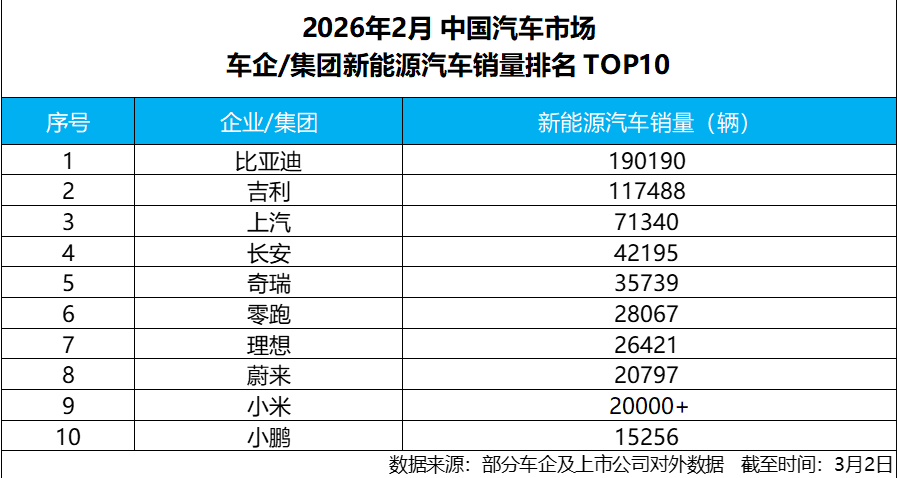
Core Insights - The competition landscape in China's new energy vehicle (NEV) market has become clearer as of early 2026, with BYD Group leading the industry with a sales volume of 190,190 units in February, maintaining a significant advantage over competitors [1][4]. Group 1: Sales Performance - BYD has maintained its position as the top seller in China's NEV market for 57 consecutive months since June 2021, with cumulative sales surpassing 15.5 million units [3]. - In February, BYD's overseas sales of passenger cars and pickups reached 100,151 units, marking a year-on-year growth of 41.4%, with total overseas sales for January-February 2026 at 200,160 units, up 42.3% year-on-year [4]. Group 2: Market Position and Strategy - BYD's strong performance in February signals its ability to build systemic advantages in the NEV market, indicating that its leadership is structural rather than coincidental [4]. - The company is set to hold a groundbreaking technology release on March 5, which has already positively impacted its stock price, reflecting investor confidence in its technological capabilities [5]. Group 3: High-End Market Development - BYD's high-end brands, including Fangchengbao, Tengshi, and Yangwang, achieved combined sales of 23,000 units in February, showing significant growth and enhancing the company's product structure and profitability [5]. - The increasing share of high-end products is expected to strengthen BYD's brand value and market influence [5]. Group 4: Future Considerations - Despite the positive outlook, BYD must focus on advancements in intelligent driving technology to compete effectively against rivals like Huawei and new entrants [5]. - The company faces challenges related to geopolitical risks as its overseas sales grow, including trade policies, tariff barriers, and localization requirements [5].
电车需求跟踪(2月):产品力推动单车带电量显著提升
Minmetals Securities· 2026-03-03 09:45
Investment Rating - The report rates the automotive industry as "Positive" [5] Core Insights - The demand for electric vehicles (EVs) is expected to recover in March due to the opening of the trade-in application channels and the launch of new products, following a decline in February caused by policy rollbacks and the Spring Festival [2][14] - The single vehicle battery capacity has significantly increased, with a year-on-year rise of 22.7% in January, indicating a focus on enhancing product capabilities among manufacturers [3][44] Monthly Focus - February retail sales are projected to decline by double digits year-on-year due to the Spring Festival and consumer hesitation, with approximately 119,000 vehicles sold in the first week of February [1][14] - The opening of trade-in application channels in March is expected to alleviate consumer hesitation and stimulate market recovery [2][14] Key Data Tracking - In January, domestic retail sales of new energy vehicles decreased by 20% year-on-year, while the penetration rate slightly dropped to 39% [3][20] - The single vehicle battery capacity for new energy vehicles reached 59.5 kWh in January, reflecting a significant year-on-year increase [44] - Exports of new energy vehicles in January reached 302,000 units, a year-on-year increase of 101%, with significant growth in both battery electric vehicles (BEVs) and plug-in hybrid electric vehicles (PHEVs) [31][37] Industry and Company Changes - The China-Europe electric vehicle tariff negotiations have progressed, with agreements to implement measures to replace tariffs with minimum pricing [4][66] - SAIC Motor Corporation expects a substantial increase in net profit for 2025, while companies like JAC Motors and BAIC BluePark are forecasting losses [67][68][69][70] - The launch of Tesla's Cybercab, designed for autonomous taxi services, marks a significant development in the industry [4]
吉利汽车(00175):2026年2月销量点评:2026 年销量稳健开局
GUOTAI HAITONG SECURITIES· 2026-03-03 09:20
Investment Rating - The investment rating for Geely Automobile is "Buy" [1] Core Views - The report anticipates that Geely Automobile will exceed its sales target of 3.45 million units for 2026, with significant improvements in profitability driven by high-end vehicles and exports [2] - The "Smart Geely 2025" strategy is expected to enhance the company's global competitiveness, leading to higher achievements [9] Sales Performance - In February 2026, Geely's sales reached 206,000 units, a year-on-year increase of 1%. New energy vehicle sales accounted for 117,000 units, with pure electric vehicles at 68,000 units (down 6%) and plug-in hybrids at 50,000 units (up 89%) [9] - For January-February 2026, total sales were 476,000 units, also a 1% year-on-year increase, with new energy vehicle sales at 242,000 units [9] Financial Summary - Total revenue projections for 2026 are RMB 471.165 billion, with a year-on-year growth of 34.5% [8] - Net profit for 2026 is estimated at RMB 23.18 billion, reflecting a growth of 35.5% [8] - The report projects earnings per share (EPS) for 2026 to be RMB 2.14, with a price-to-earnings (PE) ratio of 15 times, leading to a target price of HKD 36.61 [9] Sales Targets - The sales target for 2026 is set at 3.45 million units, representing a 14% increase from 2025, with new energy vehicle sales targeted at 2.22 million units, a 32% increase from the previous year [9]
吉利汽车3月3日斥资6757.37万港元回购436.3万股
Zhi Tong Cai Jing· 2026-03-03 09:12
Group 1 - The company Geely Automobile (00175) announced a share buyback plan, committing to repurchase 4.363 million shares at a cost of HKD 67.5737 million [1]
【乘用车2月月报】内需静待改善,出口韧性较强
东吴汽车黄细里团队· 2026-03-03 09:10
Investment Highlights - The electric vehicle (EV) market in January 2026 showed a slight decline in industry sentiment, with the implementation of the vehicle trade-in policy still ongoing across many provinces, leading to a significant year-on-year drop in retail performance [2][6] - The retail penetration rate for new energy vehicles (NEVs) in January was 37.4%, reflecting a year-on-year decrease of 2.2 percentage points and a month-on-month decrease of 11.3 percentage points [2][14] - In January, the wholesale volume of NEVs was 86.4 million units, with a year-on-year decline of 2.8% and a month-on-month decline of 44.7% [18] Globalization Data Tracking - In January 2026, the Southeast Asian market's NEV penetration rate exceeded expectations, primarily driven by the strong stimulus from Thailand's EV subsidy policy, which ended on January 31 [3][36] - Chinese automakers exported a total of 589,000 passenger vehicles in January, with 264,000 being NEVs, resulting in a penetration rate of 44.8% for NEVs [3][59] - BYD's export performance in January was better than expected, with a total of 96,900 units exported, marking a year-on-year increase of 46.0% [82] Passenger Vehicle Market Outlook - Short-term outlook indicates that the industry subsidy policies have been implemented, and there is optimism for a recovery in passenger vehicle sentiment in Q1 2026 as demand transitions from observation to action [4][7] - For the entire year, the focus should be on domestic companies that are resilient to policy fluctuations, such as Jianghuai Automobile, and those expected to see growth in the high-end electric vehicle segment, including Geely, Great Wall Motors, and others [4][7] - Export strategies should prioritize established companies with proven execution capabilities, such as BYD, Great Wall Motors, and Chery [4][7] Market Share Dynamics - In January 2026, the competitive landscape for NEVs shifted, with BYD's market share at 13.7%, down 11.3 percentage points month-on-month, while Geely's market share increased to 21.2%, up 11.2 percentage points [2][25] - The market share of Chinese brands in Southeast Asia reached 24.6%, reflecting a significant increase, primarily due to contributions from BYD and Chery [49][61] Price Segment Performance - In January, sales of NEVs in the price segments of 0-5 million, 15-20 million, 20-25 million, and above 40 million increased, with month-on-month changes of +293.62%, +4.31%, +26.63%, and +78.3% respectively [30] - The penetration rate for NEVs in the price segment above 40 million rose significantly, reaching 62%, with a month-on-month increase of 13.51 percentage points [30]