
奔驰

Search documents
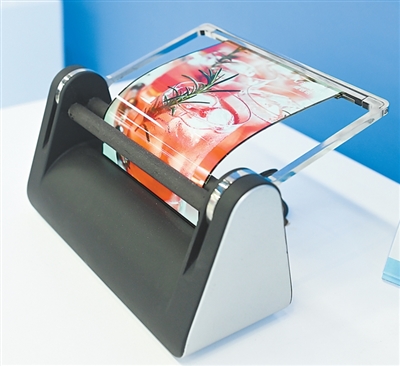
柔性屏 打开“显示”新视窗(国际科技前沿)
Ren Min Ri Bao· 2025-11-30 22:04
Core Insights - The display technology is rapidly transitioning from "rigid" to "flexible," with flexible displays being increasingly utilized in consumer electronics, commercial spaces, and smart interactions [1] - Recent advancements include the development of high-performance stretchable polymer light-emitting diodes (PLED) by a research team from the Chinese Academy of Sciences, and a prototype of a stretchable display by LG Display, capable of approximately 53% deformation [1] Group 1: Flexible Display Technology - Flexible displays are not merely traditional glass screens bent; they require a multi-layered structure where each layer must possess flexibility to ensure overall bending and folding while maintaining display quality and durability [2] - Key components include flexible substrate materials, core electronic components, and packaging technology, all of which must innovate collaboratively [2][3] - Common flexible substrate materials include polyimide and polyester, which can be as thin as 0.1 mm and withstand high temperatures and thousands of folds without deformation [2] Group 2: Core Electronic Components - Core electronic components such as thin-film transistors (TFT) and organic light-emitting diodes (OLED) rely on high-performance electronic materials, including oxide semiconductors and organic semiconductors [3] - These components work together to ensure rapid current flow, self-emission of light, and effective stress release during bending, maintaining the integrity and functionality of the display [3] Group 3: Market Expansion and Applications - The global market for flexible displays is expanding, with projections indicating that by 2024, shipments of flexible active matrix organic light-emitting diode (AMOLED) panels will reach 631 million units, accounting for 42% of the smartphone screen market [4] - By 2031, the flexible display market is expected to exceed $173 billion, with a compound annual growth rate (CAGR) of 34.3% [4] - Applications are diversifying across various sectors, including smart terminals, wearable devices, automotive, healthcare, and public services [4][5][6] Group 4: Innovations in Automotive and Healthcare - In the automotive sector, flexible displays are enhancing human-vehicle interaction, with companies like Mercedes and BMW integrating flexible OLED screens into their vehicles for improved display and energy efficiency [5] - In healthcare, flexible displays are being utilized in wearable medical devices, providing real-time health data monitoring and improving clarity and portability [6] Group 5: Future of Intrinsic Flexibility - Current flexible displays still rely on external structures for deformation, facing challenges such as fragility and resolution loss [7] - The development of intrinsic flexible materials aims to address these issues by enabling the display itself to withstand deformation through molecular structure and micro-design [7][8] - This innovation could lead to new applications, allowing displays to adapt to various devices and user needs, enhancing the overall user experience [8]
柔性屏,打开“显示”新视窗(国际科技前沿)
Ren Min Ri Bao· 2025-11-30 22:01
Core Insights - The article discusses the rapid advancement of flexible display technology, highlighting its transition from rigid to flexible forms, which is increasingly applied in various sectors such as consumer electronics, commercial spaces, and smart interactions [5][8]. Group 1: Flexible Display Technology Development - Flexible displays are characterized by their ability to bend and stretch, leading to innovative applications in products like foldable phones and curved screens [5][8]. - Recent breakthroughs include the development of high-performance stretchable polymer light-emitting diodes (PLEDs) by the Chinese Academy of Sciences, which significantly enhance optical performance and mechanical stability [5][11]. - LG Display has showcased a prototype of a stretchable display capable of approximately 53% deformation, indicating significant progress in the field [5][8]. Group 2: Manufacturing Process of Flexible Displays - The creation of flexible displays involves a complex multi-layer structure, requiring innovations in flexible substrate materials, core electronic components, structural design, and packaging technology [6][7]. - Flexible substrates must be thin, soft, and resistant to high temperatures and corrosive environments, with common materials including polyimide and polyester [6]. - Core electronic components like thin-film transistors (TFT) and organic light-emitting diodes (OLED) rely on high-performance materials to ensure rapid current flow and energy efficiency [7]. Group 3: Market Expansion and Applications - The global market for flexible displays is projected to grow significantly, with an estimated shipment of 631 million flexible AMOLED panels in 2024, accounting for 42% of the smartphone screen market [8]. - By 2031, the flexible display market is expected to exceed $173 billion, with a compound annual growth rate (CAGR) of 34.3% [8]. - Applications are expanding across various sectors, including smart terminals, wearables, automotive, healthcare, and public services, enhancing user experience and functionality [9][10]. Group 4: Future Innovations and Challenges - The concept of intrinsic flexibility is emerging, which refers to the inherent ability of materials to withstand deformation without relying on external structures [11][12]. - Research teams are exploring new material systems to improve the mechanical strength and durability of flexible displays, with ongoing challenges in achieving large-scale applications [11][12]. - The integration of sensors and AI algorithms in intrinsic flexible displays could lead to personalized and intelligent user experiences, transforming the interaction between devices and users [12].


理想重回创业公司模式!阿维塔提交港股上市申请!特斯拉全球最大超充站投入运营!零跑Lafa5、星途ET5等新车上市!丨一周大事件
电动车公社· 2025-11-30 16:18
New Car Launches - Leap Motor Lafa5 launched with a limited-time price of 92,800-116,800 yuan, featuring a compact design and advanced technology including a 600km range and laser radar assistance [2][12] - Xpeng ET5 launched with a limited-time replacement price of 134,900-149,900 yuan, emphasizing configuration and cost-effectiveness, with a 210km electric range [12][21] - New Mercedes EQE launched with prices ranging from 478,000 to 627,000 yuan, maintaining a luxurious design and advanced features [22][30] Company Dynamics - NIO reported Q3 revenue of 21.79 billion yuan, a 16.7% year-on-year increase, with a gross margin of 13.9%, the highest in three years [31][34] - Hesai Technology launched a high-performance intelligent control chip for laser radar, achieving full self-research capabilities across key components [35][39] - Li Auto reported Q3 revenue of 27.4 billion yuan, with a delivery guidance of 100,000 to 110,000 vehicles for Q4, while facing increased competition in the extended-range vehicle segment [40][46] - Pony.ai achieved single-vehicle profitability in its Robotaxi business, with a revenue increase of 72% year-on-year [47][52] - Avita submitted a listing application to the Hong Kong Stock Exchange, aiming to accelerate its growth in the smart vehicle market [53][60] - XPeng's flying car project has successfully produced its first land carrier vehicle, indicating a significant step towards mass production [61][66] - Tesla has deployed millions of self-developed AI chips, planning to release a new chip annually, enhancing its technological leadership [68][74]





备战2026,宝马亮出两张王牌
2 1 Shi Ji Jing Ji Bao Dao· 2025-11-30 12:40
Core Insights - The luxury automotive industry is facing a pivotal moment in defining luxury in the era of smart electric vehicles, with BMW positioning itself as a key player through its new generation technology cluster showcased at the Guangzhou Auto Show [1][2] - BMW's strategy includes a focus on both electrification and intelligent features, with the new generation BMW iX3 set to be produced in Shenyang in 2026, specifically tailored for the Chinese market [1][3] Sales Performance - In the first three quarters of 2025, BMW delivered 1.795 million vehicles globally, a slight increase of 2.4% year-on-year, but faced a significant decline in the Chinese market with deliveries dropping by 11.2% to 465,000 units, representing 26% of its global share [1] - The sales of pure electric vehicles reached 323,000 units, marking a 10% year-on-year increase, indicating a steady growth in electrification despite challenges in the traditional luxury segment [1] Technological Advancements - BMW is transitioning to a new sixth-generation eDrive system utilizing large cylindrical batteries, which promises over 20% improvement in energy density and 30% increase in range compared to previous square batteries [5][6] - The new battery technology allows for rapid charging, enabling 300-400 kilometers of range to be added in just 10 minutes, enhancing the overall performance and safety of the vehicles [5] Competitive Landscape - The competitive landscape in the battery market is diversifying, with companies like BYD leading in lithium iron phosphate batteries, while others like NIO and Xpeng focus on ternary lithium batteries for higher energy density [6] - BMW's approach contrasts with Tesla's high-risk strategies, opting for a more stable and mature manufacturing process to ensure scalability and reliability [6] Localization Strategy - BMW has established partnerships with CATL and EVE Energy for battery supply, aiming to create a localized supply chain in both China and Europe [8] - The intelligent cockpit and driving systems are being developed in collaboration with local firms, including Momenta for smart driving and Huawei for the cockpit interface, ensuring a tailored approach to the Chinese market [8][9] User Experience Focus - The development of the new intelligent cockpit emphasizes user experience, with a unique "visual cone" theory to enhance driver focus on critical information while minimizing distractions [9][10] - The underlying operating system for the intelligent cockpit is largely developed in China, with 70% of the source code optimized locally, reflecting a deep understanding of Chinese consumer preferences [10] Future Plans - The new generation BMW iX3 is set to launch in the second half of 2026, with plans to integrate the intelligent cockpit and driving systems across all future models [11][12] - BMW aims to maintain its brand identity while leveraging local technology, a strategy mirrored by competitors like Audi and Mercedes, who are also enhancing their collaborations in China [12]
座舱芯片战事:谁能撬开高通「铁王座」的裂缝?
雷峰网· 2025-11-28 13:48
Core Viewpoint - The article discusses the competitive landscape of cockpit chips in the automotive industry, highlighting Qualcomm's dominance and the emerging opportunities for domestic manufacturers like MTK, Huawei, and others in the context of cost and localization advantages. Group 1: Qualcomm's Dominance - Qualcomm's cockpit chip, the Snapdragon 8797, supports cabin and driving integration, establishing strong partnerships with major global automakers, including luxury brands like Mercedes and BMW, as well as new players like Li Auto and NIO [2][3]. - The collaboration creates a positive feedback loop where automakers rely on Qualcomm's performance, Tier 1 suppliers adapt to Qualcomm's solutions, and developers optimize applications around Qualcomm's ecosystem [3][4]. - Despite its strong position, Qualcomm faces challenges from domestic competitors who are increasing their market share, with companies like Chipone and Huaqin making significant inroads [3][4]. Group 2: Competitive Landscape - Domestic manufacturers are leveraging cost advantages and localized services to penetrate the market, with MTK's chips like the MT8676 and MT8678 offering competitive pricing and features [15][16]. - The market share of domestic cockpit chip manufacturers is projected to rise from under 3% in 2023 to over 10% in 2024, indicating a significant shift [36]. - MTK's strategy includes targeting entry-level markets, where cost advantages are most pronounced, and it is expected to capture over 30% market share by 2025 [18][36]. Group 3: Challenges in Cabin-Driving Integration - The integration of cabin and driving functions is seen as a critical step towards achieving centralized computing architecture in vehicles, but it presents significant technical and organizational challenges [21][24]. - Different safety standards for cabin and driving systems complicate the integration process, requiring higher levels of certification and increasing development costs [25][26]. - The complexity of developing a true cabin-driving integration chip involves balancing various technical requirements, which can lead to internal conflicts within organizations [30][31]. Group 4: Future Outlook - The future of cockpit chips will likely see a division where domestic manufacturers focus on the Chinese market while Qualcomm maintains its stronghold in the global high-end market [39]. - Companies that can combine localized services with global compatibility will have greater growth potential in the evolving automotive landscape [39].


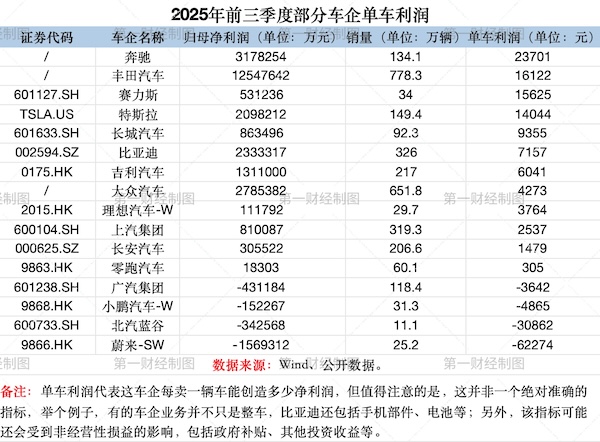
蔚来每卖1辆车亏超6万,奔驰每卖1辆车赚近2.4万
Xin Lang Cai Jing· 2025-11-28 12:37
Core Insights - The profitability of car manufacturers is a major focus, particularly the profit per vehicle sold, with significant disparities between companies [1] Group 1: Profitability of Major Car Manufacturers - Mercedes-Benz has the highest profit per vehicle among the surveyed companies, earning nearly 24,000 yuan for each car sold [1] - Toyota follows as the "profit king" globally, with a profit of approximately 16,000 yuan per vehicle and a net profit exceeding 125 billion yuan in the first three quarters [1] Group 2: Losses of Certain Car Manufacturers - NIO reported a cumulative loss of nearly 15.7 billion yuan in the first three quarters, resulting in a loss of over 60,000 yuan per vehicle sold [1] - BAIC Blue Valley also faced significant losses, with a cumulative loss exceeding 3.4 billion yuan, translating to a loss of over 30,000 yuan per vehicle [1] Group 3: Trends and Future Projections - Both NIO and BAIC Blue Valley show signs of improvement compared to the previous year, with projected losses of approximately 100,000 yuan and over 60,000 yuan per vehicle sold, respectively, in 2024 [1]


蔚来每卖一辆车亏超6万,奔驰赚2.3万
Di Yi Cai Jing· 2025-11-28 12:00
Core Insights - The profitability of major automotive companies is a focal point, particularly the per-vehicle profit, with luxury brands like Mercedes-Benz and Toyota leading the rankings [1][2] - The data indicates a shift in the narrative around electric vehicles, with companies like Seres and Tesla showing significant per-vehicle profits, challenging the notion that electric vehicles are unprofitable [1] Group 1: Profitability Rankings - Mercedes-Benz has the highest per-vehicle profit at approximately 24,000 yuan, followed by Toyota at 16,000 yuan, and Seres, a Chinese brand, at over 15,000 yuan, surpassing Tesla's profit of 14,000 yuan [1] - Among the 16 companies analyzed, only four have a per-vehicle profit exceeding 10,000 yuan, representing 25% of the sample [1] Group 2: Performance of Domestic and Foreign Brands - The "Big Three" private Chinese automakers, Great Wall, BYD, and Geely, have per-vehicle profits of 9,355 yuan, 7,157 yuan, and 6,041 yuan, respectively [2] - Xiaomi's automotive division reported a third-quarter operating profit of 700 million yuan with a delivery volume of 108,000 vehicles, showing significant improvement from a previous loss of 60,000 yuan per vehicle [2] Group 3: Challenges Faced by Multinational Companies - Volkswagen's net profit dropped by 61.5% year-on-year to 3.4 billion euros, with per-vehicle profit falling to around 4,000 euros due to various challenges including tariffs and restructuring [2] - Mercedes-Benz's net profit for the first three quarters was 3.878 billion euros, down from 7.806 billion euros the previous year, with a per-vehicle profit decline from 44,000 yuan to 24,000 yuan [2] Group 4: Losses in Certain Companies - NIO reported a cumulative loss of nearly 15.7 billion yuan in the first three quarters, with a per-vehicle loss exceeding 60,000 yuan, although there is an improvement trend compared to the previous year [3] - BAIC Blue Valley incurred a cumulative loss of over 3.4 billion yuan, with a per-vehicle loss exceeding 30,000 yuan, also showing signs of improvement [3]



欧媒:欧洲没有工业危机,有危机的是德国,而德国的危机在中国
Sou Hu Cai Jing· 2025-11-28 08:46
Group 1 - The core issue in Europe is not an "industrial crisis" affecting the entire region, but rather a specific industrial crisis in Germany [1] - Despite Germany's economic downturn, other European countries like France and Poland continue to show growth, indicating a decoupling from Germany's industrial performance [2][4] - Germany's industrial output has declined significantly, recently hitting a 20-year low, while other European economies have maintained or recovered their manufacturing output [2][4] Group 2 - The decline in Germany's industrial sector is attributed to internal factors rather than external pressures, particularly its relationship with China and competition in the domestic market [4][6] - German manufacturers face intense competition from Chinese electric vehicles, which have become strong contenders in terms of technology and cost, undermining Germany's traditional automotive dominance [4][6] - The sluggish domestic demand and investment in Germany are exacerbated by a rigid economic approach and a reluctance to adopt expansive fiscal policies during economic downturns [4][6][8] Group 3 - To address its economic challenges, Germany may need to break free from fiscal constraints and increase government spending to stimulate growth and facilitate industrial upgrades [6] - Embracing "European protectionism" could provide a temporary solution for Germany, allowing it to create demand through integrated European markets and cooperative initiatives [8]

省钱时刻到!内行人透露:十一月起,这五样东西要大降价!
Sou Hu Cai Jing· 2025-11-27 13:14
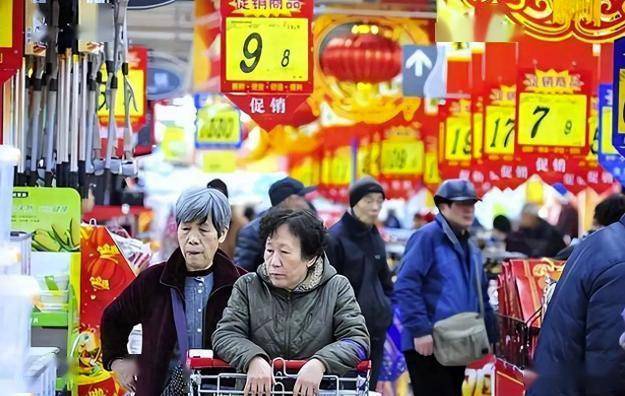
Group 1: Consumer Goods - The price of essential consumer goods such as cooking oil, toilet paper, and personal care products has significantly increased, with shopping costs rising from 200-300 yuan to 300-400 yuan for basic items [1] - A potential price correction in five major consumer sectors is expected to occur starting in November, which may alleviate some financial burdens for households [1] Group 2: Real Estate - The second-hand housing market continues to experience a downward trend, with the average price in September falling to 13,381 yuan per square meter, a year-on-year decrease of 7.38% [2] - This marks the 41st consecutive month of price decline, with many landlords willing to offer discounts of 15-20% off the listing price to facilitate transactions [2] - Factors contributing to this trend include a significant drop in prices in some regions, conservative income expectations among residents, and a more rational approach to home buying post-pandemic [2] Group 3: Automotive Industry - A price war has erupted in the automotive market, with discounts across various brands, including domestic, joint venture, and luxury imports [3] - Discounts for popular models can reach up to 30,000 yuan, with some high-end models seeing reductions close to 100,000 yuan [3] - The price war is driven by the need for car manufacturers to meet annual sales targets, increasing competition between electric and traditional vehicles, and the entry of tech companies into the automotive space [3] Group 4: Smartphone Market - The smartphone market is undergoing a price adjustment period coinciding with the "Double Eleven" shopping season, with average price reductions of 10-20% for mainstream models [5] - Factors leading to this price drop include shorter technology update cycles, increased inventory pressure from older models, and a lengthening consumer upgrade cycle [5] Group 5: Pork Market - Pork prices have fallen below 20 yuan per jin, with current prices around 17-18 yuan per jin, nearly halving from previous highs [6] - The increase in pig farming scale and changing consumer habits towards healthier diets are key factors influencing this price decline [6] Group 6: Rental Market - The rental market is showing signs of cooling, with two-bedroom rents in some areas of Shanghai dropping from 6,000 yuan to 5,500 yuan per month [8] - In lower-tier cities, the rental market is particularly affected by population outflows, leading to lower rents and longer vacancy periods [8] - Trends in the rental market reflect reduced job opportunities and slower income growth, impacting tenants' ability to afford rent [8] Group 7: Overall Market Trends - The current price adjustments across these five sectors indicate a significant shift in the consumer market, suggesting a need for more rational consumption decisions [10] - Consumers are encouraged to optimize their spending and adjust purchasing plans based on actual needs, avoiding panic buying in a market with ample supply [10]
Stellantis、宁德时代西班牙合资工厂开工建设,2030年全面投产
Sou Hu Cai Jing· 2025-11-27 00:22
Core Insights - Stellantis and CATL have officially launched a €4.1 billion battery factory in northern Spain, indicating Europe's increasing reliance on Chinese battery technology [1] - The factory is expected to achieve partial production by the end of next year, with plans to reach 30% of its designed capacity by 2028 and full production by 2030, employing nearly 4,000 people [1] - The European battery industry is still lagging behind Asian companies like CATL, despite significant investments from the EU to support local competitors [1] Company Developments - The new factory will produce lithium iron phosphate batteries with an annual capacity of approximately 50 GWh [1] - Stellantis has faced challenges with its battery joint ventures, including those with Mercedes and Volkswagen, due to a slowdown in electric vehicle demand [1] - CATL continues to expand its operations, with a new factory in Hungary set to produce various types of batteries beyond just lithium-ion technology [1] Industry Context - Local European companies such as Britishvolt and Northvolt have faced bankruptcy despite EU support, highlighting the difficulties in establishing a competitive battery industry in Europe [1] - The investment by Stellantis and CATL reflects a strategic move to bolster battery production capabilities in Europe amid growing demand for electric vehicles [1]

