易方达基金

Search documents
绩优基金强势“吸金” 新发市场70亿元股基重现
Shang Hai Zheng Quan Bao· 2026-01-22 18:32
Group 1 - The public fund issuance market has been heating up since the beginning of the year, with the first active equity fund exceeding 7 billion yuan in fundraising, specifically the Guangfa Research Smart Mixed Fund at 7.221 billion yuan [1] - Other active equity funds have also seen significant fundraising, including the E Fund Balanced Selection Mixed Fund at 3.408 billion yuan, the Huitianfu Technology Leading Mixed Fund at 2.704 billion yuan, and the Yongying Value Core Mixed Fund at 1.672 billion yuan [1] - Due to the influx of funds, some high-performing funds have started to tighten subscription limits, with specific funds reducing daily subscription limits from 500,000 yuan to as low as 10,000 yuan [1] Group 2 - Industry insiders believe that the recovery of active equity fund performance will lead to expected incremental capital in the future, as the long-term trend of changing household asset allocation is still in its early stages [2] - According to the latest public fund quarterly report, several high-performing funds saw significant growth in scale, with the Yongying Pioneer Semiconductor Smart Mixed Fund increasing from 403 million yuan to 9.326 billion yuan, and the Yongying High-end Equipment Smart Mixed Fund growing from 1.135 billion yuan to 9.765 billion yuan by the end of 2025 [3] - The substantial growth in fund scale is attributed to both rising net values and continuous inflows of capital, with notable increases seen in funds focusing on niche industries and those employing balanced allocation strategies with strong long-term performance [3]
透视张坤的四季报
Bei Jing Shang Bao· 2026-01-22 15:48
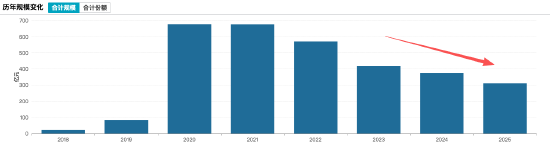
Core Viewpoint - Zhang Kun, a well-known fund manager, has disclosed the latest holdings and layout views of his four funds, indicating a reduction in management scale despite positive performance over the past year [1][2]. Fund Performance - The four funds managed by Zhang Kun reported respective increases of 6.86%, 8.46%, 11.75%, and 41.87% in 2025 [2]. - The total management scale of Zhang Kun's funds decreased to approximately 48.38 billion yuan, a decline of 14.43% from the previous quarter and 17.91% from the end of 2024 [2]. Stock Holdings - The funds have slightly increased their equity investment ratios by 1% to 3% in the fourth quarter of 2025 [2]. - Significant reductions were made in holdings of major liquor stocks such as Kweichow Moutai, Wuliangye, and Luzhou Laojiao, with a reduction of around 5% in the fourth quarter compared to a 10% reduction in the third quarter [2][3]. Sector Adjustments - Zhang Kun has adjusted the structure of investments in sectors such as pharmaceuticals, consumer goods, and technology, while maintaining positions in companies with strong business models and competitive advantages [4]. - The stock market showed significant differentiation in the fourth quarter, with sectors like oil and gas, defense, and non-ferrous metals performing well, while real estate, pharmaceuticals, and computers lagged [4]. Consumer and Housing Market Insights - Domestic consumption has remained weak in recent years, but Zhang Kun believes that the decline in housing prices in major cities is nearing its end, which could lead to an improvement in consumer sentiment [5][6]. - The long-term outlook suggests that both the actual living standards and social security levels of the population will significantly improve over the next decade, narrowing the gap with developed countries [6]. AI and Innovation - A strong domestic demand market is seen as crucial for promoting technological innovation, with the potential to attract global resources, talent, and capital [7]. - Zhang Kun expressed confidence in the business models and cash flow capabilities of the companies in his portfolio, emphasizing that the challenges faced are temporary and that the market will recognize the investment potential in domestic companies [7].
净流出,超千亿!
Zhong Guo Zheng Quan Bao· 2026-01-22 14:45
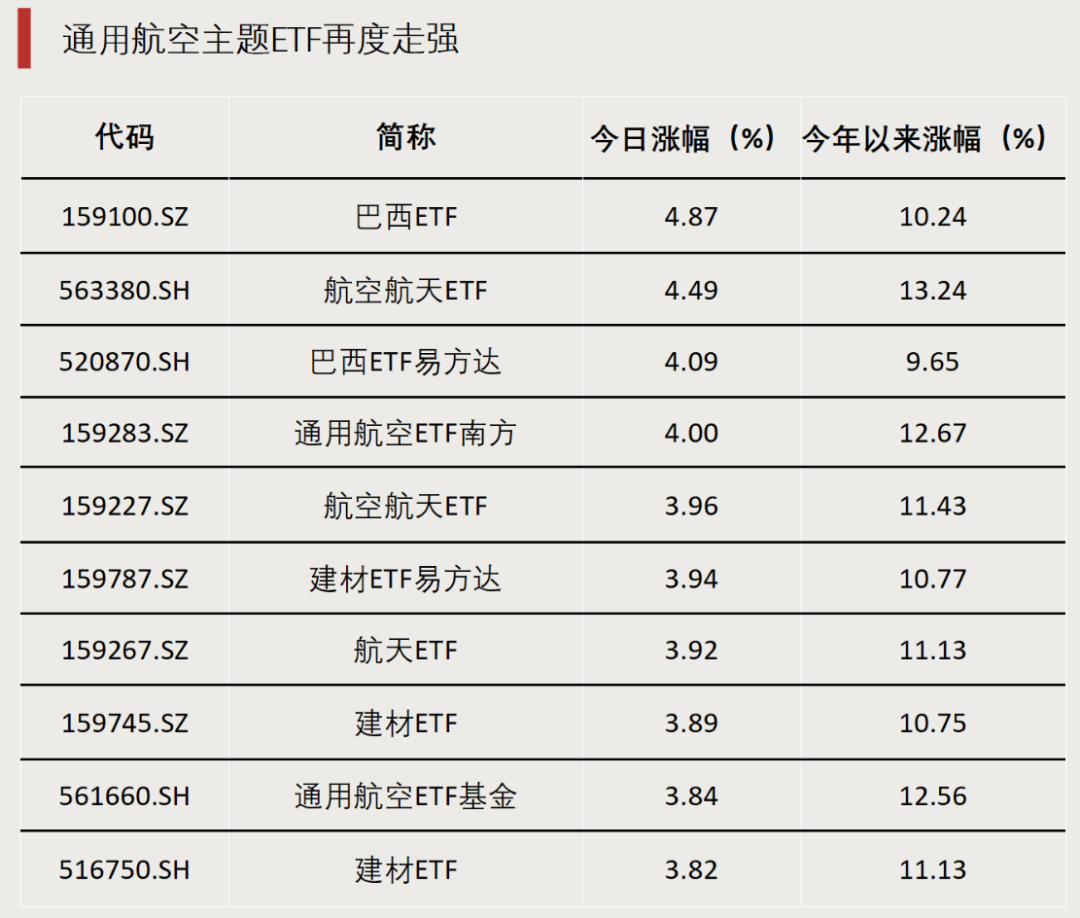
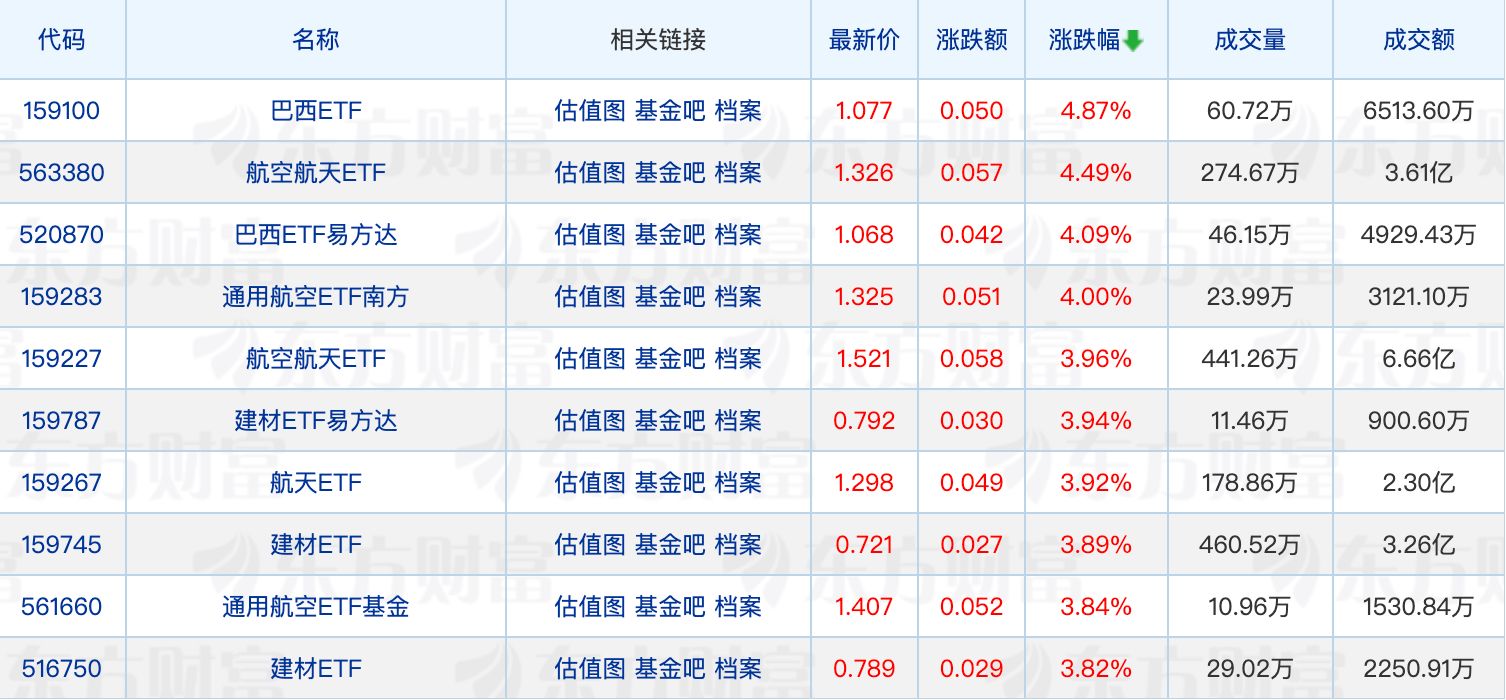
01 1月22日,A股通用航空板块再度走强,多只航空主题ETF大涨近4%,军工、卫星等相关主题ETF普遍涨超3%;此前热度较高的半导体设备、电网、黄金 股等板块集体降温,多只半导体设备主题ETF跌超2%。 02 近期,股票型ETF持续遭遇资金净流出。1月21日,股票型ETF首度出现单日净流出超千亿元的情况,创历史纪录。部分中证1000、上证50、沪深300主题 ETF净流出额集体创下单日历史新高。 03 截至1月21日,华泰柏瑞沪深300ETF、华夏沪深300ETF、嘉实沪深300ETF、华夏上证50ETF、南方中证1000ETF、华夏中证1000ETF、广发中证 1000ETF、富国中证1000ETF等宽基产品的最新份额数量,均已少于中央汇金2025年末的持仓数量。 通用航空主题ETF再度走强 1月22日,全市场仅有的两只巴西主题ETF集体涨超4%,今年以来已累计涨10%左右。 经过此前调整,A股通用航空板块今日再度走强,多只航空主题ETF涨幅接近4%,卫星、军工等相关主题ETF也普遍涨超3%;建材、油气、可控核聚变等 板块今日表现同样较为活跃,多只建材、油气、创业板人工智能等主题ETF涨超3%。 | 代码 ...

2只创业板指数ETF成交额环比增超30%
Zheng Quan Shi Bao Wang· 2026-01-22 09:24
Core Viewpoint - The trading volume of the ChiNext Index ETFs reached 6.784 billion yuan today, marking a significant increase of 1.940 billion yuan or 40.05% compared to the previous trading day [1] Group 1: Trading Volume and Performance - The E Fund ChiNext ETF (159915) had a trading volume of 5.894 billion yuan, an increase of 1.961 billion yuan or 49.87% from the previous day [1] - The GF ChiNext ETF (159952) recorded a trading volume of 378 million yuan, up by 43.072 million yuan or 12.88% [1] - The Huaxia ChiNext ETF (159957) saw a trading volume of 176 million yuan, increasing by 13.9468 million yuan or 8.58% [1] - The Rongtong ChiNext ETF (159808) had a notable increase of 32.42% in trading volume, reaching 3.8429 million yuan [1] Group 2: Market Performance - The ChiNext Index (399006) rose by 1.01% by the end of the trading day, while the average increase of related ETFs was 0.93% [1] - The leading performers among ETFs included the Ping An ChiNext ETF (159964) and the Jianxin ChiNext ETF (159956), which increased by 1.12% and 1.06% respectively [1]

白银基金溢价率已超50%;多只宽基ETF成交额创上市以来新高
Mei Ri Jing Ji Xin Wen· 2026-01-22 07:13
Group 1 - The premium rate of the silver fund has exceeded 50%, with the secondary market trading price significantly fluctuating compared to its net value [1] - Multiple broad-based ETFs have seen record trading volumes, with Southbound CSI 1000 ETF reaching a trading volume of 18.2 billion yuan, the highest since its listing in November 2016 [2] - Zhang Kun, a well-known fund manager, has reduced holdings in several liquor stocks while adjusting the structure of his funds in sectors like pharmaceuticals, consumer goods, and technology [3] Group 2 - Fund manager Xie Zhiyu has focused on allocating investments in overseas computing power and semiconductor equipment, while maintaining positions in high-quality innovative drugs and internet assets [4] - The market experienced a rebound in the afternoon, with the Shanghai Composite Index rising by 0.14% and the Shenzhen Component Index increasing by 0.5%, leading to a total trading volume of 2.69 trillion yuan [5] - The aerospace sector has shown significant growth, with nearly twenty component stocks hitting the daily limit, and several aerospace ETFs rising by approximately 4% [6] Group 3 - The airline industry is at a pivotal point, with unprecedented supply constraints and increasing passenger load factors, indicating a potential golden era for airlines [9]
十大基金经理四季报纵览:张坤、刘彦春共话内需前景,郑巍山坚守硬科技,赵诣聚焦“两端配置”
Xin Lang Cai Jing· 2026-01-22 07:09
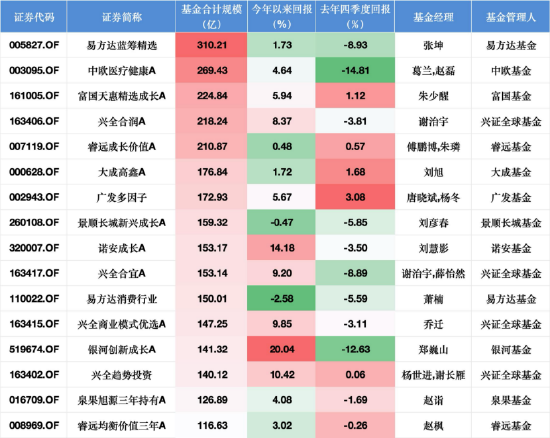
Core Insights - The 2025 fund's fourth quarterly report reveals that only 5 out of 16 large-cap active equity funds achieved positive returns in Q4, indicating significant performance divergence among funds [1][3][19] - Despite the Q4 challenges, many funds showed a rebound in performance since the beginning of 2026, with 14 out of 16 funds reporting positive returns [3][19] Fund Performance Summary - The top-performing funds in Q4 included: - Guangfa Multi-Factor with a quarterly increase of 3.08% - Dachen Gaoxin A with a return of 1.72% - Fuqun Tianhui Select Growth A with a return of 5.94% [2][3][18] - Conversely, the worst performers included: - Zhongou Medical Health A, which fell by 14.81% - Yifangda Blue Chip Select, which dropped by 8.93% [3][18] Fund Manager Insights - Zhang Kun emphasized the importance of domestic consumption and the long-term potential of investing in domestic demand companies, despite current market skepticism [4][19] - Ge Lan highlighted structural opportunities in the pharmaceutical industry, focusing on innovation and consumer recovery, with a positive outlook for Q1 2026 [6][20] - Liu Yanchun pointed out the need for improved domestic demand and stable asset prices, predicting a rise in inflation expectations [7][21] - Zheng Weishan maintained a focus on hard technology investments, particularly in the semiconductor sector, and expressed optimism about AI demand and domestic production [8][22] - Zhao Yi discussed a dual focus on AI growth and sectors like new energy and military, emphasizing the importance of fundamental analysis [10][25] - Qiao Qian stressed the need for a balance between valuation and fundamentals amid market volatility, aiming for long-term certainty [12][26] - Liu Huiying expressed confidence in the semiconductor and AI applications as key mid-term themes, anticipating breakthroughs in domestic technology [13][27] - Zhao Feng focused on the overseas growth potential of leading companies, noting a shift from product export to local manufacturing and services [14][28] - Xie Zhiyu highlighted the opportunities in the global computing wave and domestic breakthroughs, particularly in the semiconductor sector [15][29] Overall Market Sentiment - Fund managers share a common belief in the long-term potential of the Chinese economy, focusing on industrial upgrades, technological innovation, and the enduring value of quality companies [16][30]
最新!超990亿元,“跑了”!
Zhong Guo Ji Jin Bao· 2026-01-22 06:59
Group 1 - The core point of the article highlights a significant outflow of funds from stock ETFs, exceeding 990 billion yuan, with broad-based ETFs collectively experiencing a net outflow of over 1 trillion yuan [2][3] - On January 21, the total net outflow from the stock ETF market (including cross-border ETFs) reached 994.94 billion yuan, with broad-based ETFs seeing a decline in scale by 940.9 billion yuan [3] - The SGE Gold 9999 index recorded the highest net inflow of 19.29 billion yuan, while the CSI 300 index faced the largest net outflow of 581.98 billion yuan on the same day [3] Group 2 - The top-performing ETFs in terms of net inflow included the Electric Grid Equipment ETF and the Chemical ETF, with net inflows of 14.38 billion yuan and 8.26 billion yuan, respectively [6][7] - Notable inflows were also observed in the Gold Stock ETF and the Semiconductor ETF, with net inflows of 5.74 billion yuan and 5.20 billion yuan, respectively [6] - The report indicates that the Electric Grid Equipment ETF and the Semiconductor ETF from Huaxia Fund saw significant inflows, reflecting investor interest in these sectors [3][4] Group 3 - The article mentions that the CSI 300 ETF and the CSI 1000 ETF were among the largest "bloodletting" ETFs, with substantial net outflows of 168.28 billion yuan and 138.52 billion yuan, respectively [5][7] - The overall market sentiment remains cautiously optimistic, with expectations for a continued upward trend in the Chinese stock market, particularly in growth sectors such as AI and industrial metals [8] - The investment strategy suggested includes focusing on core growth assets, which are currently at historical median valuations, providing potential for valuation recovery [8]

最新!超990亿元,“跑了”!
中国基金报· 2026-01-22 06:53
Core Viewpoint - The article highlights a significant outflow of funds from stock ETFs in China, with a total net outflow exceeding 990 billion yuan, particularly from broad-based ETFs, while certain thematic ETFs experienced inflows [2][4]. Group 1: Fund Flows - On January 21, the total net outflow from the stock ETFs (including cross-border ETFs) reached 994.94 billion yuan, with broad-based ETFs suffering a net outflow of 1,078.03 billion yuan [4]. - The SGE Gold 9999 index saw the highest net inflow of 19.29 billion yuan, while the CSI 300 index experienced the largest net outflow of 581.98 billion yuan on the same day [4]. - Over a five-day period, the electric grid equipment theme index attracted over 8.9 billion yuan, and the SGE Gold 9999 index attracted over 8.3 billion yuan [4]. Group 2: Top Performing ETFs - The top inflow ETFs included the Electric Grid Equipment ETF with a net inflow of 14.38 billion yuan, the Chemical ETF with 8.26 billion yuan, and the Gold Stock ETF with 5.74 billion yuan [8]. - The latest scale of the Electric Grid Equipment ETF is 157.79 billion yuan, while the Chemical ETF stands at 267.11 billion yuan [8]. - The top outflow ETFs included the CSI 300 ETF, which had a net outflow of 168.28 billion yuan, and the CSI 1000 ETF with a net outflow of 138.52 billion yuan [9]. Group 3: Market Outlook - Guotai Fund expressed that the "spring excitement" market trend is not over, and the upward momentum in the Chinese stock market is expected to continue, focusing on growth sectors such as AI, electric power, and industrial metals [9]. - E Fund's index investment department manager noted that the market is likely to maintain a stable upward trend, with core assets in the large-cap growth sector showing potential for valuation recovery [10].

易方达蓝筹精选规模缩水65亿 业绩多期“不佳”,张坤坚信中国消费“有鱼可钓” 四季度增持阿里减持京东
Xin Lang Ji Jin· 2026-01-22 03:50
Core Insights - The article highlights the significant decline in the assets under management of fund manager Zhang Kun, with a reduction of 8.16 billion yuan to 48.38 billion yuan in Q4 2025 [1] - Zhang Kun's flagship fund, E Fund Blue Chip Select Mixed Fund, experienced an 8.93% drop in net value during Q4, underperforming the average of similar funds by 7.39% [2] - The fund's performance over the past year and three years has been notably poor, with returns of 11.56% and a cumulative decline of 19.93%, respectively, compared to the average returns of 41.32% and 19.81% for similar funds [2] Fund Performance - In Q4, the E Fund Blue Chip Select Mixed Fund's net value fell by 8.93%, ranking in the bottom 25% among peers [2] - Over the past year, the fund's return of 11.56% significantly lagged behind the average return of 41.32% for equity mixed funds and the 23.23% increase in the CSI 300 index [2] - The fund's three-year performance shows a cumulative decline of 19.93%, while similar products averaged a 19.81% increase [2] Portfolio Adjustments - Despite performance challenges, Zhang Kun maintained a high stock position of over 94% in the E Fund Blue Chip Select Mixed Fund, consistent with his investment style [5] - The top holdings remained stable, with Tencent and Kweichow Moutai leading, while Wuliangye's ranking improved from seventh to third [5] - Adjustments included a slight increase in Alibaba holdings by 3.22%, while significant reductions were made in JD Health and Focus Media by 45.52% and 20.56%, respectively [5] Macro Economic Insights - Zhang Kun provided an extensive analysis of the macroeconomic environment, emphasizing the importance of boosting consumption as a key policy focus for 2026 [6] - He argued that despite recent weak consumption data, the long-term outlook remains positive, citing potential growth in GDP and improvements in living standards [7] - Zhang Kun believes that the market will eventually recognize investment opportunities in domestic companies, despite current skepticism [7]


张坤2025四季报出炉:三只产品跑输基准 亚洲精选飘红 坚定看好中国核心资产长期价值
Xin Lang Cai Jing· 2026-01-22 03:12
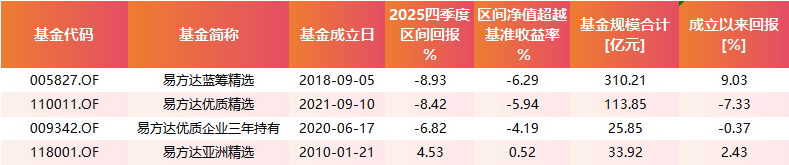
Core Viewpoint - The report highlights the investment strategies of Zhang Kun, a prominent fund manager at E Fund, focusing on the performance of his funds and his optimistic outlook on China's economic growth and consumer market potential over the next decade [1][2][3]. Fund Performance Summary - As of the end of Q4 2025, Zhang Kun managed a total fund size of 48.383 billion yuan, with three A-share focused funds underperforming their benchmarks, while the E Fund Asia Select fund achieved a positive return of 4.53%, significantly exceeding its benchmark [1][2][3]. - The E Fund Blue Chip Select (005827.OF) reported a net value growth rate of -8.93%, underperforming its benchmark by over 6 percentage points, with a total size of 31.021 billion yuan and a cumulative return of 9.03% since inception [2][3][4]. - The E Fund Quality Select (110011.OF) and E Fund Quality Enterprise Three-Year Holding (009342.OF) also reported negative returns of -8.42% and -6.82%, respectively, since their inception returns are -7.33% and -0.37% [3][4]. Market Outlook and Investment Strategy - Zhang Kun maintains a long-term optimistic view on the macroeconomic environment, asserting that the living standards and social security levels in China will significantly improve over the next decade, narrowing the gap with developed countries [2][3][4]. - He emphasizes that the current pessimistic market pricing has made high-quality companies' valuations very attractive, presenting good opportunities for long-term investors [3][4][5]. - The report indicates a structural adjustment in fund allocations, focusing on sectors such as healthcare, consumer goods, and technology, while maintaining stable stock positions [10][11][12]. Consumer Market Insights - Zhang Kun argues that the current weakness in domestic consumption is a temporary phenomenon, with significant growth potential in China's domestic market, which is expected to be a key driver for future investments [11][12][13]. - He cites the goal of achieving a per capita GDP comparable to developed countries by 2035, suggesting that China has ample room for growth in consumer spending and quality of life improvements [12][13][14]. - The report also highlights the potential for recovery in consumer sentiment as housing price declines stabilize, which could enhance consumer willingness to spend [12][13][14]. Technology and Innovation - The report discusses the unique advantages of the Chinese market in the context of the global AI wave, noting that a strong domestic demand market is crucial for technological innovation [13][14][15]. - Zhang Kun expresses optimism about domestic AI application companies, anticipating that a stronger consumer environment will facilitate better interactions between subscription revenues and model capabilities, aiding in closing the gap with global leaders [13][14][15]. Conclusion - The report reflects Zhang Kun's commitment to long-term investment strategies amid market volatility, with a focus on optimizing fund structures and capitalizing on undervalued assets, positioning for potential excess returns in the next economic cycle [15][16][17].