易方达

Search documents
[1月18日]美股指数估值数据(A股港股继续上涨,估值跟全球还差多少;全球指数星级更新)
银行螺丝钉· 2026-01-18 13:43
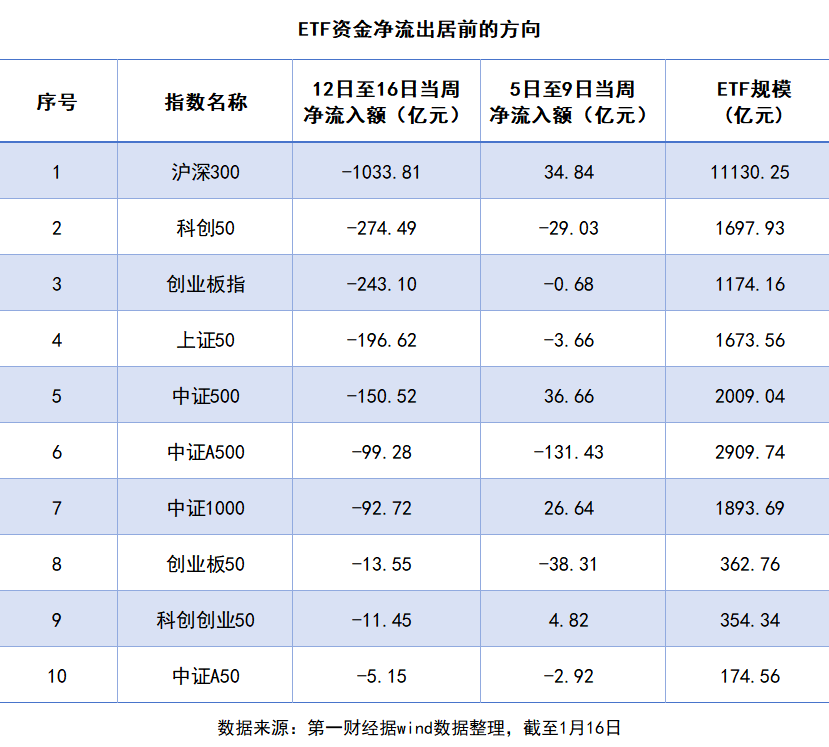
Core Insights - The global stock market experienced slight fluctuations this week, with US markets showing a minor decline while non-US markets overall increased [3][4]. - The Hong Kong Hang Seng Index rose by 2.34%, leading global markets [4]. - A-shares also saw an overall increase this week, reaching a rating of 3 stars [5][6]. Group 1: Market Signals - A-shares have shown signs typical of the later stages of a bull market, including a significant single-day subscription exceeding 100 billion yuan for stock funds on January 12 [8]. - On January 14, major exchanges announced an increase in the margin requirement from 80% to 100%, aimed at curbing leveraged investments in A-shares [9][10]. - Between January 14-16, several large ETFs experienced substantial net outflows, amounting to hundreds of billions, indicating potential profit-taking by institutional investors [11][12]. Group 2: Valuation Comparisons - As of 2024, A-shares and Hong Kong stocks were valued approximately 50% lower than the global market at a rating of 5.9 stars [20]. - Since then, A-shares and Hong Kong stocks have surged by 50-60%, outperforming the global stock market, which saw a rise of about 30% [21][22]. - The global stock index currently stands at around 23.3 times earnings, with A-shares' valuation closely approaching this level [23][24]. Group 3: Investment Strategies - The current overall valuation of A-shares and Hong Kong stocks is not considered cheap, suggesting that while there are some undervalued options, large capital investments in stock funds may not be advisable [16][17]. - Active selection and index enhancement funds have completely suspended subscriptions at the current 3-star rating, with plans to reopen once ratings reach 4-5 stars [18]. - The company has introduced a "Global Index Advisory Portfolio" that diversifies investments across multiple stock markets, including US, UK, Hong Kong, and A-shares [35]. Group 4: New Publications - The company has launched a new book titled "Dividend Index Fund Investment Guide," which quickly became a bestseller on major platforms [40]. - This book aims to address common investor questions regarding dividend-related products and is designed to be accessible for beginners [42].

ETF周成交1.28万亿
第一财经· 2026-01-18 12:37
Core Viewpoint - The recent week has seen a significant shift in the A-share ETF market, with over 200 billion yuan being withdrawn from core broad-based ETFs, marking a historical high for weekly net outflows, while nearly 70 billion yuan flowed into thematic industry ETFs, indicating a potential turning point in market trends [3][4]. Group 1: ETF Market Dynamics - From January 12 to 16, the overall ETF market exhibited a "broad-based retreat, thematic advance" pattern, with a net outflow of 212.6 billion yuan from broad-based ETFs, a dramatic increase from the previous week's 12.9 billion yuan [6][7]. - The broad-based ETFs experienced a record shrinkage, with a total reduction of over 200 billion yuan in just one week, surpassing the previous record by over 94 billion yuan [7]. - Major broad-based ETFs like the CSI 300 ETF saw the largest net outflow of 103.4 billion yuan, followed by the STAR 50 and ChiNext ETFs with net outflows of 27.4 billion yuan and 24.3 billion yuan, respectively [8][10]. Group 2: Thematic ETF Inflows - In contrast to the broad-based ETFs, thematic ETFs attracted nearly 70 billion yuan in net inflows, with 117 products receiving over 100 million yuan in net subscriptions [10][11]. - Key sectors such as software, media, and semiconductors were particularly favored, with each sector receiving over 5 billion yuan in net inflows. For instance, the Jiashi CSI Software Service ETF alone saw a net inflow of 7.5 billion yuan, reaching a record scale of 14.6 billion yuan [11][12]. - The satellite internet sector emerged as a focal point, with six satellite-themed ETFs collectively attracting 7.5 billion yuan, and the Yongying Satellite ETF alone receiving 5.8 billion yuan, marking a 156% increase year-to-date [11][12]. Group 3: Trading Volume and Market Sentiment - The trading volume for stock ETFs reached 1.28 trillion yuan, the highest in five years, reflecting a 35% increase from the previous week and a 183% surge year-on-year [14]. - On January 16 alone, the trading volume hit 312.6 billion yuan, surpassing the peak from October 9, 2024, with broad-based ETFs accounting for 212.9 billion yuan of that total [15]. - Analysts suggest that the outflow from broad-based ETFs and the inflow into thematic ETFs may indicate a healthy market adjustment, with investors reallocating funds towards sectors with clearer growth prospects [15][16]. Group 4: Regulatory Environment and Future Outlook - Recent regulatory measures aimed at cooling market speculation are seen as a correction rather than a deterrent, with expectations that market sentiment will improve within two weeks [16]. - As annual performance forecasts from listed companies begin to be disclosed, the market logic is expected to shift from valuation recovery to profit growth, prompting a reallocation of funds towards sectors with solid industrial logic and higher earnings visibility [16][17]. - The ETF market is undergoing a paradigm shift, with investors increasingly viewing ETFs as long-term asset allocation tools rather than short-term trading instruments [18].

ETF周成交超1.28万亿,资金加速“弃宽基追主题”
Di Yi Cai Jing· 2026-01-18 11:23
Core Viewpoint - A significant shift in the A-share ETF market has occurred, with over 200 billion yuan withdrawn from core broad-based ETFs and nearly 70 billion yuan flowing into thematic industry ETFs, indicating a potential turning point in market trends [1][2][7]. Group 1: ETF Market Dynamics - From January 12 to 16, over 2 trillion yuan was withdrawn from broad-based ETFs, marking a 15-fold increase compared to the previous week and setting a record for weekly net outflows [2][3]. - The core broad-based ETFs, including the CSI 300 and STAR 50, were the main targets for fund withdrawals, with the CSI 300 ETF alone experiencing a net outflow of over 1 trillion yuan [2][3]. - The total trading volume of stock ETFs reached 1.28 trillion yuan during the same week, the highest in five years, reflecting intense trading activity and rapid fund turnover [7]. Group 2: Thematic ETF Inflows - In contrast to the broad-based ETFs, thematic ETFs saw a net inflow of nearly 70 billion yuan, with 117 products receiving over 1 billion yuan in net subscriptions [3][4]. - Key sectors attracting investment included software, media, and semiconductors, with specific products like the Harvest CSI Software Service ETF receiving a net inflow of 75.43 billion yuan, reaching a record size of 146 billion yuan [3][6]. - The satellite internet sector emerged as a focal point for investment, with six satellite-themed ETFs attracting 74.71 billion yuan in net inflows, highlighting a growing interest in this area [3][4]. Group 3: Market Sentiment and Future Outlook - Analysts suggest that the significant outflows from broad-based ETFs and inflows into thematic ETFs may indicate a healthy market adjustment rather than a downturn, as investors seek more flexible and growth-oriented investment opportunities [7][8]. - The recent regulatory environment is seen as a corrective measure to excessive market speculation, with expectations that market sentiment will improve within a couple of weeks [8]. - The ongoing trend of reallocating funds from broad-based to thematic ETFs reflects a broader shift in investor strategy, moving towards long-term asset allocation rather than short-term trading [9].
投资中的两重考验|投资小知识
银行螺丝钉· 2026-01-17 13:37
Core Viewpoint - The article discusses the challenges and psychological hurdles investors face during market fluctuations, particularly during the transition from bear to bull markets, emphasizing the importance of patience and experience in investment strategies [2][3][6]. Group 1: Market Performance and Investor Behavior - The market experienced significant growth from a low of 5.9 stars to around 3.x stars by early January 2026, indicating a recovery phase where pessimistic sentiments decreased [3]. - Many investors began to realize profits during the market upturn in 2025, but the initial recovery phase was challenging as investors often felt compelled to sell once they broke even [4][5]. - By the end of Q2 2025, a dense recovery phase was noted, with many investors seeing average returns increase as the market continued to rise in Q3 [5]. Group 2: Investor Challenges and Learning - Investors faced two main tests: the initial recovery from losses and the temptation to sell upon breaking even, which many failed to navigate successfully [4][6]. - Research indicated that approximately 36.6% of fund investors were still at a loss by the end of Q3 2025, highlighting the prevalence of losses despite overall market gains [6]. - Investors who endured the bear market from 2022 to 2026 gained valuable experience, understanding the risks of market volatility and the benefits of holding undervalued investments for the long term [7].

量化基金周度跟踪(20260112-20260116):中小盘继续上涨,500指增难获超额-20260117
CMS· 2026-01-17 12:21
Report Summary 1. Report Industry Investment Rating No relevant content provided. 2. Core View of the Report The report focuses on the performance of the quantitative fund market, summarizing the performance of major indices and quantitative funds, the overall performance and distribution of different types of public - offering quantitative funds, and the better - performing quantitative funds from January 12 to January 16, 2026, for investors' reference [1]. 3. Summary by Directory 3.1 Main Index and Quantitative Fund Performance - This week (January 12 - January 16), A - shares showed mixed performance, with small - cap growth stocks leading the rise and large - cap value stocks falling. Quantitative funds recorded positive returns, and the excess returns of index - enhanced funds were divergent. Active quantitative funds rose by an average of 1.21%. The excess returns of CSI 300 Index - enhanced, CSI 500 Index - enhanced, and CSI 1000 Index - enhanced funds were 0.63%, - 0.34%, and 0.34% respectively, and the average excess return of other index - enhanced funds was 0.25%. Market - neutral funds rose by 0.16% [2][4][6]. - The weekly returns of the CSI 300, CSI 500, and CSI 1000 were - 0.57%, 2.18%, and 1.27% respectively [3][6]. 3.2 Performance of Different Types of Public - Offering Quantitative Funds - **CSI 300 Index - enhanced funds**: The weekly return was 0.06%, the excess return was 0.63%, the maximum drawdown was - 0.72%, the excess maximum drawdown was - 0.19%, and the excess return dispersion was 0.53% [14]. - **CSI 500 Index - enhanced funds**: The weekly return was 1.84%, the excess return was - 0.34%, the maximum drawdown was - 1.18%, the excess maximum drawdown was - 1.08%, and the excess return dispersion was 0.48% [14]. - **CSI 1000 Index - enhanced funds**: The weekly return was 1.61%, the excess return was 0.34%, the maximum drawdown was - 1.46%, the excess maximum drawdown was - 0.79%, and the excess return dispersion was 0.44% [15]. - **Other index - enhanced funds**: The weekly return was 1.23%, the excess return was 0.25%, the maximum drawdown was - 1.38%, the excess maximum drawdown was - 0.50%, and the excess return dispersion was 0.68% [15]. - **Active quantitative funds**: The weekly return was 1.21%, the maximum drawdown was - 1.16%, and the return dispersion was 1.61% [16]. - **Market - neutral funds**: The weekly return was 0.16%, the maximum drawdown was - 0.13%, and the return dispersion was 0.61% [16]. 3.3 Performance Distribution of Different Types of Public - Offering Quantitative Funds The report shows the performance trends of different types of public - offering quantitative funds in the past six months, as well as the performance distribution this week and in the past year. Index - enhanced funds show the performance of excess returns, but specific data is not further elaborated in the text [17]. 3.4 High - Performing Public - Offering Quantitative Funds - **CSI 300 Index - enhanced high - performing funds**: Such as E Fund CSI 300 Selected Enhanced (managed by Zhang Shengji, with a scale of 4024 million yuan, and a weekly excess return of 2.15%), and others [31]. - **CSI 500 Index - enhanced high - performing funds**: For example, Bosera CSI 500 Index - enhanced (managed by Yang Meng, with a scale of 2764 million yuan, and a weekly excess return of 0.31%) [32]. - **CSI 1000 Index - enhanced high - performing funds**: Like Huatai - Peregrine CSI 1000 Enhanced Strategy ETF (managed by Da Huang and Liu Jun, with a scale of 40 million yuan, and a weekly excess return of 1.12%) [33]. - **Other index - enhanced high - performing funds**: Such as E Fund SSE 50 Enhanced Strategy ETF (managed by Zhang Shengji, with a scale of 49 million yuan, and a weekly excess return of 2.04%) [34]. - **Active quantitative high - performing funds**: For instance, Huian Quantitative Selection (managed by Wang Minglu, with a scale of 3 million yuan, and a weekly return of 8.68%) [35]. - **Market - neutral high - performing funds**: Such as China Post Absolute Return Strategy (managed by Yao Yi and Xing Rufeng, with a scale of 48 million yuan, and a weekly return of 2.39%) [36].
挖掘超额收益新路径!ETF申报与发行成基金布局新风向标?
券商中国· 2026-01-17 04:58
Core Viewpoint - The boundary between passive investment ETFs and actively managed funds is increasingly blurring, with ETFs becoming a key indicator for active equity funds in identifying industry trends and market turning points [1][2]. Group 1: ETF and Active Equity Fund Interaction - The direction of ETF applications is becoming a "barometer" for many active equity funds, reflecting market demand and profitability [2]. - Active equity funds are increasingly adopting ETF-like characteristics, with top-performing products in 2025 showing high concentration in specific sectors, often exceeding 90% in positions [2]. - The issuance of ETFs is often seen as a precursor to industry booms, as evidenced by the rapid rise of the robotics sector following the launch of several ETFs [2]. Group 2: Sector-Specific Trends - The commercial aerospace sector has gained attention from active equity funds following the launch of the first satellite ETF, indicating a shift in investment focus [3]. - A decrease in ETF applications for consumer sectors has led to a corresponding reduction in active equity fund allocations to these areas, demonstrating a synchronized response to market trends [3]. Group 3: ETF as a Research Tool - The logic behind ETF applications has evolved from merely capturing flows to predicting industry turning points, thereby enhancing the research capabilities of active equity funds [4]. - The recent surge in chemical ETFs reflects a strategic shift in product development, aligning with active fund managers' anticipations of market reversals [5]. Group 4: Confidence in Market Recovery - ETF applications serve as confidence anchors during industry downturns, with recent ETF launches in the solar and battery sectors signaling potential market recoveries [6]. - The issuance of ETFs during low points in the market suggests a strategic approach to capitalize on upcoming industry recoveries, supported by favorable policy changes [6]. Group 5: Collaborative Advantages - The synergy between ETF product development and research departments is becoming a significant advantage for public funds, enhancing their ability to identify and capitalize on niche opportunities [7]. - The evolving role of ETFs as precursors to active fund investments provides liquidity for sectors that are undervalued and poised for recovery, creating a closed loop of investment strategy [7].

FOF发行持续回暖 银行渠道强力驱动,资产配置需求释放
2 1 Shi Ji Jing Ji Bao Dao· 2026-01-16 23:49
Core Insights - The FOF (Fund of Funds) market is experiencing a resurgence, with significant fundraising activity observed at the beginning of 2026, indicating strong demand for asset allocation products [1][13] - The total scale of FOF funds reached 2,442.92 billion yuan as of January 14, 2026, marking a steady increase from the end of 2025 and a significant growth compared to 2024 [14][15] - The issuance of new FOF funds is robust, with 23 funds expected to open for subscription in January 2026, reflecting a shift towards more stable investment strategies [3][15] Fundraising Activity - On January 5, 2026, Wanji Fund's FOF raised 2.099 billion yuan in a single day, while GF Fund's FOF raised 3.288 billion yuan in just two days [1][14] - By January 16, 2026, four newly established FOF products had collectively raised over 6 billion yuan, accounting for approximately 30% of the total new fund issuance during the same period [1][15] Market Growth - The FOF market has seen a continuous growth trend, with a 79.03% increase in scale in 2025 and a further 2.48% growth in early 2026 [14][15] - The total number of FOF funds reached 2,241.01 million shares, with a year-on-year growth of approximately 65% in 2025 [15] Product Structure - The FOF market is predominantly composed of mixed-asset FOFs, which account for 91.75% of the total scale, catering to various risk preferences [16] - Major fund managers like E Fund, GF Fund, and others have established a significant presence in the mixed-asset FOF space, with several products exceeding 10 billion yuan in scale [16] Distribution Channels - The resurgence in FOF popularity is closely linked to the support from banking channels, particularly the customized FOF offerings from banks like China Merchants Bank [5][17] - The "TREE Long-term Profit Plan" launched by China Merchants Bank has significantly boosted FOF scale, with over 10 million clients participating by the end of 2024 [5][17] Investment Strategies - FOF products are increasingly adopting passive investment strategies, focusing on index-based investments through ETFs, while also diversifying into multiple asset classes such as gold and REITs [16] - The average return of FOFs in 2025 was nearly 15%, which has positively influenced investor confidence [9][17] Market Dynamics - The current FOF sales surge is partly driven by sales efforts rather than purely organic demand from clients, indicating a potential reliance on marketing strategies [19] - Investors are advised to prioritize diversified FOFs that align with their risk preferences and investment goals, emphasizing the importance of long-term holding for compounding returns [19][20]
AI硬件板块本周领涨,半导体设备ETF易方达(159558)、云计算ETF易方达(516510)受资金关注
Sou Hu Cai Jing· 2026-01-16 10:50
Group 1 - The AI hardware sector has seen significant gains this week, with the CSI Semiconductor Materials and Equipment Theme Index rising by 9.0%, the CSI Cloud Computing and Big Data Theme Index increasing by 6.4%, and the CSI Chip Industry Index up by 5.2% [1][3] - The semiconductor equipment ETF from E Fund (159558) and the cloud computing ETF from E Fund (516510) have attracted substantial investments, with a combined average inflow of 480 million yuan and 750 million yuan respectively over the first four trading days of the week [1] - Dongwu Securities reports that domestic semiconductor equipment is entering a historic development opportunity, with a strong expansion cycle expected to begin in 2026, projecting an order growth rate exceeding 30% for the entire semiconductor equipment industry [1] Group 2 - The CSI Cloud Computing and Big Data Theme Index has a rolling price-to-sales ratio of 5.5 times, while the CSI Chip Industry Index has a price-to-book ratio of 7.8 times, and the CSI Semiconductor Materials and Equipment Theme Index has a price-to-book ratio of 8.3 times [3] - The CSI Cloud Computing and Big Data Theme Index has shown a cumulative increase of 19.3% over the past month, 28.3% over the past three months, and 15.9% year-to-date, while the CSI Semiconductor Materials and Equipment Theme Index has increased by 29.9%, 39.5%, and 27.7% respectively [8] - The CSI Semiconductor Materials and Equipment Theme Index is composed of 40 representative companies in semiconductor materials and equipment, focusing on AI chip equipment and materials [5]

AI硬件“强者恒强”逻辑延续,关注创业板ETF易方达(159915)等产品配置机会
Sou Hu Cai Jing· 2026-01-16 10:44
Group 1 - The core viewpoint of the article highlights the active performance of AI hardware sectors, such as storage chips and CPO, with significant increases in various indices, including a 2.6% rise in the ChiNext Mid-Cap 200 Index and a 1.7% increase in the ChiNext Growth Index [1] - The current market should focus on the dual growth of "technology + cycle," with AI hardware experiencing a surge similar to the previous peak during 5G base station construction, driven by rapid structural demand for AI computing power [1] - The sustained strength of AI hardware is attributed to the marginal changes in profit growth, which have not yet shown a significant turning point, suggesting a continuation of the valuation bull market [1] Group 2 - The ChiNext Index increased by 1.0%, while the ChiNext Mid-Cap 200 Index and ChiNext Growth Index saw increases of 2.6% and 1.7%, respectively, indicating a positive trend in the market [3] - The rolling price-to-earnings (P/E) ratios for the indices are 43.1 times for the ChiNext Index, 116.6 times for the ChiNext Mid-Cap 200 Index, and 41.8 times for the ChiNext Growth Index, reflecting varying levels of valuation across these indices [3] - The ChiNext Mid-Cap 200 Index consists of 200 stocks with medium market capitalization and good liquidity, with over 40% representation from the information technology sector [4]


我国团队攻克新型半导体材料领域难题,关注科创50ETF易方达(588080)等产品中长期投资机会
Sou Hu Cai Jing· 2026-01-16 10:44
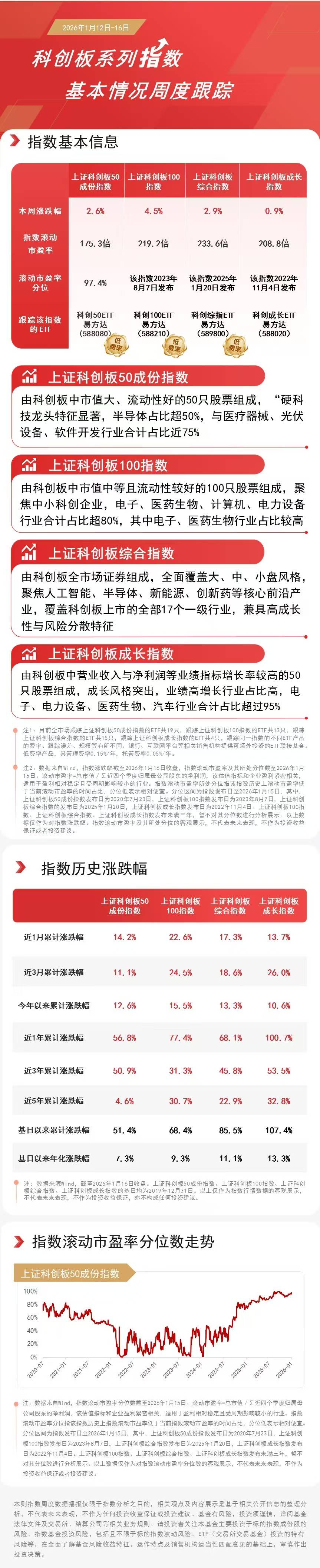
Market Performance - The Sci-Tech 100 Index increased by 4.5%, the Sci-Tech Composite Index rose by 2.9%, the Shanghai Sci-Tech 50 Component Index went up by 2.6%, and the Shanghai Sci-Tech Growth Index saw a rise of 0.9% this week [1][3]. Industry Developments - A significant breakthrough in the development of new semiconductor materials was achieved by a team from the University of Science and Technology of China, which successfully constructed a programmable, atomically flat "mosaic" heterojunction in two-dimensional ionic soft crystal materials. This technology overcomes the challenges of traditional processes that tend to damage soft crystal structures, paving the way for the development of high-performance light-emitting and integrated devices [1]. Index Composition - The Shanghai Sci-Tech 100 Index consists of 100 stocks with medium market capitalization and good liquidity, focusing on small and medium-sized tech enterprises, with over 80% of its composition in the electronics, biopharmaceuticals, computer, and power equipment sectors [5]. - The Shanghai Sci-Tech Composite Index covers all market securities, focusing on core frontier industries such as artificial intelligence, semiconductors, new energy, and innovative pharmaceuticals, encompassing all 17 primary industries listed on the Sci-Tech Board [5]. - The Shanghai Sci-Tech Growth Index is composed of 50 stocks with high growth rates in revenue and net profit, with over 95% of its composition in high-growth sectors like electronics, power equipment, biopharmaceuticals, and automotive [5]. ETF Tracking - There are currently 19 ETFs tracking the Shanghai Sci-Tech 50 Component Index, 13 ETFs for the Shanghai Sci-Tech 100 Index, 15 ETFs for the Shanghai Sci-Tech Composite Index, and 4 ETFs for the Shanghai Sci-Tech Growth Index, with varying fee rates and tracking errors [5].