腾讯控股有限公司

Search documents
GPT-5发布 能否点燃AI应用新爆点?
Zheng Quan Ri Bao Zhi Sheng· 2025-08-08 16:48
Group 1: OpenAI's GPT-5 Release - OpenAI released its latest AI model, GPT-5, which includes GPT-5, GPT-5 mini, and GPT-5 nano, all with a context length of 400K and a maximum output of 128K tokens [1] - CEO Sam Altman stated that GPT-5 is the "best model in the world" and represents a significant step towards developing Artificial General Intelligence (AGI) [1] - GPT-5 has significantly improved capabilities in mathematics, programming, visual perception, and health compared to its predecessors, making it OpenAI's most powerful model to date [2] Group 2: Performance Improvements - GPT-5 has reduced factual error rates by 45% compared to GPT-4o, and by 80% in deep thinking mode compared to o3 [2] - It is recognized as the strongest coding model, capable of creating websites, applications, and games with a single prompt [2] - The API pricing for GPT-5 has decreased, costing $1.25 per million tokens for input and $10 for output, making it more affordable than GPT-4o and significantly cheaper than competitors like Claude Opus 4.1 and Gemini 2.5 Pro [2] Group 3: Industry Analysis and Competition - Some industry analysts noted that GPT-5 did not present any groundbreaking surprises, attributing this to the diminishing returns of Scaling Laws as parameters, computing power, and data volume increase [3] - Domestic AI models in China are evolving from auxiliary tools to core productivity drivers, penetrating various sectors such as government, finance, manufacturing, and healthcare [4] - The competitive landscape for domestic large models is becoming clearer, with leading firms like Baidu capturing significant market share through numerous successful project bids [5][6]

彻底爆发!利器来了 韩国押注中国AI
Zhong Guo Ji Jin Bao· 2025-08-06 14:55
Group 1 - KIM launched the KIM ACE China AI Big Tech TOP2+ Active ETF, which tracks the Solactive China AI Big Tech Top 2+ Index, aiming to capture opportunities in AI, digital platforms, and smart industrial technologies in China [1][3] - The Solactive China AI Big Tech Top 2+ Index focuses on two main areas: cognitive technology and digital platforms, and smart systems and industrial technology, selecting 50 companies based on thematic relevance [3] - The index includes companies listed on the Hong Kong Stock Exchange or those eligible for the Shanghai-Hong Kong and Shenzhen-Hong Kong Stock Connect, with a minimum market capitalization of $2 billion and an average daily trading volume of $30 million [3] Group 2 - The top ten holdings of the index include Alibaba, Xiaomi, Tencent, Contemporary Amperex Technology, Meituan, BYD, Foxconn, NetEase, Semiconductor Manufacturing International Corp., and JD.com, with Alibaba and Xiaomi accounting for over 46% of the total weight [5][6] - Korean investors have shown a strong preference for Chinese tech stocks, with Xiaomi being the most net purchased stock by Korean investors this year [5][7] - As of August 5, 2025, Korean investors' net purchases of Chinese stocks (including Hong Kong and A-shares) reached $6.158 billion, surpassing the total for the previous year, making China the second-largest overseas market for Korean investors after the U.S. [7][8]



彻底爆发!利器来了,韩国押注中国AI
中国基金报· 2025-08-06 14:10
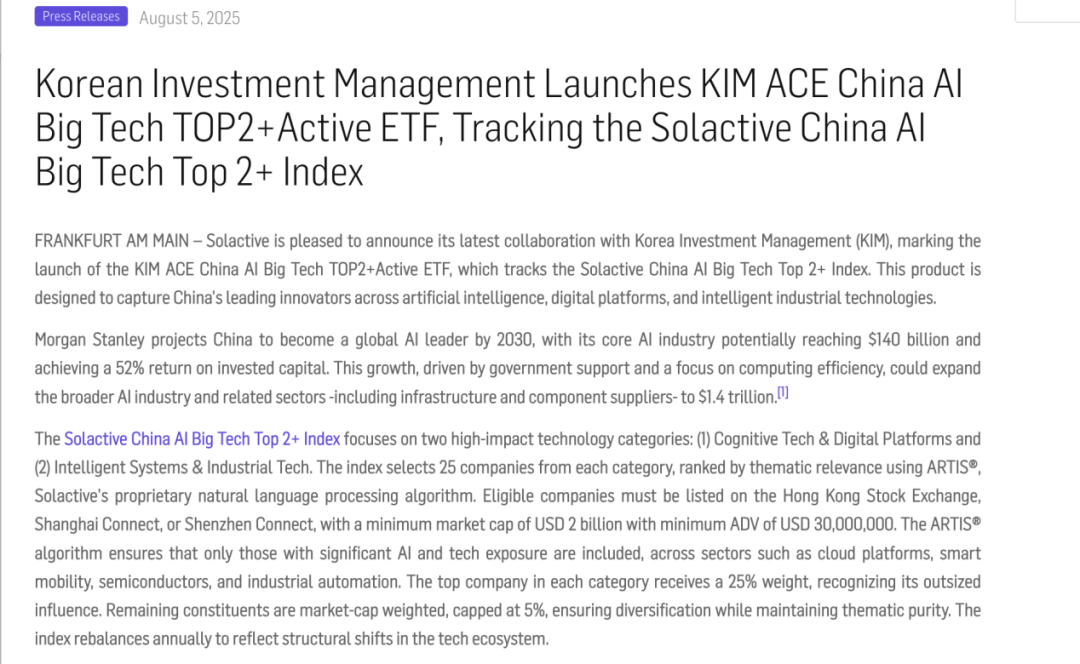
Core Viewpoint - KIM has launched the KIM ACE China AI Big Tech TOP2+ Active ETF, aiming to capture opportunities in China's AI, digital platforms, and smart industrial technology sectors [2][3]. Group 1: ETF Overview - The ETF tracks the Solactive China AI Big Tech Top 2+ Index, which focuses on cognitive technology, digital platforms, smart systems, and industrial technology [3]. - The index includes 50 companies, selecting 25 from each category, and ranks them based on thematic relevance using natural language processing algorithms [3]. - Eligible companies must be listed on the Hong Kong Stock Exchange or included in the Stock Connect programs, with a minimum market capitalization of $2 billion and an average daily trading volume of $30 million [3]. - The index emphasizes companies with a significant portion of their business in AI or technology, covering sectors like cloud platforms, smart mobility, semiconductors, and industrial automation [3]. Group 2: Market Insights - Morgan Stanley predicts that China will become a global leader in the AI industry by 2030, with the core AI industry potentially reaching $140 billion and the broader AI-related sectors reaching $1.4 trillion [3]. - The ETF was listed on July 29 on the Korea Stock Exchange under the code 0087F0.KS [5]. Group 3: Top Holdings - As of August 5, 2025, the top holdings in the index include Alibaba Group (24.23%), Xiaomi Corp (21.94%), and Tencent Holdings (5.70%), with Alibaba and Xiaomi together accounting for over 46% of the index [6][7]. Group 4: Korean Investor Behavior - Korean investors have shown a strong preference for Chinese tech stocks, with Xiaomi being the most net purchased stock among Korean investors this year [8]. - The net purchase amounts for the top Chinese stocks by Korean investors include $170.39 million for Xiaomi, $81.46 million for Alibaba, and $55.87 million for Contemporary Amperex Technology [9][10]. - From January 1 to August 5, 2025, the total transaction amount for Chinese stocks by Korean investors reached $6.158 billion, surpassing the total for the previous year [10].
中银国际固定收益周报-20250804
Bank of China Securities· 2025-08-04 08:29
1. Report Industry Investment Rating No relevant content provided. 2. Core Viewpoints - The US Treasury market reversed dramatically last week due to policy signals and economic data. The Treasury Department's statement supported the long - end of the yield curve, while Powell's hawkish tone pressured the short - end. The disappointing jobs report on Friday sent September rate - cut probabilities soaring to 87% [3][5]. - China's credit bonds were generally stable before widening on Friday. Investment - grade and high - yield bonds widened by 5bps and 40bps respectively, and China CDS and iTraxx Asia ex - Japan IG CDS widened by 3bps and 2bps respectively [4][6]. - Different sectors in the bond market had mixed performances. The financial sector was mixed, the tech sector was largely steady, other IG bonds were affected by interim results, and the high - yield corporate sector was softer [5][6][8]. 3. Summary by Related Catalogs Secondary Market Recap - **US Treasury**: Yields on 2 - year, 5 - year, and 10 - year Treasury notes fell 24bps, 20bps, and 17bps respectively. The 9 - month rate - cut probability changed from 40% to 87% due to the jobs report [3][4][5]. - **China Credit Bonds**: Before Friday, they were stable. China IG and HY bonds widened 5bps and 40bps respectively, and China CDS and iTraxx Asia ex - Japan IG CDS widened 3bps and 2bps respectively [4][6]. - **Financial Sector**: Leasing names once outperformed. FRESHK 28s and AVOL 30s tightened 5bps and 3bps before Friday. FWDGHD bonds' performance stalled. AT1s edged better, and in AMC, CFAMCI curve rose 0.2 - 0.4pt [6][7]. - **Tech Sector**: Benchmark BABA and TENCNT curves were stable. High - beta bonds like MEITUA 30s were muted. AACTEC 31s once tightened 9bps but reversed the change on Friday [8][11]. - **Other IG Bonds**: Sinopec's 1H net income fell 40 - 44%, SINOPE 30s was flattish. HNINTL 30s tightened 8bps. ZHOSHK 28s tightened 19bps. GWFOOD 30s had a gain then reversed most of it. HKAA 28s tightened 17bps [9][12]. - **High - yield Corporate Sector**: Chinese property stocks fell as home sales slumped in July. VNKRLE 27s fell 1.5pts, and Logan considered deeper haircuts in offshore - debt restructuring [10][12]. Primary Market - China Cinda HK Holdings issued RMB5.3bn bonds, with 3.5Y and 5Y priced at 2.35% and 2.43% respectively, significantly tighter than the initial pricing thoughts [16]. Recent Rating Changes - Moody's revised AAC Technologies Holdings' outlook to positive from stable due to profitability improvement and business diversification. It downgraded Shandong Energy's and Yankuang Energy's ratings to Ba2 with a stable outlook [19].
巴菲特最看重的指标!联想冲进《财富》中国“赚钱效率”五强
Zhi Tong Cai Jing· 2025-07-31 06:02
Group 1 - The core viewpoint of the news highlights Lenovo Group's impressive performance, ranking among the top 5 companies in China for Return on Equity (ROE), showcasing its robust strength as a technology giant and providing important reference for investors [1][2] - ROE is a key indicator of a company's profitability, calculated by dividing net profit by average net assets, reflecting the efficiency of generating profits for shareholders [1][2] - High ROE typically indicates strong profitability and efficient capital management, while low ROE may suggest operational inefficiencies or competitive pressures [1][2] Group 2 - Cencora leads the global ROE ranking with over 233%, followed by Home Depot at approximately 223%, with Apple and AbbVie in third and fourth place respectively, indicating that high ROE companies benefit from innovation, cost control, and market leadership [2] - Pinduoduo ranks 25th globally with over 36% ROE, being the only Chinese company in the top 50, while Lenovo Group is among the top 5 Chinese companies, reflecting its continuous innovation and global layout in the PC, server, and smart device sectors [2][3] - Lenovo Group's significant rise to 196th place in the 2025 Fortune Global 500, up 52 places from the previous year, is attributed to its strong performance in the 2024/25 fiscal year, with revenue reaching 498.5 billion RMB, marking a 21% year-on-year growth [3] - The company has maintained double-digit growth across all global regions, demonstrating its resilience and vitality as a truly global company [3] - In the context of a complex international environment and rapid technological advancements, Lenovo's focus on innovation and its hybrid AI strategy are crucial for maintaining global competitiveness [3]

33个内地城市世界500强全览:这里民企巨头最多→
Di Yi Cai Jing Zi Xun· 2025-07-30 01:14
Core Insights - The 2025 Fortune Global 500 list includes 130 Chinese companies, with 120 from mainland China, 4 from Hong Kong, and 6 from Taiwan [2] - The total revenue of Chinese companies on the list is approximately $10.7 trillion, with State Grid Corporation of China leading at $548.4 billion [2][5] - Five new entrants from China include Shandong Gold, Wistron, New China Life, China General Technology Group, and Country Garden, with Shandong Gold making its debut at rank 465 [2] Group 1: Company Rankings and Revenue - The highest-ranked private company is JD.com, with a revenue of $161.1 billion, ranking 44th globally [5] - China National Petroleum Corporation and Sinopec rank 5th and 6th, with revenues of $412.6 billion and $407.5 billion, respectively [5] - Pinduoduo saw the most significant rise in ranking, moving up 176 places to 266th, with a revenue of $54.7 billion [6] Group 2: Geographic Distribution - Beijing has the highest number of listed companies at 46, followed by Guangdong with 18, and Shanghai and Zhejiang with 12 and 10, respectively [2][4] - A total of 33 cities in China have companies on the Fortune Global 500 list, with Beijing, Shanghai, and Shenzhen being the top three [2] Group 3: Company Types - Most of the listed companies are state-owned enterprises, with 40 out of 46 companies in Beijing being central or provincial state-owned [4] - Beijing also has the highest number of private enterprises on the list, including JD.com, Xiaomi, and Meituan [4] Group 4: Profit Performance - The total revenue of the Fortune Global 500 companies is approximately $41.7 trillion, reflecting a growth of about 1.8% from the previous year [8] - The average profit of Chinese mainland and Hong Kong companies increased from $3.9 billion to $4.2 billion, a year-on-year growth of 7.4% [8]





解析《财富》世界 500 强:美国优势离不开中国产业链
财富FORTUNE· 2025-07-30 01:09
Core Insights - The 2025 Fortune Global 500 list shows that Chinese companies continue to make progress, but still face challenges in terms of quality and competitiveness compared to U.S. firms [1][19][22] Group 1: Overall Performance of Fortune Global 500 - The total revenue of the Fortune Global 500 reached $4,173.27 billion, marking an increase of nearly $1000 billion from the previous year, achieving a new peak since the list's inception [1] - The total profit of these companies reached $297.71 billion, close to the highest value recorded since the list began [1] - The threshold for entering the list has increased, with the lowest-ranked company achieving nearly $32.3 billion in sales [1] Group 2: U.S. Companies' Dominance - A total of 138 U.S. companies made the list, accounting for 27.6% of the total, with their combined revenue of $1,459.91 billion representing 35% of the total revenue of all 500 companies [2] - U.S. companies' total profit reached $133.74 billion, making up 45% of the total profits of the Fortune Global 500 [2] - The average profit per U.S. company was $9.69 billion, significantly higher than the average profit of $4.53 billion for non-U.S. companies [2] Group 3: High-Tech Sector Performance - There are 34 high-tech companies on the list, with their average revenue increasing from $88.2 billion in 2024 to $96.7 billion in 2025, a growth of 9.6% [3] - The average profit for these high-tech companies rose by 24% from $146 million to $181 million [3] - Among the 34 high-tech companies, 15 are from the U.S., with an average revenue of $121.7 billion and an average profit of $31 billion, reflecting a 19% increase in revenue and a 31% increase in profit compared to the previous year [4] Group 4: Chinese Companies' Performance - A total of 130 Chinese companies made the list, with 124 from mainland China and Hong Kong, showing a decline from previous years [9][10] - The average revenue for Chinese companies was $823.6 million, with an average profit of $42 million, which is a 7.4% increase year-on-year [10] - Despite the increase in average profit, the number of Chinese companies on the list has decreased for four consecutive years, highlighting a growing gap with U.S. companies [12] Group 5: Challenges Faced by Chinese Companies - Chinese companies are facing significant challenges in improving their operational quality and competitiveness, particularly in the context of U.S.-China trade tensions and global geopolitical conflicts [11][12] - The average sales profit margin for Chinese companies remains below the global average, with a sales profit margin of 5.1% compared to the global average of 7% [12][13] - The automotive sector, while showing growth in production and sales, has seen a decline in profit margins, with the average sales profit margin for Chinese automotive companies at only 2.2% [14][15][16] Group 6: Global Economic Context - The performance of U.S. companies, especially in the high-tech sector, has been a driving force for global economic recovery, reflecting a positive trend in the global economy [3][19] - The ongoing geopolitical tensions and trade conflicts are reshaping global supply chains, impacting the operational landscape for companies worldwide [21][22]



10家深企上榜世界500强 排位“七升三降”
2 1 Shi Ji Jing Ji Bao Dao· 2025-07-29 13:01
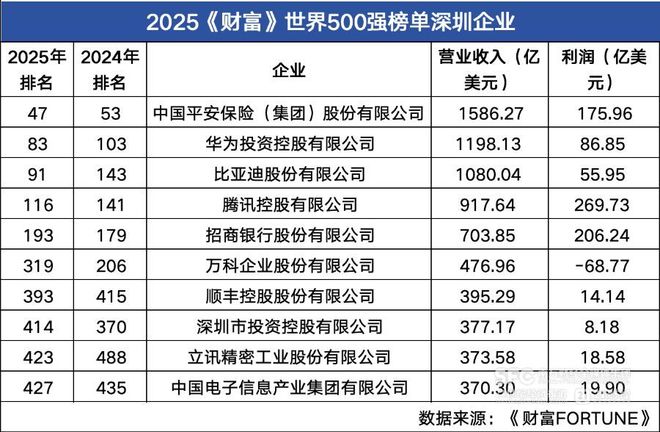
Core Insights - The 2025 Fortune Global 500 list features 130 Chinese companies, ranking second after the United States, with a total revenue of approximately $10.7 trillion for 2024 [1] - Shenzhen has 10 companies on the list, with Ping An Insurance leading at $158.63 billion in revenue [1] - The average profit for Chinese companies on the list increased by 7.4% year-on-year, from $3.9 billion to $4.2 billion [1] Company Performance - Ping An Insurance ranks 47th, with a revenue of $158.63 billion and a profit of $1.76 billion [5] - Huawei ranks 83rd, with a revenue of $119.81 billion and a profit of $868.5 million [5] - BYD, making its debut in the top 100, ranks 91st with a revenue of $108.00 billion and a profit of $559.5 million [5] - Tencent ranks 116th, with a revenue of $91.76 billion and a profit of $2.70 billion [5] - China Merchants Bank ranks 193rd, with a revenue of $70.39 billion and a profit of $2.06 billion [5] - Other Shenzhen companies include Vanke, SF Express, Shenzhen Investment Holdings, Luxshare Precision, and China Electronics, with varying rankings and revenues [5] Industry Trends - High-tech companies on the list saw significant growth, with an average revenue of $96.7 billion and an average profit of $18.1 billion, reflecting increases of 9.6% and 24% respectively [3] - Huawei remains a leader in the high-tech sector, with sales nearing $120 billion [3] - The global expansion of Chinese manufacturing is accelerating, with BYD's overseas sales reaching 89,000 units in May, a 133.6% increase year-on-year [2] - Luxshare Precision is also expanding internationally, with 87.6% of its revenue coming from overseas sales [2] Future Outlook - Shenzhen companies are expected to continue leveraging opportunities amid changing internal and external environments, positioning themselves as a strong force in the future rankings [4]






最新中国500强出炉!国家电网第一,四大行均列前十
天天基金网· 2025-07-23 11:42
Core Insights - The 2025 Fortune China 500 list shows a total revenue of $14.2 trillion for the listed companies in 2024, a decrease of approximately 2.7% compared to the previous year [1] - Net profit for these companies reached $756.4 billion, reflecting a growth of about 7% year-on-year [1] - The total revenue of the 500 companies accounts for roughly three-quarters of China's GDP, which is projected to be $18.75 trillion in 2024 [1] Group 1: Company Rankings - State Grid Corporation leads the list with a revenue of $548.4 billion [1] - China National Petroleum Corporation and China Petroleum & Chemical Corporation rank second and third, respectively [1] - The "Big Four" banks are all in the top ten, with Industrial and Commercial Bank of China ranked fifth [1] - JD.com is the highest-ranked private enterprise at 11th, followed by Alibaba at 18th and Tencent at 32nd [1] Group 2: Profitability - The top ten most profitable companies include five commercial banks and China National Petroleum, along with four private enterprises: TSMC, Tencent, Alibaba, and China Ping An Insurance [2] - TSMC ranks fourth with a net profit of $36.1 billion, while Tencent's net profit exceeds $26.9 billion, showing a year-on-year growth of over 65% [2] - Alibaba and China Ping An rank ninth and tenth in profitability, respectively, with the top ten companies accounting for approximately 41% of the total profits of the listed companies [2]






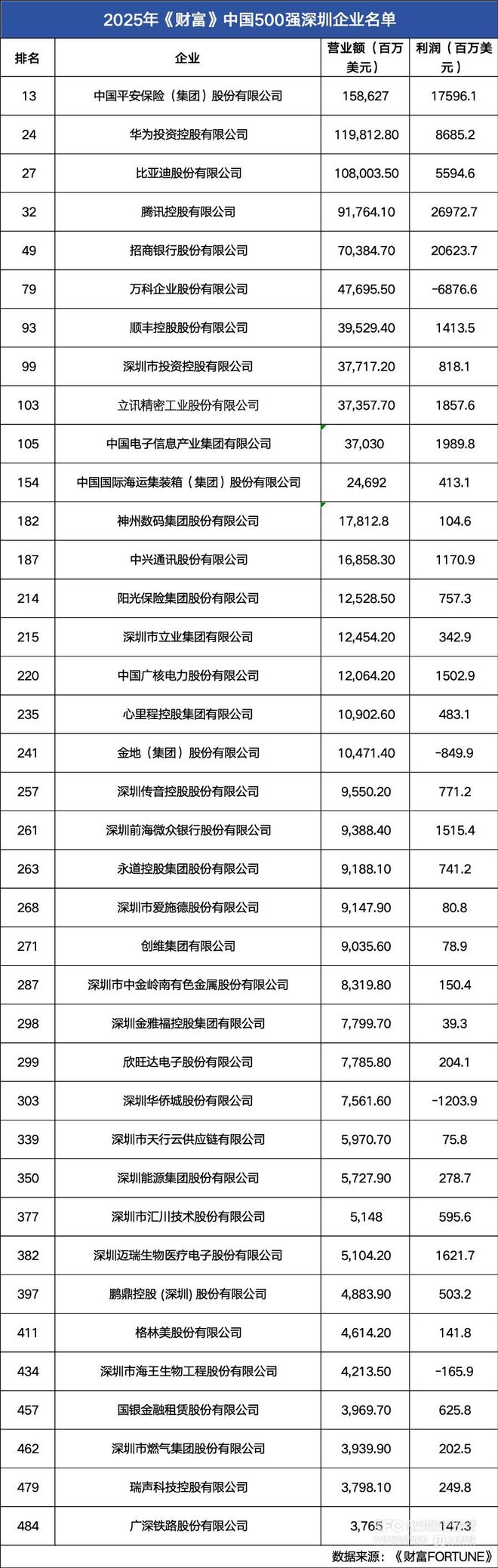
38家深企上榜《财富》中国500强,腾讯、平安最赚钱
2 1 Shi Ji Jing Ji Bao Dao· 2025-07-23 09:36
Core Insights - The 2025 Fortune China 500 list features 38 companies from Shenzhen, highlighting the city's growing economic significance [1][4] - Notable Shenzhen companies in the top 100 include China Ping An, Huawei, BYD, Tencent, and others, with China Ping An ranked highest at 13th [1][4] - The list reflects Shenzhen's economic transformation towards new growth drivers, particularly in emerging industries like renewable energy [2][3] Company Performance - China Ping An reported a revenue of $158.63 billion and a profit of $17.60 billion in 2024, with significant investments in AI [4][5] - Tencent's net profit exceeded $26.9 billion in 2024, showing a growth of over 65% year-on-year, driven by strategic investments in various sectors [4][5] - Huawei achieved a revenue of $86.21 billion, with a profit of $8.69 billion, and invested $27.97 billion in R&D, representing 20.8% of its total revenue [5][6] Industry Trends - Shenzhen's companies are diversifying across various sectors, including electronics, renewable energy, AI, and logistics, with a strong focus on new energy vehicles [2][10] - BYD sold 4.27 million electric vehicles globally in 2024, maintaining its position as the world's leading EV manufacturer [5][10] - The renewable energy sector is thriving, with companies like Grinmei and Xinnengda making significant advancements in battery technology and global market presence [10][11] Emerging Companies - Three companies made their debut on the Fortune list: Yongdao Holdings, AAC Technologies, and Guangshen Railway, indicating a broadening of Shenzhen's corporate landscape [6][8] - Grinmei and Xinnengda have shown remarkable ranking improvements, reflecting their growing influence in the renewable energy sector [6][10] Economic Impact - Shenzhen's industrial output reached over $5.4 trillion in 2024, with a 9.7% year-on-year growth, solidifying its status as China's industrial powerhouse [10][12] - The city is actively developing its AI and robotics sectors, with companies like Huichuan Technology making significant strides in humanoid robotics [11][12]