
青岛啤酒

Search documents
2025Q4基金食品饮料持仓分析:持仓继续下降,结构向大众品倾斜
Soochow Securities· 2026-01-26 12:12
Investment Rating - The report maintains an "Increase" rating for the food and beverage industry [1] Core Insights - The food and beverage sector continues to see a decline in holdings, with a shift towards mass-market products. The proportion of active equity funds in the food and beverage sector decreased to 4.04% in Q4 2025, down 0.14 percentage points from the previous quarter [9][15] - The report highlights a continued reduction in allocations to alcoholic beverages, while holdings in mass-market products have shown signs of recovery. The proportion of holdings in white liquor decreased by 0.29 percentage points to 2.92% in Q4 2025 [14][17] - The report emphasizes the importance of capturing valuation switching opportunities in five key areas: health food and supplements, leading snack brands, quality retail chains, beverage leaders with long life cycles, and sectors expected to recover from downturns, particularly dairy [29][30] Summary by Sections 1. Holdings Decline and Shift Towards Mass-Market Products - Active equity funds' holdings in the food and beverage sector decreased by 9.01% to 784 billion yuan in Q4 2025, with a total market value of approximately 1.94 trillion yuan [9][10] - The decline in holdings is attributed to a preference for technology and other sectors, while the alcoholic beverage sector continues to face downward pressure [10][14] 2. Increased Diversification in Holdings - The number of heavily held stocks in the food and beverage sector has become more diversified, with only Kweichow Moutai remaining in the top 20 heavy holdings [24][28] - The report notes that the top five stocks with the largest increase in heavy holdings include Baba Foods, Yingjia Gongjiu, Youran Dairy, Ximai Foods, and Modern Dairy [28][29] 3. Investment Recommendations - The report suggests focusing on five areas for investment: innovative health food, leading snack brands, quality retail chains, beverage leaders, and sectors expected to recover from downturns [29][30] - It emphasizes the need to pay attention to the health food sector, which is expected to benefit from an expanding consumer base and product innovation [29][30]

好客山东牵手北京地铁,探索文旅营销新方式
Qi Lu Wan Bao· 2026-01-26 08:26
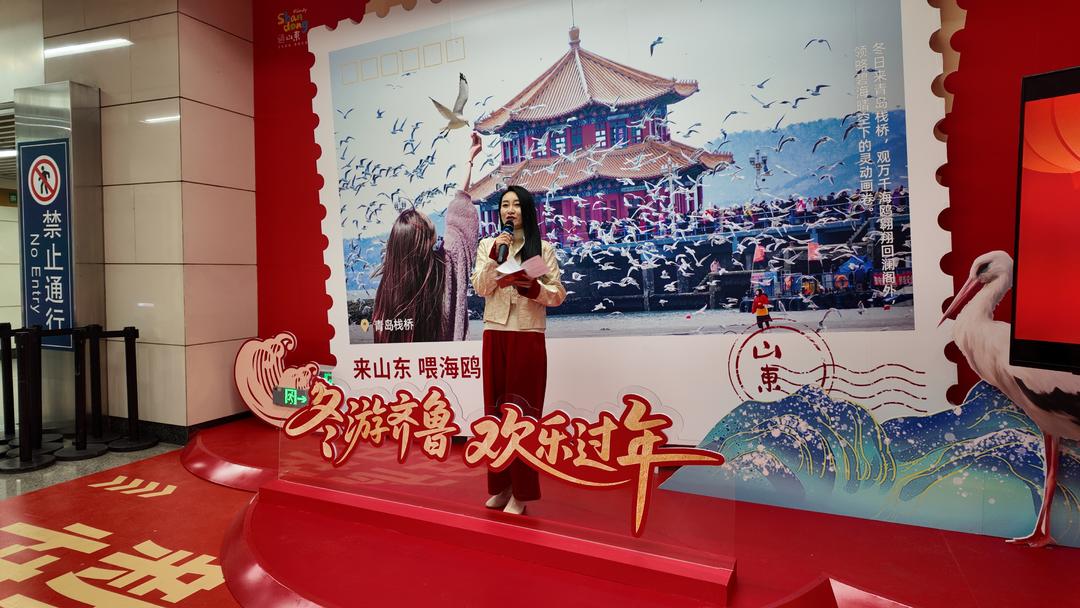
Core Viewpoint - The "Winter Tour Qilu Happy New Year" promotional event for Shandong's winter tourism was launched at the Chaoyangmen subway station in Beijing, utilizing a combination of subway advertising, ground promotion, and face-to-face sales to attract urban residents and tourists [1][2][11]. Group 1: Event Overview - The promotional event took place on January 25 at Chaoyangmen subway station, a high-traffic area in Beijing with an average daily footfall of 200,000 people [3][2]. - The event featured interactive experiences and promotional materials, including postcards, maps, and creative products, aimed at engaging the public and enhancing the appeal of Shandong as a travel destination [11][14]. Group 2: Target Audience and Engagement - The event successfully attracted interest from both local residents and tourists, with many expressing a desire to visit Shandong after engaging with the promotional activities [3][10]. - Participants included representatives from various "treasure cities" in Shandong, who actively promoted local attractions and products, highlighting the unique offerings of their regions [4][5][7]. Group 3: Marketing Strategy - The marketing strategy involved leveraging the subway as a "super lifestyle scene entrance," combining offline interactions with online promotions to maximize reach and engagement [11][13]. - The event aimed to address the challenge of attracting Beijing residents to Shandong by creating a personal connection through face-to-face interactions, thereby encouraging potential visitors to make travel decisions [13][14].

食品饮料行业周报:茅台批价坚挺旺季氛围渐起,鸣鸣很忙上市催化零食板块-20260125
Shenwan Hongyuan Securities· 2026-01-25 13:08
Investment Rating - The report maintains a positive outlook on the liquor sector, particularly on premium brands like Guizhou Moutai, Luzhou Laojiao, and Shanxi Fenjiu, while also highlighting the potential of other brands such as Wuliangye and Jinjing Wine [2][7]. Core Insights - The liquor market is undergoing a restructuring phase, with expectations of a double-digit decline in sales year-on-year for Q1 2026, but a potential stabilization in Q2 and a turning point in Q3 [2][7]. - The report anticipates a recovery in the liquor sector by the end of 2026 and into 2027, driven by improved fundamentals and valuation [2][7]. - The consumer goods sector is showing structural improvements, with competition shifting from price to quality, leading to a gradual balance in supply and demand [2][9]. Summary by Sections 1. Weekly Insights on Food and Beverage - The food and beverage sector saw a decline of 1.41% last week, with liquor down 2.80%, underperforming the Shanghai Composite Index by 2.25 percentage points [6]. - Notable stock performances included a 19.59% increase for Haoxiangni and a 14.32% rise for Wancheng Group [6]. 2. Market Performance of Food and Beverage Sectors - The report highlights the price stability of Moutai, with a current price of 1560 RMB per bottle, up 20 RMB from the previous week, indicating a positive trend in pricing [8][27]. - The report notes that Moutai's pricing has found a bottom, reducing downward risks significantly, and anticipates a potential increase in sales volume as the Spring Festival approaches [8]. 3. Industry Events and Updates - The report mentions the upcoming IPO of Mingming Hen Mang, a leading snack retail chain, which is expected to catalyze the snack sector [10]. - The report emphasizes the importance of supply chain management and digitalization in enhancing competitive advantages for companies like Mingming Hen Mang [10]. 4. Valuation Table - The food and beverage sector's dynamic PE is currently at 19.27x, with a premium rate of 10%, while the liquor sector's dynamic PE stands at 17.50x, indicating a zero premium [27].





酒行业周度市场观察-20260125
Ai Rui Zi Xun· 2026-01-25 03:02
Investment Rating - The report does not explicitly provide an investment rating for the industry Core Insights - The Australian wine market is reshaping the Chinese imported wine market after a year and a half of absence, with a significant initial increase in imports followed by a decline in sales due to inventory issues and economic pressures [2] - The low-alcohol beverage category is rapidly growing, appealing to younger consumers, but faces challenges such as brand homogenization and declining repurchase rates [2] - The white liquor industry is experiencing a shift in market dynamics, with top brands competing fiercely and some companies facing their first quarterly negative growth in nearly a decade [4] - New beverage products are emerging, with brands like Xiaojin Wine and Guoli Fang successfully capturing market share through innovative approaches [5] - The industry is expected to return to rationality in 2026, focusing on consumer needs and product quality, while smaller companies may face elimination [6] Industry Environment - The Australian wine market is seeing a resurgence in China due to the removal of anti-dumping taxes, but initial sales have not met expectations, leading to inventory issues and price reductions [2] - The low-alcohol market is projected to grow from 20 billion yuan in 2020 to 57 billion yuan by 2024, but faces challenges in brand differentiation and consumer loyalty [2] - The white liquor market is undergoing structural changes, with companies like Shanxi Fenjiu surpassing others in revenue, indicating a competitive landscape [4] - The introduction of innovative products is crucial for the industry's transformation, with a focus on low-alcohol and health-oriented offerings [5] - The industry is moving towards a more rational approach, emphasizing product quality and consumer experience, as it transitions from a bubble phase to a healthier growth period [6] Top Brand Dynamics - Guizhou Zhenjiu is upgrading its "Dazhen" product to enhance quality and market positioning, aiming to compete with top brands like Moutai [8] - Wuliangchun is celebrating its 30th anniversary with a marketing campaign that deepens emotional connections with consumers [9] - Xifengjiu is focusing on quality and cultural empowerment to drive its revival in the competitive white liquor market [10] - Moutai is launching a new product structure to meet diverse consumer needs and stabilize its market presence [14] - Niulanshan is evolving its product strategy to maintain its position in the mass market while enhancing emotional connections with consumers [18]
五大航点联动赋能 青岛机场打造东北亚对韩门户枢纽!
Qi Lu Wan Bao· 2026-01-24 11:32
齐鲁晚报.齐鲁壹点记者赵波通讯员陈晓珍 近年来,青岛机场深耕韩国市场,已形成覆盖首尔、釜山、济州、清州、大邱等五大核心城市的航线网络,精准触达韩国核心经济区域与消费市场。2025 年,青岛机场韩国市场旅客量185.7万人次,同比增长21.6%;进入2026年1月以来仍保持24%的增速,成为驱动国际市场增长的核心引擎。 中转服务持续升级构筑枢纽生态 青岛机场以"中转韩国首选青岛"为核心,强化国内国际中转功能,重点联动国内沿黄流域及中西部机场。目前已形成覆盖国内41个城市经青岛飞韩国中转 体系,并对当日中转通程旅客提供"一次值机,行李直挂"服务。 下一步,青岛机场将持续深耕韩国市场,以五大航线为支撑,以高效中转服务为纽带,以青岛的山海风情、产业优势为依托,持续打造东北亚对韩门户枢 纽,在中韩双向奔赴的征程中,书写互联互通的崭新篇章。 青岛机场首尔快线以日均32架次的高频直达航班覆盖早中晚时段,搭建起中韩经贸文化交流的空中走廊;釜山为省内独飞航点,日均往返4架次,航线紧 密衔接两地制造业与物流产业,为环黄海经济圈注入强劲动力。两大核心航线客座率长期保持在80%左右,支撑作用显著。 三条特色航线精准发力激活多元需求 ...

非白酒板块1月23日涨0.18%,*ST兰黄领涨,主力资金净流出2353.25万元
Zheng Xing Xing Ye Ri Bao· 2026-01-23 09:04
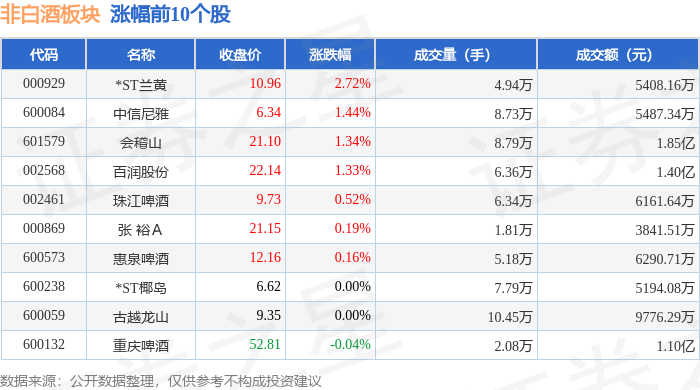
Core Viewpoint - The non-liquor sector experienced a slight increase of 0.18% on January 23, with *ST Lanhuang leading the gains, while the overall market indices also showed positive movement [1]. Group 1: Market Performance - The Shanghai Composite Index closed at 4136.16, up by 0.33% [1]. - The Shenzhen Component Index closed at 14439.66, up by 0.79% [1]. - The non-liquor sector stocks showed varied performance, with *ST Lanhuang rising by 2.72% to a closing price of 10.96 [1]. Group 2: Stock Performance - The top performers in the non-liquor sector included: - *ST Lanhuang: 10.96, +2.72%, trading volume of 49,400 shares, turnover of 54.08 million [1]. - Zhongxin Niya: 6.34, +1.44%, trading volume of 87,300 shares, turnover of 54.87 million [1]. - Huijuan Beer: 12.16, +0.16%, trading volume of 51,800 shares, turnover of 62.91 million [1]. - Conversely, stocks like Weilang Co. and ST Xifa saw declines of 2.12% and 1.88%, respectively [2]. Group 3: Capital Flow - The non-liquor sector experienced a net outflow of 23.53 million from institutional funds and 36.39 million from speculative funds, while retail investors contributed a net inflow of 59.92 million [2]. - Notable capital flows included: - Qingdao Beer: -35.13 million from institutional funds, with a retail outflow of -49.91 million [3]. - *ST Yedao: +5.45 million from institutional funds, with a retail inflow of +1.50 million [3].


富国消费主题混合C基金近3年单位净值下跌23.03% 长期重仓白酒股
Xi Niu Cai Jing· 2026-01-22 14:45
Core Insights - The performance of the Fuqua Consumer Theme Mixed Fund has attracted market attention, particularly since the establishment of its C-class shares, which has seen a decline in net asset value [2][4] Fund Performance - The C-class shares of the Fuqua Consumer Theme Mixed Fund have experienced a 29.9% decline in net asset value since their inception on January 18, 2021, with a 23.03% drop over the past three years and a modest 1.03% increase over the last year [2][3] - As of January 19, 2026, the fund's net asset value stood at 2.1520, with a recent monthly performance of -0.55% and a three-month decline of 6.19% [3] Fund Management - The fund is managed by Wang Yuanyuan, who has been with Fuqua Fund since April 2015 and has held various positions, including industry researcher and senior equity fund manager [3][4] - As of the end of Q3 2025, the fund's net asset value was approximately 4.241 billion, with 91.4% of its assets allocated to stocks and no bonds held [3] Investment Strategy - The fund has historically maintained a heavy allocation to liquor stocks, particularly Kweichow Moutai, which saw a 6.47% decline in stock price in 2025 [4] - Wang Yuanyuan indicated in the fund's Q3 report that the fund is looking to increase its allocation to the liquor sector based on low valuation levels and potential stabilization in 2026, while also screening for opportunities in the new consumption sector [4] - The fund aims to focus on high-quality growth companies in the domestic consumer sector, emphasizing brand concentration and international expansion as key growth drivers [4]

非白酒板块1月22日涨0.72%,威龙股份领涨,主力资金净流出1821.8万元
Zheng Xing Xing Ye Ri Bao· 2026-01-22 09:02
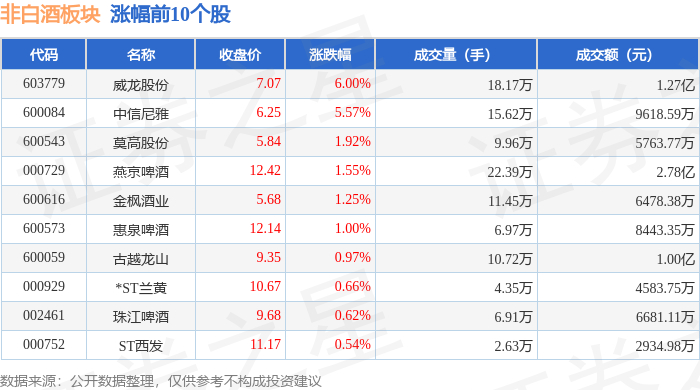
Core Viewpoint - The non-baijiu sector experienced a 0.72% increase on January 22, with Weilong Co., Ltd. leading the gains, while the Shanghai Composite Index rose by 0.14% and the Shenzhen Component Index increased by 0.5% [1] Group 1: Market Performance - The closing price of Weilong Co., Ltd. was 7.07, with a rise of 6.00% and a trading volume of 181,700 shares, amounting to a transaction value of 127 million yuan [1] - Other notable performers included CITIC Neya with a closing price of 6.25, up 5.57%, and Mogaoguan Co. at 5.84, up 1.92% [1] - The overall trading volume in the non-baijiu sector showed varied performance, with some stocks like Feike Beer and Jinfeng Wine also recording positive gains [1] Group 2: Capital Flow - The non-baijiu sector saw a net outflow of 18.218 million yuan from institutional investors and 35.8685 million yuan from retail investors, while there was a net inflow of 54.0864 million yuan from individual investors [2] - The capital flow data indicates that while institutional and speculative funds withdrew, retail investors were actively buying into the sector [2] Group 3: Individual Stock Analysis - Chongqing Beer experienced a net outflow of 16.9419 million yuan from institutional investors, while retail investors contributed a net inflow of 1.2597 million yuan [3] - Weilong Co., Ltd. had a net inflow of 14.4287 million yuan from institutional investors, but faced a net outflow of 1.19562 million yuan from retail investors [3] - Qingdao Beer saw a net inflow of 11.5279 million yuan from institutional investors, indicating strong institutional interest despite retail outflows [3]


浙江省乐清市市场监督管理局2025年12月第六期食品安全“你点我检”抽检信息通告
Zhong Guo Zhi Liang Xin Wen Wang· 2026-01-22 08:25
二、处理措施和消费提示 对抽检中发现的不符合标准规定的产品,乐清市市场监督管理局已责令相关单位立即停止生产、销售、采取下架等措施,控制风险,并依法予以查处,确保 后处理到位并根据实际情况积极开展追溯工作。其他经销与本次监测被判定问题食品相同品牌、相同货品、相同批号食品的,也应立即停止销售,主动撤 柜,并做好善后处理工作。本局将通过企业信用信息公示系统、门户网站、专业网站等公示行政处罚信息。特别提示消费者,如发现上述相同批号食品或合 法消费权益受到损害,请及时拨打12345电话向市场监管部门投诉、举报。 乐清市市场监督管理局2025年12月第六期食品安全"你点我检"抽检信息通告 近期,乐清市市场监督管理局组织抽检粮食加工品、调味品、饮料、糕点、蔬菜制品、食用油、油脂及其制品、酒类、食用农产品、餐饮食品、乳制品、速 冻食品、豆制品、淀粉及淀粉制品、肉制品、炒货食品及坚果制品、水果制品、水产制品、饼干、糖果制品、蛋制品、方便食品、罐头、食糖等21类食品 290批次样品。根据食品安全国家标准检验和判定:抽样检验合格287批次、不合格3批次(见附件)。不合格项目涉及农兽药残留、食品添加剂不符合规定、 质量指标等。具体情 ...
零工取代星巴克全职咖啡师?奈雪们早就尝试了
2 1 Shi Ji Jing Ji Bao Dao· 2026-01-22 01:32
Group 1 - Starbucks China is focusing on controlling labor costs by increasing the recruitment of part-time employees, with 61.7% of job postings for student part-time positions and 17.8% for social part-time positions [1] - The majority of full-time job postings are concentrated in lower-tier cities, with only Shenzhen and Shanghai having limited full-time positions [1] - The trend of hiring part-time workers is becoming common in the restaurant industry, as seen with Nayuki Tea, which has also shifted to a workforce primarily composed of part-time employees [2] Group 2 - The management structure at Starbucks is changing, with plans to have one store manager oversee multiple locations, a strategy aimed at reducing costs [2] - The shift from full-time baristas to gig workers raises concerns about maintaining service quality, which is a core competitive advantage for Starbucks [2][3]