
特变电工

Search documents
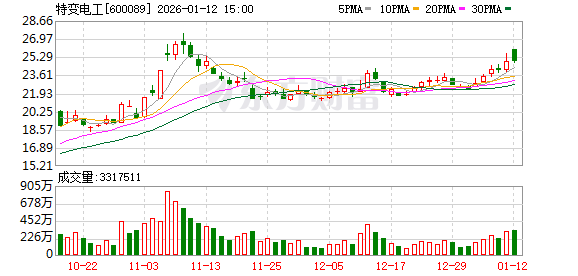
特变电工:目前公司尚不具备生产海底电缆的能力
Zheng Quan Ri Bao Zhi Sheng· 2026-01-12 13:08
(编辑 王雪儿) 证券日报网讯 1月12日,特变电工在互动平台回答投资者提问时表示,公司可为海上风电项目提供风 机、塔筒等配套装备电缆,该类电缆产品具备耐候性、耐海水腐蚀性、抗风压能力等特性。目前公司尚 不具备生产海底电缆的能力。 ...

特变电工:公司根据业主要求选定元器件
Zheng Quan Ri Bao· 2026-01-12 12:10
证券日报网讯 1月12日,特变电工在互动平台回答投资者提问时表示,公司根据业主要求选定元器件。 (文章来源:证券日报) ...

海外需求与技术升级助力光伏,光伏ETF嘉实(159123)聚焦光伏全产业链机遇
Xin Lang Cai Jing· 2026-01-12 02:31
Group 1 - The core viewpoint of the news highlights a strong performance in the photovoltaic industry, with the China Securities Photovoltaic Industry Index rising by 1.83% and key stocks such as Dongfang Risheng and Maiwei shares experiencing significant gains [1] - The National Development and Reform Commission and the National Energy Administration have jointly issued guidelines to promote the consumption and regulation of renewable energy, establishing a systematic framework driven by market and innovation [1] - The recent "2025 Photovoltaic Industry Annual Conference" focused on strategies to address "involution" competition, releasing initiatives for standard application and supply chain quality, signaling a strong commitment to institutional development and unified rules [1] Group 2 - As of December 31, 2025, the top ten weighted stocks in the China Securities Photovoltaic Industry Index include TBEA, LONGi Green Energy, and Sungrow Power, collectively accounting for 55.11% of the index [2] - The photovoltaic ETF managed by Harvest (159123) tracks the China Securities Photovoltaic Industry Index, providing a convenient tool for investing across the entire photovoltaic industry chain [3] - Investors can also access the photovoltaic ETF through an off-market connection (014605) to capitalize on investment opportunities within the photovoltaic industry chain [4] Group 3 - According to Zheshang Securities, the power equipment industry is expected to benefit from increased overseas demand, particularly optimistic about exports to the U.S. amid easing trade disputes, which may lead to growth in exports related to power and renewable energy equipment [1] - The photovoltaic equipment sector is entering a bottoming phase, with the worst period already experienced, but the themes of "cost reduction and efficiency enhancement" and "technological innovation" remain crucial [1] - The industry is advised to pay attention to the potential changes in competitive landscape due to the promotion of "anti-involution" policies and the localization of overseas renewable energy industries [1]
供需紧平衡,铝价仍具上行潜力
Hua Lian Qi Huo· 2026-01-11 15:30
1. Report Industry Investment Rating No information provided in the content. 2. Core Viewpoints of the Report - The aluminum market is in a tight supply - demand balance, and aluminum prices still have upward potential under the support of global wide - policy and the tight supply - demand balance. The traditional consumption areas have a slowdown in growth, and exports are restricted by US tariff policies, but emerging areas such as artificial intelligence, energy storage, and robotics show clear incremental demand. The "aluminum substituting for copper" trend will continue due to the high copper - aluminum price ratio. [7] - The raw material bauxite supply is expected to remain loose, but policy changes in Guinea need attention. Alumina supply pressure exists with large - scale new production capacity, and policy adjustments in the domestic industry should be closely watched. Domestic electrolytic aluminum production capacity expansion channels are basically closed, and overseas supply growth in 2026 is limited. [7] - The strategy is to hold medium - term long positions and buy on dips. The medium - term support range for Shanghai Aluminum 2603 is 23,000 - 23,300 yuan/ton. [7] 3. Summary by Relevant Catalogs 3.1 Week - ly Views and Strategies - **Macro**: Geopolitical events such as the US military action in Venezuela, the US - EU tension, and the uncertainty in the Middle East have increased market concerns. The US employment growth in December 2025 was still sluggish with 50,000 new non - farm jobs and a 4.4% unemployment rate. [7] - **Supply**: Bauxite supply is expected to be loose, but Guinea's policy changes are a risk. Alumina supply pressure persists with large new - capacity projects, and cost provides some price support. Domestic electrolytic aluminum production capacity is relatively stable, and the expansion channel is basically closed. Overseas supply growth in 2026 is limited. [7] - **Demand**: Traditional consumption areas have a slowdown, and exports are affected by US tariffs. However, emerging areas like AI, energy storage, and robotics will drive demand growth, and the "aluminum substituting for copper" trend will continue. [7] - **Inventory**: Domestic consumption has entered the traditional off - season, social inventory is increasing, and the spot discount is widening. [7] - **Strategy**: Hold medium - term long positions and buy on dips. The medium - term support range for Shanghai Aluminum 2603 is 23,000 - 23,300 yuan/ton. [7] 3.2 Futures and Spot Markets - The report presents figures on domestic aluminum futures and spot prices, A00 aluminum ingot spot premiums and discounts, LME aluminum prices, and the Shanghai - LME aluminum ratio, but no specific analysis is provided other than the data sources. [11][15] 3.3 Supply and Inventory - **Bauxite**: In November 2025, China imported 15.11 million tons of bauxite, a 22.50% year - on - year increase. From January to November 2025, the cumulative import was 187 million tons, a 29.61% year - on - year increase. In 2024, the cumulative import was 158.767 million tons, a 12.3% year - on - year increase. Guinea was the main source, accounting for 69.41%. Domestic bauxite production from January to October 2025 was 50.5155 million tons, a 5.19% year - on - year increase, but in October, it decreased by 6.96% year - on - year. Since July, domestic bauxite port inventory has declined. [25][31] - **Alumina**: In November 2025, the weighted average full cost of domestic alumina was 2,870 yuan/ton, a 4 - yuan/ton month - on - month decrease. The spot price dropped to 2,869 yuan/ton, a 2.6% month - on - month decrease. The industry was near the break - even point with an average loss of 1 yuan/ton. In November 2025, China's alumina production was 8.138 million tons, a 7.6% year - on - year increase; from January to November, the cumulative production was 84.657 million tons, an 8.4% year - on - year increase. From January to November 2025, the cumulative import was 970,300 tons, a 30.92% year - on - year decrease, and the cumulative export was 2.3433 million tons, a 46.7% year - on - year increase. The net export was 1.373 million tons, a 612.58% year - on - year increase. In 2025, it was a year of large - scale capacity investment, and there are still many projects to be put into production in 2026 and later. [39][41] - **Electrolytic Aluminum**: In November 2025, the electrolytic aluminum industry showed "increasing cost and growing profit". The weighted average full cost was 16,297 yuan/ton, a 1.9% month - on - month increase. The average profit was about 5,400 yuan/ton. The domestic aluminum smelting enterprise's built - in capacity was 45.158 million tons, and the operating capacity was estimated to be 43.479 million tons, with an operating rate of 96.28%. In November 2025, the global primary aluminum production was 6.086 million tons, a 0.5% year - on - year increase. From January to November 2025, the global primary aluminum production was 64.93 million tons. From January to November 2025, domestic electrolytic aluminum production was 40.172 million tons, a 2% year - on - year increase. In November 2025, domestic primary aluminum imports were about 1.47 million tons, a 2.44% year - on - year decrease; from January to November, the cumulative import was about 23.578 million tons, a 19.35% year - on - year increase. From January to November, the domestic primary aluminum export was about 5.83 million tons. As of January 8, 2026, the LME futures inventory was 501,800 tons, and the domestic electrolytic aluminum social inventory was 718,000 tons. [55][61][62][68][72][73] 3.4 Primary Processing and Terminal Markets - **Aluminum Alloys**: In November 2025, China's aluminum alloy production was 1.739 million tons, a 17.0% year - on - year increase; from January to November, the cumulative production was 17.456 million tons, a 15.8% year - on - year increase. In 2024, the cumulative production was 16.141 million tons, a 9.6% year - on - year increase. [81] - **Aluminum Products and Bars**: In November 2025, China's aluminum product production was 5.931 million tons, a 0.4% year - on - year decrease; from January to November, the cumulative production was 61.511 million tons, a 0.1% year - on - year decrease. In 2024, the national aluminum product production was 67.8311 million tons, a 7.7% year - on - year increase. [88] - **Aluminum Imports and Exports**: In November 2025, China's imports of un - wrought aluminum and aluminum products were 240,000 tons, a 14.0% year - on - year decrease; from January to November, the cumulative import was 3.6 million tons, a 4.4% year - on - year increase. In November 2025, the export was 570,000 tons, a 14.8% year - on - year decrease and a 13.3% month - on - month increase; from January to November, the cumulative export was 5.589 million tons, a 9.2% year - on - year decrease. [94] - **Downstream Demand**: In real estate, from January to November 2025, the national real estate development investment was 7.8591 trillion yuan, a 15.9% year - on - year decrease. In 2026, building aluminum consumption is expected to decline by 5% to 9.088 million tons, and its proportion in the overall electrolytic aluminum downstream demand will drop to 21%. In the transportation industry, the demand for aluminum in the automotive sector is expected to increase, with new energy vehicle aluminum demand reaching 4.373 million tons in 2026. In the power industry, the growth of photovoltaic aluminum consumption will slow down, while energy - storage aluminum demand is expected to increase significantly, with a 60% year - on - year increase in global energy - storage battery shipments in 2026, driving an 815,000 - ton increase in aluminum demand. [105][109] 3.5 Supply - Demand Balance Sheet and Industrial Chain Structure - **Supply - Demand Forecast**: Domestically, the decline in real - estate aluminum consumption in 2025 will be offset by the growth of new demand in photovoltaic and new - energy vehicles, and domestic electrolytic aluminum is expected to maintain a tight balance in 2026. Globally, the global primary aluminum production in 2026 is expected to be 75.4 million tons, a 2.2% year - on - year increase. The global aluminum demand is expected to increase by 2.7%, and the supply - demand will be in a tight balance. After 2027, as China's electrolytic aluminum production capacity reaches its peak, the supply increment will mainly come from overseas, and the demand from new energy and AI will continue to grow, leading to an expanding supply - demand gap. [112] - **Industrial Chain Structure**: No specific content analysis is provided other than the data source. [116]
工业硅、多晶硅周报:将取消光伏等产品增值税,出口退税-20260111
Hua Lian Qi Huo· 2026-01-11 15:19
期货交易咨询业务资格:证监许可【2011】1285号 请务必阅读正文后的免责声明。本报告的信息均来自己公开信息,关于信息的准确性与完整性,建议投资者谨慎判断,据此入市,风险自担。 华联期货工业硅、多晶硅周报 将取消光伏等产品增值税出口退税 20260111 作者:陈小国 0769-22116880 从业资格号:F03100622 交易咨询号:Z0021111 审核:萧勇辉,从业资格号:F03091536,交易咨询号:Z0019917 2 行业格局 3 期现市场 4 库存 1 周度观点及热点资讯 8 进出口 5 成本利润 6 供给 7 需求 请务必阅读正文后的免责声明。本报告的信息均来自己公开信息,关于信息的准确性与完整性,建议投资者谨慎判断,据此入市,风险自担。 请务必阅读正文后的免责声明。本报告的信息均来自己公开信息,关于信息的准确性与完整性,建议投资者谨慎判断,据此入市,风险自担。 周度观点及热点资讯 热点资讯 请务必阅读正文后的免责声明。本报告的信息均来自己公开信息,关于信息的准确性与完整性,建议投资者谨慎判断,据此入市,风险自担。 u 自2026年4月1日起,取消光伏等产品增值税出口退税。自2026年 ...
反内卷趋势无忧,太空光伏产业提速
Yin He Zheng Quan· 2026-01-09 15:34
Investment Rating - The report maintains a "Recommended" rating for the electric equipment industry [1] Core Insights - The report highlights that the trend of anti-involution is not a concern, and the space photovoltaic industry is accelerating [1] - The report discusses the recent regulatory actions in the photovoltaic sector, emphasizing the prohibition of monopolistic behaviors such as price and capacity coordination, while allowing compliance with cost-based sales and technology standard improvements [4] - The report notes a continued upward trend in industry prices, with expectations for profit recovery in 2026 as terminal demand gradually improves [4] - The rise of commercial space ventures is accelerating the development of space photovoltaic technology, with significant plans for satellite energy networks and high-efficiency energy generation [4] Summary by Sections Regulatory Environment - The market regulatory authority has halted self-regulatory actions related to the photovoltaic industry's silicon material integration platform, citing monopolistic concerns [4] - A collaborative governance framework is being established among enterprises, power generation entities, and associations to ensure compliance and quality standards [4] Industry Price Trends - The average transaction price for N-type silicon material has increased to 59,200 CNY per ton, reflecting a week-on-week increase of 9.83% [4] - Prices for N-type silicon wafers and battery cells have also seen upward adjustments, indicating a recovery in the industry [4] Space Photovoltaic Development - Elon Musk has announced plans to deploy a 100GW solar-powered satellite energy network annually, while China aims to establish gigawatt-level space data centers by 2035 [4] - Space photovoltaic technology is expected to achieve commercial viability within the next 10-15 years, driven by advancements in battery technology and reduced launch costs [4] Investment Recommendations - The report suggests focusing on companies with technological reserves in space photovoltaic, such as Junda Co., JinkoSolar, Trina Solar, and others [4] - It also recommends monitoring leading companies with strong advantages in new technologies, as well as those benefiting from anti-involution policies in the silicon material segment [4]
增动能、调结构、优监管——从深化提升行动“成绩单”看国企改革攻坚新成效
Xin Hua Wang· 2026-01-09 13:42
Group 1: Core Achievements of State-Owned Enterprise Reform - The main tasks of the state-owned enterprise reform deepening and enhancement action have been largely completed, with core functions and competitiveness of state-owned enterprises increasingly strengthened [1] - The overall landscape of state-owned assets and enterprises has undergone fundamental changes, addressing critical issues that hinder high-quality development [1] Group 2: Enhancing Development Potential - Since the 14th Five-Year Plan, central enterprises' R&D expenditure has grown by an average of 6.5% annually, with continuous annual investments exceeding 1 trillion yuan from 2022 to 2024, and basic research investment increasing by 19% annually [2] - The establishment of 134 pilot verification platforms in key industries and the implementation of 100 pilot reforms for empowering scientific and technological achievements have been initiated [2] Group 3: Structural Adjustment - Optimizing the layout and structure of state-owned assets is a key focus of the reform, essential for accelerating the transformation of momentum and supporting the construction of a modern industrial system [4] - New central enterprises have been established, and 116 strategic reorganizations have been conducted to develop pillar industries, with central enterprises' revenue in strategic emerging industries expected to exceed 11 trillion yuan by November 2025 [4] Group 4: Regulatory Enhancements - The effectiveness of state-owned asset supervision has been improved through the continuous advancement of regulatory functions and the establishment of a matrix-style regulatory model that balances object and behavior supervision [6] - The integration of artificial intelligence into the regulatory process has been emphasized, with platforms developed to enhance risk identification and management [7]
电力设备行业点评报告:反内卷趋势无忧,太空光伏产业提速
Yin He Zheng Quan· 2026-01-09 09:20
Investment Rating - The report maintains a "Recommended" rating for the electric equipment industry [1] Core Insights - The report highlights that the trend of anti-involution is not a concern, and the space photovoltaic industry is accelerating [1] - The report discusses the recent regulatory actions in the photovoltaic sector, emphasizing the prohibition of monopolistic behaviors such as price and capacity coordination, while allowing compliance with cost-based sales and technology standard improvements [4] - The report notes a continued upward trend in industry prices, with expectations for profit recovery in 2026 as terminal demand gradually improves [4] - The rise of commercial space and the acceleration of the space photovoltaic industry are underscored, with significant plans for deploying solar energy networks in space [4] Summary by Sections Regulatory Environment - The market regulatory authority has halted self-regulatory actions related to the photovoltaic industry's silicon material integration platform, citing monopolistic concerns [4] - A collaborative governance framework is being established among enterprises, power generation entities, and associations to ensure compliance and quality standards [4] Industry Price Trends - The average transaction price for N-type silicon material has increased to 59,200 CNY per ton, reflecting a week-on-week increase of 9.83% [4] - Prices for N-type silicon wafers and battery cells have also seen upward adjustments, indicating a recovery in the industry [4] Space Photovoltaic Development - Elon Musk's plan to deploy 100GW of solar-powered satellites annually is highlighted, along with China's plans for gigawatt-level space data centers [4] - The report anticipates that space photovoltaic technology will become commercialized in the next 10-15 years, driven by decreasing launch costs and technological breakthroughs [4] Investment Recommendations - The report suggests focusing on companies with technological reserves in space photovoltaic, such as Junda Co., JinkoSolar, Trina Solar, and others [4] - It also recommends monitoring leading companies with strong advantages in new technologies, as well as those benefiting from anti-involution policies in the silicon material segment [4]
电力设备行业:反内卷趋势无忧,太空光伏产业提速
Yin He Zheng Quan· 2026-01-09 07:39
Investment Rating - The report maintains a "Recommended" rating for the electric equipment industry [1] Core Insights - The report highlights that the trend of anti-involution is not a concern, and the space photovoltaic industry is accelerating [1] - The report discusses the recent regulatory actions in the photovoltaic sector, emphasizing the prohibition of monopolistic behaviors such as price and capacity coordination, while allowing compliance with cost-based sales and technology standard improvements [4] - The report notes a continued upward trend in industry chain prices, with expectations for profit recovery in 2026 as terminal demand gradually warms up [4] - The rise of commercial space and the acceleration of the space photovoltaic industry are emphasized, with significant plans for deploying solar energy networks in space [4] Summary by Sections Regulatory Environment - The market regulatory authority has halted self-regulatory actions related to the photovoltaic industry's silicon material integration platform, citing monopolistic concerns [4] - The framework for collaborative governance among enterprises, power generation parties, and associations is outlined, focusing on compliance and quality standards [4] Industry Price Trends - Recent data indicates that the average transaction price for N-type silicon material has increased to 59,200 CNY per ton, reflecting a week-on-week increase of 9.83% [4] - Prices for N-type silicon wafers and battery cells have also seen upward adjustments, with average prices reaching 1.4 to 1.7 CNY per piece and 0.39 CNY per watt, respectively [4] Space Photovoltaic Development - Elon Musk's plan to deploy 100GW of solar energy satellites annually is highlighted, alongside China's phased deployment of gigawatt-level space data centers from 2025 to 2035 [4] - The report anticipates that space photovoltaic technology will become commercialized within the next 10-15 years, driven by decreasing launch costs and breakthroughs in battery technology [4] Investment Recommendations - The report suggests focusing on companies with technological reserves in space photovoltaic, including JunDa Co., JinkoSolar, Trina Solar, and others [4] - It also recommends attention to leading companies with strong advantages in new technologies, such as LONGi Green Energy and Aiko Solar [4] - Companies benefiting from anti-involution policies in the silicon material segment, such as Tongwei Co. and GCL-Poly Energy, are also highlighted [4] - The report advises monitoring companies that prioritize synergy in energy storage and are relatively independent from the main chain, such as Sungrow Power Supply and others [4]
电力设备:反内卷趋势无忧,太空光伏产业提速
Yin He Zheng Quan· 2026-01-09 07:03
Investment Rating - The report maintains a "Recommended" rating for the electric equipment industry [1] Core Insights - The report highlights that the trend of anti-involution is not a concern, and the space photovoltaic industry is accelerating [1] - The recent regulatory actions in the photovoltaic sector aim to prevent monopolistic behaviors while allowing compliance with cost-based sales and technology standards [4] - The prices in the industry continue to rise, indicating a recovery, with silicon material prices increasing by 9.83% week-on-week to 59,200 CNY/ton [4] - The commercial space sector is emerging, with plans for deploying solar energy satellites, which could lead to significant advancements in space photovoltaic technology [4] Summary by Sections Regulatory Environment - The market regulatory authority has halted self-regulatory actions related to silicon material integration in the photovoltaic industry, focusing on preventing monopolistic practices [4] - Compliance measures are being established to ensure fair competition among industry participants [4] Industry Performance - The prices of N-type silicon wafers and cells have seen increases, with N-type cell prices rising to 0.39 CNY/W and TOPCon module prices reaching 0.7 CNY/W [4] - The industry is expected to turn profitable in 2026 as terminal demand recovers [4] Technological Advancements - The report emphasizes the potential of space photovoltaic technology, which can generate energy continuously and is projected to become commercialized in the next 10-15 years [4] - The focus is on companies with technological reserves in space photovoltaics, such as Junda Co., JinkoSolar, Trina Solar, and others [4]