
吉利汽车

Search documents
汽车及汽车零部件行业研究:智驾行业2026年投资策略:从辅助驾驶走向物理AI
SINOLINK SECURITIES· 2026-03-02 05:13
Investment Rating - The report suggests a positive investment outlook for the smart driving industry, particularly focusing on companies that can leverage cost advantages and regulatory benefits in the evolving landscape of intelligent driving technology [5]. Core Insights - The smart driving sector is expected to maintain high growth momentum, driven by the trend of "Smart Driving Equality 2.0," which will see advanced features like urban NOA (Navigation on Autopilot) becoming more accessible to consumers in the 100,000 to 200,000 RMB price range [1][12]. - The L2 level of autonomous driving is entering a strong regulatory phase, which will benefit testing institutions and lead to a significant expansion of the market for compliance testing [2][29]. - The concept of scaling law is identified as a deterministic technological trend, with advancements in end-to-end architectures approaching L4 level capabilities [3][50]. - The Robotaxi business model has shown initial validation, indicating that the industry is on the verge of a significant turning point, particularly with the potential success of Tesla's Robotaxi [4][50]. Summary by Sections Section 1: Smart Driving Equality 2.0 - The trend of smart driving equality is expected to strengthen, with urban NOA features penetrating the 100,000 to 200,000 RMB price segment, supported by robust supply and demand dynamics [1][12]. - The penetration rate of urban NOA hardware configurations is projected to increase from 16% in 2025 to 25% in 2026, with sales expected to reach 5.45 million units, reflecting a year-on-year growth of over 50% [1][12]. Section 2: L2 Regulatory Phase - The L2 level is entering a strong regulatory phase, with the implementation of stringent standards that will benefit testing institutions and expand the market for compliance testing [2][29]. - The L3/L4 autonomous driving regulatory framework is gradually being established, moving from local trials to a national legal framework [2][40]. Section 3: Scaling Law and Technological Trends - The scaling law is recognized as a key technological trend, with the end-to-end architecture reaching preliminary L4 thresholds [3][50]. - The demand for computational power on the vehicle side is expected to grow alongside the increase in model parameters, necessitating companies to develop integrated software and hardware capabilities to remain competitive [3][50]. Section 4: Robotaxi Business Model - The Robotaxi model has been validated through successful regional operations by leading L4 manufacturers, indicating a growing consumer demand for such services [4][50]. - The success of Tesla's Robotaxi is seen as a potential catalyst for the industry, with significant implications for the advancement of high-level autonomous driving technologies [4][50].






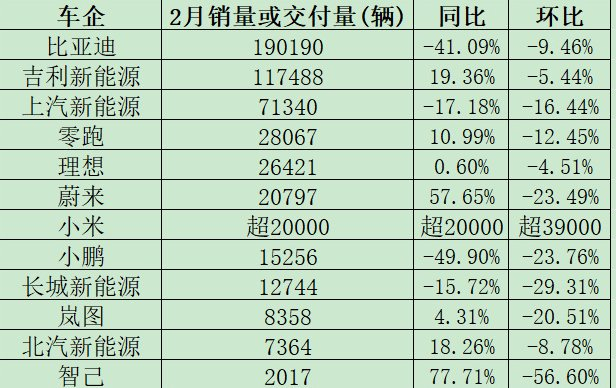
春节新政叠加致2月车企销量普降,比亚迪跌破20万辆
3 6 Ke· 2026-03-02 03:55
Core Insights - The overall performance of multiple car manufacturers in February was weak, with significant declines in sales figures compared to the previous year [1] - The decline in sales is attributed to a combination of factors including the long Spring Festival holiday, reduced effective sales days, pre-holiday inventory clearance, and consumer hesitation regarding upcoming promotions [1] Group 1: Sales Performance - BYD reported sales of 190,190 units in February, a year-on-year decrease of 41.09%, marking the first time in recent years that monthly sales fell below 200,000 units [2] - SAIC's sales also saw a year-on-year decline of 8.64% [1] - New energy vehicle sales from Geely increased by 19.36% year-on-year, while SAIC's new energy sales dropped by 17.18% [2] Group 2: New Energy Vehicle Trends - The sales threshold for leading new energy vehicle manufacturers has dropped to 20,000 units, with Leap Motor regaining the top spot among new forces with 28,067 units sold [1] - Zeekr achieved a sales increase of 70% year-on-year, reaching 23,900 units [1] - The industry is actively launching new products and enhancing charging and battery swap networks to alleviate consumer concerns about energy replenishment [1]


招银国际每日投资策略-20260302
Zhao Yin Guo Ji· 2026-03-02 03:31
Industry Overview - The Chinese automotive industry has seen weaker-than-expected performance in the first two months for new energy vehicles, with a focus on the upcoming new car releases in March to drive demand recovery [2] - Li Auto's February delivery volume decreased by only 5% month-on-month to approximately 26,000 units, outperforming most peers, primarily due to the contribution from the i6 model launched in September 2025 [2] - NIO's February delivery volume fell by 23% month-on-month to about 21,000 units, with the NIO brand contributing approximately 15,000 units [2] - XPeng's February delivery volume decreased by 24% month-on-month to around 15,000 units, falling short of expectations, with a cumulative year-on-year decline of 42% for January and February [2] Sales Forecast - The forecast for February 2026 indicates a 15% month-on-month decline in retail sales of new energy passenger vehicles to approximately 480,000 units, with a year-on-year decline of 23% for January and February [6] - The market share of new energy vehicles is expected to drop to around 40% following a reduction in purchase tax incentives starting January 2026, but is anticipated to rebound starting in March with the release of new models [6] Company Insights - NIO is expected to face challenges in 2026 due to a faster-than-expected decline in orders for new models, despite achieving its first non-GAAP net profit in Q4 2025 [5] - BYD's wholesale sales of passenger vehicles in February fell by 9% month-on-month to approximately 188,000 units, with a cumulative year-on-year decline of 36% for January and February [5] - Geely's new energy vehicle sales, including the Zeekr brand, increased by 10% year-on-year in the first two months of 2026, supported by positive market feedback for new models [5] - Leap Motor's February wholesale sales decreased by 12% month-on-month to about 28,000 units, with a cumulative year-on-year decline of 19% for January and February [5] AI in Pharmaceutical Industry - The MSCI China Healthcare Index has risen by 5.0% since early 2026, outperforming the MSCI China Index by 6.2%, despite a recent pullback in the pharmaceutical sector [6] - AI is expected to significantly change the paradigm of innovative drug development, with rapid advancements in AI applications within the pharmaceutical industry [7] - Major global pharmaceutical companies are increasingly privatizing and upgrading their core AI infrastructure to build high data barriers [7] - The launch of LillyPod by Eli Lilly, equipped with NVIDIA technology, exemplifies the integration of AI in clinical development and manufacturing processes [7] Company Recommendations - Recommended stocks include 3SBio (1530 HK), JAC (1167 HK), Genscript (2273 HK), WuXi AppTec (2268 HK), and China Biologic Products (1177 HK) [9]
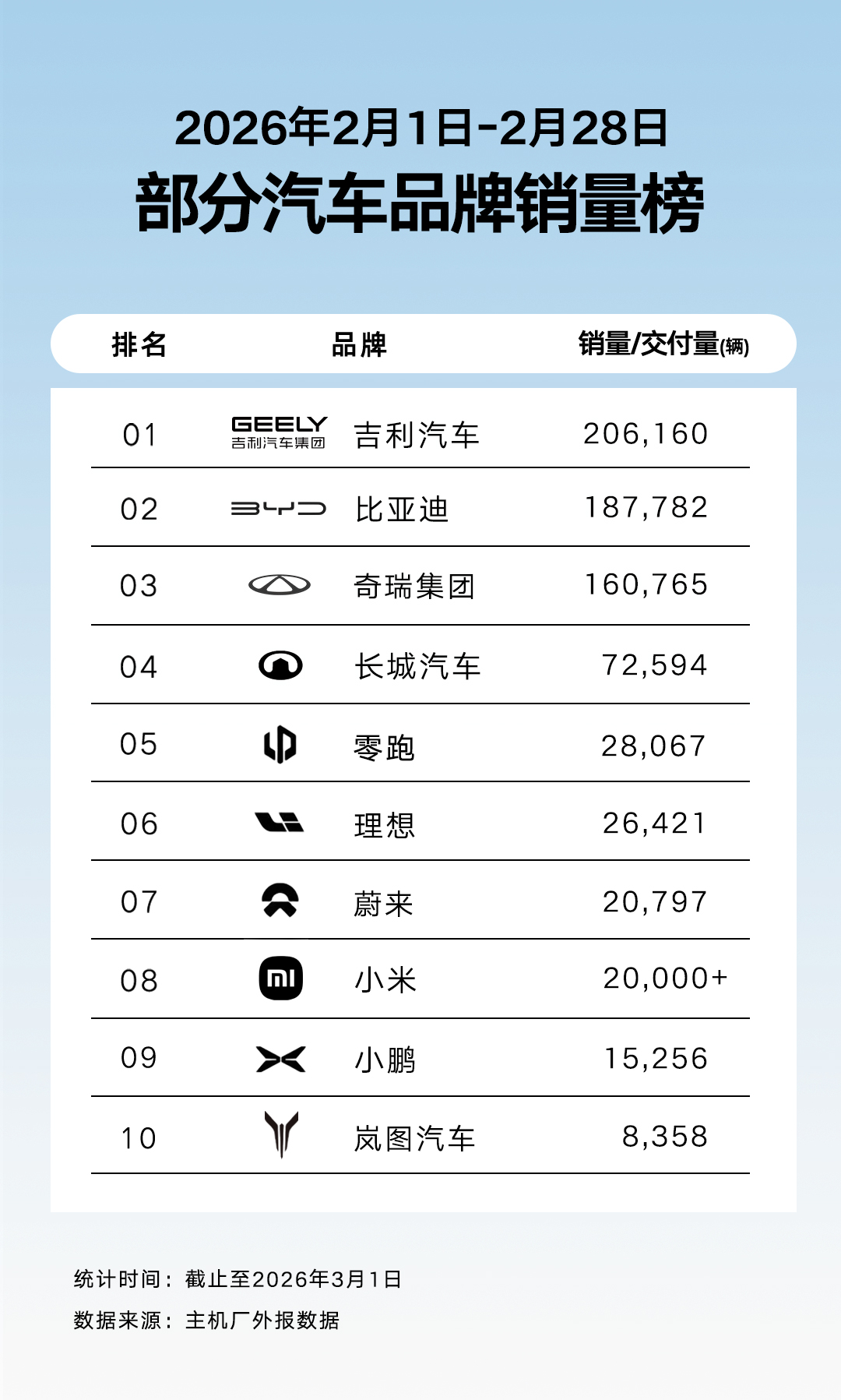
吉利汽车2月销量206160辆 海外销量60879辆,同比大增138%
Jin Rong Jie· 2026-03-02 03:25
Core Viewpoint Geely Auto Group has demonstrated significant growth in both domestic and international markets, particularly in the new energy vehicle (NEV) segment, with a focus on high-end product offerings and user value enhancement. Group 1: Sales Performance - Geely Auto Group ranked first in vehicle sales with 206,160 units delivered, followed by BYD with 187,782 units and Chery Group with 160,765 units [1] - In February, NEV sales reached 117,488 units, marking a 19% year-on-year increase, while cumulative NEV sales for January-February reached 241,740 units, up 10% [2] - Geely's global luxury tech brand Zeekr sold 23,867 units in February, achieving a 70% year-on-year growth [5] Group 2: Product Development and Launches - Geely is expanding its high-end product matrix, with the Zeekr 8X SUV set to launch in Q2, featuring advanced driving assistance systems [5] - The Geely Galaxy brand has seen strong sales, with the Galaxy E5 surpassing 250,000 units and the Galaxy M7 making its global debut in Milan [7] - The Geely China Star brand sold 81,809 units in February, with the high-end series contributing 25,458 units [9] Group 3: International Expansion - Geely's overseas sales reached 60,879 units in February, a substantial increase of 138% year-on-year, with NEV exports accounting for 40,852 units, or 67% of total overseas sales [10] - The launch of the Galaxy Starship 7 EM-i in Greece and the introduction of multiple models in Uzbekistan signify Geely's commitment to expanding its international footprint [12] - Geely has established a robust after-sales network in Uzbekistan, aiming for 100% coverage in core cities over the next three years [12] Group 4: Sustainability and Recognition - Geely Auto was included in S&P Global's "Global Sustainability Yearbook 2026," recognized as the only Chinese automaker among eight global manufacturers for its outstanding ESG performance [14] - The company aims to continue its sustainable development path, focusing on technological innovation and product upgrades to enhance user value [14]

吉利汽车2月销量点评:出口远超预期
数说新能源· 2026-03-02 03:05
Group 1 - The core viewpoint of the article highlights the growth in new energy vehicle sales, with February sales reaching 206,000 units, a year-on-year increase of 1% and a month-on-month decrease of 24% [2] - Cumulative sales for January and February stand at 476,000 units, also reflecting a year-on-year growth of 1% [2] - Exports in February amounted to 61,000 units, showing a significant year-on-year increase of 138% and a month-on-month increase of 1% [2] - Cumulative export sales for the first two months reached 121,000 units, with a year-on-year growth of 129% [2] Group 2 - By brand, Geely's total sales in February were 154,000 units, a year-on-year decrease of 11% and a month-on-month decrease of 29% [2] - The Galaxy brand sold 73,000 units in February, reflecting a year-on-year decrease of 4% and a month-on-month decrease of 12% [2] - The Zeekr brand, however, saw sales of 23,800 units in February, marking a year-on-year increase of 70% and stable month-on-month performance [2] - Lynk & Co. sold 27,400 units in February, with a year-on-year increase of 59% and a month-on-month decrease of 5% [2] Group 3 - The article concludes that Geely's January export sales exceeded expectations, and the acceleration of new energy exports continues [2] - Despite the impact of policy changes on some models' deliveries in January, high-end model sales remain robust [2] - The outlook remains positive for high-end and export growth, which is expected to contribute to volume and profit realization for the company [2]

吉利汽车:2月汽车总销量约20.62万辆 同比增长1%
Xin Jing Bao· 2026-03-02 02:20
Group 1 - The core viewpoint of the article is that Geely Automobile Holdings Limited announced its total vehicle sales for February 2026, which reached 206,160 units, representing an approximate 1% increase compared to the same period last year [2] Group 2 - Geely Automobile's total vehicle sales for February 2026 were reported at 206,160 units [2] - The year-on-year growth in sales is approximately 1% [2]
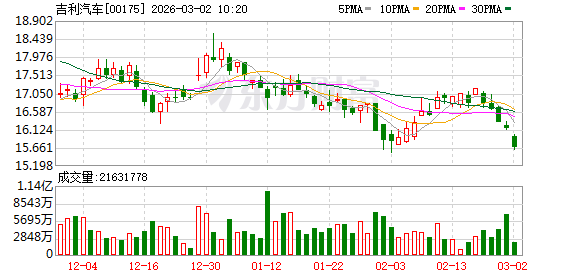
吉利汽车:2月汽车总销量约20.62万辆,同比增长1%
Bei Ke Cai Jing· 2026-03-02 02:15
Group 1 - The core point of the article is that Geely Automobile Holdings Limited reported a total vehicle sales of 206,160 units for February 2026, representing an approximate 1% increase compared to the same period last year [1] Group 2 - The announcement was made on March 1st, indicating the company's ongoing performance in the automotive market [1] - The sales figure reflects the company's resilience and ability to maintain growth in a competitive industry [1] - The report highlights Geely's strategic positioning and potential for future sales growth [1]
2月份销量公布!比亚迪2025年海外销量破100万辆!博世关停德国工厂!蔚来芯片子公司完成22亿首轮股权融资!丨一周大事件
电动车公社· 2026-03-02 02:01
New Car Launches - Toyota launched the bZ Woodland, a mid-size all-electric crossover SUV, featuring a dual-motor all-wheel drive system with a maximum power of 375 hp and an EPA range of 281 miles (452 km) [1][2][4] - Dongfeng's Xinghai T5 was launched with a price range of 153,900 to 161,900 yuan, featuring a compact SUV design and a 64.4 kWh lithium iron phosphate battery with a CLTC range of 530 km [1][8][12] - The new Changan UNI-Z PHEV was launched with a price range of 118,900 to 135,900 yuan, offering a 130 km pure electric range and various advanced features [1][15][22] Company Dynamics - BYD aims to achieve over 1 million overseas sales by 2025, while SAIC MG has surpassed 1 million sales in Europe [1][23][25] - Huawei's QianKun assisted driving system recorded over 470 million kilometers during the Spring Festival, with a significant increase in active user engagement [1][26][30] - Bosch confirmed the closure of its factory in Germany, affecting 560 jobs, as part of a global cost-cutting and capacity restructuring plan [1][31][33] - Xiaomi's assisted driving system recorded over 100 million kilometers during the Spring Festival, indicating a rise in usage frequency [1][34][36] - NIO's battery technology company was established with a registered capital of 100 million yuan, focusing on R&D [1][45][47] - NIO's chip subsidiary completed a 2.2 billion yuan financing round, marking a significant step in domestic high-end chip development [1][48][49] Sales Performance - In February, BYD sold 187,782 passenger vehicles, maintaining its leadership in the new energy sector [1][54][55] - Geely's total sales reached 204,910 units in February, with 117,488 units being new energy vehicles [1][57][58] - Leap Motor delivered 28,067 units in February, showcasing strong sales momentum [1][66] - Li Auto delivered 26,421 units in February, maintaining a dual strategy of pure electric and range-extended vehicles [1][69][70] - NIO delivered 20,797 units in February, benefiting from the launch of the new ES8 model [1][71][73] - Xiaomi's automotive division delivered over 20,000 units in February, with new models expected to boost sales further [1][74][75] - AITO's sales reached approximately 18,000 units in February, with a strong market presence [1][76][77] - XPeng delivered 15,256 units in February, continuing its dual technology strategy [1][78][79] - Great Wall Motors sold 12,744 new energy vehicles in February, reflecting a significant growth in its electric vehicle segment [1][83][86]

万人大厂因AI一夜爆裁4000人,「留下的压力也很大」;网友晒椰树广告图被指低俗:「女员工胸这么大」引争议;SpaceX最早3月秘密申请IPO
雷峰网· 2026-03-02 00:43
Group 1 - Block announced a layoff plan affecting over 4,000 employees, representing 40% of its workforce, primarily due to the rapid development of AI tools [4][5] - Jack Dorsey, the CEO, indicated that most companies will undergo similar structural adjustments in the coming year due to AI advancements [4] - Following the announcement, Block's stock price surged by 27%, adding approximately $3 billion to its market value, indicating a market reaction that values the company at $750,000 per laid-off employee [5] Group 2 - Coconuts Group faced backlash for a controversial advertisement that was deemed vulgar, highlighting ongoing issues with its marketing strategies [7][9] - The company has a history of similar controversies, having faced fines for previous advertisements that violated public decency standards [9] Group 3 - Tencent's TiMi Studio is reportedly undergoing project adjustments, with a smaller number of layoffs than initially rumored, and many employees are being offered internal transfer opportunities [17] - The adjustments are linked to the underperformance of a specific project, "Shan Hai Xun Ling," which did not meet expectations during a competitive release period [17] Group 4 - Meizu's AR brand StarV is seeking independent financing and may consider selling the brand, aligning with the company's strategic shift away from self-developed hardware projects [18][19] - The company aims to focus on high-potential innovative businesses while maintaining sales of existing products [19] Group 5 - Wahaha's precision machinery subsidiary has been dissolved, reflecting a strategic shift under the leadership of Zong Fuli to focus on core food and beverage operations [20] - This move indicates a departure from the previous diversification strategy, aiming to streamline operations and improve efficiency [20] Group 6 - Huawei's Mate 80 series flagship phones have achieved sales of approximately 3.78 million units, surpassing Xiaomi's 17 series in a competitive market [22] - The Mate 80 series has shown significant growth compared to its predecessor, indicating strong consumer demand [22] Group 7 - Xiaomi's Vision GT concept car was unveiled at the MWC 2026, showcasing the company's exploration into high-performance electric vehicles [23][24] - The concept car emphasizes advanced aerodynamics and integrates smart technology, reflecting Xiaomi's commitment to innovation in the automotive sector [24] Group 8 - Toyota reported a significant drop in net profit for Q3 of the 2026 fiscal year, primarily due to the impact of U.S. tariffs and rising operational costs [50][51] - The company is implementing cost-cutting measures and restructuring its leadership to address these financial challenges [51] Group 9 - Samsung announced plans to transform its manufacturing operations into AI-driven factories by 2030, focusing on optimizing production processes and enhancing efficiency [56] - This initiative aims to leverage AI technologies across the entire manufacturing chain, indicating a significant shift in the company's operational strategy [56]



汽车行业周报:数据中心分布式电源需求上行,产业链有望受益
KAIYUAN SECURITIES· 2026-03-02 00:24
Investment Rating - The investment rating for the automotive industry is "Positive" (maintained) [1] Core Insights - The demand for distributed power sources in North America is increasing due to the mismatch between the expansion of traditional power grids and the rapid construction of data centers, creating opportunities for on-site power generation and backup power equipment [5][16] - The automotive sector is experiencing a shift towards high-end luxury passenger vehicles, with expectations of increased performance as product matrices expand [8] - The automotive parts industry is expected to see an upward trend in profitability due to reduced competition and expansion in downstream markets [8] Summary by Sections 1. Data Center Distributed Power Demand - The power supply gap in North America is widening, leading to increased demand for distributed power sources [16] - Major tech companies are significantly increasing their capital expenditures for data centers, with a total expected expenditure of approximately $650 billion in 2026 [16][17] - The total installed capacity of data centers in the U.S. is projected to grow from about 17 GW in 2025 to approximately 50 GW by 2030 [16] 2. Industry News Highlights - Xiaopeng Motors announced that Volkswagen will be the first customer for its second-generation VLA model [34] - Huawei's autonomous driving system recorded over 470 million kilometers during the Spring Festival, equivalent to 190,000 round trips between Beijing and Shanghai [35] - NIO's chip subsidiary completed its first round of financing, raising over 2.2 billion RMB [37] 3. Market Performance - The automotive sector's performance this week saw the Shanghai Composite Index increase by 1.08%, while the automotive sector rose by 0.59%, ranking 23rd among A-share industries [7][43] - The passenger vehicle sector's PE valuation decreased, while commercial vehicles and automotive parts sectors saw an increase in PE valuations [43][46] 4. Investment Recommendations - For passenger vehicles, the recommendation includes Jianghuai Automobile and Seres, with Geely Automobile as a beneficiary [8] - In the automotive parts sector, recommended companies include Desay SV, Zhejiang Xiantong, and Meili Technology, with beneficiaries such as Weichai Power and Wufeng High-Tech [8]




