易方达基金

Search documents
基金双周报:ETF市场跟踪报告-20260119
Ping An Securities· 2026-01-19 08:47
1. Report Industry Investment Rating - Not provided in the content 2. Core Viewpoints of the Report - As of January 16, recent two - week ETF products performed well. Among domestic major broad - based ETFs, Science and Technology Innovation 100 had the largest increase, and among industry and thematic products, technology - themed ETFs had the largest increase. The Science and Technology Innovation 100ETF had net capital inflows, while the CSI 300ETF had significant net capital outflows. Also, in the past two weeks, cyclical and pharmaceutical ETFs had accelerated capital inflows, technology, consumer, military, and financial real - estate ETFs turned to net capital inflows, dividend and other large - manufacturing ETFs turned to net capital outflows, and new - energy ETFs had accelerated capital outflows. For bond ETFs, credit - bond, treasury - bond, and local - bond ETFs turned from net inflows to net outflows, convertible - bond ETFs turned to net inflows, and policy - financial - bond and short - term - financing ETFs had accelerated net outflows [2][9][16] 3. Summary According to the Table of Contents 3.1 ETF Market Review - **Performance and Capital Flow**: As of January 16, in the past two weeks, among domestic major broad - based ETFs, Science and Technology Innovation 100 had the largest increase, and among industry and thematic products, technology - themed ETFs had the largest increase. The Science and Technology Innovation 100ETF had net capital inflows, while the CSI 300ETF had significant net capital outflows. Cyclical and pharmaceutical ETFs had accelerated capital inflows, technology, consumer, military, and financial real - estate ETFs turned to net capital inflows, dividend and other large - manufacturing ETFs turned to net capital outflows, and new - energy ETFs had accelerated capital outflows. For bond ETFs, credit - bond, treasury - bond, and local - bond ETFs turned from net inflows to net outflows, convertible - bond ETFs turned to net inflows, and policy - financial - bond and short - term - financing ETFs had accelerated net outflows [2][9][16] - **Product Structure Distribution**: As of January 16, in the past two weeks, 9 new ETFs were established, with a total issuance of 5607 million shares, all being stock ETFs. Compared with the end of 2025, the scales of industry + dividend ETFs, commodity ETFs, and QDII - ETFs increased by 14.33%, 9.87%, and 6.05% respectively, while the scales of bond ETFs and broad - based ETFs decreased by 9.78% and 3.98% respectively [2][23] - **Fund Manager Scale Distribution**: As of January 16, China Asset Management had the largest on - exchange ETF scale of 96.4259 billion yuan. The ETF management scales of China Asset Management and E Fund expanded by over 26 billion yuan compared with a year ago [24] 3.2 Classification of ETF Tracking - **Technology - Themed ETF**: Products tracking semiconductor materials and equipment had the highest net capital inflows in the past two weeks, while products tracking the National Securities Chip index had net capital outflows [28] - **Dividend - Themed ETF**: Products tracking the low - volatility dividend had the highest net capital inflows in the past two weeks, while products tracking the CSI Dividend index had net capital outflows [31] - **Consumer - Themed ETF**: Products tracking the S&P 500 Consumer Select Index had a relatively high premium rate. ETFs tracking the CSI 800 Consumer index had the highest net capital inflows in the past two weeks, while products tracking the CSI Liquor index had net capital outflows [34] - **Pharmaceutical - Themed ETF**: ETFs tracking medical devices had the highest net capital inflows in the past two weeks, while products tracking the CSI Medical index had net capital outflows [37] - **Large - Manufacturing - Themed ETF**: Products tracking the satellite industry had the highest net capital inflows in the past two weeks, while products tracking robots had net capital outflows [40] - **QDII ETF**: Products tracking the Hang Seng Technology index had the highest net capital inflows in the past two weeks, while ETF products tracking the Hang Seng Healthcare index had net capital outflows [43] 3.3 Popular Themed ETF Tracking - **AI - Themed ETF**: AI - themed products mostly rose in the past two weeks, with an average return of 10.88%. Products tracking cloud computing had the largest increase. Since 2025, there has been an overall net capital inflow, with a large inflow from mid - February to April, a continuous outflow from May to August, and a large inflow since mid - August. In the past two weeks, there was a significant net capital inflow of 18.301 billion yuan [55] - **Robot - Themed ETF**: Robot - themed products performed well in the past two weeks, with an average return of 7.17%. Products tracking the robot index had the largest increase. After February 2025, capital showed a rapid inflow trend as a whole, and there was a net capital outflow of 3.909 billion yuan in the past two weeks [59] - **New - Energy - Themed ETF**: New - energy - themed products mostly rose in the past two weeks, with an average return of 4.10%. Products tracking the CSI New Energy index had the largest increase. There was a continuous outflow before August 2025, a large inflow from August to October, and a large outflow since late October. In the past two weeks, there was a net capital outflow of 3.111 billion yuan [65] - **Satellite and Commercial Space - Themed ETF**: Satellite and commercial space - themed products mostly rose in the past two weeks, with an average return of 14.38%. Products tracking the satellite industry had the largest increase. There was a small inflow in late August 2025 and a large inflow since mid - December. In the past two weeks, there was a significant net capital inflow of 17.542 billion yuan [70] - **Central Huijin, Guoxin, and Chengtong - Held ETF**: As of June 30, 2025, the scale of ETFs held by Central Huijin, Guoxin, and Chengtong totaled 39.1336 billion shares. In the past two weeks, there was a net capital outflow of 172.9 billion yuan. In the past two weeks, China AMC CSI 500 ETF, Harvest CSI 500 ETF, and Guotai SSE 180 Financial ETF had the highest capital inflows [74]
宽基ETF,再度放量
Shang Hai Zheng Quan Bao· 2026-01-19 08:26
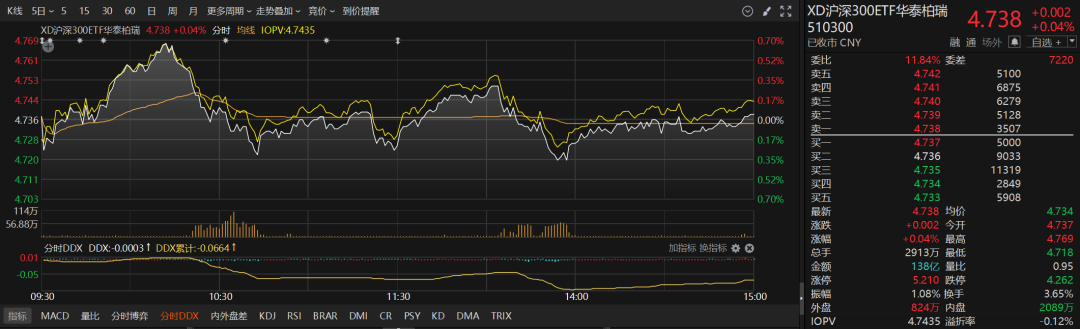
Group 1 - The core viewpoint of the article highlights a significant increase in trading volume for major broad-based ETFs, specifically the Huatai-PB CSI 300 ETF and the Southern CSI 500 ETF, on January 19 [1][3][5] - During the period from January 14 to 16, stock ETFs (excluding cross-border ETFs) experienced a net outflow of 163.54 billion yuan, with broad-based ETFs alone seeing a net outflow of 198.48 billion yuan [9] - Despite the outflows, the new fund issuance market remains active, with some funds announcing early closure of fundraising due to high demand [12] Group 2 - The Huatai-PB CSI 300 ETF recorded a trading volume of 138 billion yuan on January 19, with notable spikes in trading activity during specific time frames [3] - The Southern CSI 500 ETF also showed significant trading volume, reaching 127 billion yuan for the day, indicating a similar trend to the Huatai-PB CSI 300 ETF [5] - Other ETFs, such as the Huatai-PB CSI A500 ETF and the Huaxia CSI A500 ETF, also exceeded 100 billion yuan in trading volume, reflecting a broader trend in the market [7] Group 3 - Certain thematic ETFs, such as the Harvest Software ETF and the Southern Nonferrous Metals ETF, attracted significant inflows, indicating a divergence in investor interest within the ETF market [10] - The market outlook suggests increased volatility in 2026, but structural opportunities remain significant, particularly in sectors like AI, solid-state batteries, robotics, and innovative pharmaceuticals [13]

本周40只新基扫描:富国、鹏华、工银瑞信、华夏、易方达等26家公募PK 主题指数、FOF稳健、混合成长齐上阵
Xin Lang Cai Jing· 2026-01-19 08:17
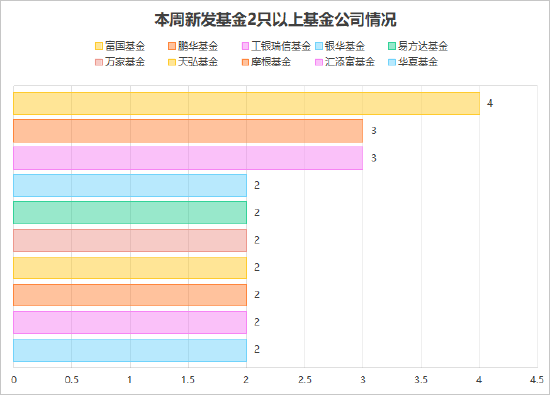
Group 1 - The public fund market is experiencing a new round of product issuance starting from January 19, with 40 new funds launched for subscription, involving 26 fund management companies [1][14] - The distribution of new funds includes 15 stock funds, 12 FOF funds, 9 mixed funds, and 4 bond funds [1][14] Group 2 - Among the 15 stock funds, theme index funds are the main focus, covering sectors such as engineering machinery, non-ferrous metals, chip design, healthcare, photovoltaic, animal husbandry, and artificial intelligence [3][16] - New funds are closely aligned with current market hotspots and policy directions, particularly in technology innovation and high-end manufacturing, with specific funds targeting semiconductor and AI industries [3][16] - The new funds also focus on renewable energy, industrial metals, and resource sectors, reflecting ongoing investment in energy transition and infrastructure [3][16] Group 3 - The 12 FOF funds launched are characterized by a "stable" positioning and set minimum holding periods of 3 to 6 months, aiming to provide clear styles and strong operational discipline for medium to long-term investment [6][19] - The overall strategy for the new FOFs emphasizes "fixed income+" with a significant allocation to bond assets, typically between 70% to 85%, serving as a stability component for returns [7][20] - Many FOF products include gold as a standard asset, highlighting its role as an inflation hedge and risk management tool in the current macroeconomic environment [7][20] Group 4 - The 9 mixed funds exhibit diverse strategies, focusing on themes such as quantitative stock selection, healthcare innovation, and consumer sectors in Hong Kong, with most funds having equity allocations between 60% to 90% [10][12] - The majority of mixed funds incorporate Hong Kong stock indices in their performance benchmarks, indicating a focus on valuation recovery opportunities in the Hong Kong market [10][12] Group 5 - The 4 newly issued bond funds primarily adopt a "fixed income+" strategy, suitable for investors with moderate to low risk tolerance, with most having low subscription thresholds [12][13] - The bond funds are designed to provide a stable income while allowing for some equity exposure, with varying subscription periods to accommodate investor preferences [12][13]
竞逐科技与高端制造,公募ETF发行大爆发
Huan Qiu Wang· 2026-01-19 06:28
Core Viewpoint - The A-share market has entered a new round of structural trends in 2026, with sectors like commercial aerospace, new energy, and artificial intelligence (AI) applications showing strong performance, leading to a significant increase in the issuance of thematic ETFs and their net asset values [1] Group 1: Thematic ETF Performance - The Satellite ETF managed by Yongying Fund has achieved a return of 17.92% year-to-date and a 99.10% increase over the past six months, with its scale rising from 2.4 billion to 17 billion yuan, making it the first satellite-themed ETF to exceed 10 billion yuan in size [1] - The Huaan Gold ETF has surpassed 100 billion yuan in scale, becoming the first gold ETF in China to enter the "billion club" due to rising gold and silver prices [1] Group 2: Fund Company Activities - Multiple fund companies are actively launching thematic ETFs focused on "pan-technology + high-end manufacturing," targeting investment directions such as electric utilities, sub-sectors of the Sci-Tech Innovation Board, and battery themes that are not yet overcrowded [2] - The Invesco Great Wall Fund's electric utility ETF raised 1.667 billion yuan in just 7 days, indicating strong investor interest in the electric sector [2] - The Tianhong Fund's chip design thematic ETF raised 607 million yuan in 8 days, while the Southern Fund's AI ETF raised 514 million yuan in only 6 days [2] Group 3: New Energy and Resource ETFs - In the new energy sector, battery-themed ETFs are experiencing "same-topic competition," with the Dacheng Fund's battery ETF raising 442 million yuan in just 4 days, the shortest subscription period in the market [4] - Several fund companies have reported new ETFs focused on industrial metals, indicating a strong interest in upstream resource sectors [4] Group 4: ETF Issuance Trends - The number of new ETFs issued has surged from 281 in 2021 to 363 in 2025, with technology, new energy, and pharmaceutical thematic ETFs showing remarkable performance [5] - The Huaxia Hang Seng Internet Technology ETF's shares have increased from 7.555 billion at issuance to 66.869 billion, an expansion of nearly 8 times [5] - However, there is a notable trend of divergence within thematic ETFs, with some products experiencing a rapid decline in scale, highlighting the importance of long-term sector attractiveness and product differentiation [5] Group 5: Market Outlook - Analysts suggest that the recent surge in thematic ETF issuance is closely linked to the structural trends in the A-share market in 2026, with institutional investors quickly positioning themselves in popular sectors [6] - If the related industries maintain their growth, these ETFs may become a significant direction for capital inflow, but fund companies must focus on lifecycle management and market demand to avoid resource wastage [6]
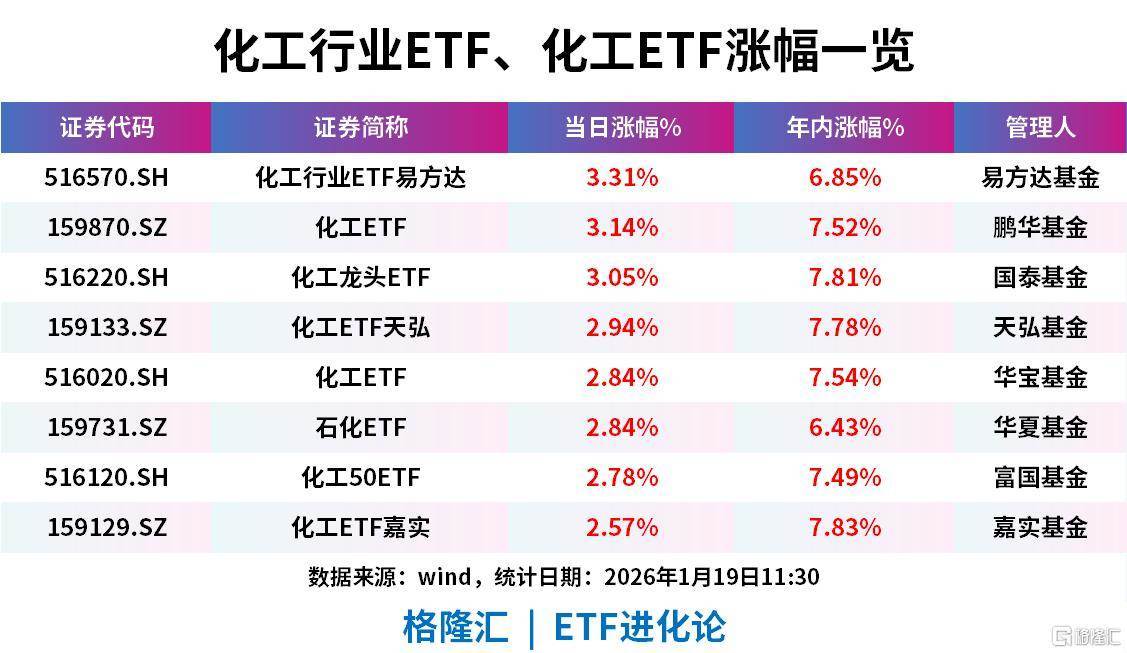
化工行业ETF易方达、化工ETF、化工龙头ETF涨超3%,化工ETF、化工50ETF强势吸金
Sou Hu Cai Jing· 2026-01-19 05:48
Group 1 - The chemical sector ETFs have shown positive performance, with the top performers being the Chemical Industry ETF by E Fund, which increased by 3.31% on the day and 6.85% year-to-date, and the Chemical ETF by Penghua, which rose by 3.14% and 7.52% respectively [2] - In the past 10 trading days, significant net inflows were observed in the chemical sector, totaling 45.71 billion yuan for the Chemical ETF and 15.23 billion yuan for the Chemical 50 ETF [4][6] - The Chemical ETF tracks the CSI Sub-Industry Chemical Theme Index, with nearly 50% of its holdings concentrated in large-cap leading stocks, including Wanhua Chemical and Salt Lake Industry, while the remaining 50% is diversified across various sub-sectors [8] Group 2 - The chemical industry is expected to experience a recovery in profitability by 2026, following a period of bottoming out in earnings and valuations, with supply-demand rebalancing as a new starting point [8] - According to Tianfeng Securities, the chemical industry is entering a phase of capacity release, with a potential reversal in supply-demand dynamics expected by 2026 [8] - Huatai Securities indicates that the chemical raw materials and products sector is at a turning point, transitioning from active destocking to passive restocking, with a recovery in domestic and international demand anticipated in 2026 [9]
天量资金,动向延续
Zhong Guo Ji Jin Bao· 2026-01-19 04:17
Core Viewpoint - On January 16, the A-share market experienced a decline, with a net outflow of over 85.5 billion yuan from the stock ETF market, indicating a continued trend of capital withdrawal [2][3]. Group 1: Market Performance - The three major indices in the A-share market closed lower, with the Shanghai Composite Index down 0.26%, the Shenzhen Component Index down 0.18%, and the ChiNext Index down 0.2% [3]. - The semiconductor industry chain saw significant gains, particularly in advanced packaging and memory sectors, while the cultural media and short drama gaming sectors experienced adjustments [3]. Group 2: ETF Fund Flows - As of January 16, the total scale of 1,308 stock ETFs in the market was approximately 4.9 trillion yuan, with a reduction of 15.365 billion units in fund shares, leading to a net outflow of 85.505 billion yuan [3][4]. - Industry-themed ETFs and strategy-style ETFs saw substantial inflows, amounting to 19.118 billion yuan and 1.768 billion yuan, respectively [4]. - The ETF tracking the semiconductor materials and equipment index had the highest single-day net inflow of 2.995 billion yuan [4]. Group 3: Notable Inflows - A total of 57 ETFs had net inflows exceeding 1 billion yuan on January 16, with the top three being the non-ferrous metals ETF, semiconductor equipment ETF, and electric grid equipment ETF, which saw net inflows of 1.811 billion yuan, 1.785 billion yuan, and 1.562 billion yuan, respectively [4]. - Leading fund companies continued to attract net inflows, with E Fund's semiconductor equipment ETF and artificial intelligence ETF each receiving over 600 million yuan [4]. Group 4: Market Outlook - The broad-based ETFs experienced the largest net outflow, totaling 106.907 billion yuan, with the CSI 300 index products seeing a net outflow of 58.007 billion yuan [6]. - Market analysts expect a "spring offensive" driven by ample liquidity and improved risk appetite, particularly as 2026 marks the beginning of the "14th Five-Year Plan" [6].

天量资金,动向延续
中国基金报· 2026-01-19 04:09
Group 1 - On January 16, the A-share market opened high but closed lower, with all three major indices declining. The stock ETF market continued to experience net outflows, with a total outflow of over 85.5 billion yuan on that day [2][4]. - As of January 16, the total scale of 1,308 stock ETFs in the market was approximately 4.9 trillion yuan. The number of fund shares decreased by 15.365 billion, leading to a net outflow of 85.505 billion yuan based on average pricing [4][5]. - Industry-themed ETFs and strategy-style ETFs saw significant inflows, amounting to 19.118 billion yuan and 1.768 billion yuan, respectively. ETFs tracking the semiconductor materials and equipment index had the highest single-day inflow of 2.995 billion yuan [5]. Group 2 - On January 16, 57 ETFs had net inflows exceeding 1 billion yuan, with the top three being the non-ferrous metals ETF (1.811 billion yuan), semiconductor equipment ETF (1.785 billion yuan), and electric grid equipment ETF (1.562 billion yuan) [5][6]. - The top 20 stock ETFs by net inflow included the non-ferrous metals ETF, semiconductor equipment ETF, and electric grid equipment ETF, with respective inflows of 1.811 billion yuan, 1.785 billion yuan, and 1.562 billion yuan [6]. - Conversely, broad-based ETFs experienced significant net outflows, totaling 106.907 billion yuan, with the CSI 300 index products seeing a net outflow of 58.007 billion yuan [8][9]. Group 3 - The fund manager from E Fund indicated that January is a traditional "opening red" window for credit issuance, expecting the market to enter a "spring offensive" driven by ample liquidity and improved risk appetite [10]. - ICBC Credit Suisse Fund anticipates that more industrial policy details will be implemented in 2026, particularly in technology innovation and green transformation, with monetary policy likely to remain moderately loose [11].

开年两个“万亿”,ETF“非对称”优势如何突围?
券商中国· 2026-01-19 02:31
Core Viewpoint - The article highlights the significant growth and evolution of ETFs in China, with two major records achieved in early 2026, indicating a robust and competitive market landscape. The focus is on the "Matthew Effect," where leading players like Huaxia and E Fund continue to dominate, while smaller firms carve out niches through differentiated strategies [1][2]. Group 1: ETF Market Overview - As of January 16, the total size of all listed ETFs reached 6.07 trillion yuan, managed by 58 fund companies. Huaxia Fund's ETF surpassed 1 trillion yuan on January 12, later adjusting to 964.82 billion yuan due to market fluctuations [2]. - The top five fund companies account for 53.21% of the total ETF market size, with E Fund and Huatai-PB following Huaxia in scale [2][3]. Group 2: Competitive Dynamics - The article discusses the "liquidity moat" and "institutional allocation preference" as key factors contributing to the scale disparity among ETF managers. Larger ETFs tend to attract more institutional investments due to better liquidity, reinforcing the dominance of leading firms [3][5]. - The analysis indicates that the competition among ETF managers is shifting from simple scale to a more complex ecosystem approach, focusing on product differentiation and comprehensive solutions for investors [8][9]. Group 3: Product Differentiation and Strategy - Smaller fund companies are encouraged to focus on niche markets and innovative strategies to compete effectively against larger firms. The article emphasizes the importance of creating unique products that meet specific investor needs [6][10]. - The future of ETFs is seen as moving towards "solution-oriented competition," where the emphasis is on providing complete investment solutions rather than just tracking indices [8][9]. Group 4: Future Trends and Innovations - The article notes that the global market for actively managed ETFs is expected to grow significantly, with a projected size of 1.84 trillion USD by the end of 2025, indicating a shift in investor preferences towards active management strategies [10]. - Companies like Pengyang Fund are exploring new product categories, such as long-term bond ETFs, to enhance their offerings and meet evolving market demands [6][10].

华西证券研究所副所长王方群:公募降费下的券商卖方研究
Zhong Guo Ji Jin Bao· 2026-01-19 00:50
Core Insights - The continuous deepening of capital market reforms is leading to a decline in commission rates for public funds, posing challenges to traditional sell-side research models, prompting broker research departments to explore transformation opportunities [1] Group 1: Market Changes - Since the implementation of reduced trading commissions on July 1, 2024, the commission rate for public fund stock transactions has decreased from 0.073% in 2023 to 0.0515% in 2024, with a further decline expected to 0.0369% in the first half of 2025 [2] - In the first half of 2025, brokerage firms' commission income from public fund trading is projected to be 4.458 billion yuan, representing a year-on-year decrease of 25% [2] Group 2: External Expansion Strategies - To counteract the pressure from declining commissions, broker research departments are expanding their client base beyond public funds, targeting insurance asset management, private equity, QFII, and bank wealth management clients [2][3] - Insurance asset management institutions are highlighted as a key focus, with contributions to overall commission income reaching approximately 20% for broker research departments [2] Group 3: Internal Strategic Collaboration - Internally, broker research departments are enhancing their value creation by integrating research with investment and investment banking, aiming for efficient collaboration [4] - A dedicated industrial research team has been established to better serve local governments and other real industries, reflecting a broader trend among brokerages [4] Group 4: Professional Development - Analysts are encouraged to focus on in-depth research of industry supply chains and collaborate across sectors to provide more specialized services [5] - Institutional sales teams are urged to move beyond traditional roles and enhance their professional skills to better serve institutional clients [5] Group 5: Overall Strategy - The dual strategy of "internal and external expansion" is seen as a pathway to construct a diversified income structure and deepen professional capabilities, opening up broader development opportunities for sell-side research in the evolving market [5]

这些主题,资金大幅净流入
Zhong Guo Zheng Quan Bao· 2026-01-18 23:34
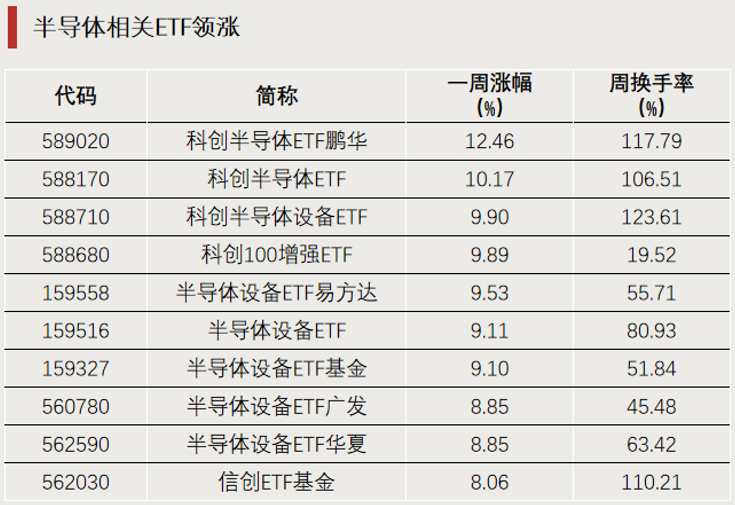
Group 1: ETF Performance - Semiconductor-related ETFs led the gains from January 12 to 16, with the Penghua Semiconductor ETF and the Sci-Tech Semiconductor ETF both exceeding a weekly increase of 10% [1][3] - The top ten ETFs by weekly increase were predominantly semiconductor-related, with several ETFs showing gains over 8% [3] - Year-to-date, as of January 16, multiple semiconductor ETFs have already increased by over 20%, outperforming the broader market [3] Group 2: Fund Flows - From January 12 to 16, the software ETF (159852) saw the highest net inflow of 7.543 billion yuan, followed by the non-ferrous metals and media ETFs, each exceeding 6 billion yuan [2][8] - The overall trading activity was robust, with broad-based ETFs like the A500 ETF and the CSI 300 ETF leading in transaction volumes [9] Group 3: Sector Performance - Aerospace and satellite-related ETFs experienced significant declines, with several ETFs dropping over 6% during the same period [6][7] - High turnover rates were noted in many aerospace and satellite ETFs, exceeding 100% [6] Group 4: Market Outlook - The market is expected to maintain a stable and positive trend, supported by a strengthening yuan and improving fundamental expectations [11][12] - The easing of monetary policies in major economies is providing a favorable external funding environment for emerging market assets [12]