江淮汽车

Search documents
车企组团出逃俄罗斯,304亿直接打水漂?
虎嗅APP· 2026-01-10 13:26
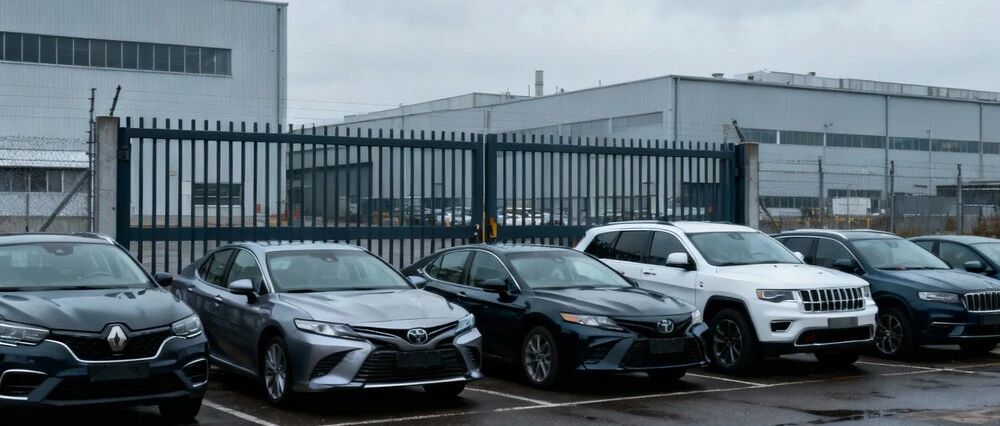
Core Viewpoint - International car manufacturers that exited the Russian market two years ago are now facing significant challenges in potentially returning, with substantial investments at stake and geopolitical instability persisting [5][7]. Group 1: International Car Manufacturers' Exit - Many international car manufacturers, including Hyundai, voluntarily exited the Russian market in response to Western sanctions, selling their assets at symbolic prices while retaining buyback rights [5][10]. - The urgency of the situation has left companies like Hyundai grappling with the dilemma of either investing heavily to restore operations or losing significant investments made in local facilities [7][11]. - Mazda has opted not to exercise its buyback rights after selling its stake in a Russian joint venture, indicating that the decision to abandon the investment was relatively straightforward due to the lower production capacity of its facility compared to others [12][13]. Group 2: Buyback Rights and Future Decisions - Several international car manufacturers, including Renault, Ford, Nissan, and Mercedes-Benz, have retained buyback rights for their Russian assets, with expiration dates ranging from 2027 to 2029 [15][16]. - The geopolitical crisis has caught these companies off guard, as they initially viewed their exit as temporary, expecting to return once stability was restored [17][18]. - Renault's attempt to exercise its buyback rights was met with a demand for a substantial compensation of 112.5 billion rubles (approximately 9.7 billion RMB), highlighting the financial implications of re-entering the market [21][22]. Group 3: Rise of Chinese Car Manufacturers - The exit of major international brands has created a vacuum in the Russian automotive market, which has been seized by Chinese car manufacturers, leading to a significant increase in their market share from 9% in 2022 to 49% in 2023, and projected to reach 62% in 2024 [24][27]. - Chinese automotive exports to Russia are expected to grow significantly, with projected figures of 16.3 million units in 2022, 55.3 million in 2023, and 128 million in 2024 [28]. - By 2024, Chinese brands are anticipated to dominate the top sales rankings in Russia, with several brands like Haval, Chery, Geely, and Changan leading the market [29][30]. Group 4: Challenges Ahead for Chinese Manufacturers - Despite the initial success, Chinese car manufacturers face increasing challenges in Russia, including new tax regulations and negative media portrayals that could impact their market position [34][36]. - The Russian government has implemented higher taxes on imported vehicles, which could significantly reduce profit margins for Chinese manufacturers [37][38]. - Concerns regarding the reliability and quality of Chinese vehicles have been raised in Russian media, potentially affecting consumer perceptions and sales [39][40]. Group 5: Future Outlook - The future of the automotive market in Russia remains uncertain, with two potential trends emerging: international manufacturers may either reclaim their assets and re-enter the market, or they may abandon their investments, leaving Chinese brands to navigate a challenging environment [45][46]. - The complexity of the situation necessitates careful consideration from all manufacturers looking to establish a foothold in the Russian market, as they must prepare for various potential outcomes [42][46].

2025年汽车以旧换新超1150万辆,全年乘用车零售2374.4万辆
Xinda Securities· 2026-01-10 11:06
Investment Rating - The industry investment rating is "Positive" [2] Core Insights - The report highlights that in 2025, over 11.5 million vehicles will be replaced under the vehicle trade-in program, leading to a total retail of 23.744 million passenger cars, with approximately 54% being new energy vehicles [20][3] - The report indicates a projected growth in the automotive market, with a U-shaped sales trend expected for passenger vehicles in 2026, maintaining overall sales levels similar to 2025 [20] - Key companies to watch include BYD, Geely, Great Wall Motors, and others in the passenger vehicle sector, as well as major players in commercial vehicles and auto parts [3][20] Industry Performance - The A-share automotive sector underperformed the market, with a weekly increase of 2.53% compared to the 2.79% rise in the CSI 300 index, ranking 24th among A-share industries [3][9] - The report notes that the passenger vehicle segment saw a 3.8% year-on-year increase in retail sales, while new energy vehicles experienced a 17.6% growth [20] Key Industry News - The Ministry of Commerce announced that the vehicle trade-in program will exceed 11.5 million vehicles in 2025, contributing to over 1.6 trillion yuan in new car sales [20] - Geely received the largest L3 autonomous driving test license in China, covering an area of 9,224 square kilometers [20] - Baidu's autonomous driving platform, "萝卜快跑," obtained the first full unmanned testing license in Dubai, paving the way for commercial operations [20] Upstream Data Tracking - The report includes tracking of key material prices such as steel, aluminum, and lithium carbonate, which are crucial for automotive manufacturing [23][24]





安徽汽车产业谋变:一份协议,三方协同
Xin Hua Wang· 2026-01-10 02:10
Core Insights - NIO has officially produced its one millionth vehicle, marking a significant milestone for the company and the Chinese automotive industry [1][3][6] - The company aims to transition into a new growth phase focused on high-quality growth, with plans to enhance its technology and infrastructure [5][9] Group 1: Milestone Achievement - On January 6, NIO celebrated the production of its one millionth vehicle at its manufacturing facility in Hefei, symbolizing its entry into the "million-vehicle club" [1][3] - NIO has invested 65 billion yuan in research and development and holds 9,900 patents, establishing a unique battery swapping service system [1][3] - The company achieved a record delivery of 22,256 units of the new ES8 in December, the highest monthly sales for vehicles priced over 400,000 yuan in China [4][6] Group 2: Strategic Partnerships - NIO signed a collaborative innovation agreement with Chery and JAC Motors to build an open and competitive automotive ecosystem [1][5] - The partnership aims to enhance joint research and development of vehicles and key components, as well as localize chip development [5][8] Group 3: Future Growth Plans - NIO's chairman, Li Bin, outlined a three-phase development strategy, with the current phase focusing on high-quality growth and technological leadership [3][5] - The company plans to invest in 12 core technology systems for smart electric vehicles and aims to establish over 10,000 charging and battery swapping stations by 2030 [5][9] - NIO targets an annual growth rate of 40% to 50% while expanding its global market presence [5][10] Group 4: Industry Context - In 2025, NIO, Chery, and JAC Motors achieved significant milestones in high-quality growth, global expansion, and high-end breakthroughs [8][12] - The automotive industry in Anhui province is experiencing a transformation, with a focus on innovation and competitiveness [8][9] - NIO's success contributes to the overall growth of the automotive sector in Anhui, which aims to lead in both production and exports [8][12]

同星科技:公司汽车领域主要与长安、江淮、奇瑞、松芝等企业合作
Zheng Quan Ri Bao Wang· 2026-01-09 14:15
Core Viewpoint - The company, Tongxing Technology, is positioned to benefit from the recent approval of L3-level conditional autonomous driving vehicles by the Ministry of Industry and Information Technology, which is expected to create new market demand and development opportunities for the company [1] Group 1: Partnerships and Collaborations - The company collaborates with major automotive enterprises such as Changan, JAC, Chery, and Songzhi [1] - Deep Blue Automotive, a long-term strategic partner of the company, has officially launched L3-level autonomous driving, which is anticipated to stimulate market demand [1] Group 2: Future Strategies - The company plans to deepen cooperation with existing core customers, leveraging synchronous research and quality system advantages to enhance the value and share of individual vehicle components [1]
收官2025!全年零售超2300万辆 近八成A/H股上市车企完成销量增长
Xin Lang Cai Jing· 2026-01-09 12:01
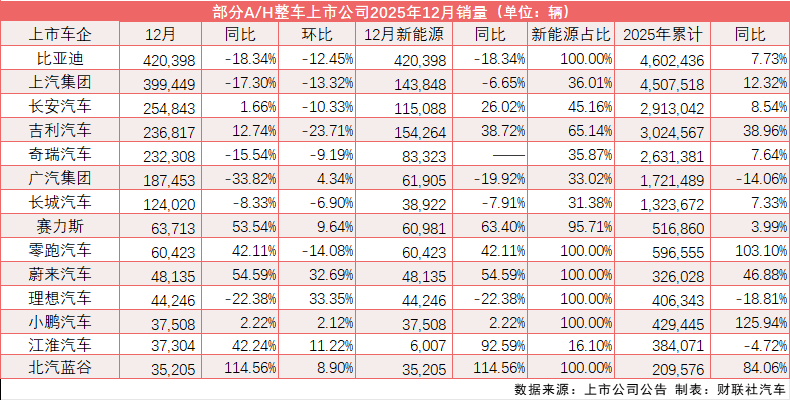
Core Insights - The overall retail sales of passenger cars in China for 2025 are projected to reach 23.744 million units, representing a year-on-year growth of 3.8% [1] - The market trend is expected to follow a "U-shaped" pattern, with a sustained demand for vehicle replacements in 2024-2025 [1] - The actual sales performance exceeded initial expectations, with a revised growth forecast for the passenger car market [1] Company Performance - BYD leads the market with a total sales volume of 4.602 million units in 2025, with overseas sales reaching 1.05 million units, a 145% increase year-on-year [3] - SAIC Motor follows closely with 4.507 million units sold, marking a 12.32% increase, driven by its transition to new energy vehicles and expansion in overseas markets [4] - Geely's total sales reached 3.025 million units, a growth of 38.96%, with new energy vehicle sales increasing by 90% [4] - Changan Automobile sold 2.913 million units, up 8.54%, benefiting from the synergy of multiple new energy brands [5] - Chery Automobile achieved sales of 2.631 million units, a 7.64% increase, with notable export performance [5] - Great Wall Motors sold 1.324 million units, a growth of 7.33%, with significant increases in new energy and overseas sales [5] New Energy Vehicle Trends - New energy vehicle sales for SAIC reached 1.643 million units, a 33.1% increase, contributing to a historical high [4] - Geely's new energy vehicle sales are projected to reach 2.22 million units in 2026, indicating a penetration rate increase from 55.8% to 64.3% [4] - New entrants like Leap Motor and Xpeng Motors are experiencing rapid growth, with Leap Motor achieving a 103.1% increase in annual deliveries [6] - Xpeng Motors delivered 429,000 units, a 125.94% increase, and plans to launch several new models in 2026 [6] Market Outlook - The passenger car market is expected to maintain a steady performance in 2026, with overall sales projected to be flat compared to 2025 [2] - Export growth for passenger vehicles is anticipated to remain above 10% [2] - The market for small electric vehicles is expected to slow down, with growth projected at around 10% due to policy impacts [8]
同星科技(301252) - 2026年1月9日投资者关系活动记录表
2026-01-09 10:06
Group 1: Industry Trends - The company views the trend of "aluminum replacing copper" as significant due to cost advantages, with copper prices exceeding 100,000 CNY/ton while aluminum prices remain stable [2] - The shift from copper to aluminum in heat exchangers for refrigeration in appliances is a key development direction, indicating a broader industry trend [2] - The trend of "aluminum replacing copper" is expanding from the air conditioning and home appliance sectors to high-growth areas such as new energy vehicles and power generation, highlighting its importance for both cost reduction and national resource security [2] Group 2: Automotive Sector - The company's automotive sector primarily collaborates with major clients such as Changan, JAC, Chery, and Songzhi [3] - The recent approval of L3 level conditional autonomous driving vehicles by the Ministry of Industry and Information Technology is expected to create new market demand, providing development opportunities for the company [3] - The company aims to deepen cooperation with existing core clients, leveraging synchronous R&D and quality systems to enhance the value and market share of its automotive components [3] Group 3: Data Center Development - The company is focusing on the research and production of efficient liquid cooling heat exchange equipment for data centers [3] - The global data center market is expected to continue expanding due to the increasing maturity and application of technologies such as artificial intelligence and cloud computing [3] - The company plans to actively seize market opportunities by aligning its technological capabilities and production capacity with industry trends [3]
2025中国汽车行业十大年度品牌热点 | 精进2025——汽车行业10个十大年度盘点
Jing Ji Guan Cha Wang· 2026-01-09 09:33
Core Insights - The automotive industry in China experienced significant changes in 2025, characterized by a mix of opportunities and challenges, with a focus on innovation and collaboration among companies [2][4] - The report highlights the "Top Ten" annual reviews across various categories, reflecting the industry's evolving landscape [2] Group 1: Market Dynamics - The Chinese automotive market is undergoing accelerated differentiation and reshuffling, with leading companies expanding their ecosystems while some brands face pressure [4] - The competition has intensified, leading to a survival-of-the-fittest scenario, where some brands are on the brink of elimination [4][22] Group 2: Brand Influence - Chinese automotive brands are gaining global influence, with eight companies making it to the Fortune Global 500 list, marking a significant increase from previous years [5] - BYD, Geely, and Chery have notably improved their rankings, reflecting the rising global presence of Chinese brands [5] Group 3: Brand Strategy and Integration - Many automotive brands are restructuring their business architectures, with notable mergers and acquisitions, such as Geely's acquisition of Lynk & Co [7][8] - The trend of integrating brand operations is seen as a response to market pressures and a strategy to enhance competitiveness [9] Group 4: Technological Advancements - Companies are launching unique smart technology brands to keep pace with rapid advancements in intelligent technology, with several brands unveiling new systems and platforms [10] - The establishment of these technology brands is aimed at enhancing market perception and showcasing core competencies in smart mobility [11] Group 5: Foreign Brand Strategies - Foreign joint venture brands are initiating a "Localization 2.0" strategy, enhancing collaboration with local suppliers and adapting to the Chinese market [12] - This shift includes a focus on electric and intelligent vehicle development, indicating a more proactive approach to market integration [13] Group 6: Reputation Management - In response to negative online narratives, many automotive companies are taking legal action to protect their brand reputations, indicating a shift towards more aggressive reputation management strategies [19][20] - The industry is witnessing a rise in legal actions against misinformation, reflecting the importance of brand integrity in the digital age [21] Group 7: Market Exit and Brand Survival - Weaker automotive brands are facing significant challenges, with some declaring bankruptcy or undergoing restructuring to survive [22] - The industry is experiencing a natural selection process, where only the most adaptable brands are likely to thrive [23] Group 8: Sales Channel Evolution - The once-popular "supermarket store" model for car sales is losing traction, with many brands reassessing their sales strategies in favor of more traditional dealership models [24] - This shift indicates a move towards more sustainable and efficient sales practices in the automotive sector [25] Group 9: Luxury Brand Performance - The ultra-luxury automotive segment is facing declining sales in China, with several brands reporting significant drops in their sales figures [26] - The overall market conditions and changing consumer preferences are contributing to the challenges faced by these high-end brands [27]
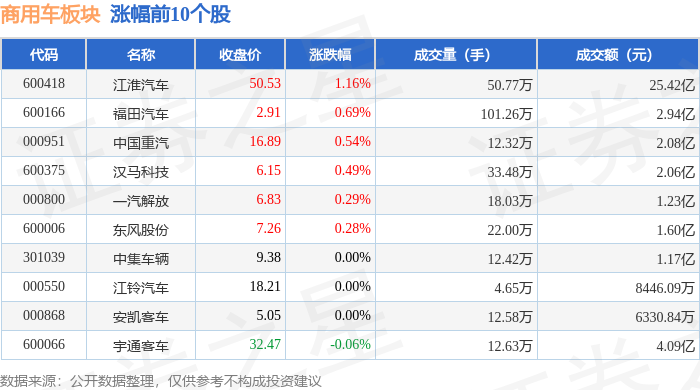
商用车板块1月9日涨0.41%,江淮汽车领涨,主力资金净流出8050.68万元
Zheng Xing Xing Ye Ri Bao· 2026-01-09 08:54
Core Viewpoint - The commercial vehicle sector experienced a slight increase of 0.41% on January 9, with Jianghuai Automobile leading the gains. The Shanghai Composite Index rose by 0.92%, while the Shenzhen Component Index increased by 1.15% [1]. Group 1: Market Performance - Jianghuai Automobile closed at 50.53, up by 1.16% with a trading volume of 507,700 shares [1]. - Foton Motor and China National Heavy Duty Truck both saw increases of 0.69% and 0.54%, closing at 2.91 and 16.89 respectively [1]. - The overall trading volume for the commercial vehicle sector was significant, with Foton Motor achieving a transaction value of 294 million [1]. Group 2: Fund Flow Analysis - The commercial vehicle sector saw a net outflow of 80.51 million from institutional investors, while retail investors contributed a net inflow of 31.18 million [2]. - Among individual stocks, Zhongshun Vehicle had a net inflow of 12.14 million from institutional investors, while it faced a net outflow of 1.44 million from speculative funds [3]. - China National Heavy Duty Truck experienced a net inflow of 2.94 million from speculative funds, despite a net outflow of 3.27 million from retail investors [3].


研报掘金丨开源证券:维持江淮汽车“买入”评级,尊界S800销量持续爬坡
Ge Long Hui A P P· 2026-01-09 05:25
Core Viewpoint - Jianghuai Automobile is expected to face slight pressure on traditional vehicle sales in 2025, while the rapid growth of the Zun Jie brand is anticipated to drive performance improvements [1] Group 1: Sales Performance - In December 2025, the company is projected to achieve vehicle sales of 37,300 units, representing a year-on-year increase of 42.2% [1] - The total vehicle sales for the year 2025 are expected to reach 384,100 units, reflecting a year-on-year decline of 4.7%, primarily due to the downturn in the traditional vehicle segment [1] Group 2: Financial Forecasts - The company has adjusted its 2025 earnings forecast downward due to ongoing pressure in its traditional business [1] - Conversely, the earnings forecasts for 2026 and 2027 have been revised upward, driven by anticipated significant breakthroughs in Zun Jie brand sales [1] Group 3: Market Position and Future Prospects - The upcoming launch of the MPV is expected to lead to substantial sales growth [1] - The approval of a 3.5 billion yuan capital increase will support the development of the Zun Jie platform, positioning it as a benchmark in the domestic ultra-luxury automobile market [1] - The company maintains a "Buy" rating based on these developments [1]
项兴初拜访任正非,江汽、华为解锁合作新蓝图
Sou Hu Cai Jing· 2026-01-09 03:27
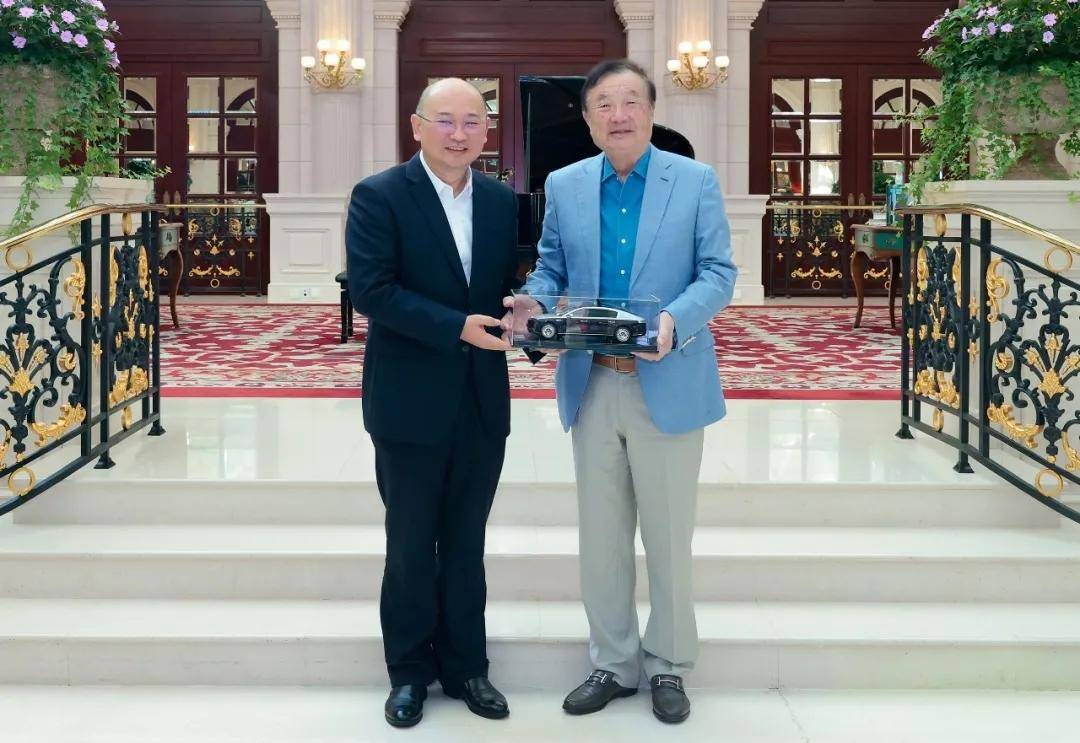
Group 1 - Jiangqi Group's Chairman and General Manager, Xiang Xingchu, visited Huawei's founder Ren Zhengfei in Shenzhen to discuss the trends in the automotive industry's intelligent transformation and the progress of their cooperative projects [1] - The two companies aim to expand their cooperation in key areas such as automotive intelligence and enterprise digitalization, contributing to the high-quality development of the new energy vehicle industry [3]